Plant care
Monthly houseplant inspection: a four-pass walk that catches slow drift
· Updated
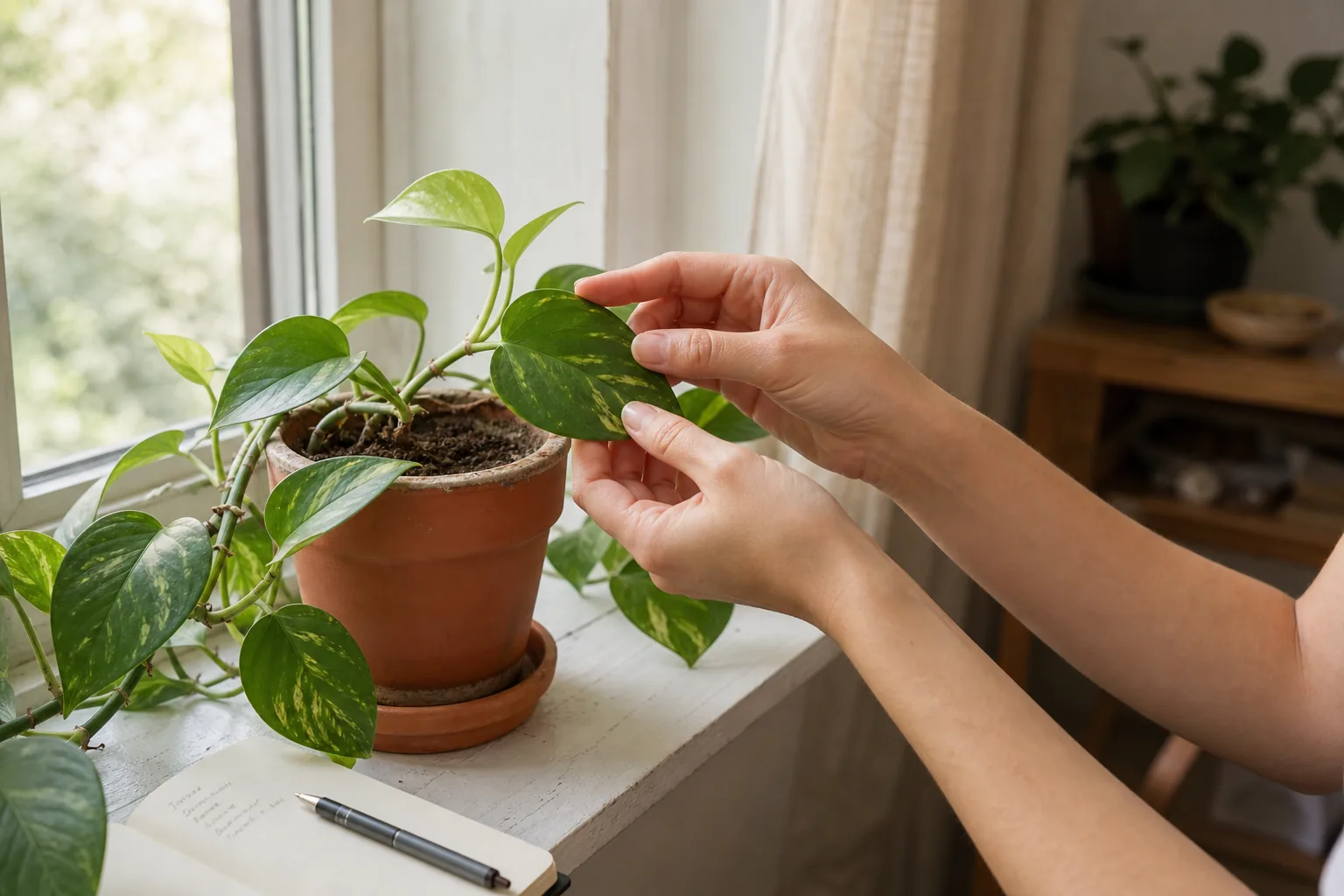
A monthly houseplant inspection is a slow, plant-by-plant walk meant to surface changes that take weeks to become visible. It complements, but does not replace, the quick weekly glance you already do on watering day. The point is comparison: what does this plant look like this month compared to last month.
That comparison is what a weekly routine is not built for. Watering-day checks are well-suited to fast signals like current soil moisture, freshly visible pests on the leaf surface, or a sudden wilt. They are less suited to the slow drift that builds across weeks: salt and mineral residue on the soil surface, fine spider mite damage accumulating across leaves, light at a window shifting with the season, or new leaves arriving smaller than the ones they replaced.
A monthly cadence is a Houseplant Supplies suggestion, not a prescription from a university extension office. It is a window of a few weeks rather than a fixed day on the calendar, and it sits between your weekly check and any seasonal care moves. Use it where it fits, and flex it when a plant clearly needs something different.
Why monthly catches things weekly doesn’t
Some changes only register when you compare one month to the last. A weekly check in similar weather can normalize drift you would otherwise notice. Salt and mineral deposits from tap water and fertilizer accumulate on the soil surface over weeks, not days. Sap-sucker insects like spider mites, mealybugs, and scale produce damage that builds across multiple leaves before it becomes the headline problem; the Montana State University Extension lists branch dieback, stunted growth, leaf drop, and yellowing as typical outcomes, and each of them develops slowly enough that a single weekly glance tends to miss it. Light at a window shifts as the sun angle changes, as trees outside leaf out or shed, and as you rearrange the room. None of these are visible in a single weekly glance. All of them become visible when you deliberately look at the same plant a month apart.
For the cadence you already do on watering day, see the simple weekly houseplant care routine.
Set up: a four-pass walk, one plant at a time
The format matters more than the timing. Pick a window of a few weeks, walk the room once, and for each plant do four passes in order: light, water rhythm, leaves, and soil, pot, and roots. The order is intentional. Light is the slowest-moving input, so it sets context for everything else. Water rhythm tells you whether the rest of the plant’s story makes sense. The leaf scan picks up both pest signals and light signals. The soil pass catches residue and structural change.
Going plant by plant, not room by room, is the point. You are giving each plant a comparable view this month versus last month. Walking through the room checking soil moisture across all pots would be faster, but it would not give you the slow comparison that makes a monthly pass useful. As you walk, also pay attention to what has changed around the plant: a new heating vent cycling on, a window left cracked in colder weather, or a piece of furniture moved between the plant and the light. Our guide on drafts, vents, and sun-heated glass covers the microclimate side of that.
Pass 1: light audit
Stand where the plant sits and look at the window the way the plant sees it, ideally at the time of day it usually gets the most light. Three things are worth noticing month over month:
- The shadow on the wall or floor. A sharper or longer shadow than last month means more direct sun is reaching this spot. A softer or shorter shadow means less.
- New obstructions outside. A tree leafing out across spring, a new building under construction, or a neighbor’s awning going up all cut usable light without you noticing day to day.
- The brightness on the leaves themselves. New leaves arriving smaller than the ones they replaced, longer gaps between leaves on a vining plant, or fading variegation are slow light signals that are easy to miss in a week but obvious across a month. Our guide on leggy growth as a light signal walks through how to read stretched internodes as a light story rather than a problem to treat.
For a fuller way to read what a window is offering, see our guide on reading the natural light in your room.
Pass 2: water rhythm
Stick a finger into the soil an inch or two down. Lift or tip the pot slightly and compare how it feels now to how it felt a month ago. Then look at the plant itself. New growth that is firm and perky is consistent with the watering rhythm you have been running. New growth that is soft, pale, or smaller than the last flush is a clue that the rhythm is not matching the plant’s needs.
A monthly check is the right place to notice a pot feeling lighter than it used to, because the weight of the dry pot is something your hands normalize without you realizing it. A difference in weight when dry versus when freshly watered tells you whether the root mass and potting mix are still working together, or whether the mix has compressed enough that water is running through without soaking in.
If the rhythm you settled on a few months ago no longer seems to be matching the plant, our guide on watering by observation rather than the calendar walks through how to retune it without swinging to the other extreme.
Pass 3: leaf-by-leaf scan
This is the slowest pass. Run a hand across a few leaves and check the surface. Look at leaf joints, the underside of leaves, and the soil line where the stem meets the mix. Hold a leaf up to the light and look for fine pale dots that were not there last month.
A few signals are worth flagging:
- Sticky residue on the leaf surface. That is honeydew, the residue typically left by sap-sucking insects like aphids, mealybugs, and scale, though residue can persist after the insects themselves have been managed. Our guide on sticky leaves and honeydew walks through how to read that signal calmly.
- Fine pale stippling on the upper surface of leaves, sometimes with very fine webbing in the joints. Spider mites are roughly 1/20 inch or smaller, and the most noticeable sign of an infestation is usually the damage rather than the insect itself, according to the University of Alaska Fairbanks Cooperative Extension Service. A monthly scan is the right scale to catch this building across leaves. Our guide on spider mites and stippling covers what to do before treating.
- White fluffy tufts at leaf joints or along the soil line. Our guide on mealybugs that may have been hiding covers the places these pests tend to settle and why a quick glance at the top of the foliage misses them.
- Slow accumulation of brown tips and crispy edges across many leaves, suggesting a sustained condition rather than a single bad watering. Our guide on brown tips and crispy edges walks through the diagnostic order, which is not just humidity.
- Small dark flies that lift off the pot when you tap the soil surface. Fungus gnats are usually a surface-moisture signal as much as a pest one. Our guide on fungus gnats and surface moisture covers the calm approach.
You are not diagnosing during the scan. You are noticing what changed since last month and letting the rest of the guides do the identifying.
Pass 4: soil, pot, and roots
Run a finger across the soil surface and look along the inside rim of the pot. A white, crusty residue on the mix or on the pot rim is, in most cases, mineral or fertilizer salt deposits rather than mold or fungus, according to the University of Maryland Extension. The University of California’s Stanislaus Sprout blog adds that enough accumulated salt in the soil can kill water-absorbing root tips and produce wilting and leaf drop downstream, which is why a small visible crust is worth taking seriously before it shows up as a wilting plant.
For a closer read on what a crust can mean and how to track it over time, our guide on white crust on soil or pot surfaces walks through the observation.
A monthly pass is also a reasonable moment to ask whether the potting mix itself has aged out. Organic components in a mix break down over months, structure collapses, drainage changes, and the surface can take on a compacted feel. Our guide on whether potting mix has aged out covers the call between refreshing and leaving the mix alone.
If you have not done so in a while, lift the plant out of its pot and look at the root ball. Roots circling the outside of the root ball, mix that has compressed into a dense block, or roots growing out of the drainage holes are all monthly-scale observations that point toward either repotting or refreshing the mix. Our guide on whether a houseplant actually needs a new pot walks through the decision rules so a lift does not turn into an automatic repot.
Note what you noticed, without becoming a spreadsheet gardener
Documentation is where monthly inspections usually collapse under their own weight. A single sentence per plant is enough: “new leaves smaller, no pests seen, light at window a bit weaker than last month.” Anything heavier than that tends to stop happening after the second month. The point of the note is to give next month’s walk a baseline to compare against. The NC State Extension Gardener Handbook’s chapter on diagnostics treats repeated structured observation as the backbone of plant problem-solving, which is essentially what the four-pass walk is asking you to do.
When a monthly finding should turn into an action
Most observations from a monthly walk do not require an immediate response. A few do:
- A visible white crust on the soil surface across multiple plants, especially in pots you fertilize regularly, is worth addressing before it produces wilted leaves downstream.
- A sticky residue plus insects visible at leaf joints is worth isolating that plant from the rest of the collection while you read up on what you are seeing. Our guide on isolation when a monthly check finds something covers the calmer version of that move.
- A pot that has gone light quickly for several months in a row is worth a closer look at the root ball and the mix.
- Light drift that has been building for two or three monthly walks is worth a small move or a rotation, not a single big shuffle.
If you find something you are not sure how to read, treat the inspection as the start of a question rather than an answer. Local independent nurseries and your regional university extension office are good next steps for anything that points to pests, disease-like symptoms, or a sustained decline. The monthly walk is meant to surface what to ask, not to give a final diagnosis.
When monthly is the wrong cadence for that plant right now
Monthly is a reasonable cadence for an established plant in steady conditions, sitting alongside your weekly watering-day glance. It is not the right cadence for every plant, every time.
- A newly brought-home plant, a plant that is recovering from stress, or a plant that is pushing out a flush of new growth deserves more frequent observation, at least for a while.
- A very slow-growing plant in a stable spot with stable conditions may not need as much as a full four-pass walk; a lighter monthly look is fine.
- A plant where you found something on a previous walk usually deserves a closer look at the next watering day rather than waiting a full month to revisit.
Adjust the cadence to the plant in front of you. The four-pass structure is a template, and the timing is a suggestion.
A simple way to start
If you have not been doing a monthly inspection, the simplest entry point is to walk your collection once over the next few weeks, do the four passes plant by plant, and write one sentence per plant. The next time you do it, the sentences give you a baseline. The value is not in any single observation. It is in the comparison that becomes possible once you have two months of notes to look back at.
Sources
- Montana State University Extension: Houseplant winter critters
- University of Alaska Fairbanks Cooperative Extension Service: Houseplant pests and control
- University of Maryland Extension: Mineral and fertilizer salt deposits on indoor plants
- UC ANR Stanislaus Sprout: Leach your houseplants to avoid salt problems
- NC State Extension: Extension gardener handbook, chapter 7: diagnostics