Plant care
Where to put a houseplant: drafts, vents, and sun-heated glass
· Updated
A bright spot is only one of four forces acting on a houseplant. The same window that gives a plant its light can also drop cold air onto the leaves below it, blow warm dry air across the foliage, or heat the glass until a leaf pressed against it cooks. Placement is really a microclimate audit, and once the temperature and airflow side is read alongside the light side, many puzzling symptoms stop looking mysterious.
The starting move, picking a spot that gets the light the plant needs, is the right one. It is just not the finish line. The job of this piece is to add the next layer: how air temperature, airflow, and surface temperature around that spot change what the plant actually lives in, and how to read the early signs without jumping to a diagnosis. If the light side is not yet sorted, the reading-natural-light walkthrough pairs with this one.
Why a bright spot is not always a safe spot
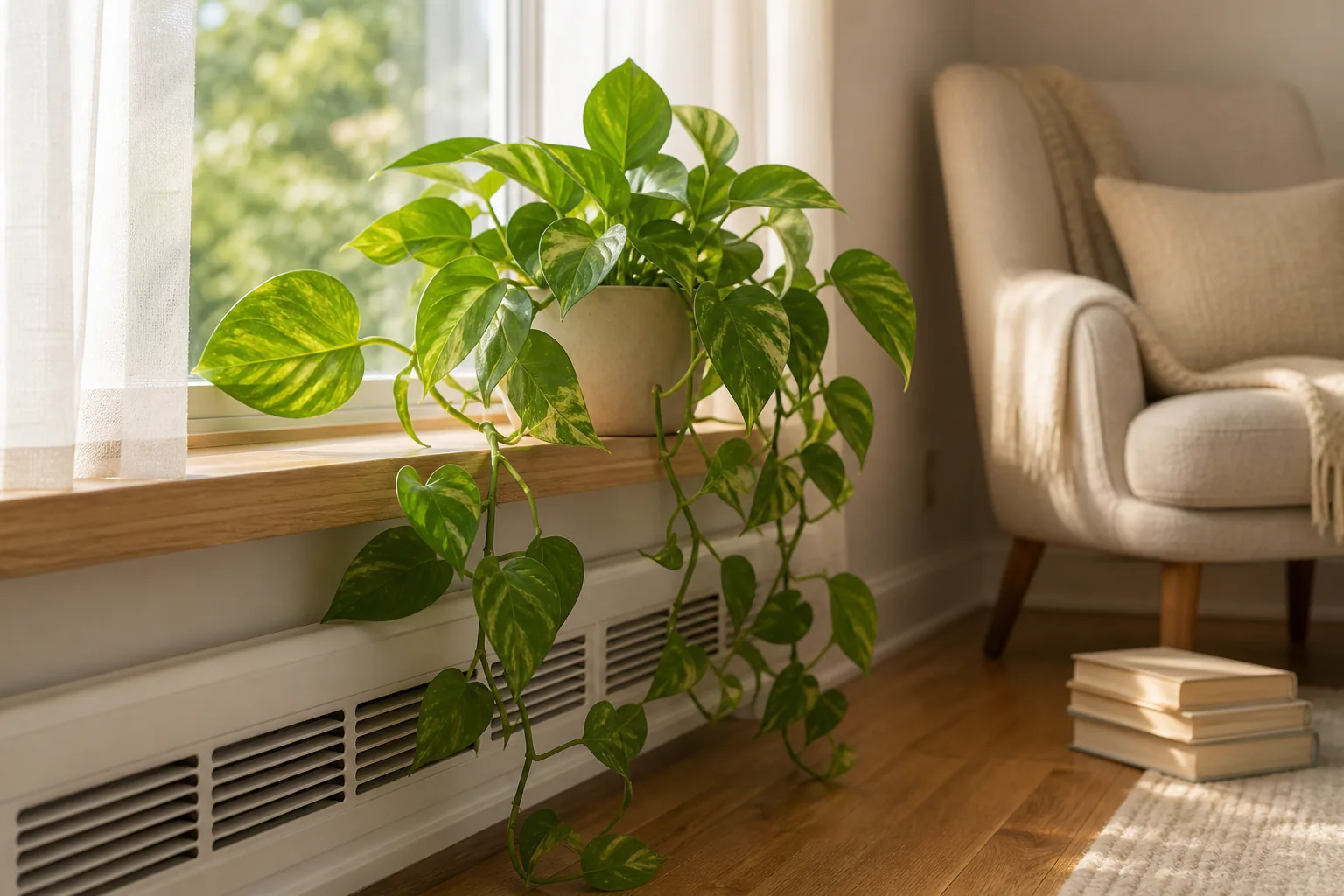
A spot offers a plant at least four things at once: light intensity and duration, ambient air temperature, the direction and strength of air movement, and the surface temperature of whatever the leaves or pot are touching. Light is the most visible, which is why it usually gets all the attention. The other three forces are quieter but can overrule light in a hurry. A south-facing window in January can be the brightest, coldest spot in the room. A sill above a baseboard vent can be the brightest, driest spot in the room. The thermostat in the hallway does not see any of that.
University extensions and botanical gardens describe temperature for foliage houseplants as a band, not a single number. Most indoor plants tolerate normal temperature fluctuations, and the published ranges converge around 65 to 75°F (about 18 to 24°C) during the day with a modest drop overnight. The University of Maryland Extension notes that foliage plants generally grow best between 70 and 80°F. The University of Nebraska 4-H guide puts the daytime band at 65 to 75°F with night temperatures 10 to 15°F cooler. University of Connecticut Extension describes an ideal as nighttime temperatures dropping only 5 to 10°F below daytime. The point of listing these is not to invent a precise rule. It is to show that sources describe tolerance as a range, and that tolerance is about the spot as much as the thermostat.
Cold drafts: where they actually come from in a home
The most common indoor draft sources for plants are windows, doors, and heating vents. Cornell Cooperative Extension, the Morton Arboretum, and reprinted extension guidance all call these three out by name. The list is short because the mechanisms are short: cold outdoor air leaks through gaps, and the room’s warm air rushes to replace it. Where the leak is, the air keeps moving.
In practice that means:
- Exterior doors used through the day in winter, especially older doors with worn weatherstripping.
- Older or single-pane window frames, where cold air drops off the glass as a small column at sill height.
- Gaps around electrical outlets or baseboards on outside walls.
- The crack under an attic hatch or near a window air conditioner that is not perfectly seated.
Cold air tends to settle near the floor and at sill height, which is one reason a spot that feels fine when a reader walks past it at standing height can be noticeably colder at plant height on a sill. This is also why a thermometer hung on the wall and the air around a windowsill plant can disagree.
Hot, dry air from vents, radiators, and fireplaces
There are two separate problems here, and they are easy to confuse.
The first is ambient room warmth, which most foliage plants tolerate well. Cornell Cooperative Extension and the New York Botanical Garden both treat warm indoor air as generally fine, with the New York Botanical Garden suggesting about 65 to 75°F during the day and 55 to 65°F at night. The second is direct contact or direct airflow from a heat source, which is the placement risk. A forced-air vent, a baseboard heater, a radiator, or a wood stove pushes warm dry air at the leaves and dries the soil from the top down faster than the rest of the room is drying. The pot sitting on a radiator shelf cooks the root zone from below even when the leaves feel fine.
Houseplant and HVAC sources describe this as a local microclimate: the air right at the vent reads warmer and drier than the air a few feet away. The thermostat in the hallway does not register that gap. The leaf closest to the vent dries out and curls first, and the soil in the pot skims dry a day ahead of the other plants in the room. These are useful clues, but they overlap with underwatering and with low humidity, which is why one symptom is not enough on its own to call it a vent problem.
Hot glass and sun-baked windowsills
There is a difference between a leaf sitting in a sunbeam a few inches from the glass and a leaf pressed against sun-heated glass, and the second is the riskier one. South- and west-facing windows in summer, and lower-angle winter sun on east windows, are often the hottest glass surfaces in a home. A dark wood sill, a stone ledge, or a metal tray can absorb that heat and radiate it back into the leaf touching it. The rest of the room can feel perfectly fine while the leaf at the glass is baking.
Extension sources describe leaf scorch as a water-balance failure rather than a light-dose failure. Missouri Botanical Garden and South Dakota State University Extension both frame it as leaves losing water faster than the roots can replace it under heat, sun, and dry soil. Commercial houseplant sources add that hot glass is its own trigger, sitting alongside direct sun, dry roots, and sudden exposure to strong light. The mechanism fits: a heated glass surface accelerates water loss locally and raises the leaf tissue temperature, which is a different injury from a leaf that simply got too much light.
A pot on a dark sill in direct sun is doing the same thing at the root zone. The pot itself can absorb heat and pass it into the soil, which dries faster than expected and can stress roots even when watering is on schedule.
Reading the plant without jumping to a diagnosis
The early signs that placement, rather than watering or light, is part of the problem have a few common patterns. None of them are proof on their own, because the same symptoms have other causes. They are reasons to look at the spot, not verdicts.
Patterns worth noticing:
- Leaf curl, browning, or drop on the side of the plant nearest a window, door, or vent, while the far side looks healthier.
- Dry brown patches on a single leaf that touches the glass, or on the leaves that sit on the sill-side of the pot.
- Soil that dries much faster than the rest of the room’s plants, especially if the pot feels warm through the side.
- Leaves that look fine in the morning and droop or curl by late afternoon on cold nights, or the reverse on hot afternoons.
- New growth coming in smaller, paler, or with crispy edges while older leaves still look normal.
Each of those can also be a watering issue, a humidity issue, a light issue, or a root issue. The pattern that points back at placement is the one-sidedness: symptoms that follow the geometry of the spot rather than the whole plant.
A small, reversible placement test
Once a spot is suspect, the move worth making is small and reversible. Shift the plant a few feet in one direction, into a spot that has similar light but is away from the suspect source, and leave it there for one to two weeks. Keep watering, feeding, and pot size the same. Watch the new growth rather than the damaged older leaves, because older leaves will not un-damage and only new leaves count as fresh evidence.
A few feet is often the difference between sitting in a boundary microclimate and sitting in the bulk air of the room. A spot one foot from a drafty window is inside the cold column dropping off the glass. A spot three feet back in the same room usually shares the room’s air rather than the window’s air. The trade-off is that light drops too, so the new spot may need to be a touch closer to a different window or a step up onto a plant stand to keep light comparable.
If new growth over the next two weeks looks healthier and the older damaged leaves stay stable, the placement was probably part of the problem. If new growth looks the same or worse, the placement was not the main issue and watering, light, or roots deserve the next look.
When to wait before reacting
A few windows of time make placement symptoms hard to read. The first two to four weeks after bringing a plant home are one of them: the plant is adjusting to new light, new air, new watering, and any prior stress from the trip. Symptoms in that window are easy to misread as a placement problem when they are really an adjustment problem. Seasonal transitions in the home, the first cold snap, the first time the heat kicks on, are another. The thermostat setting might not have changed, but the air around the sill has.
The honest move in those windows is usually to wait, log what is happening, and avoid stacking changes. Repotting a plant that is also adjusting to a new spot or to the first run of the furnace tends to hide whatever the real signal is.
A short recap
- Treat the spot, not the room, as the unit of placement. Light, air temperature, airflow, and surface temperature all act on the same plant at the same time.
- Cold drafts show up near exterior doors, old window frames, and exterior-wall outlets. Hot dry air shows up near vents, radiators, and stoves. Sun-heated glass and dark sills add a contact-heat problem that has nothing to do with the sunbeam itself.
- One-sided symptoms are a useful clue but never proof. Pair them with a one- to two-week placement test and look only at new growth.
- Avoid big changes during the first few weeks after a plant arrives or when the heating season starts; both windows produce symptoms that look like placement stress but usually pass.
Sources
- University of Maryland Extension, Temperature and humidity for indoor plants: https://extension.umd.edu/resource/temperature-and-humidity-indoor-plants
- University of Nebraska 4-H, Guide to growing houseplants: https://go.unl.edu/4hhouseplants
- Cornell Cooperative Extension Oswego County, Houseplants: http://thatscooperativeextension.org/gardening/houseplants
- Missouri Botanical Garden, Scorch, sunburn, and heat stress: https://www.missouribotanicalgarden.org/gardens-gardening/your-garden/help-for-the-home-gardener/advice-tips-resources/insects-pests-and-problems/environmental/scorch
- South Dakota State University Extension, Leaf scorch and sunscald in the garden: https://extension.sdstate.edu/leaf-scorch-and-sunscald-garden