Plant care
How to read the natural light in your room before you place a houseplant
· Updated
The honest way to read indoor light is to spend about ten minutes watching your window on a partly cloudy day. Note where direct sunbeams actually land, how long they stay, and what is between the sky and the plant. Then treat the plant itself as the final sensor: leaf color, stem spacing, and the direction it leans will confirm or contradict what you saw.
This guide is observational. Your room, your hemisphere, and your plant species all change the answer, so use the method below as a starting point and adjust from there. For a fuller description of what Houseplant Supplies does and does not claim about plant care, see our plant care disclaimer.
Light is the most common silent cause of indoor plant problems, and it is the hardest to guess from across the room. Most plant tags use four labels: direct sun, bright indirect, medium, and low. None of those labels mean much until you read the room they describe.
Why indoor light is the first thing to understand before buying a plant
Indoor light has three observable parts working at once: how bright it is, how long it lasts, and what quality of light reaches the leaves. University extension publications describe this as intensity, duration, and quality. A single label like bright is doing three jobs. Two windows on the same wall can fall into different categories because one is shaded by a neighboring building and the other is not.
The reason light matters more than watering or fertilizer is that the wrong light shows up slowly and quietly. A plant in too little light does not collapse. It stretches, pales, and slowly stops producing new growth. A plant in too much light gets crispy patches on the side facing the window. Both look like other problems at first glance, which is why people often blame water, food, or the plant itself before they blame the spot it is sitting in.
The four honest categories, tied to what you can see
It helps to replace the labels with descriptions of what the room actually does.
Direct sun means sunbeams land on the leaves for at least four hours during the day, generally at an unshaded south or southwest window in the northern hemisphere. Direct light at an east window is gentler because morning sun is cooler. Direct light at a west window can be hot and is more likely to scorch leaves.
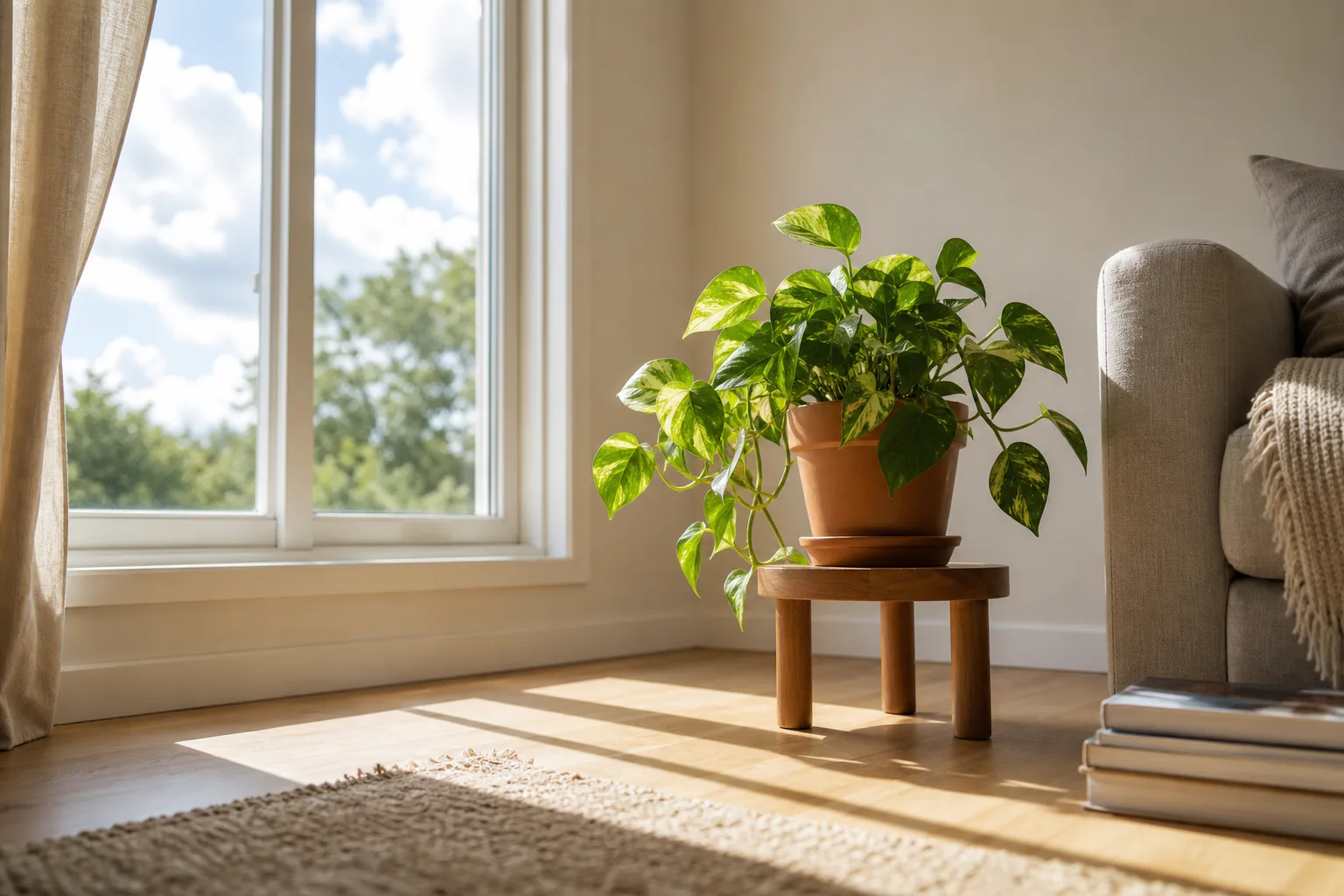
Bright indirect means the plant has a clear view of the sky but no sunbeam ever lands on the leaves. A spot a few feet back from a sunny window, or right next to a sunny window behind a sheer curtain, often fits here. Many popular tropical houseplants such as pothos, philodendron, monstera, fiddle leaf fig, and peperomia want this condition.
Medium light is a working category for a room that feels comfortably bright during the day, with no direct sun on the plant and only a partial view of the sky. A practical reader-applied benchmark is whether you can comfortably read a book in the spot without turning on a lamp; treat that as your own observation rather than a fixed rule.
Low light means a dim corner or a spot several feet from any window. You can still see the room during the day, but no direct sun reaches the spot and the sky is mostly blocked. Low light is a tolerance band, not a happy place. Most plants sold as low-light will persist rather than thrive, and growth will slow over months.
These descriptions are tied to direction, hours, distance, and obstacles, not to a number on a meter.
How to observe your window for ten minutes on a partly cloudy day
Pick a partly cloudy day and stand where the plant will sit. Look toward the window. Ask three questions.
Does the plant see open sky from its spot, or is its view mostly wall, furniture, or buildings? The more sky the plant sees, the more daylight it receives, even if no direct sunbeam lands on the leaves.
Do direct sunbeams ever cross this spot, and for how long? Watch a partly cloudy day for ten minutes. Beams passing through the spot will be obvious when the cloud moves. Time how long they linger across the day rather than judging from one moment. Four or more hours of direct beam on the spot is the conventional threshold for the direct category. If the sun only grazes the spot for a shorter window, or never lands on the leaves at all, the spot is more likely bright indirect. Use the hours as your own graded scale rather than as fixed rules; the firm thresholds extension publications define are the four-hour direct-sun mark and the absence-of-direct-sun cases like a north-facing window or a shaded corner.
How sharp is the shadow your hand casts a foot above the leaves? Hold one hand flat, palm down, in the spot the leaves will be. A sharp, well-defined shadow means direct sun is hitting it. A soft, faint shadow with fuzzy edges means bright indirect or medium light. No visible shadow means low light.
The shadow test is doing roughly what a light meter does, but in plain terms. You can repeat it in different seasons without buying anything.
Reading obstacles: curtains, trees, neighboring buildings, frosted glass
Direction tells you where the light comes from. Obstacles tell you how much of it actually arrives. Curtains, trees, neighboring buildings, frosted or tinted glass, deep window wells, overhangs, and even tall furniture between the window and the plant can each drop usable light by a noticeable amount.
A sheer curtain softens direct beams without removing them, and the spot behind a sheer often reads as bright indirect even when the sun is on the window. A closed opaque curtain drops the spot into low light regardless of how sunny the window is. Frosted or tinted glass filters out a meaningful share of light before it enters the room. A tree outside the window, or a neighboring building, blocks the brightest hours of direct sun even at a south-facing window.
Light also falls off quickly with distance. The further the plant sits from the glass, the less useful light it receives, and this drop-off is sharper than most people expect. One practical reference rule of thumb is that most plants do best within about four feet of a bright window, though a larger window or a brighter direction lets you push that distance out further.
For readers in the southern hemisphere, the bright direct-sun window is north-facing and the dim direction is south-facing. East and west keep their morning and afternoon character. If you are not sure which hemisphere you are in, watch the window itself rather than trusting the compass label.
Matching common houseplant groups to the light you actually have
Once the spot is classified, matching plants to it is mostly common sense. Cacti, succulents, herbs, and many flowering houseplants want direct sun or very bright indirect. Most foliage tropicals such as pothos, philodendron, monstera, peperomia, and prayer plant want bright indirect and will tolerate medium with slower growth. Snake plant, ZZ plant, cast iron plant, and pothos are commonly cited as tolerant of medium and low light, but in practice they persist rather than thrive in dim conditions and produce smaller leaves over time.
A reader who has only low light should not expect a flowering plant or a variegated plant to look the same as it does in a greenhouse. Choosing a plant whose natural habitat matches the spot is more honest than trying to push a sun-loving plant into a dim corner with fertilizer and grow lights. If you want a starting point for plants that fit a range of indoor conditions, the Houseplant Supplies shop can be one option, though the room should always come first.
What a plant tells you when light is wrong
The plant is the final sensor. Symptoms worth reading over weeks rather than diagnosing from a single leaf include the following.
Insufficient light tends to show up as pale or yellowing leaves, especially on older growth. Long spaces between leaves on the stem, sometimes called leggy or stretched growth. Smaller new leaves compared to older leaves. The plant leaning toward the window. Loss of variegation, where patterned leaves fade toward green. A plant that is not flowering in season, despite otherwise good care, is also a quiet signal.
Excess light tends to show up as bleached, faded, or yellow patches on the side facing the window. Crispy or brown edges. Sudden dry spots that appear after a hot afternoon.
Watering problems overlap with these. A chronically overwatered plant in low light can look similar to a chronically underwatered plant in bright light, and yellow leaves have several possible causes including light, water, temperature, and root health. University extension and reference sources caution against diagnosing from a single symptom. Watch the pattern across the whole plant over weeks, and check whether you have changed watering, light, temperature, or the room itself at the same time.
Simple seasonal adjustments without buying new equipment
The same spot can move between categories across the year. A place that gets strong direct sun for several hours in midsummer may receive no direct sun at all in winter when the sun is low. A spot a few feet back from the window that is bright in summer often becomes noticeably dim in winter. In temperate climates this seasonal swing is one of the most common silent causes of winter decline in plants that did fine the rest of the year.
Practical adjustments do not require a meter. Move the plant closer to the window in winter and farther back in summer. Adjust sheer curtains seasonally where your climate makes that useful, opening them when you want more light and closing them when direct sun is hot on the leaves. Turn the pot occasionally so growth stays even on all sides and the plant does not lean toward the window. If a plant is struggling in winter despite otherwise good care, repeat the ten-minute observation and reclassify the spot.
A short checklist before you place any new plant
- Window direction. North is usually dim, south is usually bright, east is morning, west is afternoon in the northern hemisphere. The pattern flips in the southern hemisphere.
- Hours of direct sun on the spot, timed across a representative day rather than guessed from a single moment.
- Distance from the window, with shorter distance generally meaning more usable light.
- Obstacles between the sky and the plant, including curtains, trees, neighboring buildings, frosted glass, and overhangs.
- The plant’s own feedback after four to six weeks in the spot, including leaf color, stem spacing, and any leaning.
- Whether the spot’s lowest seasonal category still matches the plant’s tolerance.
If two of those answers do not match what the plant tag says, trust the room and the plant before the tag.
Sources
- University of Minnesota Extension — Lighting for indoor plants and starting seeds: https://extension.umn.edu/planting-and-growing-guides/lighting-indoor-plants
- University of Maryland Extension — Lighting for Indoor Plants: https://extension.umd.edu/resource/lighting-indoor-plants
- UF/IFAS Gardening Solutions — Light for Houseplants: https://gardeningsolutions.ifas.ufl.edu/plants/houseplants/light-for-houseplants/
- Accent Decor — Do’s and Don’ts: Light Levels For Houseplants: https://www.accentdecor.com/blog/2024/07/dos-and-donts-light-levels-for-houseplants/
- UC ANR Statewide IPM Program — Houseplant Problems: https://ipm.ucanr.edu/home-and-landscape/houseplant-problems/