Plant care
White crust on houseplant soil: how to read it
· Updated
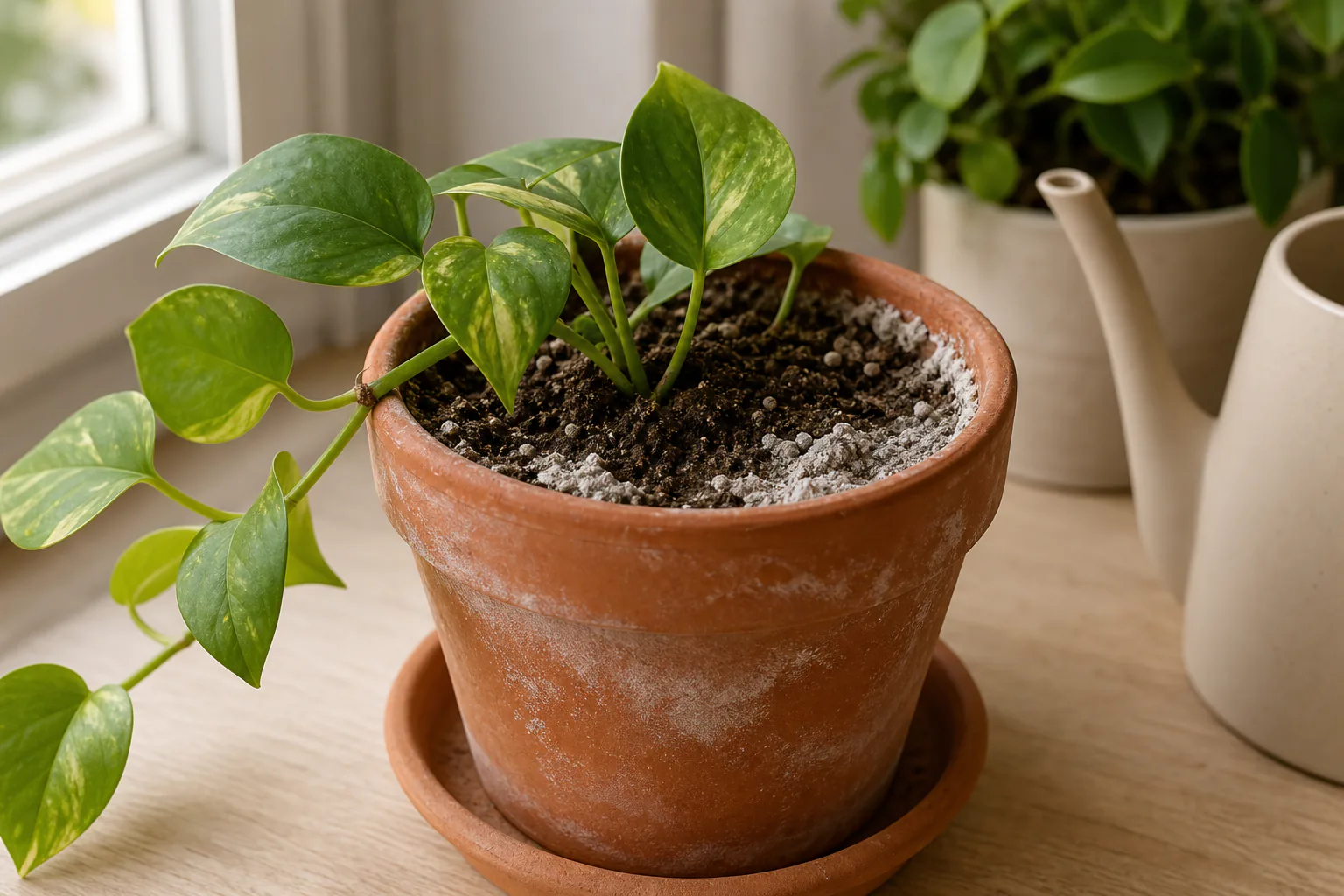
You spot a thin white crust on the surface of your potting mix, or a chalky ring on the rim of the pot, or a faint white bloom on the outside of an unglazed terracotta. Before you change anything, it helps to slow down and look at what you are actually seeing.
In most homes, that white crust is one of three things: soluble salts left behind by fertilizer, mineral deposits left when tap water evaporates, or a soft, fuzzy surface-mold look-alike. The visible residue alone is not a diagnosis of plant health. It is a clue, and where the residue sits, what it feels like, and how the plant is doing overall help you narrow it down.
Start by treating the white crust as a clue, not a verdict
A crust on the soil or the pot is information about water and fertilizer passing through the pot, not a verdict about the plant. A healthy, fast-growing plant can sit next to a clearly crusted pot, and an unhealthy plant can have perfectly clean soil. University extension publications describe the appearance of salt crust without claiming it confirms any single problem, and they treat leaf symptoms as separate evidence rather than as something to infer from a crust alone. The aim of this article is to help you observe, narrow down, and respond proportionately.
The three things the white crust usually is
In most homes, a white crust on houseplant soil or pot surfaces turns out to be one of three things:
- Soluble salts from fertilizer, deposited where water evaporates from the soil surface and the rim.
- Mineral deposits from tap water, which can also leave a chalky rim and, on unglazed terracotta, a separate white bloom on the outside walls.
- A surface-mold look-alike, which is texturally different from a crust and tends to appear on persistently damp surfaces with limited airflow.
A quick way to read the residue is to look at two things: where it sits, and what it feels like.
What soluble-salt buildup from fertilizer looks like
University of Maryland Extension describes mineral and fertilizer salt deposits as appearing as a white crystallized coating on the soil surface. Cornell University’s extension material explains the underlying mechanism: excessive soluble salts accumulate when fertilizer is applied repeatedly without enough water to leach the salts through the pot. In practice, this crust tends to show up in the spots where water evaporates first: the rim of the pot, the very top of the mix, and the edges of the surface where moisture has wicked up and dried. It usually feels dry, gritty, or crystalline rather than soft.
Common contributors, drawn from the accumulation mechanism Cornell describes and from general fertilizer-label guidance, include:
- Feeding more often than the fertilizer label suggests.
- Mixing fertilizer at a stronger dilution than the label recommends.
- Watering lightly each time, so moisture only reaches the top of the root zone and salts concentrate near the surface.
- Watering rarely enough that salts are never flushed through the pot.
Crust alone does not mean the plant is overfertilized. University of Maryland Extension lists the typical leaf-level symptoms of high soluble salts in indoor plants as browning or dieback of leaf tips and margins, sometimes with yellowing or stunting. Those are separate, visible-in-real-life cues worth noticing, but they are not something to infer from a crust photo or a description alone.
What mineral deposits from water look like, including on terracotta
When the crust looks chalky and off-white to grayish and sits more heavily on the rim and outside of an unglazed pot, the water itself is the more likely culprit. University of Illinois Extension makes the underlying point directly: soluble salts in containers can come from both fertilizer and water sources.
On glazed pots, you usually see the mineral residue on the rim and on the surface of the mix, because that is where water evaporates and leaves its load behind.
On unglazed terracotta, you can also see it on the outside walls. Water moves through the porous clay, and as it evaporates from the outside surface it leaves minerals behind. The result is the soft white bloom sometimes called efflorescence. This is a property of the clay and the water moving through it, not a sign of trouble with the plant. An older terracotta pot in a hard-water home will tend to show this residue more than a newer one. Switching to a glazed pot reduces the outside bloom but does not address the water-source minerals moving through the root zone.
The practical implication is that the answer to water-source crusts usually lives in local water-quality information rather than on a product page, and is worth checking before changing anything else.
The surface-mold look-alike and how to tell it apart
A fuzzy white patch on the surface of the mix is not a crust. It is often described as a saprophytic fungus feeding on organic matter in the top layer of the mix, and it appears most often where the surface stays damp for long stretches and airflow is limited. The key distinction is texture: a salt or mineral crust is dry and crunchy or crystalline, while mold is soft, fuzzy, or slightly cobwebby when you brush it.
A few conditions make the mold look-alike more likely:
- A consistently damp surface, especially in pots that get bottom-watered and rarely dry on top.
- Low light, which slows water uptake and keeps the surface wet longer.
- Limited airflow in the room, around a cluster of pots on a tray, or in a closed terrarium.
- A mix with a lot of fresh organic matter at the surface.
Visual identification alone has limits. A loose, fine, white mineral residue can read almost like fuzzy growth at a glance, and some saprophytic fungi produce pale, dusty patches rather than a clear fuzz. If the residue is hard to tell apart, the practical move is to ask a local nursery or extension service to confirm what the growth actually is before deciding whether anything stronger than airflow is needed. Fungicide recommendations are outside the scope of this article.
A proportionate response: gentle removal, a fresh top layer, and occasional leaching
When the residue is clearly dry and crunchy, and the pot drains freely, a small, reversible routine covers most situations. None of these steps is urgent.
- Lift the visible crust off the surface. A spoon, a fork, or a stiff piece of cardboard works. Discard what you remove rather than mixing it back in.
- Refresh a thin top layer of fresh potting mix — roughly half an inch or so — to replace the material that held the residue.
- If soluble-salt buildup from fertilizer is the likely cause, leach the pot occasionally. Extension language for leaching is to water the pot thoroughly until water runs out of the drainage holes, carrying the salts with it. Empty the saucer afterward and let the pot finish draining before returning it. University of Illinois Extension defines this procedure as a way to move harmful soluble-salt buildup out of the soil. One published starting cadence, in UC ANR’s Stanislaus Sprout blog, is roughly every two or three months. It is a starting point, not a rule, and is most useful when salt crust keeps coming back.
None of these steps “fixes” anything by itself. If the crust returns within a few weeks, the underlying cause is usually one of the habits listed earlier: feeding more than the label recommends, feeding too often, watering only the top of the mix, or a water source that brings a heavy mineral load of its own.
If the residue is soft and fuzzy rather than crunchy, the proportionate response is closer to airflow and surface dryness than to leaching. Scrape off what you can, loosen the top of the mix gently, and let it dry a bit longer between waterings.
Before you change your routine, look at the bigger picture
The crust is part of a wider story that includes how often you water, how strong the light is in the room, how often and how strongly you feed, and how the plant looks overall. The approach is the same observation-first method used in our guide to how to read the natural light in your room before you place a houseplant: treat the obvious observation as a question to be unpacked rather than a verdict.
A few questions are worth sitting with:
- Where on the pot and the mix does the crust sit?
- Does the residue feel crunchy or fuzzy?
- Has the plant been fed in the last few weeks, and at what strength and frequency?
- Is the plant otherwise growing well, or are leaf tips starting to brown and is new growth slowing?
- How long does the mix typically take to dry between waterings?
If the answers settle toward salt buildup, the proportionate response is the small routine above. If they settle toward water-source minerals, the next question is about your local water, which is information a local water utility or extension service can provide. If the residue is fuzzy and the conditions lean damp, airflow and surface dryness are the practical levers.
When to pause and ask a local nursery or extension service
There are times when the right next step is a second opinion rather than another habit change. Consider pausing to ask a local nursery, a master gardener program, or your regional extension service when:
- The crust keeps returning within a few weeks despite the steps above.
- The plant is showing leaf symptoms that don’t match the residue story.
- The residue is on a species you have never grown before and you are not sure what its surface normally looks like.
- You want to know your local water hardness before deciding anything about water source.
The crust itself is not urgent. The plant’s overall condition is what warrants attention.
Sources
- University of Maryland Extension — Mineral and Fertilizer Salt Deposits on Indoor Plants
- University of Maryland Extension — Fertilizer Toxicity or High Soluble Salts in Indoor Plants
- Cornell University — Soluble Salts in Soils and Plant Health
- University of Illinois Extension — Watering Container Gardens
- UC ANR Stanislaus Sprout — Leach Your Houseplants to Avoid Salt Problems