Plant care
Fungus gnats and houseplants: a calm, indoor-safe plan
· Updated
Small dark flies hovering around a potted plant are almost always fungus gnats, and the problem is usually about moisture and organic matter in the mix, not about needing a harsh spray. The fastest, safest indoor progress comes from letting the top of the potting mix dry between waterings, keeping the soil surface clean, and using yellow sticky traps as a monitor. If pressure is still high after a few weeks of that routine, a label-compliant biological product can be added as a supplement.
This guide walks through how to be sure you’re dealing with fungus gnats (and not fruit flies or drain flies), why the soil surface is the place to focus, what a realistic timeline looks like under typical room conditions, and when it’s worth checking in with a local expert.
What fungus gnats are, and how to tell them apart from fruit flies and drain flies
Adult fungus gnats are small, roughly an eighth to a quarter inch, slender, and dark, with noticeably long legs and long segmented antennae. They tend to rest on the soil surface or run across the pot when you water, and they’re often seen on windows nearby. Fruit flies look different: rounder, often tan or brown, with prominent red or dark eyes, and they cluster near produce, drains, or other fermenting material. Drain flies look different again, with fuzzy, moth-like wings, and they rest on bathroom or kitchen walls close to drain openings.
Where you see the insect is the most useful field cue. Flies hugging the pot and the soil surface almost always mean fungus gnats. Flies near the fruit bowl or the sink trap almost certainly do not.
This distinction matters because the treatments diverge. Vinegar jar traps and drain cleaners, useful for fruit flies and drain flies, do not reach a fungus gnat population, because the reproductive stage lives in the potting mix, not in the kitchen.
Where fungus gnats come from: moisture, organic matter, and new plants
Two conditions reliably drive fungus gnat problems indoors: consistent surface moisture and a steady supply of organic matter on or near the soil surface. Peat-based, fine-textured potting mixes hold water at the top. Mix that has been kept constantly damp, or that has a layer of fallen leaves, spilled mix, or surface algae on it, gives larvae both the food and the moisture they need to complete their development.
New plants and fresh bagged potting mix are common entry points. Eggs and tiny larvae can travel in either, and the problem often becomes visible a couple of weeks after a new plant joins the collection. If you bring plants home regularly, see our guide to inspecting and quarantining a new houseplant before adding the newcomer to your shared watering routine. A brief isolation period is also the easiest window to catch a fungus gnat problem before it spreads across the shelf.
The life cycle, and why the soil surface is where the work happens
At typical indoor temperatures, around 65 to 75°F, the egg-to-adult cycle takes roughly three to four weeks, with continuous overlapping generations. Eggs hatch in about three to six days. At roughly 75°F, the larval stage lasts around ten days and pupation about four days before adults emerge from the soil and start the cycle again. Warmer rooms shorten the timeline; cooler rooms lengthen it.
The larvae, the stage doing the actual feeding, live in the top layer of the potting mix. They feed on fungi, algae, decaying organic matter, and fine root hairs. Heavy infestations can stress seedlings and young plants, while mature houseplants in ordinary pots usually tolerate moderate populations without obvious harm to the foliage.
Two implications follow. Spraying the air or the leaves does not reach the stage you’re trying to suppress. And whatever you change about watering has to hold for several weeks, because new adults are emerging while the current ones are being caught.
A prevention-first routine: dry-down, top-dressing, and surface hygiene
Across university extension guidance, the foundation is cultural, not chemical. The single most useful change is letting the top one to two inches of potting mix dry between waterings. That thin dry layer is hostile to egg-laying and to young larvae, and it does not require drying the entire root ball to the point of plant stress.
Practical habits that support that goal:
- Check the top inch before watering. If a finger pressed into the mix still feels cool or damp, wait another day.
- Clear fallen leaves, spilled mix, and other debris from the soil surface when you see them.
- Empty saucers shortly after watering so pots are not sitting in standing water for long.
- Consider a coarse, well-draining top-dressing, such as a thin layer of gravel or sand, to help the surface dry faster between waterings. This is a supporting habit, not a fix on its own.
The mix itself also matters. Standard peat-based potting mixes hold moisture at the surface longer than mixes with coarser amendments such as perlite or orchid bark. If you’re repotting anyway, a faster-draining mix makes the dry-down habit easier to maintain, especially in low-light rooms where the surface dries slowly.
Watering changes that interrupt the cycle without harming the plant
The lever you control is when water goes in, and how much. Two habit changes support dry-down without underwatering the plant:
- Water thoroughly when it’s time, then let the surface dry before the next pass. Shallow, frequent sips keep the top layer damp all the time, which is the exact condition fungus gnats prefer.
- Try bottom-watering for plants in standard peat-based mix. Filling the saucer and letting the root ball wick moisture upward leaves the top of the mix drier between cycles. Bottom-watering is one tool, not a standalone fix; you’ll still want to confirm dryness at the surface rather than relying on habit alone.
For a fuller method of judging when a plant actually needs water, our guide to a no-calendar way to judge when a plant needs water walks through the observation routine that makes dry-down easier to sustain without chronic underwatering.
Monitoring with yellow sticky traps: what catches mean and what they don’t
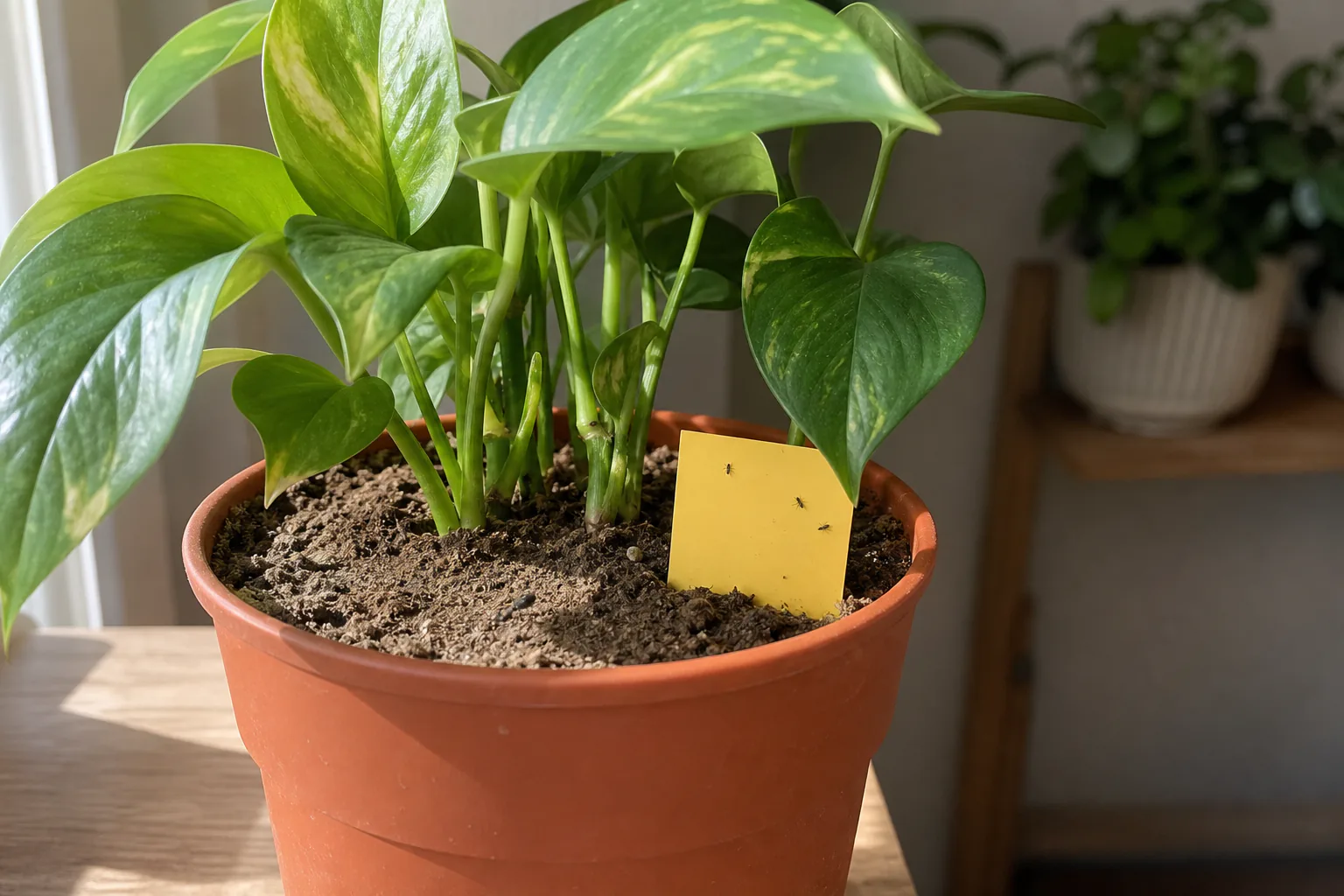
Yellow sticky traps are the standard indoor monitoring tool for fungus gnats. Place a card near the foliage of an affected pot, low enough that passing adults brush against it. Over the next three to seven days, you’ll get two useful things: confirmation that the insect really is a fungus gnat, and a sense of whether pressure is rising or falling.
The honest framing matters. Sticky traps catch adults and they do not reach larvae in the soil. On their own they rarely clear an infestation; paired with the dry-down and sanitation routine, they let you see whether the trend across one to two weeks is going in the right direction. A rising count means egg-laying is still outpacing your interventions. A steadily falling count means the soil surface is becoming hostile enough to break the cycle.
Label-compliant options for stubborn infestations, framed as a supplement to dry-down
If pressure is still high after several weeks of consistent dry-down and sanitation, a biological option can be layered on top. Bacillus thuringiensis israelensis, usually shortened to BTI, is the class most often referenced for fungus gnat larvae when applied as a soil drench. University extension services describe it as targeting the larval stage.
The catch is that BTI is not a single product with a universal recipe. Formulations vary by brand, and indoor-houseplant labeling and application rates differ across products. The safe move is to choose a product whose label specifically lists houseplant or indoor container use, then follow that label for the dilution and the re-application interval. Do not improvise a ratio from a forum thread or a video.
What to avoid, and it’s worth saying plainly: home-remedy soil drenches, including hydrogen peroxide mixed at home in varying ratios, dish soap, or vinegar solutions, are not what university extensions recommend. These mixes are widely discussed online, but their effects on root tissue and soil biology are not well quantified, and homemade soap products in particular are documented to burn foliage. If a friend or a video suggests a “one-drench fix,” treat it as a flag rather than a recipe.
Insecticides and miticides are a different category. University extension guidance is consistent that insecticides are rarely needed for typical indoor fungus gnat problems. If you’re considering one, read the current product label carefully, confirm indoor use is listed, and follow the label exactly. For homes with pets or children, that label review is also the right place to look for any safety guidance specific to your situation.
When to stop troubleshooting and ask a local nursery or extension service for help
A reasonable expectation, given the three-to-four-week life cycle and overlapping generations, is that pressure should fall noticeably over several weeks of consistent dry-down and surface hygiene. It doesn’t always. Several scenarios are worth handing off to a local nursery or your regional cooperative extension service:
- Multiple pots are heavily infested and the population isn’t declining after three or four weeks of cultural control.
- A plant is declining, with yellowing, soft stems, or leaf drop, and you’re not sure whether the cause is larval root feeding, chronic overwatering, root rot, or something else entirely.
- You’re considering a pesticide and want a current, region-specific recommendation rather than a generic online answer.
- Pets or children share the space, and you want guidance specific to your home before using any product.
A photo and a short description of the routine you’ve already tried is usually enough to start a useful conversation. Remote troubleshooting has limits, and a fungus gnat problem in a stressed plant is one where a quick second opinion is worth the call.