Plant care
How to tell when a houseplant actually needs water
· Updated
Most indoor plants do best when you water them based on what the soil and the plant are telling you, not on a fixed day of the week. The reliable habit is simple: check the soil about two inches down, lift the pot to feel how heavy it is compared to when it was last watered, and use leaf behavior as a secondary signal. How often those checks lead to watering depends on your light, your pot, your mix, the season, and the plant itself, which is exactly why the calendar was not working.
Both the University of Maryland Extension and the University of Illinois Extension describe the same basic check: insert a finger to about two inches and water if the soil at that depth feels dry. Treat that as a starting point, then build the rest of your routine around it.
Why a watering calendar stops working in real rooms
The same plant in the same pot can dry out in just a few days one week and take more than a week the next, even when nothing about the plant itself has changed. What changed was the light coming through the window, the temperature in the room, and maybe the heating cycling on and off overnight. A weekly schedule cannot see any of that, so it ends up either underwatering the plant on a bright week or keeping it soggy on a dim one.
Four things do most of the work in setting your real watering rhythm: light, pot, mix, and season. The plant itself matters too, but the room sets the tempo. Once you accept that the answer is “it depends on your room,” the rest of this guide is just a set of tools for noticing what your room is doing.
The quick soil check: finger, chopstick, or wooden skewer
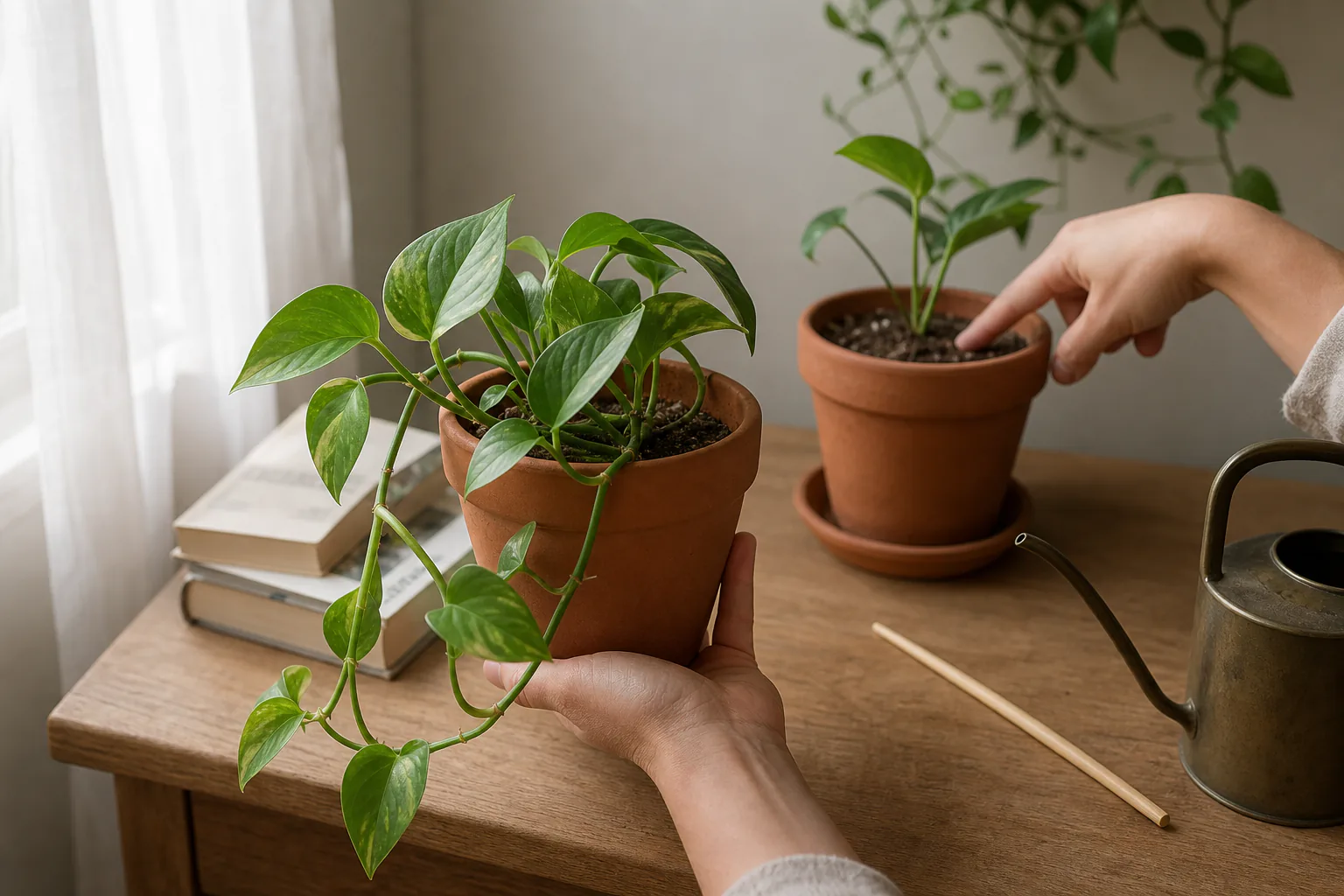
For most typical foliage plants, push a finger into the potting mix to about the second knuckle, roughly two inches. If it comes up dry and the mix feels crumbly rather than damp, the plant probably needs water. If it comes up dark and cool with mix clinging to it, wait and check again in a day or two.
A wooden chopstick or bamboo skewer is a useful second tool, especially in deeper pots where the top dries faster than the root zone. Push it all the way to the bottom of the pot, leave it for a minute, and pull it out. If the wood comes out stained dark and feels damp, the lower root zone is still wet, even if the top looks dry. This single trick catches a lot of overwatering mistakes, because the surface is the first thing to dry and the last thing to tell you the truth.
For plants with deeper or woody root systems, two inches is a rough guideline rather than a hard rule. The idea is the same: sample the root zone, not the surface crust.
Learning each pot’s dry weight
Pick up the pot right after you have given it a thorough watering and notice how heavy it feels. Check it again a few days later and notice how much lighter it has become. Do that two or three cycles in a row and you will start to recognize each pot’s “dry weight” by feel alone. That baseline is per pot and per plant, so it does not transfer, but it is one of the most reliable signals you can build because weight does not lie.
Two honest limits. Very large pots in big nursery containers are awkward to lift, so the soil check has to do more of the work. And decorative outer cachepots hide the weight of the inner nursery pot, which is why most growers either lift the inner pot out for a moment or keep their plants in nursery pots that sit inside the decorative shell.
Reading leaf and stem signals without jumping to conclusions
Leaf behavior is the third channel, and it is the easiest to misread. Soft, slightly drooping leaves that perk up within hours after a watering usually do mean the plant was thirsty. Leaves that stay droopy in soil that still feels damp are pointing somewhere else, almost always at root trouble rather than thirst. Wilting is not proof of underwatering on its own, and treating wet-soil wilt with more water is one of the most common ways indoor plants are lost.
Use leaves as confirmation, not as the trigger. If the soil is dry at two inches and the leaves are starting to soften, water. If the leaves are soft and the soil is still damp, do not water, and start looking at the pot and the roots instead.
What actually changes the answer in your home
Light
Light is the single biggest reason two otherwise identical setups dry down at different speeds. Brighter light tends to mean faster water use through the leaves, which tends to mean the pot dries sooner. Lower light means the opposite. This is why two people with the same plant on the same schedule can have completely different results: their windows are different.
If you have not already mapped the light in your room, it is worth doing before you trust any watering rhythm. Our guide on how to read the natural light in your room walks through the categories step by step, and the short version is that once you know whether your plant sits in bright, medium, or low light, you can predict whether it will dry faster or slower than the label suggests.
Pot size and material
Larger pots hold more mix and more water, so they usually dry more slowly than small pots in the same light. Pot material matters too. Unglazed terracotta is porous clay, so moisture evaporates through the walls and the mix typically dries faster than it would in plastic or glazed ceramic. Plastic and glazed pots hold moisture longer, which can be helpful in a bright warm room and risky in a dim cool one. None of this changes what the plant needs, but it changes how fast the soil gets there.
Potting mix
Coarser mixes with bark, perlite, or pumice tend to dry faster and re-wet more easily after they dry out. Finer, peat-heavy mixes can hold moisture longer, and they often resist rewetting once they dry, with water running down the inside of the pot and out the drainage hole while the root ball stays dry. A quick soak from the bottom, setting the pot in a few inches of water for fifteen or twenty minutes, usually solves that second problem.
Season and indoor humidity
Most typical foliage plants slow their growth and water use in winter. Days are shorter, light intensity is lower, and indoor air tends to be drier from heating, which sounds like it should mean faster drying but in most cases does not, because the plant itself is using less water and that slowdown outweighs the effect of drier air. Expect the same plant in the same pot to need water less often in winter than in summer, and resist the urge to water on a summer schedule just because the room still feels warm.
The specific plant and its growth stage
A plant in active growth, pushing out new leaves in spring and summer, drinks more than the same plant resting in winter. Some species run on a different calendar entirely. Many succulents slow down in summer heat and grow in the cooler months. Treat species norms as starting estimates, then let your soil and weight checks confirm them.
These factors stack rather than act alone. A pothos in a small terracotta pot in bright indirect light in summer is going to dry much faster than the same pothos in a large glazed ceramic pot in medium light in winter. Most watering mistakes come from guessing one factor and ignoring the rest.
When the signals disagree
If the soil at two inches is still damp and the leaves are drooping, the answer is almost never more water. Check whether the mix has compacted, whether the pot has become crowded with roots, and whether the drainage hole is still open. Gently slide the plant out of its pot and look at the roots: in most common houseplants, healthy roots are firm and pale, while rotten roots are dark, soft, and may smell sour. Root trouble is a separate problem with its own recovery steps, and a full troubleshooting walkthrough is worth a separate post.
For now, the rule is simple. Wet soil plus drooping leaves does not mean more water. It means stop and look at the pot and the roots.
A simple weekly observation habit
Once a week, walk past each plant and do three things. Push a finger or skewer into the soil to about two inches. Lift the pot and compare its weight to how it felt right after the last watering. Glance at the leaves for any change from last week. Water only when at least two of those three say the plant is dry. The exact day of the week does not matter; the routine does.
In a month or two you will notice that some plants drink on a fast rhythm and others on a slow one, and you will start to water each one on its own tempo without thinking about it. That is the whole point of the observation habit: it is not a chore, it is a way of paying attention, and the plant will tell you what it needs if you let it.
Sources
- University of Maryland Extension – Watering Indoor Plants
- University of Illinois Extension – Watering (Houseplants)
- Texas A&M AgriLife Extension – Light, Temperature and Humidity
- Oregon State University Extension – Environmental Factors Affecting Plant Growth
- Wu et al., 2025 – The role of light in regulating plant growth, development and stress responses (PMC)