Plant care
How to tell your houseplant's potting mix has aged out
· Updated
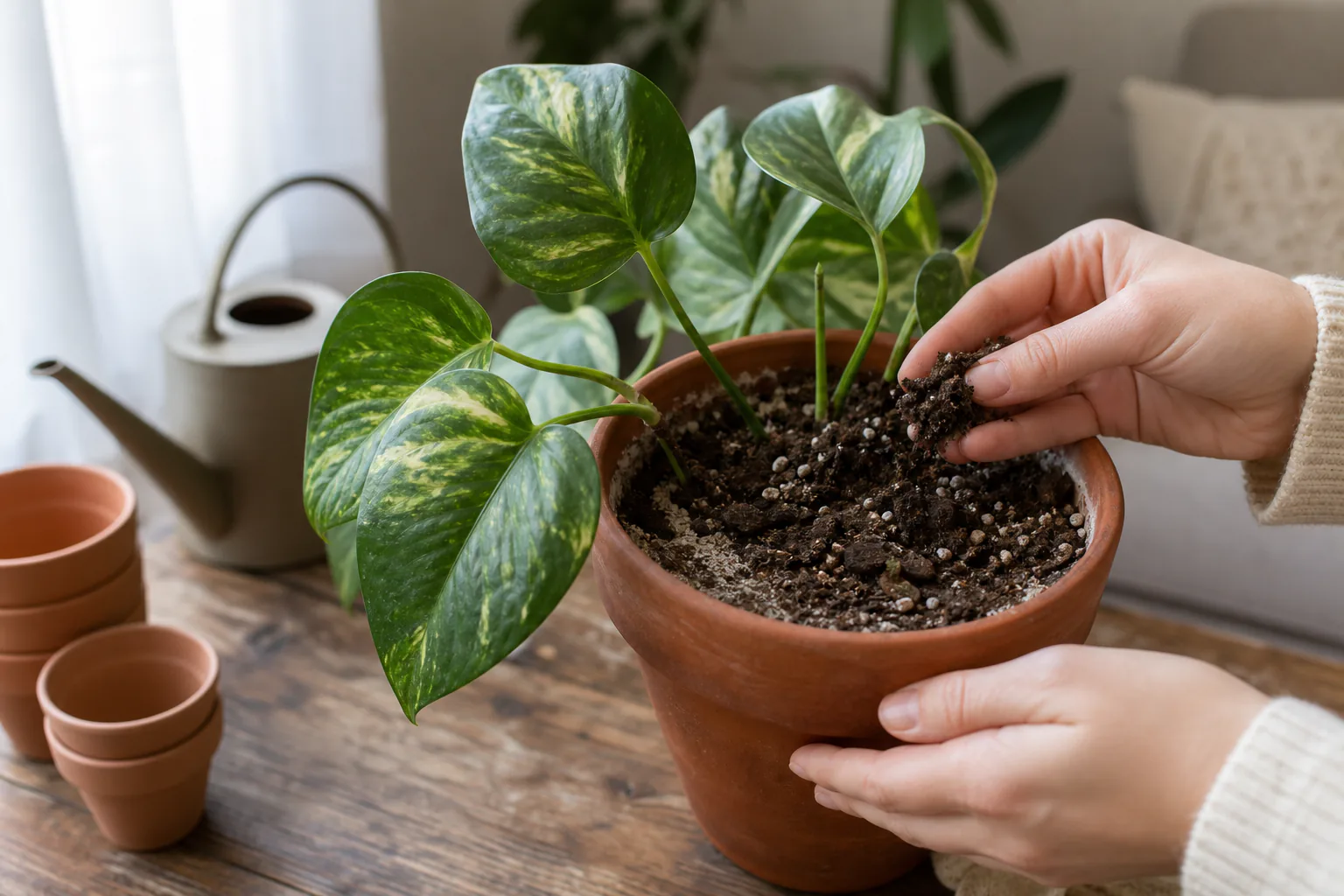
Most indoor potting mixes don’t fail on a schedule, and they don’t all age the same way. The medium inside the pot is an engineered, mostly soilless blend of organic components like peat, coir, or pine bark, plus mineral pieces like perlite or pumice, and it slowly breaks down, compacts, and loses the air and water relationships it was designed to deliver. When that happens, the plant usually shows you first through the medium itself: a hard crust on top, a visible gap between the mix and the pot wall, water that beads or shoots straight through, a pale mineral residue on the surface, or roots that have matted into the shape of the old root ball.
None of those signs is a verdict on its own, and none is tied to a single date. Look for several of them together in a plant that has been in the same pot for many months, and you’ve earned the right to act. The action can be as small as changing how you water, as moderate as scraping off the top few centimeters and replacing them with fresh mix, or as involved as a full repot into new medium, depending on which signs are present and which species is involved.
This guide is built around five checks you can do without any tools, what each one usually means, and how to choose between doing nothing, doing a partial refresh, and doing a full repot. If you’re also seeing slowed growth and aren’t sure whether the medium is the actual cause, the most common non-mix reason an indoor plant struggles is light, and it’s worth ruling out before you change anything in the pot — start with how to read the natural light in your room.
Why potting mix is not a permanent material
Indoor potting mixes are built to do two things at once: hold moisture around the roots while letting air back in. That’s why they’re mostly not garden soil. They’re a manufactured blend designed to behave predictably in a small, closed container, and the components they’re chosen from — peat, coir, bark, perlite, pumice, vermiculite — are picked to support that balance.
Over months and years, the organic components physically change. Peat particles shrink and harden as they dry out, coir breaks down more slowly but still settles, and pine bark slowly decomposes and sheds fine dust that fills the gaps it was originally supposed to leave open. The mineral pieces hold their shape much longer but can still get buried under compacted fines. The University of Arkansas Cooperative Extension notes that most indoor plants only need full repotting every three to five years, which is a useful sanity check: if a plant has been quietly thriving in the same pot for two years, the mix is probably still doing its job, even if it doesn’t look pristine.
Quick checks you can do with your eyes and fingers
Five physical checks will tell you more about the state of the medium than any calendar will. None of them requires tools.
- Texture pinch. Scoop a pinch of surface mix and rub it between your fingers. Fresh, healthy mix is loose and slightly springy. Compacted mix holds its shape, feels spongy or dense, and may leave a residue on your skin. A pinch that crumbles loosely is closer to what the mix was on day one.
- Surface hardness. Press your fingertip gently into the top of the medium. If the surface gives a little and your finger comes away with bits of mix on it, the surface still has air in it. If the surface resists your finger, or has cracked into a polygonal pattern, the top layer has lost its porosity.
- Gap between mix and pot wall. Run a finger down the inside of the pot, just under the rim. If you can feel a clear channel between the mix and the pot wall, the medium has physically shrunk as its organic components decomposed. This is one of the most reliable mid-life symptoms of an organic mix and is hard to fake with watering habits alone.
- Water behavior. Pour a small amount of water onto the surface and watch what happens. It should darken the mix and slowly soak in. If it beads on top, runs down the inside wall, or shoots out the drainage hole in a few seconds without darkening the mix, the medium has lost its ability to take up water evenly. The same is true if water pools on top without absorbing at all.
- Finger test. Push a finger or an unglazed wooden chopstick an inch or two into the medium. This is a long-standing extension-recommended way to gauge both moisture and surface hardness. If the top inch feels noticeably harder or drier than what’s underneath, the surface has compacted or crusted. If the whole depth feels uniformly tight, the compaction goes deeper.
Drainage and rewetting: how old mix behaves with water
The most common water-related symptom of aged mix is hydrophobic behavior. Peat-based mixes are the worst offenders: peer-reviewed work on peat and coir substrates documents measurable differences in how each holds and releases water, and industry sources note that peat-based mixes tend to dry from the bottom up and, once thoroughly dry, can repel water even when re-watered. The water doesn’t soak in. It channels down cracks, runs down the inside of the pot, and exits through the drainage hole having barely touched the root zone.
This is also the symptom most often misread as “I need to water more.” A dry-looking plant in a hydrophobic pot can be sitting in a wet reservoir at the bottom and a bone-dry, water-repelling layer on top. The University of Arkansas Extension flags this directly: wilting and leaf drop are often the first signs of overwatering rather than a mix problem, and the finger test is the first check.
A separate water symptom is slow drainage in a pot that previously drained quickly. If water now sits on the surface for a long time before disappearing, the air spaces in the upper layer have filled in. If the water still disappears quickly but the mix never feels damp a centimeter down, the water is channeling rather than soaking. Both patterns point to a medium that has changed physically, not to a plant that has suddenly decided it needs less or more water.
How the medium behaves depends a lot on what it was made from. Coir-based mixes are reported to rehydrate more readily than peat and to resist compaction longer, with a near-neutral pH in the 5.8 to 6.8 range. Pine-bark and other chunky organic mixes — the kind used for orchids, aroids, and bromeliads — drain faster and resist compaction better, but the bark still decomposes over time and sheds fine particles that fill in the gaps it was meant to leave open. Mineral-rich cactus and succulent mixes compact the least because there is little organic matter to break down, but they show mineral accumulation on the surface more visibly because there is little organic buffering to absorb it. The general direction is the same in every case; the rate is not.
Surface signs: crust, gap, and mineral residue
Three surface observations are useful and easy to make.
White or yellow crust. A pale crust on the soil surface, or a similar stain on the inside rim of a porous clay pot, is mineral accumulation. The two most common contributors are hard water — calcium and magnesium left behind as water evaporates — and soluble salts from fertilizer. The two are usually mixed together, and a homeowner cannot reliably tell them apart without a test. Either way, the crust is a real signal that something has been depositing on the surface for a long time, but it is a gradual observation rather than an emergency.
Gap between mix and pot wall. Already covered in the checklist, but worth restating: a visible or finger-detectable channel between the medium and the pot wall is one of the cleaner signals of mid-life mix shrinkage. It tends to show up before the surface gets obviously bad.
Surface algae or a persistent greenish film. A thin layer of algae can grow on a mix that stays moist for long stretches. Algae is more often a watering-habit or light-level clue than a mix-aging clue, but it can show up alongside compaction and crusting in a pot that has been wet for a long time.
What the roots tell you, and what they don’t
A gentle surface peek is often enough to clarify which problem you actually have. Tip the plant slightly out of the pot, or slide it out just enough to see the outer surface of the root ball, then slide it back.
Three patterns are worth knowing:
- Roots circling tightly in the shape of the pot. This is a pot-size problem, not a mix problem. The plant needs a bigger container, not necessarily new medium, and the right next step is to read more about deciding between a partial refresh and a full repot.
- Roots brown, soft, or smelling sour. This is a watering or drainage problem. The mix may have been wet too long, the pot may lack drainage, or both. The medium is innocent until the watering pattern has been corrected.
- Roots holding the old mix together like a sock, with the mix visibly compacted around them. This is the pattern that points most directly at the medium itself. The bulk mix has lost its structure, the roots have grown into whatever shape it now has, and a real refresh or repot is more likely to help than another adjustment to watering.
Deciding what to do: refresh, repot, or wait
Once several observations line up, three responses are reasonable. Each fits a different level of problem.
Adjust how you water. If the only real signal is a slightly hard top inch or a mild hydrophobic tendency, the cheapest experiment is to switch to deep, infrequent watering and to try bottom watering: set the pot in a tray of water and let the medium wick from below until the surface darkens. Peat-based mixes in particular respond well to a slow soak from the bottom. Nothing is replaced, and the medium has a chance to recover its rewetting behavior. If the plant responds over the next few weeks, the mix was probably still working.
Do a partial top-refresh. If the surface is clearly compacted or crusted and there is visible mineral buildup, replacing the top three to five centimeters of mix with fresh medium is a real and useful option. It does not address deeper compaction, a hydrophobic bulk, or a root-bound plant, so it is not the same as a repot, but it does address the layer where most of the surface symptoms live. This is a widely used homeowner practice; the extension literature treats full repotting as the formally recommended response when a medium is clearly broken down.
Do a full repot. If the observations stack up across the checklist — roots matted into the shape of the old mix, water that runs straight through, a gap at the pot wall, a plant that has stopped growing despite reasonable light and watering — a full repot into fresh medium is justified. Choosing what to repot into matters as much as the act of repotting; if you’ve reached that point, the natural next read is how to choose a replacement potting mix.
When not to change the mix
Several situations look like mix problems but are not, and changing the medium in those cases will not help.
- The plant is dormant or just slow. Many indoor plants slow down for part of the year, and a quiet phase is not evidence of mix failure.
- The plant was recently repotted. Fresh mix behaves a little differently for the first few weeks; a slightly settled surface right after a repot is usually just settling, not aging.
- The actual problem is light. Far more indoor houseplants fail from insufficient or inappropriate light than from old mix. If the plant has stopped producing new growth and the medium looks reasonable, check the light before checking the soil.
- The actual problem is watering. The finger test exists for a reason. Yellowing lower leaves and wilting in a wet pot are overwatering clues. Repotting a chronically overwatered plant into fresh mix just resets the same problem in a few weeks.
A short version
The potting mix is an engineered material with a real but uneven functional life. The fastest way to know whether yours has aged out is to look at it, pinch it, pour a little water on it, and gently peek at the roots. If several observations line up, you can adjust your watering, do a partial top-refresh, or do a full repot, in that order of disturbance. None of these choices is on a calendar, and none of them is the right answer for every plant.
Sources
- University of Arkansas Cooperative Extension Service — Repotting Houseplants
- North Carolina State University — Container Soils and Soilless Media
- Londra (2018), MDPI Water — Hydrological Behavior of Peat- and Coir-Based Substrates
- Dias (2025), PMC — Potential of Pine Bark to Replace Perlite in Coir-Based Substrates
- Cornell University — Comprehensive Assessment of Soil Health, third edition
- Black Gold — Do Outdoor Containers Need New Potting Mix Every Year?
- Dirtcraft Living Soils — Pro Tip Corner