Plant care
A simple weekly houseplant care routine
· Updated
A 10 to 15 minute weekly walk-through of your plants — touching the soil, glancing at each spot’s light, scanning leaves for early pest signs, and doing a small cleanup only when something actually needs it — is more useful than any fixed watering or fertilizing schedule. The purpose of the routine is to notice, not to do the same thing to every plant on the same day.
This article lays out a flexible weekly rhythm built around four short checks. It is designed for a small indoor collection in an ordinary home, and it explicitly separates the habit of looking from the habit of watering or feeding.
Why a weekly observation habit beats a fixed schedule
Indoor plants live in conditions that change quietly: a curtain drawn a little further in the afternoon, a tree outside leafing out in spring, a heating vent that runs more in January, a new lamp added to the room. None of these register as a single dramatic event, but over weeks they shift what a plant actually experiences. A habit of looking once a week catches those slow changes; a habit of watering on a fixed day does not.
UC Marin Master Gardeners tells readers to examine plants regularly and check on them routinely, rather than watering on a fixed day. The University of Nevada Reno Extension adds that plants in larger pots are commonly checked on a weekly basis, with smaller pots checked more often. Neither source treats weekly as a watering or feeding cadence. Both treat it as a seeing habit.
The other half of this framing is honest: weekly is a default, not a rule. A very stable plant in a steady spot may not need a weekly visit. A struggling or recently repotted plant may benefit from a quick daily glance for a short time. Treat the weekly walk-through as a rhythm that scales up or down, not as a contract.
What a weekly check-in looks like in real time
For a small collection of typical houseplants, plan on roughly 10 to 15 minutes. The exact number varies — a dozen small pots in a bright window take longer than three large floor plants in a dim corner — and the order of operations stays the same. Treat the time as a working estimate rather than a target; the goal is to do the four checks, not to finish in a fixed number of minutes.
Walk from plant to plant rather than working species by species. Doing the same four checks in the same order each week builds automaticity, and seeing plants side by side makes small changes easier to notice. If you skip a week, the routine is forgiving; pick it up again the next time you walk past.
The four checks, in order:
- Soil and moisture, by touch.
- Light, at the spot the plant actually sits.
- Pests and leaf condition.
- Small cleanup and reset.
The rest of this article goes through each one.
Step 1: Soil and moisture check (the touch test)
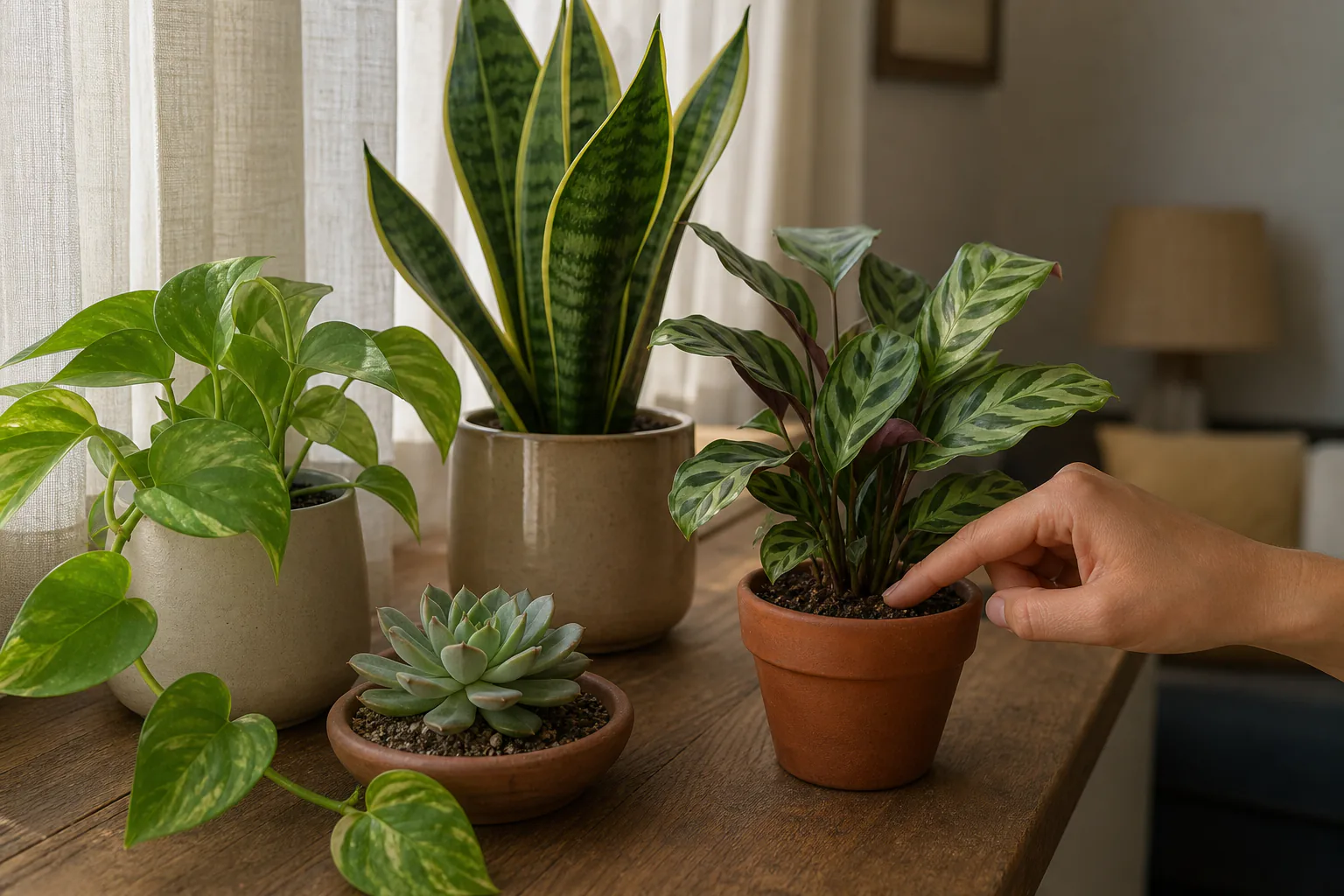
For each plant, push a finger or a wooden skewer a couple of centimeters into the soil and feel what comes up. Dry at that depth means the plant is probably ready to water; cool and damp means it is not. That is the whole decision. There is no day of the week attached to it.
The University of Maryland Extension recommends a finger-test to a depth of about two inches as a way to decide when to water. The University of Nevada Reno Extension suggests checking roughly an inch below the surface. Smithsonian Gardens gives the same advice in simpler terms: stick a finger into the soil to check moisture before watering. None of these sources describe watering as a fixed weekly action.
For a fuller method that accounts for pot size, mix, and season, see our forthcoming guide on deciding when to water without a schedule.
Step 2: Quick light check at each spot
Once a week, ask the same question for every plant: is this spot still as bright as it was last week? The honest answer often surprises people. A shelf that was bright in October may be dim by January. A tree outside may have leafed out and quietly filtered an afternoon window. A chair moved six inches to the left can change how much direct sun reaches a windowsill plant.
If a spot has changed, move the plant closer to its original light conditions, or change the source (open a curtain, raise a blind). For a deeper method of assessing what kind of light a room actually offers — including the shadow-test that distinguishes bright indirect from medium light — see our guide on how to read the natural light in your room before placing a houseplant.
Step 3: Pest and leaf inspection
The third check is a fast scan, not a deep audit. Take a few seconds per plant and look at the tops and undersides of the leaves, the stem joints, and the soil surface. Flip at least one leaf per plant to see the underside clearly. Virginia Tech’s Extension Master Gardener training material specifically directs inspectors to check the undersides of foliage. Smithsonian Gardens recommends inspecting new plants carefully for insects or diseases before adding them to a collection.
If you spot anything unfamiliar during the scan, do not start treating it on the spot. Note which plant it is, isolate it from neighbors if it has recently moved, and consult a species- or pest-specific guide. This article stays educational on what to look for during the scan; detailed identification and any treatment belong in dedicated identification posts, not in a general weekly routine.
Step 4: Small cleanup and reset
Cleanup is the part of the routine you only do when there is something to clean up. It is not a weekly obligation.
- Remove leaves that are fully yellow or fully brown. Smithsonian Gardens lists removing affected leaves as part of routine care.
- Dust large leaves with a soft, damp cloth if a visible film has built up.
- Rotate pots a partial turn if a plant is leaning hard toward one light source.
- Top off or empty cachepot water so roots are not sitting in a reservoir longer than intended.
- Deadhead spent blooms on flowering plants.
If nothing needs doing, do nothing. Routine is a noticing habit, not a handling habit. Plants that get poked at every week do not always thank you for it.
Adapting the routine: new plants, seasons, and recovery
The same four checks apply to almost every plant, but the emphasis shifts in three situations.
Newly acquired plants. Smithsonian Gardens recommends inspecting new plants carefully for insects or diseases before they enter a collection. For the first few weeks, treat the routine as light observation: same checks, less interference. Do not repot, fertilize, or change the light right away. Stability matters more than action. For more on handling the first weeks with a new plant, see our forthcoming guide on acclimating a new houseplant.
Seasonal shifts. In winter, indoor humidity typically drops when heating runs, and day length shortens. Indoor relative humidity in a typical home often sits between roughly 30 and 50 percent, with lower readings common during the heating season. For plants, that often means slower growth and longer intervals between waterings, while the leaf scan stays important because dry air stresses foliage. In summer, growth usually speeds up, soil dries faster, and pest activity tends to rise, so the soil check and pest scan carry more weight. These are generalizations; your specific room and species may behave differently.
Recovering plants. A plant that has just been repotted, or one recovering from overwatering or a pest problem, does not need the full four checks every week. It needs a quick daily glance for a short period: is it wilting, are new leaves coming in, is the situation improving or sliding? Once it stabilizes, return to the weekly rhythm.
When weekly is too much, or not enough
A weekly walk-through is a default, not a rule. A houseplant routine should match your available time and the plant’s environment, not be a universal prescription.
A few honest examples:
- A sturdy, slow-growing plant in a stable spot may only need a check every two or three weeks.
- A collection of small succulents in a sunny window can dry out fast; many readers check those every few days during summer.
- A plant that just lost several leaves or has visible damage may warrant a brief daily look for a couple of weeks until it stabilizes.
- Plants in dormancy, including some succulents, some bulbs, and some temperate species in winter, often need less interference, not more.
The point of the habit is to be in touch with the collection, not to perform a fixed number of actions. If life gets busy for a fortnight, the routine survives; it is meant to.
A simple weekly houseplant checklist you can print or save
If you want a compact version to keep on the fridge or in a notes app, here is the whole routine in one place.
Soil. Touch a finger or skewer a couple of centimeters into each pot. Water only if it feels dry at that depth.
Light. Glance at the spot each plant actually sits in. If brightness has shifted, adjust placement or curtains.
Leaves and pests. Scan tops and undersides of leaves, flip at least one leaf per plant, and look at the stem joints and soil surface. Note anything unfamiliar and isolate the plant until you can identify it.
Cleanup, only as needed. Remove fully yellow or brown leaves, dust large leaves if needed, rotate leaning plants, empty or top off cachepot water, and deadhead spent blooms.
Do the four checks in the same order each week, plant to plant, in roughly 10 to 15 minutes. Skip a week if you need to; resume when you can. Adjust the cadence up or down for new plants, dormancy, and recovery.
The habit is meant to give you a reliable read on what your collection actually needs, so you stop guessing and stop over-caring in equal measure.