Plant care
Why is my houseplant getting leggy?
· Updated
Why is my houseplant getting leggy?
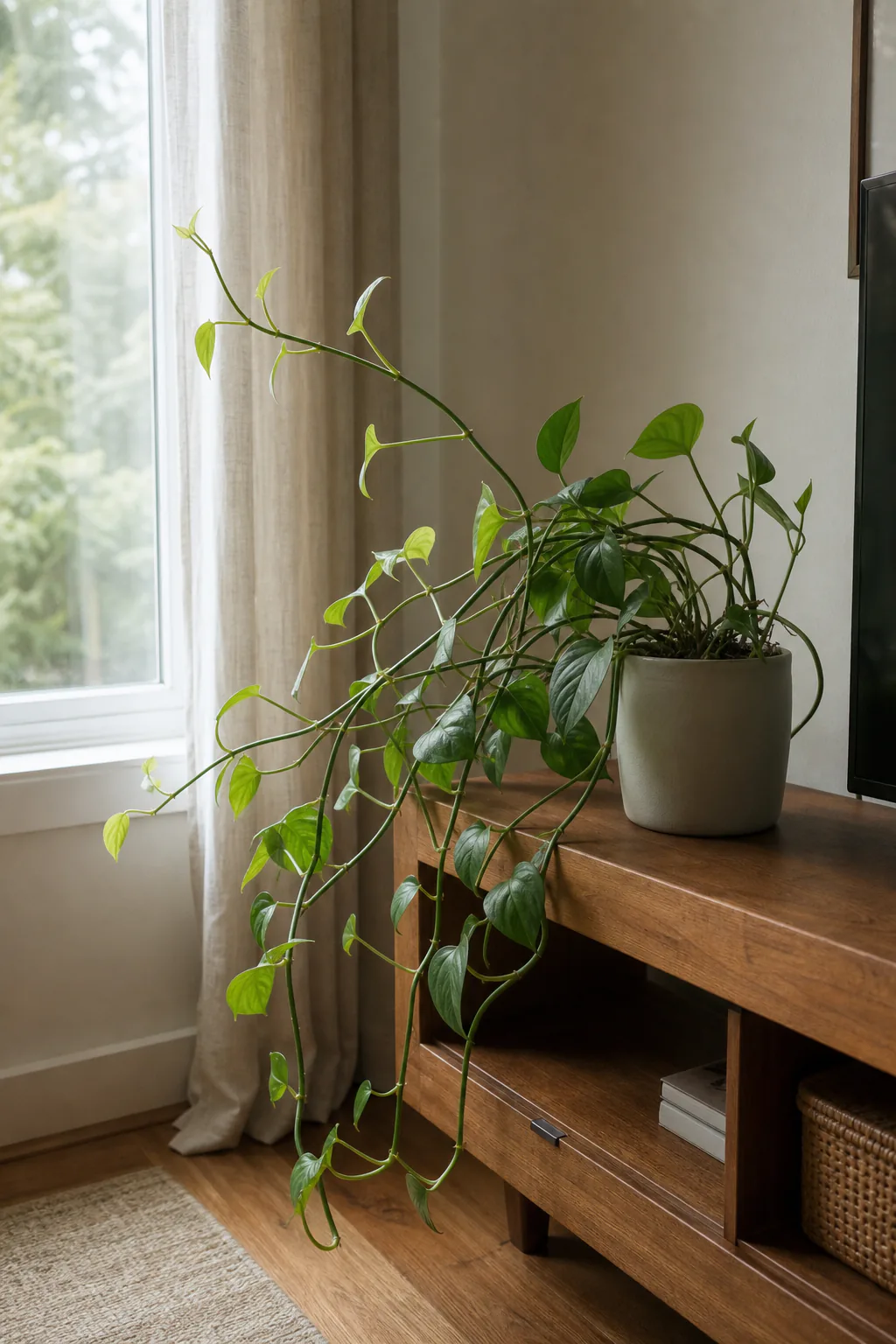
If your houseplant is getting leggy — long gaps between leaves, smaller new leaves than older ones, or a noticeable lean toward the window — the most common reason is that the plant is not getting enough usable light in its current spot. Here is the honest part up front: existing stretched stems will not shrink back. Only new growth reflects current conditions, so any improvement shows up on the next flush of growth, not on the stems already formed. And some long-stemmed plants, like pothos, philodendron, and tradescantia, are expected to trail or vine regardless of how much light they get.
This is an observation-first guide. The goal is to help you read what the plant is actually telling you, then make a realistic change.
What leggy growth actually looks like on a houseplant
Leggy is a loose word, but the on-plant signals are pretty specific when you slow down and look.
The most useful one is internode length — the gap between two leaves on the same stem. In healthy new growth, those gaps are short and consistent with the species. In low light, those gaps stretch out, sometimes visibly so. University of Maine Extension describes this kind of growth as etiolation: “elongated, spindly stems and pale leaves due to being grown in low-light conditions.”
A few related signs tend to travel together:
- New leaves are smaller than older leaves on the same plant.
- New leaves are paler, thinner, or less saturated than older ones.
- Stems feel thinner or weaker than the older, woodier sections.
- The plant leans or grows toward the brightest light source in the room.
One sign alone is not enough to diagnose low light. A single long internode can happen during a weather shift or a recent move. The pattern is what matters — long gaps, smaller leaves, and a directional lean all showing up together.
Why light is usually the driver
Plants do not stretch for fun. Stems grow longer between leaves when the light reaching them is too low in intensity or too short in duration for that species. A botany textbook chapter on shade avoidance describes this as a basic response: stems of plants raised in low light elongate more rapidly than normal. Internodes get longer because the plant is trying to push new leaves into a brighter spot.
Light in a real home falls off fast with distance. A spot right next to a south-facing window receives dramatically more light than a shelf three or four feet into the room, even when the room “feels” bright to you. North-facing windows and shaded interiors sit much further down the spectrum. University of Maryland Extension associates low light with roughly 25 to 100 foot-candles, typically found at north windows or in rooms lit mainly by lamps.
What sits between the plant and the sky matters as much as distance. Sheer curtains, trees outside, an awning, an adjacent building — each cuts what reaches the leaves.
How to check the light your plant is actually getting
Before moving anything, do a quick read of the room.
- Window direction. Unobstructed south- and southwest-facing windows deliver the most direct sun in the northern hemisphere; north windows deliver the least. UF/IFAS Gardening Solutions defines direct-light rooms as those receiving four or more hours of direct sun’s rays, typically through unshaded south or southwest exposures.
- Distance from glass. The brightest usable spot is usually right against the window or within a foot or two of it. A plant sitting on a console table across the room receives far less, even if the room “looks” sunny.
- Obstructions. Trees, neighboring buildings, awnings, frosted or sheer glass, and interior shelves all filter light. A plant directly under a shelf lip will receive less than one a few inches away.
- Season. The same window can deliver very different light between January and July. North windows in winter are essentially dim.
If you want a deeper method for evaluating the spot before you move the plant, our guide on how to read the natural light in your room walks through a practical at-home approach. The short version here: combine window direction, distance, and obstructions to estimate where your plant sits on the spectrum from low light to direct sun.
Repositioning without shocking the plant
If you suspect low light is the issue, the move should be gradual. In general, shade-grown leaves are not built for direct sun, and a sudden jump from a dim corner to a bright south window can scorch them — pale patches, crispy edges, or bleached spots on the leaves that were facing the light. Gradual moves tend to work better than abrupt ones.
A gentler approach:
- Move the plant a foot or two closer to the brighter spot over a few days rather than relocating it all at once.
- Watch the leaves for a week. New damage after a move usually shows up within days.
- If you are moving from a north or shaded window toward direct sun, intermediate positions (a bright east window, a spot a few feet back from a south window, behind a sheer curtain) reduce the shock.
- Rotate the pot a quarter turn each week so the lean does not re-form toward one direction.
The realistic shape of “more light” for most low-light-grown plants is closer to the window, a brighter window, or both. Whether that means more intensity, more duration, or a less obstructed path depends on the room.
Pruning leggy stems: what actually happens
Pruning is useful, but it does not make existing stretched stems shorter. The original section between two leaves stays the same length. What pruning can do is encourage new shoots to emerge from nodes closer to the soil, which over time gives the plant a fuller look lower down.
A few things worth knowing:
- In practice, cuts just above a leaf node often produce new shoots from that node on soft-stemmed plants like pothos, philodendron, and tradescantia.
- On woody-stemmed plants like ficus or schefflera, branching from older bare wood tends to be less reliable. New shoots are more likely from nodes that still have leaves or healthy buds nearby.
- The cut pieces often root in water, so pruning doubles as a way to start a fuller replacement plant.
If the plant is a climber — a pothos, philodendron, or similar that should have been climbing all along — the long stems are often a sign that the plant needed support earlier. Our post on supporting a climbing houseplant without damaging it walks through moss poles, trellises, and the timing of adding them. A climber with something to attach to will produce shorter, more tightly-spaced leaves along the stem than one left to dangle.
When ‘leggy’ is just the plant’s habit
Not every long-stemmed plant is stretching. Some are doing what they would do in any light.
- Pothos and heartleaf philodendron are grown specifically for their vining habit. Long stems are the plant, not a flaw. Grower references describe philodendrons as having both vining or climbing forms and upright forms, with vining types being the most commonly grown indoors.
- Tradescantia, string-of-pearls, and similar trailing plants produce long stems by design.
- Some succulents naturally elongate over time, even in good light, especially older specimens or caudex-forming types.
The useful question is whether the recent growth looks like the older, well-grown sections of the same plant. If a pothos that previously had tight, evenly-spaced leaves is now pushing leaves with much wider gaps and smaller size, that is a stretch pattern worth responding to. If the spacing and leaf size on new growth look consistent with the older stems, the plant is probably just doing its thing.
A realistic timeline for new growth
Improved light only shows up on the next flush of growth. The stretched stem you see today will look the same in a month — the difference, if any, will be visible on the new shoots that come in after you move the plant.
How quickly that becomes visible depends on:
- Species. Faster-growing plants like pothos and tradescantia tend to respond quickly under better conditions; slower growers like ZZ or sansevieria typically take longer.
- Season. Most houseplants push growth in spring and summer and slow down in fall and winter, so a light improvement made in November may not be visible until the next spring flush.
- Prior conditions. A plant that has been in deep shade for months may take a while to recover its color and vigor even after light improves.
There is not a fixed recovery window. The honest framing is: the next new growth is where to look, and the rate depends on the species and the season.
A practical next step
Start by reading the plant, not the room. Compare recent new growth to older growth on the same plant — gaps, leaf size, color, lean direction. If the recent growth is stretched, smaller, and pale, low light is a reasonable working theory.
Then read the room: window direction, distance from the glass, obstructions, season. If you find a mismatch — a “bright indirect” plant sitting several feet from a north window, for example — a gradual move closer to better light is a reasonable first response.
Prune to tidy and to encourage lower branching, not to shrink the existing stretched sections. And accept that some long-stemmed plants are simply long-stemmed by nature.
If the symptoms do not match the pattern described here, or if a plant is also showing signs of rot, pests, or sudden leaf drop, that points somewhere other than light. A local nursery or your regional extension office can look at the actual plant and the actual room, which is more useful than guessing from a photo.
Sources
- University of Maine Cooperative Extension — Bulletin #5059, “Too Much Water or Not Enough Light?”
- University of Maryland Extension — “Lighting for Indoor Plants”
- UF/IFAS Gardening Solutions — “Light for Houseplants”
- University of Illinois Extension — “Popular houseplants: Is it philodendron or pothos?”
- LibreTexts Botany — “4.2.4: Etiolation and Shade Avoidance”