Plant care
When does a houseplant actually need a new pot?
· Updated
The short answer: most houseplants do not need a new pot on a calendar. They need one only when specific, observable signs show up — roots circling inside the container or escaping the drainage hole, water running straight through without being absorbed, a mix that has compacted or pulled away from the pot sides, or a plant that has become top-heavy in its container. If those signs are absent, the calmest move is usually to leave the plant alone. If the mix is tired but the pot is still roomy, refresh the top layer of mix instead of upsizing. And if you do need to move a plant up, go up only about 1–2 inches (2–4 cm) wider in diameter.
That is the whole decision in three sentences. The rest of this guide walks through how to actually make the checks in your own room, what each observation means, and when to step back instead of acting.
Why “every year” or “every two years” is not a useful rule
It is tempting to anchor repotting to a fixed interval. The University of Arkansas Cooperative Extension notes that most houseplants do not need to be repotted more often than once a year, and many can go three to five years without it. Growth rate is what actually drives the timing, and growth rate depends on the light in the room, the temperature, the watering routine, and the plant itself.
Two plants in the same pot for two years can be in very different conditions. One may be root-bound and tipping over. The other may still have a half-empty root ball because the light in that corner is too low to push much new growth. A fixed schedule treats them the same and helps one while disturbing the other.
If you have been watching growth slow down, or you have just acquired a plant in a small nursery pot and want to be sure, run through the checks below rather than acting on a date.
The checks to do before you decide: roots, water, growth, top-heaviness
There are five observations that, taken together, give you a clear answer. None of them require special equipment, and only one of them involves taking the plant out of its pot.
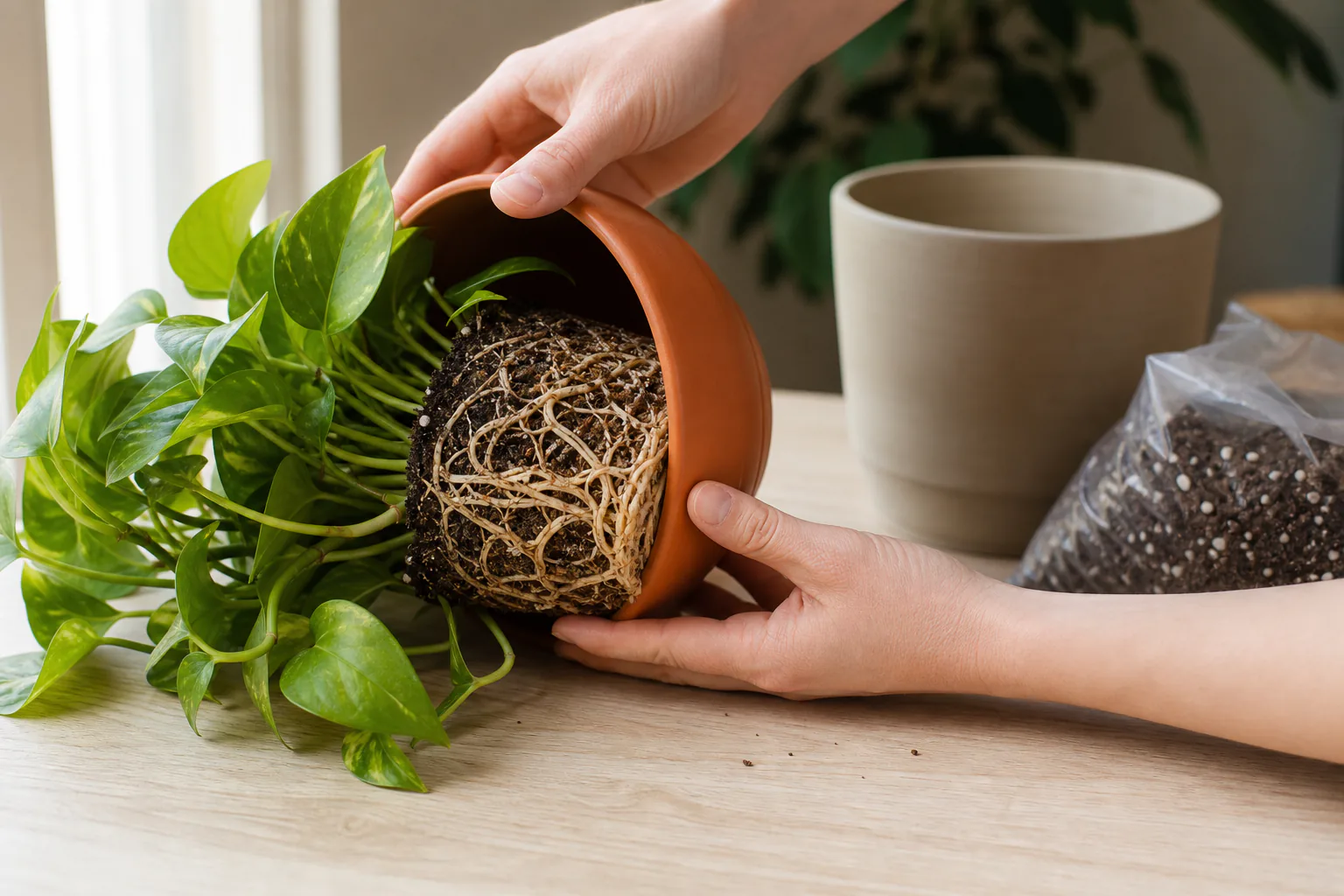
Look at the drainage hole. A single root tip peeking out is not a crisis. A dense mat of roots pressing against the hole, or roots visibly circling the outside of the root ball when you tip the pot, is a stronger signal. If you can see only one or two thin roots, watch for the other signs before deciding.
Watch what water does. When you water the way you normally do, does the mix slowly darken and absorb moisture, or does the water run straight out the bottom with the surface barely changing? Water that runs through too quickly can mean a root-bound plant has filled the container, or it can mean the mix has compacted and lost its ability to hold moisture.
Read the surface of the mix. A hard crust on top, a white or yellowish salty film, or a mix that has visibly pulled away from the sides of the pot all suggest the medium is tired. A salty crust in particular is a sign from the University of Arkansas extension that the mix should be replaced, even if the pot itself is still the right size.
Notice the growth pattern. A plant that has been producing healthy new leaves and then suddenly stops, or starts putting out noticeably smaller new leaves with no obvious change in light or water, may be running out of room. Compare across a full season rather than a single week.
Lift the pot. A plant that is tipping in its container, or that feels top-heavy for the size of the pot, is sending a structural signal. This one alone is not enough to repot, but combined with one or two of the others it usually points toward moving up.
Reading the roots without disturbing the plant more than necessary
If the signals above are mixed, the most direct check is a quick slide-out inspection. Water the plant a day or two beforehand so the root ball holds together. Tip the pot on its side, support the base of the stems with one hand, and slide the root ball out gently. You are looking at it, not pulling it apart.
Healthy roots are typically white or pale and firm, as described by West Virginia University Extension. A dense circling mass where you can barely see the original mix is a root-bound plant that genuinely needs more room. Soft, brown, smelly roots are a different problem — likely root rot — and need their own response rather than a simple repot.
Once you have looked, slide the root ball back in. The whole process takes a couple of minutes and gives you a much clearer answer than guessing.
What the water and the surface of the mix are telling you
It is worth pausing on water behavior because it is the easiest signal to read in real time. A mix that wets evenly and stays moist long enough to use most of what you poured in is doing its job. A mix that has become unable to absorb moisture evenly — where water beads on the surface, channels down the sides, or escapes the bottom almost immediately — has lost its structure and is no longer feeding the plant well, even if the pot is still roomy.
This is one of the clearest cases for refreshing the mix without upsizing. The pot is fine. The medium is exhausted. Replacing the top few inches of mix, or repotting back into the same container with fresh medium, addresses the actual problem.
A surface crust or salt film is the related signal. It usually comes from fertilizer salts and minerals in tap water building up over months. A top-dress with fresh mix, gently scratched into the top inch, dilutes the buildup without the disturbance of a full repot.
When the season matters: a calmer window for most houseplants
The calmer time to repot most houseplants is during active growth. Penn State Extension and the University of Arkansas both point to spring, or late winter as natural light begins to increase, as the window where the plant is waking up and can recover from root disturbance by pushing new growth.
Repotting during dormancy or low-light months does not kill the plant, but it does mean the root system sits in fresh, moist mix for longer without using it, which raises the risk of overwatering problems while the plant is less able to recover. If you have checked the plant and the signs clearly point to repotting but you are in a low-light stretch of the year, it is usually fine to wait a few weeks for growth to pick up — unless the container is so crowded that the plant is actually suffering.
Some commercial gardening sources suggest fall as a workable alternative window, particularly for plants that go dormant in winter. For most readers, though, the safer default is to wait for active growth.
Three honest outcomes: leave it, refresh the mix, or move up one pot size
This is the part of the decision that gets skipped over most often. Repotting is treated as the only move, when in practice there are three honest answers.
Leave the plant alone. If roots still have room, the mix absorbs water evenly, and growth has been steady, the plant is telling you it is fine. This is a real outcome, not a missed step. Most houseplants most of the time belong here.
Refresh the mix. If the pot is still the right size but the mix is compacted, salty, or no longer absorbing water well, refresh the top layer or move the plant back into the same container with fresh medium. This addresses the actual problem — tired medium — without putting the roots into a larger body of moist mix they cannot use.
Move up one pot size. If the roots are clearly circling, escaping the drainage hole, or packed so densely that there is barely any mix left, the plant genuinely needs more room. Go up only about 1–2 inches wider in diameter than the current pot.
Pot sizing restraint: why one size up is usually enough
The 1–2 inch increment shows up across university extension guidance, including UC Marin Master Gardeners and West Virginia University Extension. The reasoning consistent across these sources is that a much larger pot leaves a lot of moist mix around the root ball that the plant cannot draw down quickly, which is widely understood to raise the risk of overwatering problems.
Going up two or more sizes at once means a longer stretch where roots are sitting in soil that stays wet for too long. Smaller, more frequent moves keep the root mass and the moisture in closer balance.
Signs that repotting can do more harm than good right now
A few situations are worth pausing on before you act:
- The plant is currently flowering. Repotting during active bloom can stress a plant that is putting energy into flowers, and reputable horticultural sources generally recommend waiting.
- The plant is under visible stress — wilting, sudden leaf drop, or soft stems — for reasons that have nothing to do with pot size. Address the underlying cause first.
- The roots look soft and brown. That points toward root rot rather than being pot-bound, and the response is different.
- You have just brought the plant home. Newly purchased plants can usually wait for the next active growth window unless the roots are clearly escaping the nursery pot.
In any of these cases, the better move is to wait and observe rather than repot immediately.
A short pre-repot checklist for the day you decide to act
When the signs point clearly to moving up, a few small steps make the day go more smoothly:
- Water the plant a day or two ahead so the root ball holds together.
- Have the new pot, fresh mix, and a clean working surface ready before you unpot anything.
- Choose a pot that is 1–2 inches wider in diameter than the current one, with a drainage hole.
- Slide the plant out, look at the roots, and settle it into the new pot at the same depth it was growing before.
- Many indoor gardeners wait a few weeks before resuming fertilizer so the new roots have time to settle in without being pushed.
Growth rate, recovery, and how quickly the new mix dries all depend on the natural light where this plant sits, so it is worth thinking about that room before you choose the new pot’s location.
Sources
- Penn State Extension – Repotting Houseplants: https://extension.psu.edu/repotting-houseplants
- University of Arkansas Cooperative Extension – Repotting Houseplants: https://www.uaex.uada.edu/counties/white/news/horticulture/20210428RepottingHouseplants.aspx
- UC Marin Master Gardeners – Houseplant Care: https://ucanr.edu/site/uc-marin-master-gardeners/houseplant-care
- West Virginia University Extension – Common Houseplant Care: https://extension.wvu.edu/lawn-gardening-pests/indoor-plants/common-houseplant-care
- Brooklyn Botanic Garden – When, Why, and How to Repot Your Houseplants: https://www.bbg.org/article/when_why_and_how_to_repot_your_houseplants