Plant care
Sticky houseplant leaves: a calm, inspection-first guide
· Updated
The short answer
A sticky or tacky film on a houseplant’s leaves is most often honeydew, a sugary residue left behind by small sap-sucking insects feeding on the plant. Honeydew itself is an observation, not a diagnosis. It tells you to inspect the plant carefully, especially along new growth, leaf undersides, and stem joints, before deciding what to do next.
The point of this guide is to slow the moment down. You do not need to name the exact insect to begin a thoughtful look at the plant, and you do not need to reach for any spray yet. A few minutes of careful observation will usually tell you whether you are dealing with something simple, something that warrants a longer inspection, or something you would rather have a local expert look at in person.
Houseplant Supplies does not offer remote pest diagnosis. The guidance below is meant to support your own inspection, not to replace an in-person look from a local nursery, county extension office, or university pest management program when you are uncertain. Our general care disclaimer covers what we can and cannot tell you from a written description.
Sticky leaves are an observation, not a verdict
It is tempting to feel a tacky leaf and jump straight to a conclusion: a specific bug, a specific product, a specific treatment. The more useful move is to treat the stickiness as a starting prompt for looking. Several different things can leave a film on a leaf, and only some of them involve insects at all.
Keeping that frame in mind helps you do three things. First, you avoid treating the plant for a problem it does not have. Second, you gather simple observations that make any later conversation with a local expert far more useful. Third, you give yourself permission to wait a day or two before doing anything more involved than a gentle wipe with a soft cloth.
What honeydew actually is
Honeydew is a sugary waste excretion produced when certain sap-sucking insects feed on a plant. The insects tap into the plant’s sap, take in more sugar than they can use, and excrete the excess. The result is a clear to slightly amber residue that feels tacky or sticky to the touch and tends to land on leaves below the feeding site, on nearby stems, and on whatever surface is closest underneath the plant (University of Maryland Extension; Mississippi State University Extension).
A few characteristics are worth noticing:
- It is sticky, not wet. Touch a leaf with clean, dry fingers; if your fingers come away tacky, that is more consistent with honeydew than with plain water.
- It often follows gravity. Honeydew tends to drip and pool, so the leaves directly under where the insects are feeding usually show it first.
- It can be hard to see in small amounts. A faint shine on a windowsill or tabletop below the plant can be an early clue.
Honeydew is not something the plant produces on its own, and it is not the same as guttation, the watery droplets that some houseplants push out at leaf margins overnight.
Ruling out non-pest explanations first
Before assuming insects, it is worth spending a minute on the simpler explanations. A sticky or shiny film on a leaf can also come from:
- Guttation. Watery droplets at the very edges or tips of leaves, usually appearing overnight and drying without residue. Not sticky.
- Hard-water or fertilizer-salt deposits. Whitish, chalky crusts on leaf tips, edges, or wherever water droplets dry, especially on plants watered from above with mineral-rich tap water or recently fertilized.
- Leaf-shine product residue. An oily or waxy film that appears after a spray or wipe-on product has been applied, usually concentrated on the upper leaf surface in the pattern of application.
- Dust or general indoor grime. Loose, dry, and easy to lift with a dry cloth. It is not tacky.
- Over-misting. Frequent misting in a poorly ventilated room can leave mineral residue and damp patches that look similar to honeydew from a distance.
A simple test helps. Wipe a small area with a soft, damp cloth. If the residue lifts easily and the leaf underneath looks healthy, and if the residue is concentrated on the upper leaf surface only, you are probably looking at one of the non-pest explanations above. If the film is sticky, present on leaf undersides as well as upper surfaces, and concentrated below where the insects would naturally feed, honeydew is the more likely cause.
None of this is a substitute for looking at the plant itself. It is just a way to set up the next step.
Where to look: a calm inspection routine
Small sap-sucking pests are good at hiding. A reasonable inspection routine looks at the places they tend to favor, in roughly this order (Mississippi State University Extension; UC IPM; Colorado State University):
- Leaf undersides. Most houseplant sap-sucking pests spend much of their time on the undersides of leaves, where they are less visible and less exposed.
- New growth and growing tips. Tender, soft tissue is easier to feed on, so fresh leaves, stem tips, and emerging shoots are common gathering points.
- Leaf axils. The small angles where a leaf meets the stem are protected crevices that pests favor.
- Stem joints and branch crotches. The junctions between stems and branches are another set of protected hiding spots.
- The crown of the plant and the soil surface. Some pests, particularly mealybugs, can be found at the base of stems, in the crown, or even on the soil surface.
A few practical tools help.
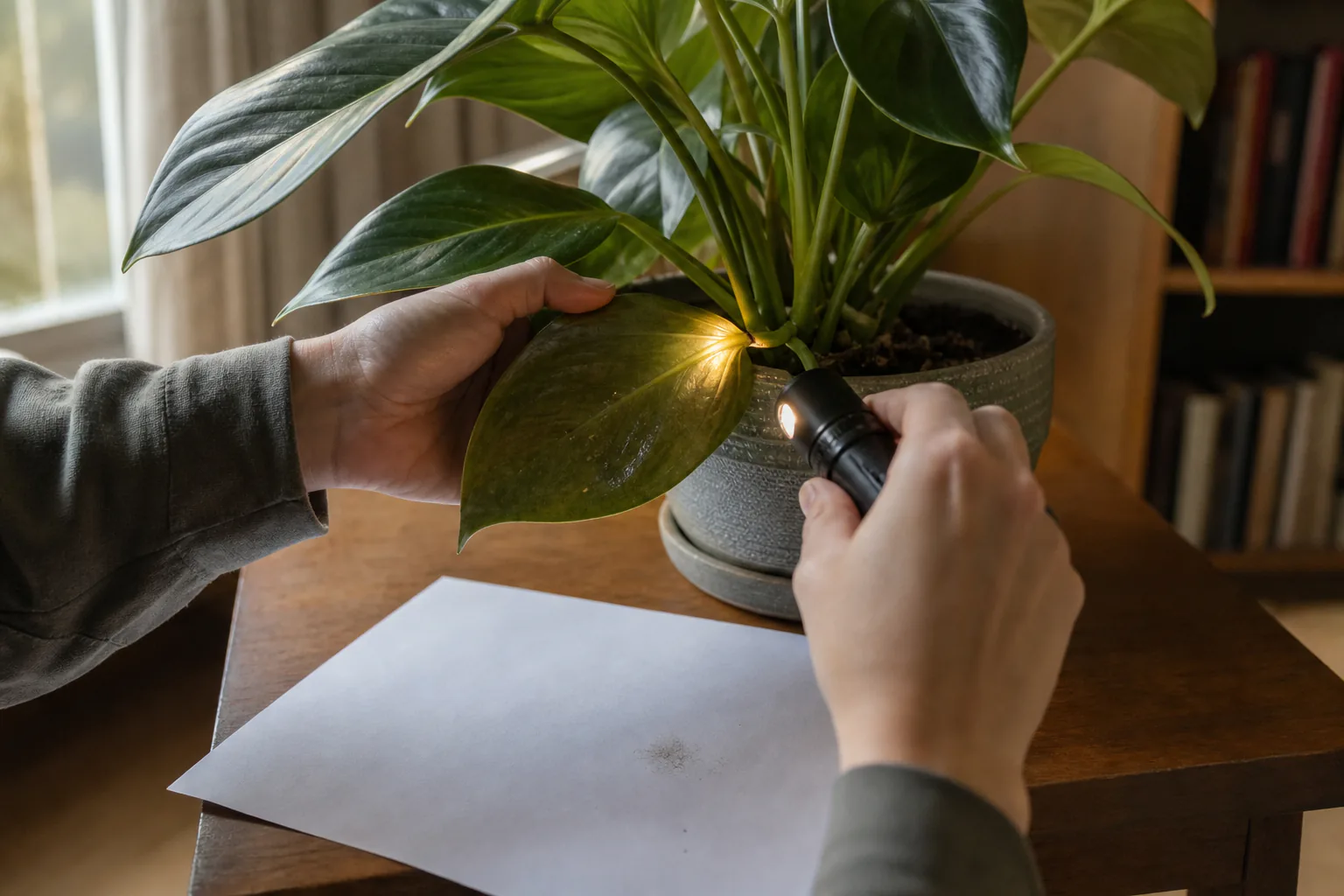
- Use a flashlight, even in a bright room. Side lighting makes small insects and shiny residues easier to see.
- A small magnifier, the kind found in a hobby or electronics kit, is useful if you have one.
- Hold a sheet of white paper under a stem and tap or shake the foliage gently. Small, mobile pests sometimes fall onto the paper where they are easier to spot than on the plant.
- Photograph what you see, including close-ups. Photos taken over several days are often more useful for identification than a single snapshot.
Take your time. There is no need to make a verdict on the first pass.
Small sap-sucking insects that commonly leave honeydew
You do not need to identify the exact species from a written description, and this guide is not going to try to do that for you. What is useful is to know the general category of pests that can produce honeydew on indoor plants, so the shapes and colors you see during inspection have a context.
The sap-sucking insect groups most commonly associated with honeydew on houseplants are:
- Aphids. Small, soft-bodied, often green, brown, black, or pink. Usually clustered on new growth or leaf undersides. They move slowly when disturbed.
- Mealybugs. Small, soft-bodied, and covered in a white, cottony or waxy material. Often found in leaf axils, branch crotches, or along stems, and easy to miss at low density (UC IPM).
- Soft scale. Small, rounded or oval bumps on stems or leaf undersides, often brownish and easy to mistake for part of the plant. They do not move as adults.
- Whiteflies. Tiny, moth-like insects that flutter up when the plant is disturbed. Usually found on leaf undersides.
If you find a clear match for one of these, you have an observation worth sharing with a local expert. If you find something that does not quite match any of them, that is also worth noting. The point of the inspection is not to name the insect from your living room. It is to gather enough information to have a productive conversation.
Secondary signs that often travel with honeydew
Two secondary signs are worth watching for, because they show up alongside honeydew often enough to be useful.
- Sooty mold. A black, soot-like film on the surfaces of leaves below where insects are feeding. Sooty mold is a group of saprophytic fungi whose dark, powdery spores colonize and break down honeydew on the leaf surface (UC IPM). The fungi do not infect plant tissue. Most extension sources describe sooty mold as more cosmetic than directly harmful, though heavy coverage can block light and reduce photosynthesis, which can affect growth over time. The practical takeaway is that sooty mold is a sign to look upward on the plant for the insect activity that produced the honeydew, not a problem to treat with fungicide on its own.
- Ant trails. Ants and wasps are attracted to honeydew because of its sugar content (Colorado State University). Ants walking up the stems or across the pot indoors are a possible secondary clue, especially if they keep returning to the same plant.
Other softer signs include shiny patches on a nearby windowsill or tabletop and slight leaf distortion or yellowing near feeding sites, and some growers describe a faintly sweet smell in heavier buildups, though that is the least reliable of the secondary clues.
What to do before reaching for any treatment
A few gentle, non-chemical steps are worth doing while you are still in the observation phase. They reduce the residue, slow the buildup of sooty mold, and buy you time to look more carefully.
- Isolate the suspect plant. Move it away from your other houseplants while you inspect, so that anything mobile has less chance of spreading.
- Wipe the leaves and stems. Use a soft cloth dampened with plain water and gently wipe affected surfaces. Repeat on a schedule, perhaps every few days, and watch whether new stickiness appears.
- Photograph the plant. A clear photo today, another in three days, another in a week, will tell you more than a single inspection.
- Pause before any spray. Homemade soap, hydrogen peroxide, vinegar, and essential-oil blends circulate widely, but extension sources do not endorse them as substitutes for first identifying the insect. Commercially labeled insecticidal soaps and horticultural oils are discussed in extension literature, but product labels and the specific plant and pest all matter, so the safer baseline is gentle cleaning and continued observation until you have a firmer sense of what is on the plant.
If you do decide that a treatment is warranted, your local independent nursery, county extension office, or university integrated pest management program can help match a treatment to the specific insect, the plant, and your home. Their guidance will be more specific to your situation than anything you can read in a general article.
When to ask a local expert for help
Some signs are hard to read on your own. Tiny scale insects, early-stage mealybug colonies, and whitefly nymphs can all look similar in a photo or a written description, and the difference between them matters when choosing a response. When you are uncertain, it is reasonable to ask for an in-person look.
Reasonable places to ask include:
- A local independent nursery or garden center with staff experienced with indoor plants.
- Your county or state cooperative extension office, which often runs plant clinics or Master Gardener hotlines.
- A university integrated pest management program, which can offer identification and least-toxic management guidance specific to your region.
Bringing a physical sample (a leaf or a small cutting in a sealed bag) or a series of clear close-up photographs makes the conversation go faster. You can also reach out through our contact page if you have a question about how to use the resources on this site.
A short observation log worth keeping
A simple note on paper or in your phone is enough. For each plant where stickiness has appeared, jot down the date, where on the plant the residue showed up first, what you found during inspection, and what changed after a gentle wipe. Over a week or two, this log often shows a pattern that a single inspection cannot, and it gives a local expert something concrete to work from if you decide to ask for help.
Sticky leaves are not an emergency. They are a signal to slow down and look. With a steady hand, a flashlight, and a little patience, you can usually figure out enough to decide whether you are comfortable continuing on your own or would rather have someone experienced take a look.
Sources
- University of Maryland Extension – Honeydew and sooty mold
- Mississippi State University Extension – Insect pests of houseplants
- University of California Integrated Pest Management – Mealybugs
- University of California Integrated Pest Management – Sooty mold
- Colorado State University Agricultural Biology – Houseplant pests