Plant care
Houseplants that survive a beginner: what tolerant of a learning curve really means
· Updated
A houseplant that is “tolerant of a learning curve” is one that can absorb the typical beginner mistakes — a missed watering, an extra watering, modest light, a rearranged shelf — without collapsing. There is no unkillable houseplant, and no plant forgives every mistake. What the label really means is that a forgiving plant buys you time while you figure out soil moisture, light, and routine. Each species in the beginner set has a documented failure mode worth knowing before you bring one home.
If you share a home with a curious pet, the safer move is to start with the pet-aware houseplant choices guide rather than guess from a list.
What “tolerant of a learning curve” actually means
When plant shops call a species “easy,” they are usually selling a feeling, not a guarantee. The phrase beginner-friendly houseplant is more useful when it is broken into observable traits: how the plant responds to dry-down between waterings, how much light variation it tolerates, how clearly it signals stress before collapse, and how it recovers when a routine slips. “Impossible to kill” and “foolproof” are marketing labels that no university extension source supports.
“Tolerant of a learning curve” is a more honest version of the same idea: the plant can absorb predictable beginner mistakes while you are still learning. It does not mean indestructible. A snake plant can rot if you water it on a calendar. A pothos can stretch and pale if you keep it in a dark corner. The forgiving label is relative, and the failure mode of each species is real.
The mistakes a beginner is most likely to make
University extension publications describe the same handful of patterns again and again. Overwatering leads the list — usually because beginners water on a calendar or splash a little every day rather than checking the soil, and it helps to learn how to tell when a houseplant actually needs water before building a routine. Picking the darkest corner of the room is second, driven by the idea that “indoor plants grow in shade.” Repotting a new plant immediately into a much larger container traps moisture against the roots and is a common trigger for root rot. Fertilizing on day one, before the plant has acclimated, can stress tender roots and is more likely to harm than help. Moving the plant from shelf to shelf while you search for “the right spot” adds stress to a plant that is already adjusting.
Most of these mistakes are absorbable, but only by the right species in the right place. The mistake that reliably kills beginner plants is not the watering itself — it is the combination of soggy soil, a pot without drainage, and a root system that never gets a chance to dry back. Healthy roots are firm and white; rotted roots turn brown and soft, and recovery becomes a slower project than learning to water in the first place. If you are not sure which side of the line the plant is on, the overwatered vs underwatered diagnostic sequence walks through the difference without guessing.
The five traits that make a houseplant forgiving
Forgiving species share a few traits you can look for. They tolerate dry-down between waterings rather than demanding constant moisture. They accept a range of light from medium to bright indirect, with real caveats for “low light” claims — extension sources are careful to say low-light plants grow more slowly and need less water, not that they thrive. They show slow, readable warning signs — a soft leaf, a drooping stem, a browning tip — before they collapse. They recover after a stress event rather than quietly failing. And they are reasonably priced and easy to replace if a mistake still costs the plant.
No single species has all five. Snake plant is highly drought-tolerant but highly rot-prone in wet soil. Spider plant is forgiving of skipped waterings but tends to tip-burn — often linked to minerals in tap water, though dry air and underwatering can produce a similar look. The beginner shortlist below pairs each species with the trait you can lean on and the failure mode you should respect.
A short, honest beginner shortlist
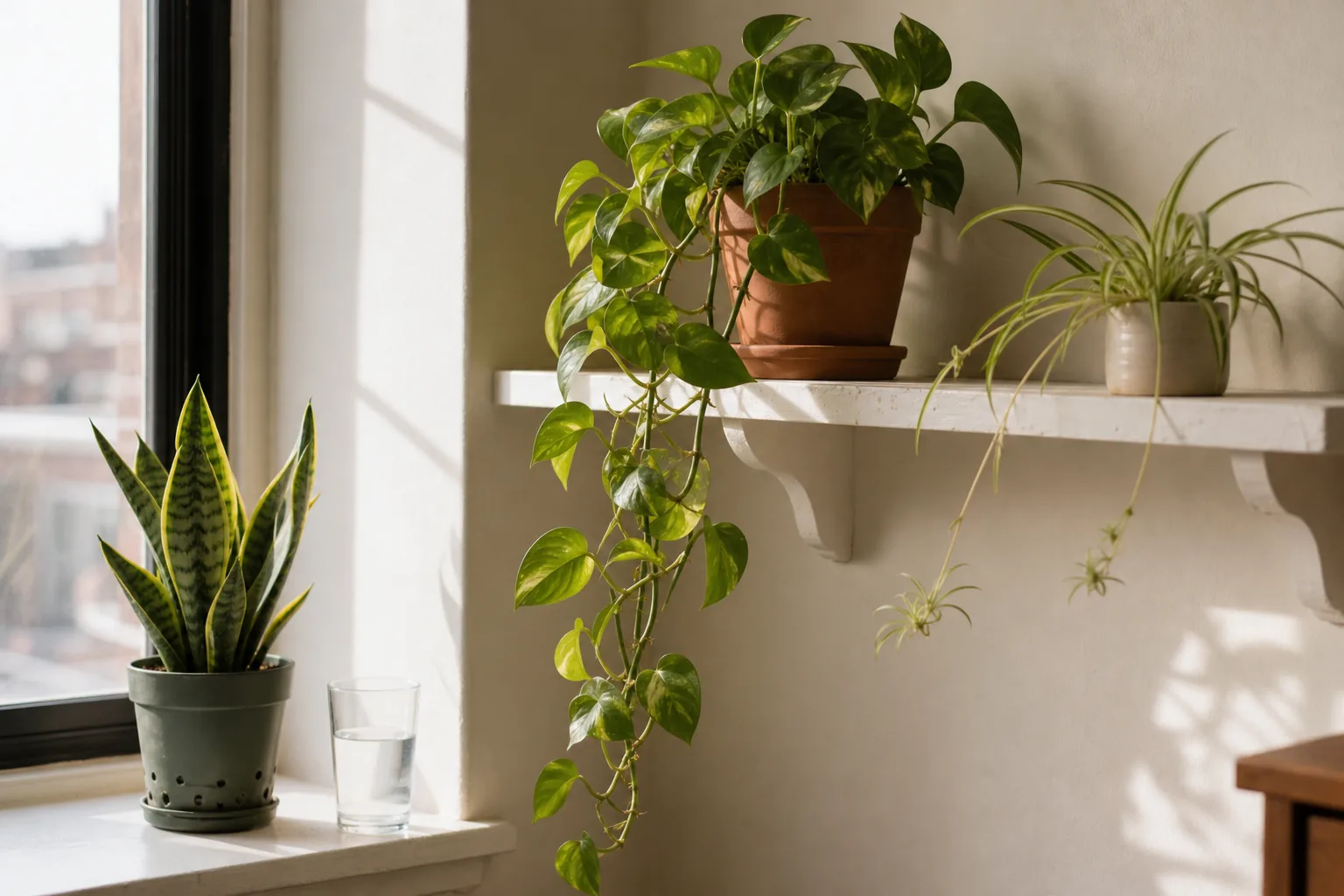
Pothos is the canonical beginner plant, and the pothos care guide covers it in detail. It tolerates dry-down, signals when it is thirsty, and recovers quickly from a missed watering. Its failure mode is sustained overwatering and cold drafts near a winter window.
Snake plant is widely sold as unkillable and is a frequent subject of misleading marketing. The snake plant care guide explains what “low light tolerance” actually means: the plant tolerates it but barely grows, and its main risk indoors is rhizome rot when the soil stays wet.
ZZ plant tolerates long dry spells because its rhizomes store water. The ZZ plant care guide sets out the overwatering trap clearly — wet soil is the one thing this plant does not forgive.
Spider plant gives fast visual feedback: leaf tips brown when something is off, and the plantlets on long stems are a useful early sign of a happy plant. The spider plant care guide covers its preference for bright indirect light over the deep-shade corners most owners try first.
Heartleaf philodendron travels well on a shelf or in a hanging pot and is a master gardener program pick as a first plant. The heartleaf philodendron care guide covers placement and watering cues, and notes that variegated cultivars need more light than the all-green form.
Chinese evergreen is among the more shade-tolerant species in this shortlist and is often the better pick for a genuinely dim corner. The Chinese evergreen care guide is honest about its light floor and the dry-down between waterings it still requires.
A small succulent at a sunny windowsill is beginner-friendly only at a south- or west-facing window with direct sun. The indoor succulent care guide explains why a succulent on a dim desk etiolates and why most “easy succulent” failures are actually light failures.
Matching the plant to your actual room
Forgiveness is conditional on light. Eastern- and southern-exposure windows are the brightest typical indoor placements — University of Georgia and Cornell Cooperative Extension both note that — and a windowless room sits outside the beginner-friendly range. The right move is to read the room before you read the list. The guide to choosing a houseplant for your room and the guide to reading natural light lay out a simple observation habit: which direction does the window face, can you read a book there during the day, and how does the light change across seasons.
A bright indirect shelf — a window that gets a few hours of direct sun, or strong indirect light all day — fits pothos, philodendron, or spider plant. A dim apartment room with a north-facing window fits Chinese evergreen or ZZ, with the understanding that both will grow slowly. A sunny sill fits succulents, with the caveat that they need a faster-draining mix than the leafy species. The guide to choosing a potting mix walks through why drainage drives most overwatering outcomes.
What to do in the first two weeks
New plants need a quiet first two weeks. Acclimating a new houseplant in place — without repotting, without fertilizer, without moving it around — is the single habit that protects the first month. Skip the repot until you have watched the plant settle into your room. Skip fertilizer entirely until you see active new growth, which for most species means a few weeks at the soonest. Check soil moisture by weight or by finger before watering — a plant in a fresh nursery mix is usually wetter than the buyer expects.
Inspect the plant for pests before you place it near your other plants. The guide to inspecting and isolating a new houseplant covers a simple first-week check under leaves and along stems that keeps an early infestation from spreading. Quarantine is not about paranoia; it is a habit that protects the plants you already have.
Acclimation is the explanation for most early “beginner failures.” A leaf or two yellowing or dropping within the first two weeks is normal adjustment, not a verdict. Move the plant to its spot, leave it there, and resist the urge to “fix” problems that have not yet declared themselves.
Plants often sold to beginners that are not actually beginner-friendly
Some species are marketed to beginners because they photograph well, not because they forgive mistakes. Fiddle leaf fig drops leaves after a move, a draft, or an inconsistent week of watering, and rarely recovers quickly enough for a new owner to learn from. Calathea and prayer plant need steady humidity and filtered or distilled water; they collapse in dry indoor air and show crisping edges within days. A succulent on a desk away from a sunny window etiolates quickly and quietly.
The honest take is that none of these is “easy” in the same sense as pothos or ZZ. They are real plants with real needs — just not needs a beginner can meet on the first try. If you still want one, the species guides elsewhere on the site cover what each actually requires, so you can decide with eyes open rather than trust a marketing headline.
A realistic six-month beginner plan
Most beginner collections fail because the owner took on too many plants at once. A short, honest plan looks like this: start with two plants in the same room, since conditions are easier to compare and your watering muscle memory builds around one set of conditions, not five. Use a simple weekly houseplant routine of about ten or fifteen minutes — enough to feel the soil, rotate the pots, and look under leaves. Revisit placement after a month based on what the plants actually do, not on what they were supposed to do. Add a third plant only when the first two have stayed steady through a full season change.
That rhythm gives you room to learn without losing the plant, and gives each plant a fair trial in conditions you have actually observed rather than imagined.
When a beginner problem is not a beginner problem
Some problems are outside the scope of a beginner guide. Sudden collapse across multiple plants at once, suspected pesticide exposure, recurring pest issues after two or three treatments, or an unlabeled plant you cannot identify — these are situations where the right move is to talk to a local nursery, a master gardener extension line, or a knowledgeable friend who can actually see the plant. Houseplant Supplies is not a remote diagnosis service; for problems that look serious or unusual, a local set of eyes is more useful than another web page.
If a beginner plant dies despite your best reading of the room and the soil, that is not a failure of the species or of you. It is information. Many beginners lose a plant or two along the way. The goal of a forgiving shortlist is to make sure the second plant survives — and the third, and the fourth — while you are still learning.
Sources
- Easy low-maintenance houseplants — Iowa State University Extension
- Exciting houseplant selections for beginners — Clemson University HGIC
- Tips for growing houseplants in Maine — University of Maine Cooperative Extension
- My favorite houseplant for beginners — Master Gardeners of Northern Virginia
- Growing indoor plants with success — University of Georgia CAES