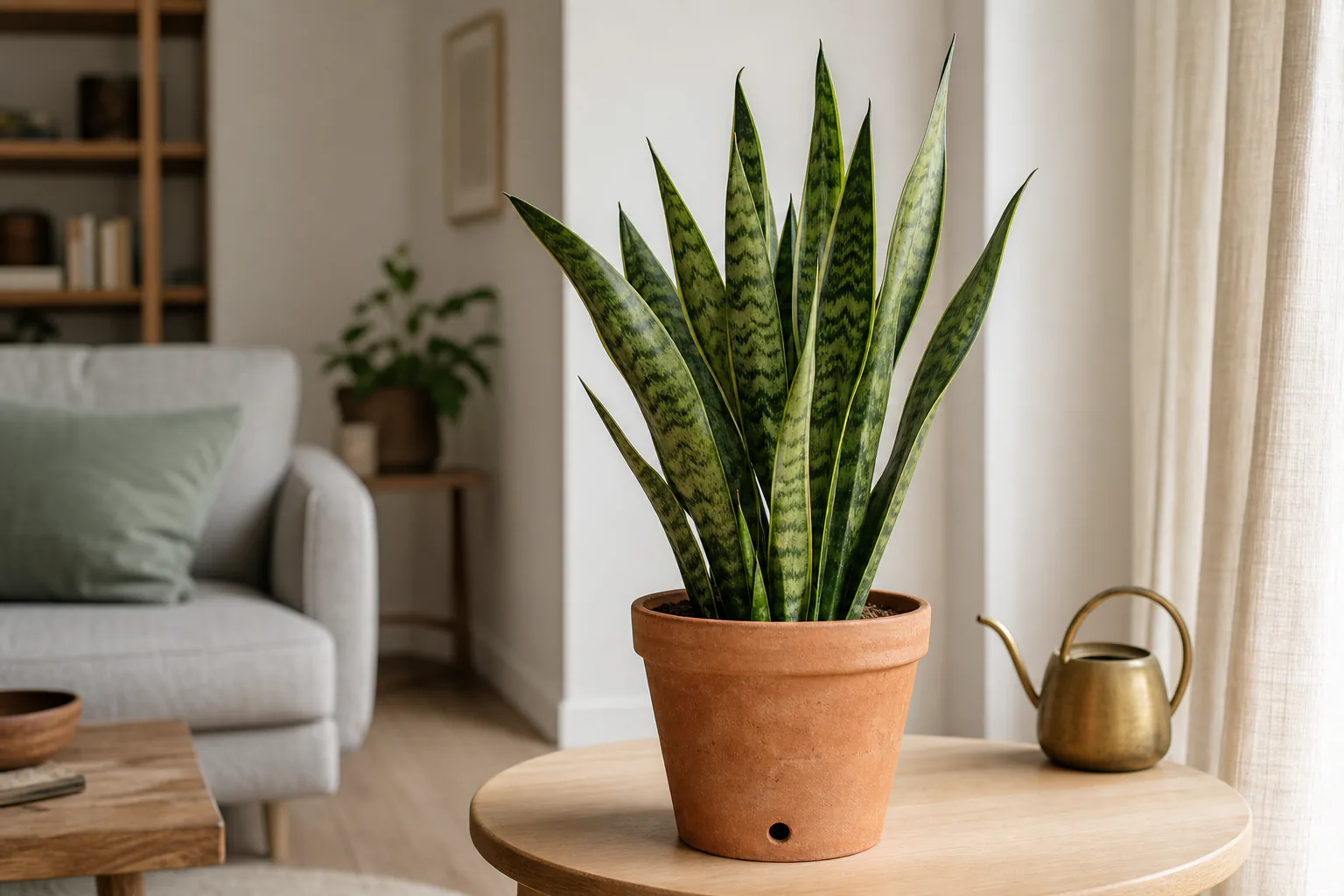
Plant care
Snake plant care in a real room: what 'low light tolerance' actually means
· Updated
The snake plant (Dracaena trifasciata, still sold under the older name Sansevieria trifasciata in many places) has a reputation for being unkillable. It is often described as the plant you can put in a dark corner and forget. There is some truth to that, but only part of it. The honest version is that a snake plant tolerates low light better than most houseplants, while still doing most of its actual growing in a brighter spot. The trick to keeping one looking decent is understanding that its tolerance and its needs are not the same thing.
What ‘low light tolerance’ actually means for a snake plant
University extension services and botanical gardens consistently describe a snake plant as a plant that thrives in bright, indirect light, and that tolerates low light rather than preferring it. Penn State Extension calls it a forgiving, low-maintenance houseplant but still notes it does best in bright indirect light. Clemson University’s home and garden information center says it can tolerate low light settings but will grow more slowly in that environment. The Missouri Botanical Garden describes it as preferring warm, bright locations while tolerating some shade.
The difference between thriving and tolerating is the difference between a plant that produces new leaves over the course of a year and a plant that simply continues to hold the leaves it already has. Both are alive. Neither is broken. But if you were sold a snake plant on the promise that it would grow in a windowless hallway, the more accurate expectation is that it will probably survive there for a long time without doing much of anything.
The light and watering trade-off you cannot avoid
The reason this matters for watering is simple: the same plant uses water at very different rates depending on how much light it gets.
In a bright, indirect spot near a window, the plant is actively photosynthesizing. It pulls water from the soil, the leaves stay firm, and the pot dries out on a predictable cadence. A normal “water when the topsoil is dry” routine is safe in that spot.
In a dim corner, the plant slows down. It uses water more slowly, the soil stays damp for longer, and the same routine begins to keep the roots wet for too long. Because a snake plant is a succulent, storing water in thick leaves and underground rhizomes, it is far more sensitive to sitting in wet soil than to drying out a bit between drinks. The combination of low light plus a generous watering schedule is the single most common reason these plants decline.
This trade-off is not a flaw of the plant. It is just the basic physics of how much water a slow-growing plant actually needs.
Where a snake plant does well in a real room (and where it slowly declines)
NC State’s plant toolbox gives a concrete range: a snake plant can handle 2 to 6 hours of direct sun a day, with the rest of the day in lower light, and it will still tolerate very low light beyond that. Missouri Botanical Garden and the New York Botanical Garden both add the caveat to protect the plant from harsh afternoon sun, which can scorch the leaves.
A practical indoor translation:
- A spot a few feet from an east-facing window, or near a south- or west-facing window with a sheer curtain, is usually where a snake plant looks its best. Leaves stay upright, markings stay vivid, and you can expect new growth over the year.
- A spot 6 to 10 feet back from a bright window, or in a room with one smaller window, is fine for a snake plant. Growth will be slower than in the bright spot, but the plant will hold its shape and stay healthy.
- A spot deep in a room with no direct sun, or in a hallway lit only by lamps, is where the plant tolerates rather than thrives. Expect slow or no new growth, and be especially careful with watering here.
If you are not sure where your spot falls, how to read the natural light in your room walks through a simple shadow test you can do in a few seconds.
How to tell when a snake plant actually needs water
Forget the “every two weeks” or “once a month” rules. They are not wrong, exactly, but they ignore the three variables that actually drive how often a given plant needs water in a given room: light, pot size, and soil mix. A small snake plant in a bright window and a large snake plant in a dim corner should not be on the same schedule.
A better routine is to check three things:
- Pot weight. Lift the pot just after watering and remember how heavy it feels. Check it again a week later. A pot that needs water feels noticeably lighter.
- Topsoil and finger depth. Stick a finger an inch or two into the soil. If the top is dry and the soil below is just barely damp, it is time to water. If the soil still feels cool and moist two knuckles down, wait a few more days.
- Leaf condition. Leaves that look slightly wrinkled, or that have lengthwise grooves along the surface, are using their stored water. Firm, smooth, upright leaves mean the plant is well-hydrated.
In a dim spot or in winter, the gap between “needs water” and “does not need water” can stretch to many weeks. In a bright spot during the growing season, it can be days rather than weeks. The only reliable answer is the pot-weight and topsoil check.
Why slow or no growth is usually normal, not a problem
A reader who buys a snake plant and watches it for three months without seeing a single new leaf often assumes something is wrong. Usually, nothing is wrong. Snake plants are simply slow growers, especially in low light, and they tend to push out new leaves in pulses rather than on a steady schedule.
The honest expectation is:
- In a bright, indirect spot, a healthy snake plant may produce a few new leaves over a year, often in spring or early summer.
- In a dim corner, the same plant may produce no visible new leaves for a year or longer, and still be perfectly healthy.
If the leaves are firm, the markings are clear, and there is no yellowing at the base, the plant is doing what the extension sources predict it will do. Fertilizer will not fix the underlying light issue and can add to salt buildup in soil that is not drying out between waterings. Patience is usually the correct response.
What overwatering in low light looks like on the plant itself
This is the failure mode worth learning to recognize, because it is the one most likely to catch you off guard in a snake plant placed in a dim corner.
Signs that the soil is staying wet too long:
- Yellowing at the base of the leaves, where they meet the soil. This is the most common early symptom.
- Soft or mushy leaves, especially the outer ones, rather than firm upright ones.
- A pot that still feels heavy days after watering.
- A sour or stale smell from the soil, which suggests the rhizomes or roots are starting to rot.
Signs that the plant is genuinely thirsty, which is rarer in low light:
- Wrinkled, slightly shriveled leaves, sometimes with lengthwise grooves.
- A pot that feels unusually light.
- Soil that is bone-dry all the way through, not just on the surface.
The two situations look different on the plant and in the pot, and they call for opposite responses. Yellowing at the base on a plant in a dim corner almost always means stop watering and let it dry out, not water more. If the whole root mass and rhizomes have gone soft and smelly, the plant is unlikely to recover and a local nursery can help confirm what you are seeing.
Two choices make overwatering in low light much less likely: a free-draining mix (a cactus and succulent blend, or regular potting soil amended with perlite or coarse sand) and a pot with a drainage hole. Both are part of the watering routine, not separate from it.
A simple, honest care routine for a snake plant
If you want a single page you can keep coming back to, here is the shortest version that holds up:
- Light. A few feet from a bright window is best. A few hours of direct sun, especially morning sun, is fine and will encourage new growth. Deep interior corners work for survival but not for growth, and they require extra care with watering.
- Soil and pot. Use a sharply draining mix and a pot with drainage. This is the easiest single thing you can do to prevent the most common problem.
- Watering. Check pot weight and the top couple of inches of soil. Water thoroughly when the pot feels light and the soil is dry down to your finger, then let it drain. In low light or in winter, the gap between waterings may stretch to many weeks; in bright light during the growing season, it may shrink to days rather than weeks. The pot and the soil are the source of truth, not a calendar.
- Temperature. Keep the plant in a normal indoor range, away from cold drafts from windows in winter. It is commonly suggested to keep the plant above roughly 10 °C (50 °F), and away from cold drafts; specific thresholds vary slightly by source. The safer hedge is simply to keep it in the part of the room where you are comfortable.
- Pets and children. Snake plants are considered toxic if ingested because the leaves contain saponins. If you have cats, dogs, or small children who chew on plants, place it out of reach and contact your veterinarian or a pet poison-control line if any part of the plant is eaten.
- Repotting. Only when the pot is crowded with rhizomes and the plant is pushing itself up or cracking the container. Snake plants prefer being a little tight in their pots.
A snake plant kept in a bright spot, in a free-draining mix, watered based on what the pot and the leaves are telling you, will quietly do its job for years. The “plant it in a dark corner and forget it” version works for survival, but it leaves most of what makes the plant interesting on the table.
Sources
- Penn State Extension: Snake plant, a forgiving, low-maintenance houseplant
- Clemson HGIC: Exciting houseplant selections for beginners
- Missouri Botanical Garden: Dracaena trifasciata plant finder
- NC State University: Dracaena trifasciata plant toolbox
- New York Botanical Garden LibGuides: Snake plant (Dracaena)
- University of Minnesota Extension: Lighting for indoor plants and starting seeds