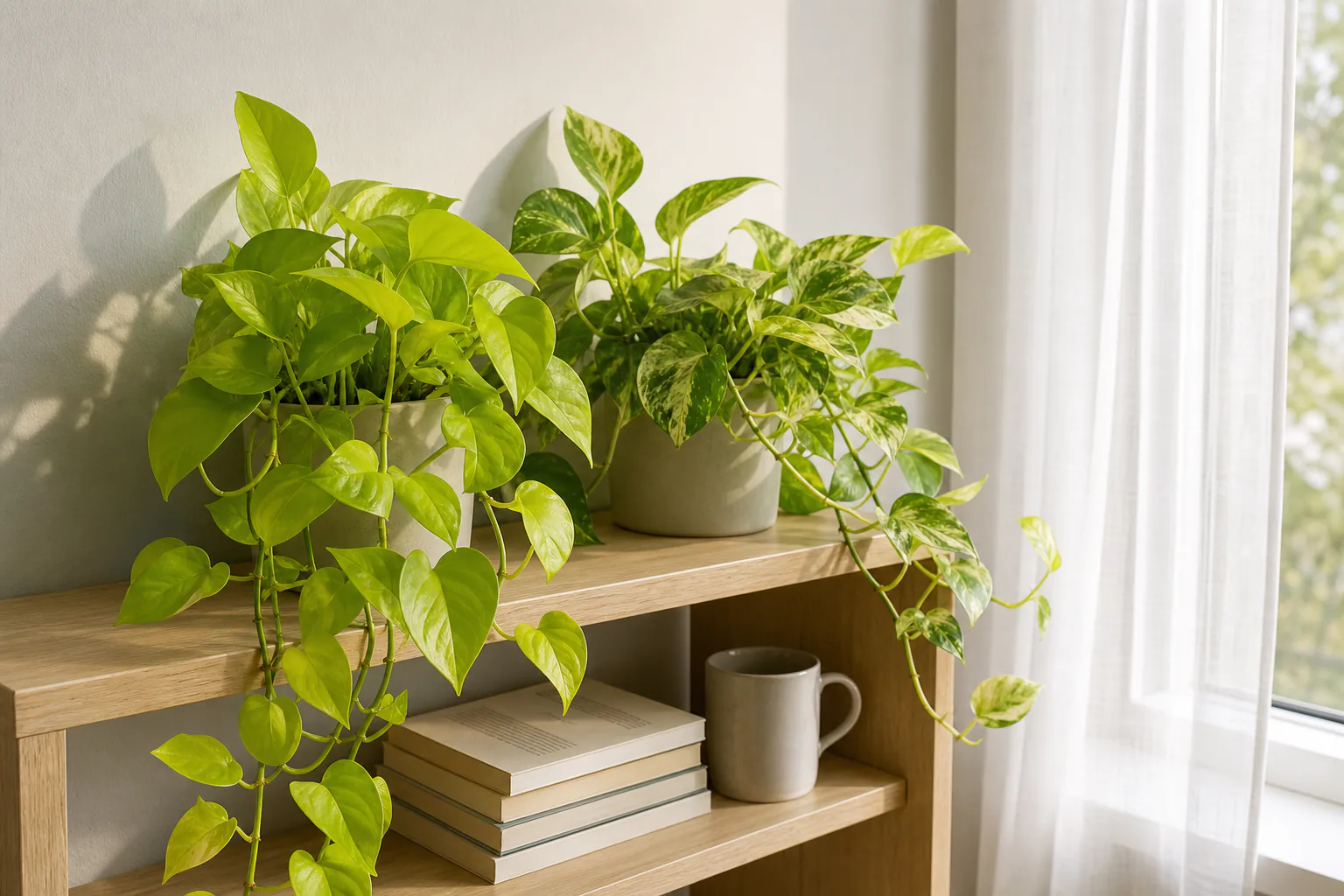
Plant care
Pothos care: how to read your room, water by feel, and tell surviving from thriving
· Updated
Pothos is one of those plants that gets called “easy” so often that owners stop noticing what it is actually doing. A pothos that is merely surviving looks a lot like a pothos that is thriving, until you learn to read the leaves, the spacing between them, and the mix in the pot.
The short version: a pothos (Epipremnum aureum) tolerates a wide range of indoor conditions, but it grows best in bright, indirect light, in a pot that drains freely, watered when the top inch or two of mix has dried down. The simplest way to judge your own setup is to watch new leaf size, internode spacing, and variegation over a few weeks rather than to follow a fixed schedule.
What “easy plant” actually means for a pothos
University extension services describe pothos in two layers. The first layer is tolerance. Penn State Extension notes that pothos is tolerant of a range of indoor conditions, and Clemson HGIC says pothos “will tolerate lower lighting conditions.” The second layer is what it actually prefers. Wisconsin Horticulture says pothos “does best in filtered light, with high humidity, and temperatures between 70 and 90°F, but pothos will survive a wide range of environmental conditions.”
That gap between “tolerates” and “does best” is the most useful thing to know about pothos. A pothos can stay green for years in a dim corner and look fine at a glance. The same plant, moved a few feet closer to a bright window, will often start putting out larger leaves with shorter gaps between them within a few weeks.
Where pothos grows in the wild, and why that matters indoors
Pothos is a climbing aroid, commonly described as native to islands of the western Pacific, where it scrambles up tree trunks toward filtered canopy light. Indoors, that climbing habit shows up as aerial roots: small, brown, woody nubs along the vine that the plant uses to grip surfaces. Aerial roots are not a sign of stress on their own. They are a sign of a healthy plant doing what pothos does in nature.
The forest-floor origin also explains two practical indoor habits. Pothos prefers its root zone to dry slightly between waterings rather than stay evenly wet, and it does not want direct sun on its leaves, which can scorch them quickly. Both behaviors make more sense once you know the plant evolved under a leafy ceiling rather than in an open field.
Reading the light in your pothos’s spot (with the shadow test)
The clearest way to set a pothos up well is to do the shadow test at the spot where the plant actually sits, at the time of day it normally receives light. Hold your hand a few inches above a piece of paper or the floor. A soft, faint shadow with no clear edges reads as low light. A defined but not harsh shadow reads as medium or bright indirect. A sharp shadow with bright, contrasty edges usually means direct sun, which a pothos will not thank you for.
Pothos prefers moderate-to-bright, indirect light. Penn State Extension describes its range as “moderate to bright light,” and Clemson HGIC says pothos “prefer bright, indirect light.” Our guide to how to read the natural light in your room before you place a houseplant goes deeper into the shadow test and light categories if you want the full framework.
A north-facing window, a spot set back from an east- or west-facing window, or a few feet from a south-facing window behind a sheer curtain all count as moderate-to-bright, indirect for most homes. University of Minnesota Extension frames “low light” as roughly the kind of light you would find in a north window or a fairly dark corner, which is a useful anchor for what pothos is actually tolerating rather than preferring.
Watering pothos by dry-down, not by calendar
The most common way to over-care for a pothos is to water it on a fixed schedule. Pothos is prone to root rot if its mix stays soggy, and the time it takes to dry down depends on pot size, pot material, the mix you used, the light it sits in, and the season. A schedule that works in March under a bright window can waterlog the same plant in December under a weaker one.
A better habit is to check before you water. Stick a finger, a wooden skewer, or a chopstick an inch or two into the mix. If it comes out cool and damp, wait. If it comes out dry and warm, water thoroughly until water runs from the drainage holes, then let the pot drain freely. Lift the pot before and after watering a few times to learn what a wet pot feels like versus a dry one in your specific setup. The weight difference is real and becomes obvious with practice.
Surface dryness is a poor signal on its own. The top of a peat- or coir-based mix often dries out a day or two before the root zone does, so watering as soon as the surface feels dry tends to keep the deeper roots too wet for too long.
Pot, mix, and drainage that match pothos roots
Pothos wants a pot with a drainage hole and a mix that holds some moisture but lets excess water escape. A standard indoor potting mix works for most people. If it holds water for a long time, mixing in a handful of perlite or orchid bark helps air reach the roots.
Terracotta pots dry faster than plastic or glazed ceramic. Small nursery pots dry faster than oversized decorative pots. If you keep your pothos inside a cachepot for looks, lift the inner pot after watering to make sure it is not sitting in runoff. A pothos left in standing water inside a decorative pot is a common setup linked to root rot in pothos care guides.
What healthy pothos growth looks like: leaves, internodes, and aerial roots
When a pothos is doing well, you can usually see it without measuring anything.
- New leaves come in at least as large as the most recent mature leaf on that vine.
- Internodes (the bare stem between leaves) stay short, so the vine looks full rather than leggy.
- Aerial roots appear as small brown nubs along the vine, especially near nodes.
- Vines push out new growth on a steady cadence during the active season, which for most homes means spring through early fall.
When a pothos is merely surviving, the picture looks different. New leaves are noticeably smaller than the previous ones. Internodes stretch, so the vine looks leggy with long bare sections between leaves. Aerial roots may still appear, but the overall pace slows or stalls.
If you are not sure which category your plant is in, pick three of the newest leaves and measure them. Check again in three to four weeks. The trend matters more than any single leaf.
Cultivar differences: golden, marble queen, N’Joy, neon, and others
Most pothos sold as “pothos” are cultivars of Epipremnum aureum, and they do not all behave the same way. Clemson HGIC notes that “lower light may cause variegated varieties to lose” their variegation, and that Marble Queen “requires more light than other varieties.” Marble Queen is often confused with Snow Queen; Marble Queen is the faster, greener of the two.
All-green forms, including the standard golden pothos and the solid chartreuse Neon, tolerate lower light more readily and are commonly described as faster-growing than variegated cultivars. Variegated cultivars such as Marble Queen, N’Joy, Pearls and Jade, and Manjula have less chlorophyll in their leaves and need more light to keep both their pattern and a steady growth pace.
If a variegated pothos starts pushing out mostly green new growth, that is usually a light response rather than a disease. Move it closer to a bright, indirect window and watch the next few leaves.
Common pothos problems and what to check first
Yellow leaves, leggy vines, and brown tips are the three most common pothos complaints, and they usually point to a small set of causes.
- Yellowing, especially on lower leaves with soft stems, usually means the mix is staying too wet. Check the drainage hole and the dry-down rhythm before changing anything else.
- Long gaps between small new leaves, with the plant otherwise looking healthy, usually means not enough light. Try a brighter spot before reaching for fertilizer.
- Brown, crispy leaf tips often have more than one possible cause: dry indoor air, mineral content in tap water (a widely cited but not extension-tested contributor), fertilizer residue, or a mix that swings from very dry to very wet. Try one change at a time, starting with the easiest, which is usually humidity and water quality.
Pests can show up on pothos the same way they show up on other houseplants. If you see webbing, sticky residue, or small moving specks on the leaves or stems, treat it as a separate question and follow any product label carefully. For anything that looks like a pest or disease problem you cannot identify, a local nursery or county extension office can take a look at a sample.
A quick note on safety: pothos contains calcium oxalate crystals and can cause oral irritation if chewed by pets or people. Keep the plant out of reach of curious animals and small children, and contact a qualified veterinarian, medical professional, or local poison-control resource if you are concerned about exposure. Do not try to treat mouth or stomach symptoms at home based on a guess.
A simple weekly and seasonal check-in for a pothos in a real room
A once-a-week look is usually enough.
- Glance at the newest leaf. Is it similar in size to the previous one, or smaller?
- Check the soil with a finger or skewer before deciding whether to water.
- Notice the spot. Is the light the same as last month, or has a tree outside leafed out and changed it?
- Look at the underside of a leaf or two for anything unusual, especially in dry winter indoor air.
In winter, growth usually slows. The plant will dry out more slowly because the light is lower and the air is cooler. Avoid leaving a pothos in a window where overnight temperatures drop below about 50°F, which can happen on older, single-pane glass in cold snaps. That is the time to lengthen the gap between waterings rather than to keep the same rhythm all year.
When to repot, prune, or leave a pothos alone
Repot when the root ball fills the pot and water runs straight through without being absorbed, or when roots circle the drainage hole. Going up one pot size at a time is usually enough.
Pruning is optional. Cutting a long vine just above a node will often encourage the plant to branch from lower down. The cut pieces can be propagated in water, which is also how most pothos are shared between friends.
If your pothos is sitting in a moderate-to-bright, indirect spot, the mix is draining, and new leaves are holding their size, the best thing to do is often to leave it alone. Pothos responds more to a stable, well-chosen spot than to frequent changes.