Plant care
How to choose a potting mix for houseplants
· Updated
There is no single “best” potting mix for every houseplant. The right bag is the one whose ingredients match three observable conditions: how the plant handles sustained moisture around its roots, how fast water leaves the container, and how the room’s light, warmth, and humidity dry the medium. Read the ingredient list on the back of the bag, not just the marketing on the front, and match what you see to the plant in front of you.
Why “best potting soil for houseplants” is the wrong question
Search results for that phrase return a wall of brand rankings and DIY recipes, often written as if every houseplant grew in the same conditions. They do not. A pothos in a terracotta pot near a south window and a fern in a plastic pot in a dim bathroom are working with very different dry-down times, and a single recipe cannot do both jobs well.
Extension guidance from Clemson, Iowa State, and Illinois consistently frames the choice around the plant, the container, and the room rather than a universal ratio. Once you start there, the bag choice becomes a smaller, more repeatable decision you can run for any new plant you bring home.
Three conditions that should drive the choice
Before you look at bags, look at three things you can actually observe.
The plant’s moisture tolerance. Most houseplants fall into one of four loose groups based on their tolerance for sustained moisture around the roots: tropical foliage that prefers even moisture without staying soggy (pothos, philodendron, monstera, peperomia), succulents and arid plants that prefer the medium to dry out between waterings (cacti, succulents, snake plant, ZZ), epiphytes like most orchids whose roots need air more than they need water-holding material, and moisture-loving plants like ferns, calathea, and peace lily in many homes.
How water leaves the pot. A terracotta pot with a drainage hole dries fast. A nursery pot slipped into a cachepot with no airflow dries slowly. The same mix behaves differently in each.
How the room dries the medium. Bright, warm, dry rooms pull moisture out of any mix quickly. Cool, dim, humid rooms slow it down. If you have already worked through how to read the natural light in your room, you have most of what you need to estimate dry-down speed. Brighter light usually means faster drying, which shifts how well the same bag matches different plant groups; a mix that suits a moisture-loving plant in a dim room may dry out a succulent too quickly in a bright one.
What the label is actually telling you
Front-of-bag language is marketing. The ingredient list on the back is information.
Products labeled “potting mix” are typically soilless blends built from sphagnum peat moss, perlite, vermiculite, coconut coir, and sometimes compost or bark. Products labeled “potting soil” are more likely to also contain some mineral soil alongside similar amendments, according to UConn Extension and the USDA-NIFA affiliated Ask Extension service. As a general starting point drawn from extension framing, soilless blends tend to drain more reliably in containers than mixes containing mineral soil, which is why they are the usual recommendation for indoor use.
On the ingredient list, ingredients are typically listed in approximate order of amount, with the largest component first. You can use that order as a rough map.
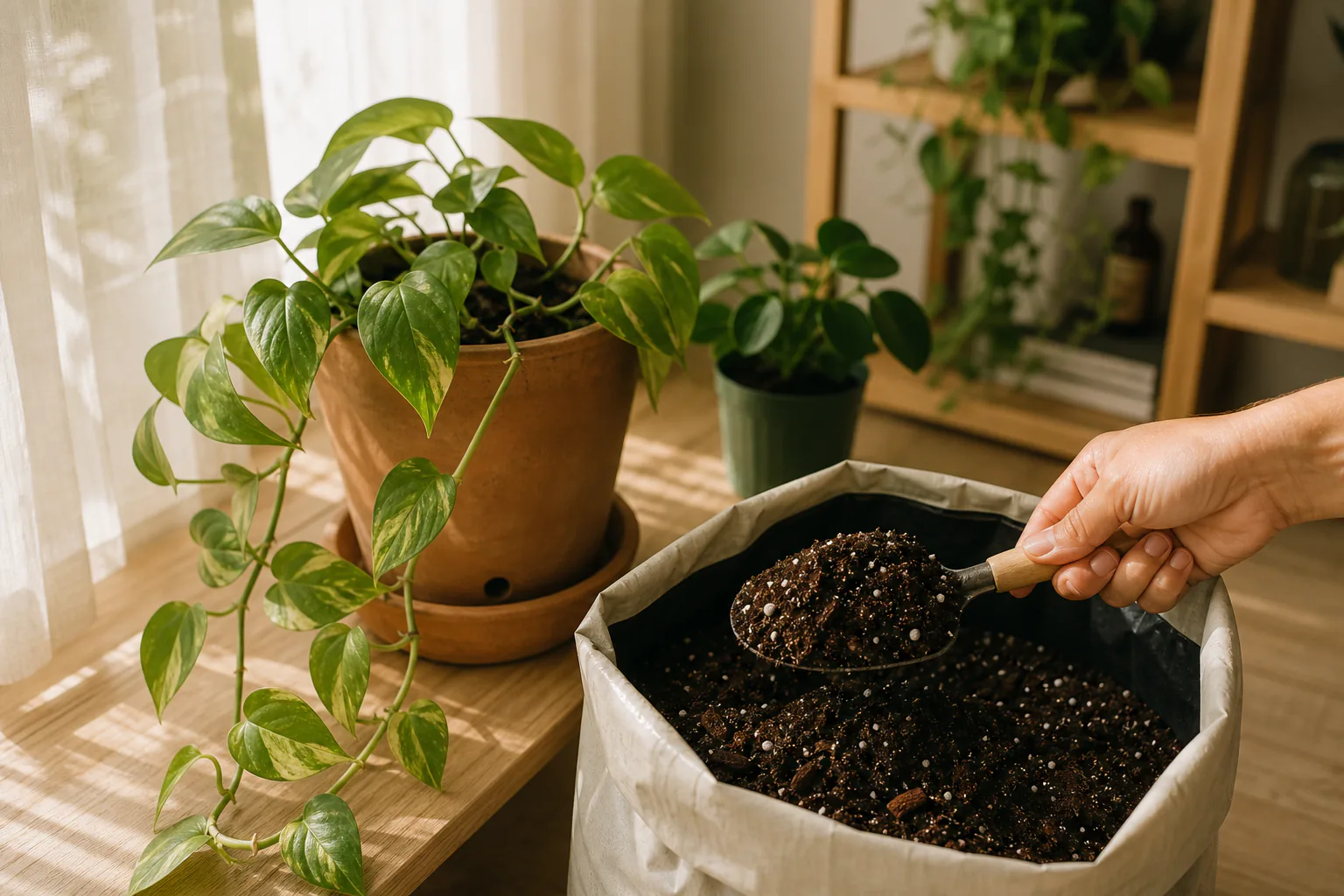
Drainage and aeration ingredients include perlite (the small white specks), pumice, chunky orchid bark, and coarse sand. Their job is to keep air in the root zone and let water pass through. Iowa State Extension and University of Washington plant propagation materials both describe perlite and vermiculite as lightweight minerals added to improve drainage and aeration, with perlite specifically creating tiny air tunnels.
Water-holding ingredients include peat moss, coco coir, bark fines, vermiculite, sphagnum, and compost. Their job is to hold moisture and nutrients around the roots. Iowa State groups peat, coir, bark, compost, soil, and vermiculite primarily as water-holding components.
Perlite versus vermiculite is one of the cleanest signals on a label. Perlite is mostly for drainage and aeration. Vermiculite also holds noticeably more water. A bag heavy in perlite will dry faster; a bag heavy in vermiculite will hold more water around the roots. Either can be appropriate, but they push the mix in opposite directions.
A useful phrase to recognize is “well-draining.” It is not an ingredient. It is a behavior of the mix, meaning water passes through quickly and air remains in the pore space. The ingredient list tells you whether a mix will actually behave that way; the front-of-bag word does not.
Matching a mix to plant groups
Tropical foliage
A standard indoor foliage mix is built around a peat or coco coir base with perlite or pumice for aeration and a small amount of bark for chunk. Clemson HGIC describes peat-lite mixes (peat moss with perlite or vermiculite) as a long-standing indoor foliage default and notes coco coir as a more recent alternative. Clemson offers one specific foliage suggestion of two parts peat, one part perlite, and one part coarse sand; Illinois Extension offers a general guideline of about one-third soil, one-third peat, and one-third perlite or vermiculite, with the caveat that some plants need a more specific mix. Treat both as starting points attributed to their source rather than as the only recipe.
Succulents and arid plants
These need fast drainage and lower water-holding content. A cactus and succulent mix typically has more coarse mineral material and less peat or coir than a foliage mix. If your home runs warm and dry, a cactus mix often works as-is. If your home runs cool or dim, even a cactus mix may stay wet longer than expected, and extension guidance varies on whether amending with extra perlite or pumice at home is the right move.
Orchids and epiphytes
Most orchids are not terrestrial plants. Their roots are built to encounter air, which is why standard potting mix is usually the wrong medium for them. Fairchild Tropical Botanic Garden’s orchid culture guidance emphasizes that orchid roots need air, and the typical result is a chunky, bark-based medium rather than a fine-textured mix. If the bag you are holding looks more like bark chips than soil, you are probably in the right aisle.
Moisture-loving plants
Ferns, calathea, and peace lily in many homes prefer a mix that holds more moisture and has less aggressive aeration. A higher proportion of peat or coir, with less perlite than a typical foliage mix, is closer to what these plants want. If the room is on the dry side, even this group often needs more frequent watering rather than a different bag.
What to be cautious of on the label and on the shelf
A few common things to watch for.
Outdoor garden soil or topsoil. Bags intended for outdoor beds are not built for the drainage and aeration that containers need, and they tend to compact in pots. They also bring outdoor pest pressure into the room.
Heavy mixes with no visible aeration component. If you open the bag and see only fine, dark material with no perlite, pumice, or bark, expect it to hold a lot of water and to compact over time.
“Feeds for X months” claims. These are manufacturer statements printed on the bag, usually tied to a slow-release fertilizer mixed in. Extension sources do not independently verify these durations, so treat the claim as information about what is already in the bag rather than a promise. Let the plant’s growth rather than the bag’s timeline guide further feeding decisions.
“Sterile,” “pathogen-free,” or “pest-free” claims. Treat these as label language unless a specific source backs them up. Most extension sources describe bagged mixes by ingredient function rather than by sterility guarantees.
How the pot and the room change the answer
Even the right bag can behave differently depending on what holds it.
A terracotta pot breathes through its walls and dries the medium faster than a glazed ceramic or plastic pot of the same size. A pot with no drainage hole, or a cachepot that holds standing water at the base, will keep the root zone wetter than the bag’s ingredient list suggests. If the pot cannot drain, even a fast-draining mix will sit wet, and a more moisture-tolerant plant group may be the safer choice.
Room conditions matter too. A bright window, a heating vent, or a low-humidity winter room all push the same mix toward faster drying. A north-facing room, a bathroom with regular shower steam, or a cool basement pushes the same mix toward slower drying. The bag does not know which room it is in; you do.
A simple test after you bring the bag home
The label is a guess. A short observation confirms it.
Open the bag and feel the texture. You should be able to see or feel a balance between fine material (peat, coir, compost) and coarse material (perlite, pumice, bark). If the texture matches the plant group you are potting, you are starting in the right place.
Water a small amount through a sample in any small pot or cup and time how long it takes for water to begin draining and for the surface to stop glistening. For most tropical foliage mixes, you should see water move through within a few seconds and the surface should look damp but not pooled.
Over the next week, lift the dry pot before watering and notice how much lighter it feels than right after watering. The timing between watering and that “light pot” moment is your real dry-down interval for that mix, in that pot, in that room. Compare that interval to what your plant prefers, and adjust either your watering frequency or, if the gap is large, the mix.
When to switch mixes or refresh the medium
Organic components break down over time. Fine material compacts, drainage slows, and the mix holds more water than it did when fresh. Tropical foliage plants generally benefit from being repotted every few years to refresh the mix and give roots more room, according to Missouri Botanical Garden houseplant guidance.
If the surface stays wet for many days, the medium smells sour, or water runs straight through without the pot feeling like it absorbed anything, those are signs the mix has lost structure and is ready to be refreshed.
A short recap
- Flip the bag and read the ingredient order rather than the front label.
- Group your plant as tropical foliage, succulent or arid, epiphyte, or moisture-loving.
- Check whether the bag’s drainage and water-holding ingredients match that group.
- Adjust for your pot and room rather than trusting any one recipe.
- Run a short observation test after you bring the bag home.
That is enough to make the bag choice a small decision you can re-run for every plant you bring into the room.
Sources
- Clemson HGIC — Indoor Plants – Soil Mixes
- Iowa State University Extension — Potting Media: Components and Handling
- UConn Extension — Potting Media
- Illinois Extension — Houseplants: Get Started
- University of Washington — Plant Growth Media and Fertilizer in the Nursery
- Fairchild Tropical Botanic Garden — Orchids 101: Basic Orchid Culture
- Missouri Botanical Garden — Houseplant Help
- Ask Extension — Soil, Potting Soil and Gardening Mix (#895418)