Plant care
Chinese evergreen care for medium and lower-light rooms
· Updated
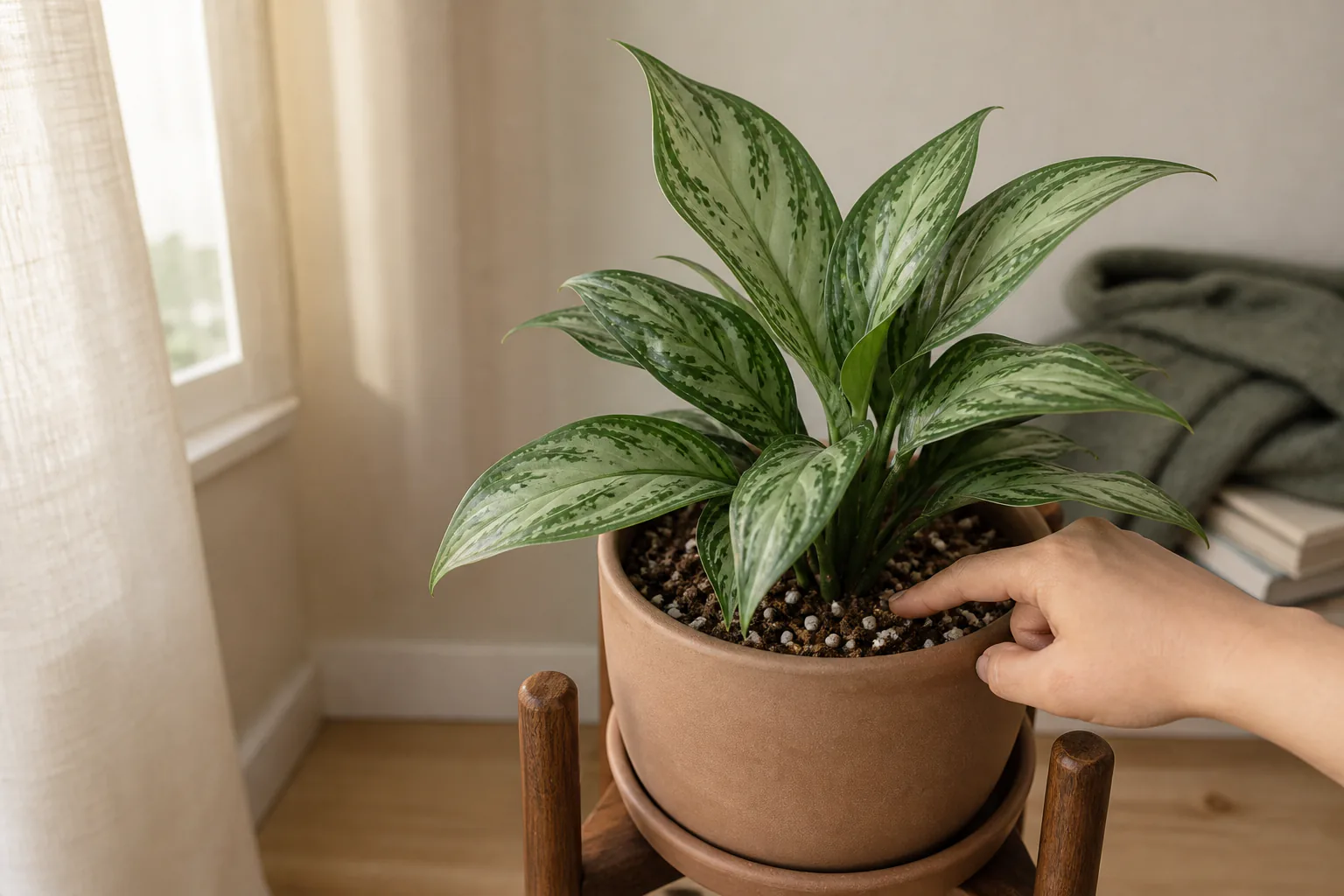
A Chinese evergreen (Aglaonema) is one of the more forgiving foliage plants for a room that is not a bright sunny window, but it is not a “dark corner” plant. It tolerates medium and the brighter end of lower indirect light, and it grows slowly rather than at the pace you might see in a greenhouse. If you place it where the leaves keep their natural color, water only after the top inch or two of mix has dried, and grow it in a well-drained mix in a pot with drainage, it can hold steady in an apartment or office for years.
What follows is a room-grounded approach to Chinese evergreen care, anchored in what you can actually see in your space. If you have not already classified the light in the spot you have in mind, our guide on how to read the natural light in your room pairs well with this one, since the placement rules below reuse the same vocabulary.
What “medium and lower light” actually means for a Chinese evergreen
Clemson University’s Home & Garden Information Center places Chinese evergreen in “low to moderate, indirect light.” The New York Botanical Garden’s plant-care FAQ recommends “medium light” and warns against direct sun. NC State Extension’s Plant Toolbox describes the plant as doing well in “diffuse sun or good indirect light.”
Translated into a real room, that means an open spot several feet back from an unobstructed east- or north-facing window, or close to a window that gets filtered rather than direct light. A few hours of indirect morning light through an east-facing window are usually fine — what to avoid is direct sun on the leaves themselves. A south-facing window with direct afternoon sun is not — the foliage will bleach and scorch with repeated exposure.
Two caveats worth holding onto. First, “low-light tolerant” is not “no-light tolerant.” Chinese evergreens still need some indirect daylight. In genuinely dim spots, growth slows to a crawl and variegated cultivars (silver, pink, or red-tinged leaves) often lose some of their pattern. Second, University of Florida / IFAS Extension notes that more variegated forms do better in the medium-to-brighter end of the range if you want to preserve their markings.
Where to place it in a real room (and where not to)
Useful spots in most homes and offices:
- Three to six feet from an east-facing window with a sheer curtain, blinds, or a tree outside filtering the light.
- A north-facing window where the plant sits a little back from the glass, so the leaves do not press against cold panes in winter.
- A reading nook or interior wall that still gets bounced light from a brighter room nearby.
- A bathroom with a frosted window, if the heating and humidity are ordinary.
Places to avoid:
- Right against a cold window in winter. The leaf closest to the glass can chill below 55–60 °F and show damage.
- Above or beside a heating or cooling vent. Dry drafts stress the foliage even when the soil moisture is fine.
- A spot that gets direct afternoon sun through an unobstructed south- or west-facing window.
- A hallway or interior corner that never receives any daylight at all.
If the plant is sitting in a spot you suspect is too dim, the leaves will tell you over time. New growth comes in thinner, darker green, and stretched, and any silver or pink variegation fades. Move it closer to the window one step at a time rather than jumping it into a much brighter location.
Watering in lower light: why the mix dries slowly
The single most useful care rule for a Chinese evergreen in a dimmer room is the dry-down test. Clemson HGIC recommends keeping the mix moist but allowing the top one to two inches to dry before watering again. The Spruce puts it more simply: only water when the top inch of soil becomes dry, and remember that the plant “does not tolerate soggy soil and prefers to be on the dry side.”
In practice, that means inserting a finger one to two inches into the mix each time you think about watering. If it still feels cool and moist, wait. In a medium indirect light spot this typically translates to roughly every seven to ten days during active growth, but in a dim spot the same plant in the same pot can go two weeks or more between waterings. Proven Winners uses the 7–10 day interval as a starting point and explicitly notes it varies with light and humidity.
A few extra checks help. Lift the pot before you water, then again a few days later. A lighter pot is a drier pot, and the difference in weight builds a quick feel for the cycle. Water should run out the drainage hole each time you water. If it beads on top of the mix or runs straight down the inside of the rootball and out, the mix has pulled away from the pot edges and you should water slowly in two passes, or consider refreshing the mix.
Pot, drainage, and mix for a slower-growing plant
Aglaonema rewards two related habits: a chunky, well-drained mix and a pot with a drainage hole. Clemson HGIC specifies a commercial soilless mix amended for extra drainage; The Spruce calls for a well-draining potting mix in general.
An off-the-shelf indoor or tropical mix usually works. If it feels heavy and fine in the bag, mixing in a small amount of perlite, orchid bark, or pumice loosens it up. The goal is a mix that drains quickly, holds some air at the roots, and does not stay waterlogged for days in the dim corner of a room.
On the pot, the drainage hole matters more than the material. Terracotta breathes a little and helps in dim rooms where the mix dries slowly; plastic is fine if you adjust how often you check. A pot that is one to two inches wider than the current rootball is usually the right next size up. Going much larger fills with extra mix that stays wet longer than the roots can use it.
What healthy growth looks like — and what it doesn’t
In a decent spot, a Chinese evergreen holds its leaves upright or gently arching, keeps the natural variegation of its cultivar, and pushes out new leaves at the active growing points during the warm months. Inside a home, growth is slow, and that itself is not a sign of a problem. Plants in dim corners grow more slowly than plants in brighter spots; a long quiet stretch between new leaves is normal for this species indoors.
Signals that the spot or care is off:
- Thin, dark-green-only new leaves on long, leggy stems. Not enough light, over time.
- Yellowing on many leaves at once, especially lower leaves. Usually too much water, or a mix that has compacted and stays soggy.
- Limp, drooping leaves that do not recover after watering. Usually a watering mismatch, sometimes a chill.
- Brown, crispy leaf edges with the rest of the leaf otherwise healthy. Most often dry indoor air, especially in winter with heating running.
Reading the leaves: yellowing, drooping, and crisp edges
Yellow leaves are the most common concern readers raise. On a Chinese evergreen, the more frequent cause indoors is overwatering or a mix that has compacted and no longer drains, not underwatering. If yellowing is happening on multiple leaves at once, check the root zone first. Gently lift the rootball and look for dark, soft roots and a sour smell, which point to root rot from a mix that stays too wet.
Drooping leaves usually mean either the mix has dried past the point the roots can recover quickly, or it has stayed wet long enough that the roots have begun to fail. Lift the pot to feel its weight, and use the finger test in the top inch or two before adding water.
Crisp edges are nearly always about humidity rather than watering. Clemson HGIC notes that Chinese evergreens “grow well in an average house with low to moderate humidity,” and NC State adds they prefer higher humidity but tolerate drier air. If only the tips are browning and the rest of the leaf looks fine, the local air is likely drier than the plant prefers, especially in a heated room in winter. A pebble tray nearby or grouping the plant with other foliage can help; the plant does not require a humidifier to stay healthy.
Seasonal changes: winter slowdown and summer recovery
Chinese evergreens slow down in winter even when temperatures stay in their preferred range. Less light, shorter days, and cooler windowsills add up to a plant that uses less water and puts out little new growth. Proven Winners recommends reducing watering in the cooler months, and a flat few months of growth is not cause for alarm.
In summer, with warmer temperatures and longer days, watering picks up and new leaves should resume. This is the active season for light feeding if you choose to feed at all — a diluted indoor plant fertilizer at the low end of the label rate, applied only to a plant that is actively growing and in decent light. Skip feeding on a struggling or dimly lit plant, and skip feeding entirely in winter.
Repotting and refresh: when to leave the plant alone
Chinese evergreens do not need frequent repotting. A slow grower in a lower-light spot can stay in the same pot for two to three years without complaint. Move it up one pot size (one to two inches wider) when roots are circling the pot or growing out of the drainage holes, or when the mix has broken down so far that water runs straight through without being absorbed.
If a refresh is due but the plant is otherwise fine, a top-dressing of fresh mix and a gentle loosening of the outer roots, returned to the same pot, often does the job without the stress of a full repot.
Common pests to inspect for during routine care
Indoor foliage plants, Chinese evergreen included, are commonly visited by mealybugs (small white cottony tufts in the leaf joints), spider mites (fine webbing and a dusty look on the undersides of leaves), and scale (small brown bumps along stems or leaf undersides). The most reliable first step is regular inspection while you water: lift leaves, look at the stem joints and undersides, and check new growth.
If you spot something, isolate the plant from other houseplants so the issue does not spread, and follow the directions on any treatment product carefully. For anything beyond a light, localized find, a local nursery or extension office can help identify the pest and suggest appropriate next steps.
A short checklist before you set the pot down
- Light: the spot reads as medium to the brighter end of lower indirect light, with no direct sun on the leaves.
- Mix: a well-draining soilless mix in a pot with a drainage hole.
- Watering: only when the top one to two inches of mix feel dry to the touch.
- Temperature: roughly 65–80 °F, away from cold drafts and dry vents.
- Expectations: slow growth, steady leaves, less new growth in winter — that is the normal pattern.
A Chinese evergreen rewards observation more than effort. The more you watch how the leaves, the dry-down, and the light respond to the spot you chose, the easier it gets to keep this one looking good for years.
Sources
- Clemson University HGIC — Chinese Evergreen (Aglaonema) Care, Cultivation & Growing Guide
- NC State Extension Plant Toolbox — Aglaonema
- New York Botanical Garden — How do I care for my Chinese evergreen houseplant?
- Proven Winners — Indoor Chinese Evergreen Care Guide
- The Spruce — How to Grow & Care for Chinese Evergreen (Aglaonema)