Plant care
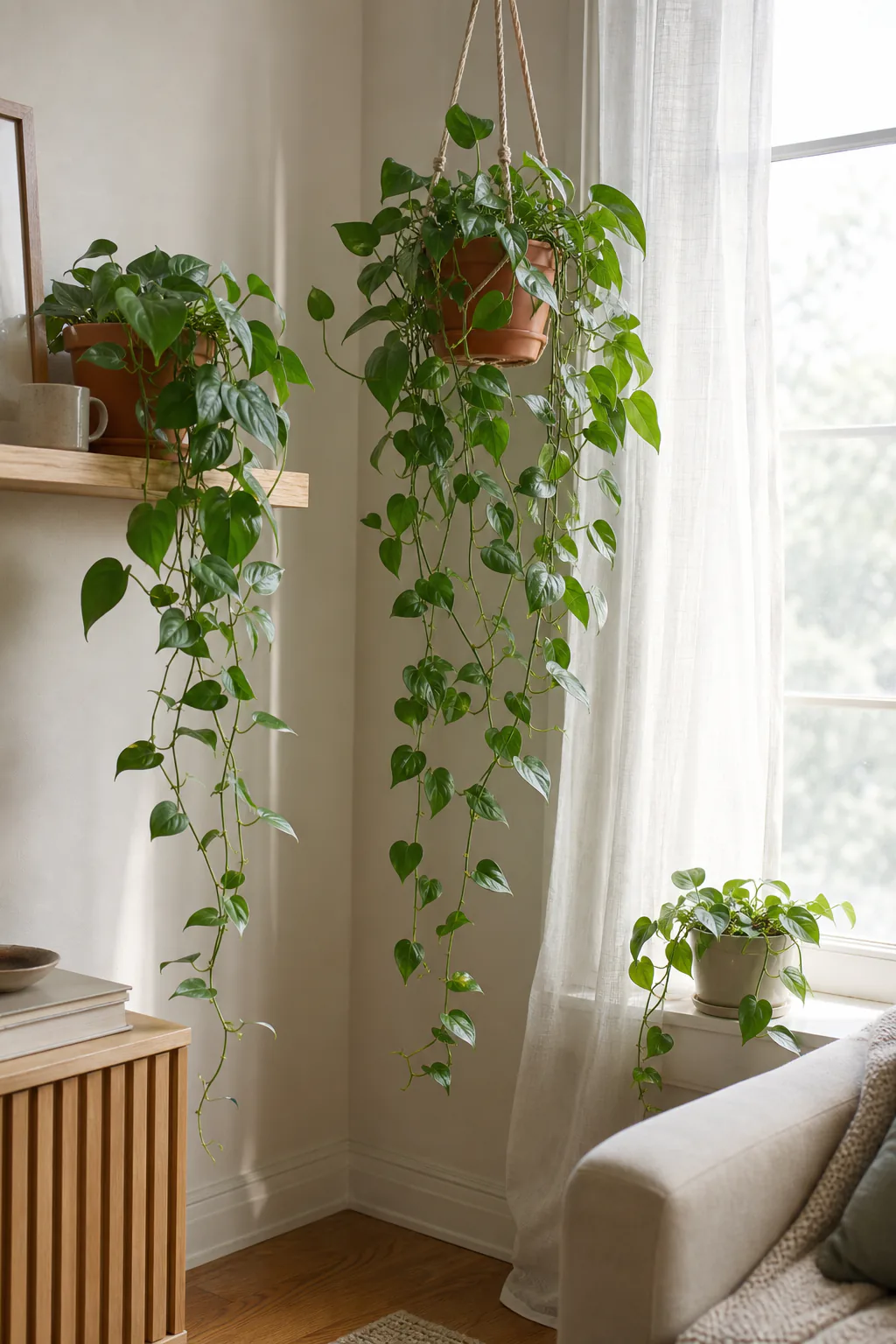
Heartleaf philodendron care on a shelf, in a hanging pot, or on a windowsill
· Updated
Heartleaf philodendron (Philodendron hederaceum) is a trailing houseplant that does best in medium to bright indirect light, in a loose well-draining mix, and on a watering rhythm you read from the pot rather than from a calendar. How it actually grows depends a lot on where you place it. A shelf, a hanging pot, and a windowsill each give the plant a different combination of light, dry-down speed, and airflow, and the plant will tell you which one suits it by the size and spacing of its leaves, the fullness of its crown, and how quickly the mix dries.
That is the short version. The longer version is below, written so you can read your own plant in your own room.
What a heartleaf philodendron is, and what it isn’t
Heartleaf philodendron is a trailing member of the Araceae family, native to Mexico, the Caribbean, Central America, and parts of South America. In the wild it climbs and trails under a leafy canopy, which is why indoor plants do well in filtered light rather than in direct sun.
A few quick clarifications:
- The plain green form is most common, but the same species is sold under cultivar names like ‘Brasil’ (green with chartreuse variegation), ‘Micans’ (velvety juvenile foliage), and ‘Lemon Lime’ (yellow-green tones). They are the same plant under different leaf coloration, and the basic care is the same.
- It is often confused with pothos (Epipremnum aureum). Extension services commonly group the two in the same factsheets, which tells you how often the mix-up happens. They are different genera with subtly different petioles and growth habits, and care is similar but not identical.
Shelves, hanging spots, and windows: how placement changes what you watch for
The same plant in three different spots is three different micro-environments. Rather than treat placement as decoration, treat it as a setting you can read.
A shelf a few feet from a window is often a textbook medium indirect light spot. The light arrives from one side, so the side of the plant facing the window tends to push out fuller, more closely spaced leaves, while the back of the pot thins. The pot usually sits in a stable temperature band and the mix dries at a moderate pace. Watch for one-sided growth and rotate the pot a quarter turn every couple of weeks to even it out.
A hanging pot near a window often reads as a brighter spot than the same shelf, because the foliage is exposed on more sides. The trade-off is that the pot is usually shallower and exposed to more air, so the top of the root ball dries faster than the sides and you may find yourself watering more often than a shelf neighbour. Stems trail evenly because light wraps around the pot, but the top of the canopy can still thin if the hanger is in a dim corner.
A windowsill delivers the strongest light of the three placements, which is sometimes good and sometimes not. Sills that face the strongest midday sun in your hemisphere can throw direct light onto leaves and scorch them, especially where a tree or building does not filter the window. In winter, the same glass can be cold enough to damage leaves that press against it. Use the sill if your window is east-facing or shaded by a tree, building, or sheer curtain, and watch both the leaves and the temperature of the glass.
Reading the light where you actually want to place it
The placement tells you roughly what kind of light the plant is getting, but it is worth confirming with a quick check. Hold your hand about a foot above where the leaves will be, with the window to one side. A sharp, well-defined shadow means bright direct light; a soft-edged but clearly visible shadow means bright indirect; a faint shadow means medium indirect; no real shadow means low light.
If the heartleaf philodendron is going to live there, you want at least a soft-edged shadow for most of the day. University extension sources converge on medium to bright indirect as the comfortable range, with a noted tolerance for lower light but reduced vigour there. In genuinely dim corners, leaves shrink, internodes lengthen, and stems stretch toward whatever light they can find. If you want a deeper read on light in your room, the Houseplant Supplies guide to reading natural light walks through the shadow test and the time-of-day variation in more detail.
Watering by feel, not by a calendar
There is no universal watering schedule for a heartleaf philodendron, because the dry-down depends on the pot, the mix, the light, and the season. The two cues that work across all three placements are:
- The top inch or first knuckle of mix is dry when you press a finger in.
- The pot feels noticeably lighter than it did right after you watered.
A drooping vine is not automatically a sign it needs water. In cool rooms vines can droop from cold; in warm rooms a sudden droop with a heavy pot often means the mix is staying wet too long. Lift the pot before you water.
In practice this means the hanging pot in the warm, bright spot dries out days before the deeper shelf pot in the same room. The plant is not inconsistent; the conditions are.
Potting mix, pot size, and drainage for a trailing philodendron
A loose, chunky, well-draining mix suits trailing aroids. The exact bag you buy matters less than the texture: water should run through the mix rather than pool on top, and air should be able to move through it after watering. Compacted or fine mixes hold too much water and starve the roots of oxygen, which is one of the more common failure modes for this plant.
Pot size should match the root mass. A nursery pot with a drainage hole, sized so there is roughly a finger-width of space between the root ball and the side, is plenty. The trailing vine will spill over the edge either way. A decorative cachepot without drainage changes the rhythm of watering substantially, because water that drains into the cachepot keeps the bottom of the root ball wet. If you use one, tip out any standing water after each watering.
Uneven growth, leggy stems, and a thinning crown
Most of the visible problems on a heartleaf philodendron are not diseases; they are responses to light and water. A few patterns worth recognising:
- Bare lower stems on a shelf, with leaves concentrated at the tips. Often a light issue: the back of the pot is too dim, or the plant has not been rotated.
- Long gaps between leaves on a hanging stem in a dim corner. Same cause: the spot is dimmer than the plant prefers, and it is stretching toward the light.
- Yellowing lower leaves while the rest of the plant looks fine. Often a watering issue, but could also be normal senescence as the plant sheds its oldest leaves.
- Brown, crispy leaf edges. Usually dry air or inconsistent watering rather than light.
- Soft, mushy stems near the soil. Usually prolonged overwatering, sometimes combined with a cold spot.
When the diagnosis is light, rotation and a brighter spot help more than fertiliser. When the diagnosis is water, the fix is reading the pot before you water rather than watering on a fixed day.
Pruning and propagating from the same stem
Pruning and propagation solve the same problem: a thinning crown. Snip a long stem just above a node, which is the little bump where a leaf meets the stem, and you will usually get a new branch from just below the cut. The piece you cut off can go in a glass of water until roots form at the node, then back into the same pot to fill a bare patch. Plain green cuttings root easily, and variegated cuttings keep their leaf pattern, though the variegation can fade or revert if the light is too low.
You do not need to be precious about it. Heartleaf philodendron tolerates a hard trim, and the cut ends tend to push out new growth within a few weeks in active season.
A short list of things worth watching for
A few general signs that something in the setup is off, not a checklist for diagnosis:
- Leaves shrinking on new growth. The spot is usually too dim.
- Leaves bleaching yellow or developing dry patches. The spot is probably too bright, or the leaves are catching direct sun.
- Yellowing lower leaves with a wet pot. Probably overwatering.
- Limp stems with a light, dry pot. Probably underwatering.
- Sudden leaf drop after a move. Often a stress response; give the plant a couple of weeks before reacting.
A short note on safety around pets and children
Heartleaf philodendron is a member of the Araceae family, and extension sources treat members of this family as toxic if ingested because of the calcium oxalate compounds they contain. Severity varies with the individual and with the amount, which is why a calm, general statement is more honest than a simple safe-or-unsafe verdict. If you share a home with curious pets or small children, your veterinarian or local poison-control centre is the right source for guidance specific to your situation.
Sources
- Missouri Botanical Garden — Plant Finder: Philodendron hederaceum. missouribotanicalgarden.org
- University of Florida / IFAS Gardening Solutions — Heartleaf Philodendron. gardeningsolutions.ifas.ufl.edu
- Clemson University HGIC — Philodendron, Pothos, Monstera. hgic.clemson.edu
- NC State Cooperative Extension — Plant Toolbox: Philodendron hederaceum. plants.ces.ncsu.edu
- SDSU Extension — Philodendron: Houseplant How-To. extension.sdstate.edu