Plant care
Overwatered or underwatered: how to tell before you change anything
· Updated
The short answer
Overwatered and underwatered houseplants can look almost identical from the leaves. Yellowing, wilting, drooping, and leaf drop all show up in both cases, which is why a single leaf symptom is not a reliable verdict. The honest answer lives lower down, in the soil, the pot, and the roots.
A low-disruption inspection runs in roughly this order: lift the pot to feel its weight, check the soil at one to two inches down, look at the pot and saucer to see whether water is sitting where roots can reach it, then read the leaves and stem as supporting evidence rather than the final word. Only inspect the roots directly if repotting was already on the table. The most common right next step is to wait and observe for several days before changing anything.
Why overwatered and underwatered houseplants can look almost the same
University of Maryland Extension notes that the primary symptom of excess moisture is wilting or yellowing of lower and inner leaves, and that overwatered plants may also show what look like drought symptoms, such as scorch and leaf drop. Rockledge Gardens puts it plainly: wilting is paradoxical, because overwatered plants often wilt much the same way underwatered plants do, with the difference showing up in texture (soft and limp versus dry and crispy) rather than in the wilting itself.
That overlap is the trap. If you water a soggy plant because it looks thirsty, the problem gets worse. If you stop watering a genuinely dry plant because the leaves look the same as an overwatered one, the problem also gets worse. The only honest way out is to look at what is happening below the surface before changing the routine.
Start with the pot: lift, feel, and notice the weight
Lifting the pot is the cheapest and least disruptive first check. Right after a thorough watering, the pot should feel noticeably heavy. Several days later, it should feel lighter as the mix dries. The difference becomes learnable for the same plant in the same pot, even though it is not a measurement.
A pot that still feels heavy days after watering is holding water. That does not by itself prove overwatering, but it raises the question of whether the pot is draining, whether the mix is staying too wet, and whether the plant is actually using the water. A pot that feels much lighter than you remember is drying out faster than expected, which can be a sign of underwatering, of a very bright or warm room, or of a mix that has broken down.
A few honest limits: this is a comparison, not a number, and it is weakest for very small pots, very light plastic pots, and any plant recently moved to a new mix. Use it as one input, not as the answer.
Check soil moisture at depth, not just the surface
The surface of a peat- or coir-based potting mix is a poor witness. Both ingredients can shrink away from the pot wall as they dry, and dry peat in particular can develop a crust that resists re-wetting. A dry top layer can hide a still-moist root zone, and a freshly watered top can hide dry soil below.
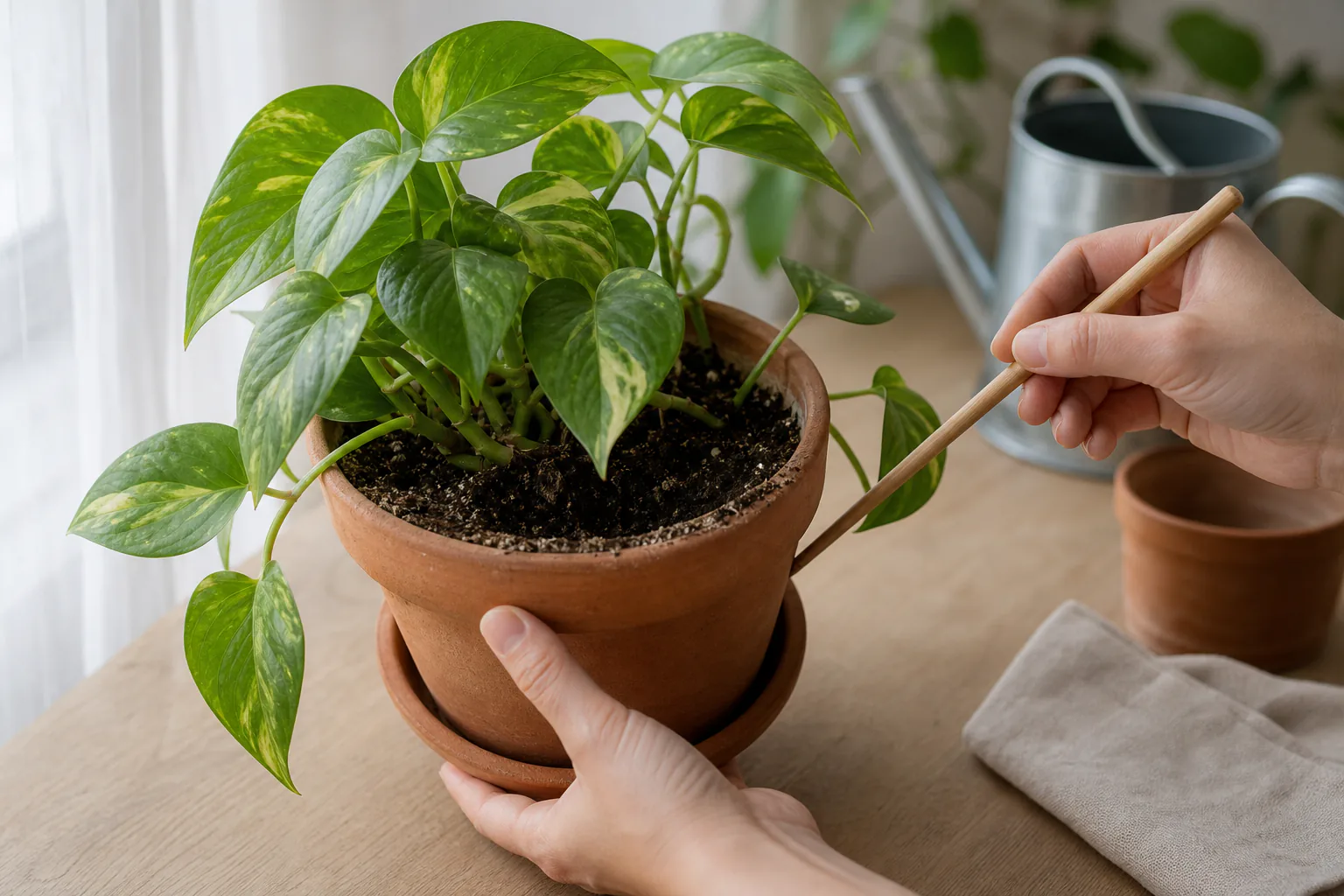
The fix is to check at depth. A finger or a plain wooden chopstick pushed one to two inches into the mix will give you a more honest reading than the surface alone. Moist mix feels cool and leaves a little residue on your skin. Dry mix feels warm and loose. A wooden probe that comes up with dark staining on it is telling you the root zone is still wet.
If the deeper soil is wet and the plant is wilting, that combination is the most important clue in the whole inspection. It usually means the roots are not moving water up to the leaves, even though water is available. That is a different problem from thirst, and the response to it is not more water.
Read the pot and saucer: is water sitting where roots can reach it?
Look at the pot and the saucer or cachepot about 30 to 60 minutes after watering. If water is still standing there and the pot is sitting in it, the roots are effectively in a small bog, no matter how carefully you measured the watering can. The same volume of water in a porous terracotta pot with a draining saucer behaves very differently from the same volume in a glazed pot or a decorative cachepot with no drainage.
A ‘drainage problem’ and a ‘too-frequent watering’ problem can produce identical wilt patterns. That is why the inspection looks at the pot and saucer, not just the schedule. If standing water is part of the picture, the next question is about the pot and how water leaves it, which is covered in more detail in the piece on why drainage changes what ‘overwatered’ really means.
Use leaves and stems as supporting evidence, not the verdict
Once the soil and pot have given you a reading, the leaves become useful as a second opinion rather than the first witness.
A few honest patterns, taken together rather than alone:
- Texture. Overwatered leaves tend to feel soft, limp, or mushy. Underwatered leaves tend to feel dry and crispy, with curling and crisping at edges or tips.
- Where damage shows up. In many species, older and lower leaves going first is consistent with both problems. The pattern is not the verdict; the soil is.
- Stem feel near the soil line. A firm stem suggests the plant is structurally intact. A soft, mushy, or hollow stem at the base is a warning sign that the problem goes below the surface.
- Speed. Symptoms from underwatering tend to appear and progress quickly once the plant runs short on water. Symptoms from overwatering tend to accumulate gradually as the root zone stays wet, and the most alarming signs often appear only after prolonged saturation.
None of these are diagnostic on their own. They are most useful as a sanity check on what the soil and pot have already told you.
If a careful root inspection is on the table: what healthy and stressed roots look like
Unpotting a plant just to peek at the roots is its own disturbance, and it is usually a bad reason to repot. If a repot was already on the calendar for other reasons (the plant is root-bound, the mix has broken down, the pot is the wrong size), then a careful look at the roots during that work is reasonable.
UF/IFAS Extension describes what overwatered roots look like: soft and brown or black, with the soil often developing a sour, rotten smell. In most common indoor species, healthy roots are firm and white, tan, or pale. Roots that are dark, soft, mushy, sometimes slimy, and that crumble when handled are usually lost.
If the inspection surfaces a sour smell from the soil, soft dark roots, or a mushy stem base, that is the point at which general troubleshooting gives way to local expertise. A local nursery or your regional extension service can look at the plant in person, which is something an article cannot.
What to do if the plant looks underwatered
If the soil is dry at depth, the pot feels light, and the pot and saucer are draining cleanly, the plant may simply be thirsty. Water thoroughly until water runs out of the drainage holes, let the pot drain, and then leave it alone. Do not compensate with extra waterings in the following days; the next decision is when to water again, which is its own question and is covered in how to read soil moisture before the next watering.
If the dry condition repeats on a short cycle, the underlying issue is often the room, not the routine. A bright, warm, dry room will pull moisture out of the pot faster than the plant can use it. That is where a quick read of how much light your room actually delivers tends to be more useful than another adjustment to the watering can.
What to do if the plant looks overwatered (and why drainage usually matters more than frequency)
If the soil is wet at depth, the pot still feels heavy days after watering, the saucer is holding water, and the leaves are wilting anyway, the right move is to stop adding water and let the root zone dry. Move the plant to a spot with good airflow if you can, and make sure the pot is not sitting in standing water. Do not water again until the deeper soil has actually dried.
In most of these cases, the deeper issue is not how often you water. It is what happens to the water after it lands. A mix that has broken down, a pot with no functioning drainage, or a cachepot holding water at the base will keep a root zone wet no matter how carefully you measure the watering can. The honest fix usually lives there, not in the schedule.
A note on what to expect: damaged leaf tissue does not turn green again. Yellow leaves, brown patches, and crispy tips are gone for good. Recovery shows up in new growth looking healthy, not in old leaves regreening.
When the honest answer is to wait and observe before changing anything
After running the inspection, the most common right next step is to do less, not more. Give the plant a few days at its current moisture level. Watch for new growth rather than for old leaves to recover. Re-run the pot-weight and soil-moisture checks before the next decision.
The reason for restraint is simple: once a plant is already struggling, every extra watering adds stress rather than relief, especially when the root zone has not had time to recover. Rushing to fix what looks like underwatering in a soggy pot is one of the easiest ways to push a struggling plant over the edge.
A short inspection checklist you can save for next time
- Lift the pot. Heavy days after watering is a flag. Much lighter than expected is a different flag.
- Push a finger or a wooden chopstick one to two inches into the mix. Cool and slightly sticky is moist. Warm and loose is dry.
- Check the saucer or cachepot 30 to 60 minutes after watering. Standing water there is part of the problem.
- Feel the stem near the soil line. Firm is reassuring. Soft or mushy at the base is not.
- Look at the leaves as a second opinion, not the verdict. Soft and limp versus dry and crispy is a supporting signal, not a diagnosis.
- Only unpot to look at roots if a repot was already on the calendar. If you see dark, mushy roots and a sour smell, that is the moment to call a local nursery or extension service.
- After the inspection, the default next step is to wait and observe for several days before changing the routine.