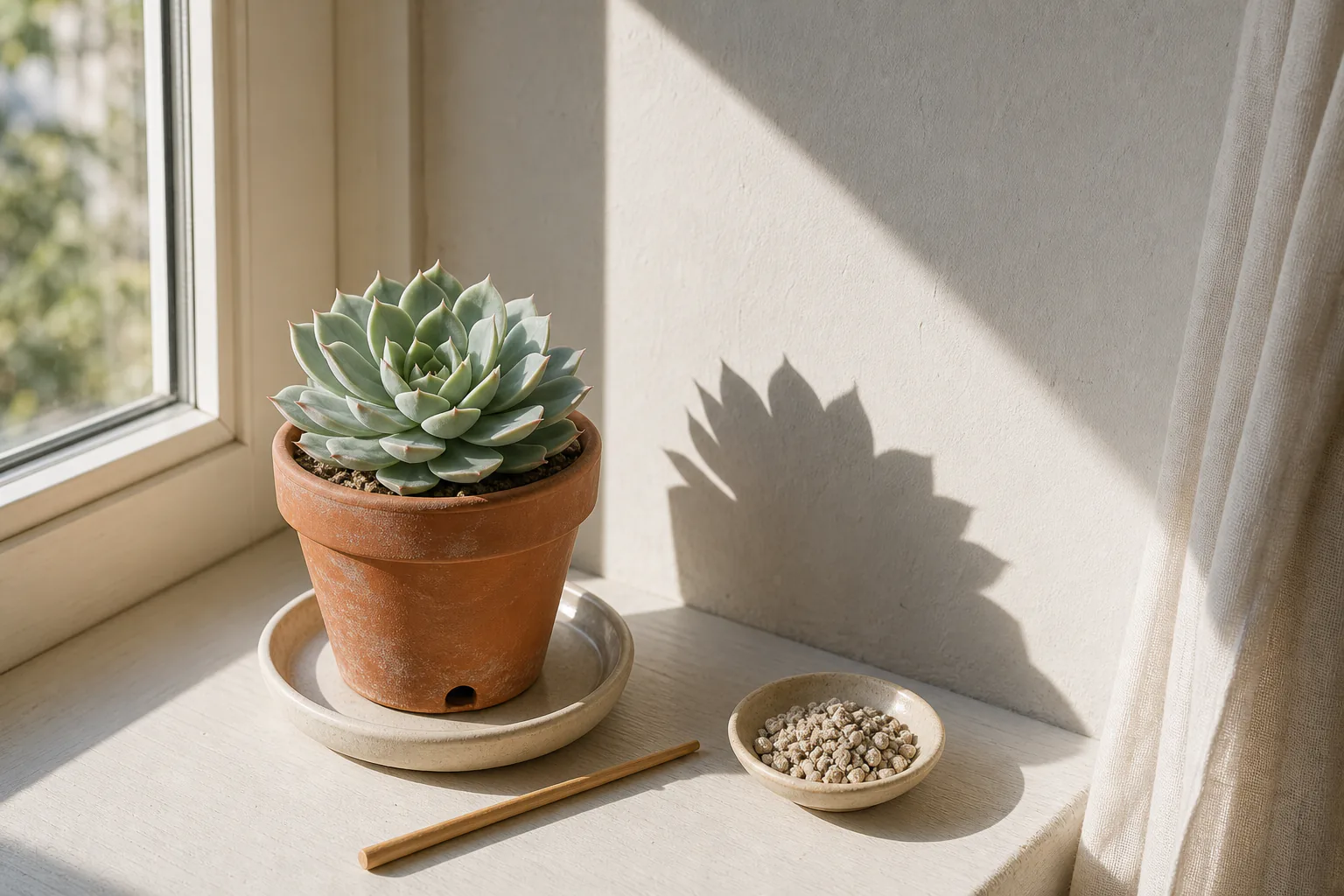
Plant care
How to care for indoor succulents without a watering schedule
· Updated
How to keep an indoor succulent alive and compact
An indoor succulent stays healthy when it gets enough direct or strong bright light at a window and a medium that dries through between waterings. The two are linked: in brighter light the plant uses more water and the medium dries faster, so a pot that stays damp for weeks in a dim corner is the same pot that suits a healthy rhythm on a sunny sill. Almost every common indoor succulent problem (stretching, mushy leaves, sudden collapse, leaves dropping one by one) traces back to one of those two things being off.
The rest of this guide is built around observation. Instead of a watering schedule, you will learn to read your window with a shadow test, watch the plant for what it is actually doing, and choose a pot and mix that let the roots breathe.
Why a succulent is not just a small houseplant
Succulents are a category of plants that store water in thickened leaves, stems, or roots. That single trait changes almost everything about how they want to be grown indoors.
- They tolerate dry air and missed waterings better than tropical foliage plants, because they are already carrying their own reserves.
- They are sensitive to wet feet, because roots adapted to dry quickly between rains do not cope well with a medium that stays damp for days.
- They respond to low light by stretching, because reaching for more sun is a survival move, not a sign of growth.
Treating a succulent like a pothos or a peace lily (water when the surface looks dry, keep it in a corner with bright indirect light) usually produces a stretched, pale plant with a soft base within a few months. The fix is not more attention; it is a different rhythm.
A quick note on category: “succulent” covers a wide range of indoor plants. Echeveria and similar rosette succulents sit on the high-light end. Haworthia, Gasteria, Aloe, and the snake plant (Sansevieria, often reclassified as Dracaena) sit further down the light scale and tolerate brighter-indirect spots. The principles below apply to the whole group, with light intensity adjusted to the plant you actually own.
What “a sunny window” actually means in your room
Light is the dominant variable for an indoor succulent, and it is the one most often guessed at. You can measure it well enough for houseplant purposes with the shadow test described in our guide to reading the natural light in a room.
In short: hold your hand or a leaf-shape between the sun and the windowsill at the time of day you are thinking of placing the plant. A sharp-edged, dark shadow means direct sun is hitting the sill. A soft-edged but clearly visible shadow means bright indirect light. A faint, blurry shadow means the spot is too dim for most rosette succulents.
What counts as “enough” depends on the plant:
- Echeveria and other sun-loving rosette succulents do best with several hours of direct sun at the windowsill, in a south- or west-facing exposure in the Northern Hemisphere.
- Haworthia, Gasteria, and most Aloe accept a bright-indirect spot a step back from that same window, and will stretch if forced into deep shade.
- Sansevieria (often sold as Dracaena) tolerates a wider range, including corners that only get a short window of direct or strong indirect light.
Extension sources describe this in different numbers (Iowa State notes ten or more hours of bright light for many succulents, and the New York Botanical Garden suggests a six-hour minimum). The reason for the spread is that windows, orientations, and species all differ. Treat any single figure as a rough guide and let the plant’s growth pattern confirm or contradict it.
How the same window changes through the year
The sun’s path shifts with the seasons. In midwinter in the Northern Hemisphere, the sun rises and sets further south and tracks a low arc, so its rays reach deeper into rooms but for fewer hours a day. In midsummer the sun climbs a higher arc, light enters more steeply, and the same south-facing window can become almost too intense at midday.
This is worth observing rather than assuming:
- A south or west window that is bright in summer may shade your succulent in winter because the sun has moved along the horizon.
- A spot a few feet back from the window that reads as bright indirect in spring can become dim indirect in autumn as the days shorten.
- A north-facing window (in the Northern Hemisphere) rarely gives rosette succulents what they need, while east-facing windows often give a useful morning burst that suits mid-range succulents and Aloe.
A practical approach is to revisit the shadow test on the same windowsill three times a year: once near the winter solstice, once around an equinox, and once at midsummer. The exercise takes a minute and prevents the slow drift where a plant stretches over six months without anyone noticing the light has changed.
Reading the plant: compact growth, color, and leaf feel
Plants answer back more reliably than any schedule. A few patterns cover most indoor succulents:
- Compact rosette with tight leaf spacing and stable color. Light is adequate. New leaves emerge close together and the plant holds its shape.
- Long gaps between leaves, leaning toward the window, fading from green to pale yellow-green. Light is too low. The plant is reaching. This growth will not shrink back; only new compact growth signals recovery, and the rest of the stem keeps its stretched form.
- Firm, plump leaves you can gently press without them giving. The plant has water reserves and is not asking for a drink.
- Soft, mushy, or translucent leaves that come away easily. Overwatering or a mix that has stayed damp too long. This is the most common path to rot.
- Thin, wrinkled, or slightly floppy leaves. The plant has used its stored water. The medium is probably dry and it is time to water thoroughly.
- Crisp brown patches, white or yellow bleached areas on the most exposed leaves. Too much direct sun, especially after a sudden move into stronger light. Move the plant back a step and let it acclimate.
If you see a few crisp patches but the rest of the plant looks fine and is producing healthy new growth, that is closer to sun-stress coloring, which is normal for many rosette succulents and not a reason to panic.
Watering by observation, not by calendar
The watering rhythm that suits an indoor succulent is usually described as “soak and dry.” That means watering thoroughly, letting the medium dry through, and only watering again when both the plant and the medium say it is time. It is not a fixed interval.
Two checks before you water:
- The medium. Pick up the pot: a dry pot is noticeably lighter than a freshly watered one of the same size. The surface of a dry gritty mix turns from dark to pale as it dries. Push a wooden chopstick or skewer into the root zone; if it comes up cool and dark with mix clinging to it, the medium is still damp.
- The plant. Firm, plump leaves mean the plant is still using its reserves. Soft or wrinkled leaves mean the plant has caught up to the dry-down and is ready for a soak.
When you do water, do it thoroughly. Pour slowly until water runs from the drainage holes, then let the pot drain for a few minutes. After that, empty the saucer or cachepot. A succulent sitting in standing water for hours is one of the most reliable ways to invite root rot, and the reasons why are explained in our guide to drainage, cachepots, and pots without holes.
In winter, with shorter days and slower growth, the medium dries more slowly and the plant uses less water; the dry-down interval naturally lengthens. In a sunny, dry, heated room in summer it can shorten. The rhythm changes with the season, which is exactly why a calendar tends to misfire.
Pot, mix, and drainage for indoor succulents
Pot and mix work as one system, and the goal is to let water leave the root zone quickly and let air back in.
- Choose a pot with a drainage hole. A decorative cachepot without one can still be used, but only as an outer shell, with the succulent in a nursery pot or a pot with drainage inside it. Standing water in a sealed container is the highest-risk setup for a succulent.
- Prefer an unglazed terracotta or other breathable material where it suits the room. The walls let moisture escape and the medium dries faster.
- Use a gritty, fast-draining medium. Standard indoor potting mix holds too much water on its own for most succulents. Look for mixes built around mineral components such as pumice, perlite, coarse sand, or gravel, which give the medium air space and let water pass through.
- Match the pot to the plant. A pot that is much larger than the root ball holds extra moisture the roots cannot use. Going up only one size at a time when repotting keeps the medium from staying wet in pockets the roots have not grown into yet.
The University of Minnesota Extension and other sources describe the same general picture: cacti and succulents grow in well-drained, sandy, low-organic media and need only modest water and fertilizer. Stay away from recipes that lock you into one brand or one ratio; the underlying principle is drainage and air around the roots.
Common indoor succulent problems and what they often point to
- Etiolation (stretching). Almost always low light. Move the plant closer to the window, rotate it a quarter turn each week for even growth, and accept that the stretched stem will not revert. New growth at the tip is what you are watching for.
- Mushy, translucent leaves at the base. Overwatering or a mix that stays too damp. Unpot the plant, inspect the roots, and remove anything dark and soft. Let the cut surfaces dry in open air, then repot into a drier, grittier medium. Hold off on watering until the cut roots have callused and the plant shows early signs of new growth or its leaves firm back up.
- Wrinkled, thinning leaves. Underwatering or a long dry-down. Soak the medium thoroughly and watch the leaves plump up over a day or two.
- Sun-bleaching or crisp patches. Too much direct sun, often after a sudden move. Move the plant back a step and reintroduce it to brighter light over a week or two.
- Leaf drop with otherwise firm leaves. Often a sudden change in light, temperature, or watering rhythm. Stabilize the conditions and resist the urge to compensate with extra water.
This list is a starting point, not a diagnosis. If a problem does not match these patterns, or if you see signs of pests or disease, a local nursery or your regional extension service is a better next step than an online guess.
When to leave the succulent alone
A healthy indoor succulent is mostly a patient plant. It does not need frequent watering, it does not need fertilizer more than a few times a year in the growing season, and it does not want to be moved around the room every few days. Pick the brightest appropriate window for the species you own, set up a pot and mix that dry through, water when the plant and the medium both say it is time, and then leave the plant to do what it does.
Most of the time, the next thing you will notice is new compact growth, a leaf or two plumping back up after a soak, or a slow color shift as the seasons change. That is the succulent telling you the rhythm is right.
Sources
- Iowa State University Extension and Outreach — Growing succulents indoors
- University of Minnesota Extension — Cacti and succulents
- NC State Cooperative Extension — Light considerations for indoor plants
- New York Botanical Garden — Succulents in your home
- Piedmont Master Gardeners — Succeeding with succulents