Plant care
Indoor peperomia care: a calm, observation-first guide
· Updated
If your peperomia came from a grocery shelf or an online shipment without a species label, you are not missing context — that is how most of them enter homes, and it does not change what they need. The short answer: a peperomia is a compact, semi-succulent houseplant that wants bright indirect light, an airy well-drained mix, a small pot with drainage, and a watering rhythm that lets the top of the mix dry before you water again.
That short answer is the spine of this guide. What follows is the observation-first way to keep a peperomia healthy indoors, including how to read its leaves when something feels off.
What “peperomia” actually covers
The plants sold as peperomia are a small slice of a large genus. NC State University describes peperomia as a genus of small herbaceous perennial houseplants, and the University of Arkansas Cooperative Extension Service places the group at well over a thousand species, mostly native to Central and South America. Many of them are described as succulent or semi-succulent, storing water in thickened leaves.
The species most often sold indoors include:
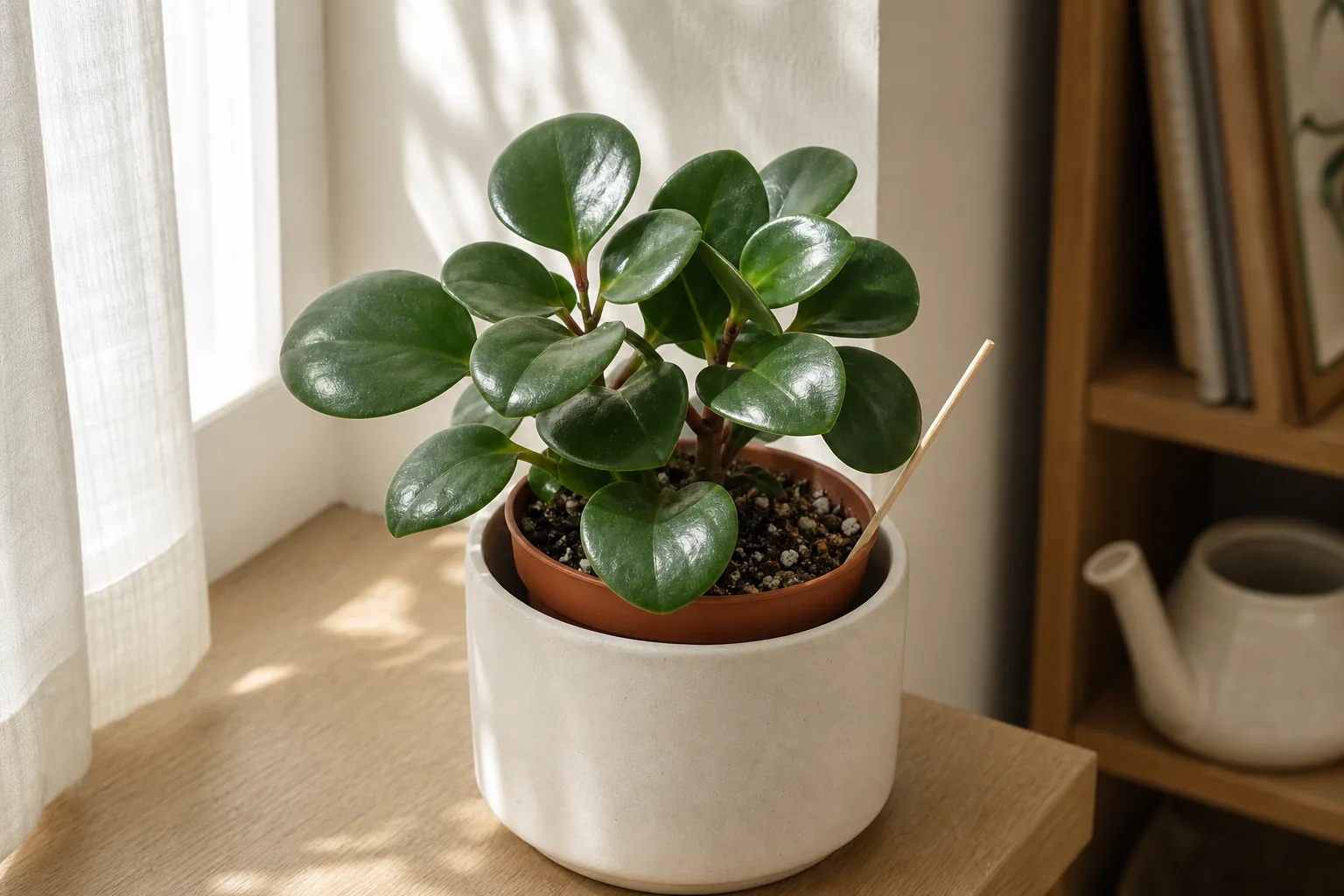
- Peperomia obtusifolia, the baby rubber plant, with thick, glossy green leaves that are sometimes variegated. It tolerates drier conditions and average indoor humidity.
- Peperomia argyreia, the watermelon peperomia, with thinner leaves patterned like a watermelon rind. It reads humidity more strongly and can crisp in dry indoor air.
- Peperomia caperata, with deeply ridged, rippled leaves. It has similar humidity sensitivity to watermelon.
- Peperomia tetraphylla and Peperomia rotundifolia, with smaller, often trailing leaves.
- Peperomia clusiifolia, sometimes called red-edge peperomia, with thicker leaves edged in red.
- Peperomia ‘Hope’ and similar hybrids, sold as compact trailing plants.
The shared baseline covers all of them. The differences show up in how fast the mix dries, how easily the leaves crisp at the edges, and how the plant responds to a dry winter room.
Where to put a peperomia
Most peperomia come from the tropical understory, which is why they tolerate lower light than many houseplants but stay more compact in brighter spots. Clemson University’s Home & Garden Information Center, NC State, and the National Garden Bureau all place peperomia in bright indirect light.
In a real room, a peperomia can sit closer to the glass in front of a bright, mostly indirect window such as one facing east or north. For a hot south- or west-facing window, stepping a few feet back or hanging a sheer curtain softens the midday sun enough to avoid leaf scorch. The placement is not a single rule so much as a match between your window and your species — thicker-leaved peperomia handle a brighter sill than thinner-leaved ones.
The signs of light that is too low are not subtle. Long gaps between leaves, pale new growth, and a plant that leans toward the window are all the peperomia stretching. The signs of light that is too high are dry, papery patches on the leaves that face the window.
If you are not sure how bright a spot actually is, our guide on how to read the natural light in your room walks through the simple checks you can do with your hand and a piece of paper. To recognize a stretched-out peperomia in time, see our guide to why a houseplant gets leggy.
How to water a peperomia without a schedule
The single biggest mistake with peperomia is watering on a calendar. Sources from Clemson HGIC to the National Garden Bureau all converge on the same rule: let the upper portion of the mix dry between waterings. The National Garden Bureau suggests at least the top quarter of the potting mix should dry out before you water again, and grower experience suggests waiting a little longer for thinner-leaved varieties such as watermelon and caperata so the upper third of the mix has had a chance to dry as well.
Two practical ways to check:
- The finger test. Push a finger or a wooden skewer an inch or two into the mix. For thicker-leaved peperomia (obtusifolia, clusiifolia), water when the top inch is dry. For thinner-leaved peperomia (watermelon, caperata), wait until the top third feels dry.
- The lift test. Lift the pot right after watering and remember that weight. Lift it again a few days later. A peperomia ready for water feels noticeably lighter.
When you do water, soak the mix thoroughly until water exits the drainage hole. That thorough soaking, followed by a real dry-down, is what peperomia roots evolved for. Frequent shallow sips keep the upper mix wet and the lower mix dry, which is the worst of both worlds for a shallow root system.
For a deeper look at observation-first watering, our guide to watering houseplants without a schedule covers the same method in more detail.
Pot size and potting mix
Peperomia have small, shallow root systems. Grower experience indicates that healthy peperomia are typically repotted only every four to six years to freshen the mix, with the pot size increased by just one when repotting is needed. That tells you two things: the plant prefers a snug pot, and the mix matters more than the container.
An airy, well-drained mix gives the shallow roots the airflow they need between waterings. Clemson HGIC recommends a well-drained potting mix, and common practice is to amend a standard indoor mix with perlite or orchid bark to keep it from staying soggy. A dense, peat-heavy mix holds moisture longer and is the most common reason a peperomia stays wet past its preferred dry-down. For a fuller walk-through, see our guide to choosing a houseplant potting mix.
The pot itself should have a drainage hole. Without one, the lower mix stays saturated and the roots begin to soften. A cachepot works well — set the peperomia in a snug nursery pot inside a decorative outer pot, and remove it to water so it can drain freely. The reasoning behind drainage is laid out in our guide to houseplant pot drainage and cachepots.
Temperature, drafts, and humidity in a real room
Peperomia are tropical plants, but ordinary indoor conditions are usually fine. Average indoor temperatures in the 65°F to 75°F range match what most homes sit at year-round, and these figures are commonly cited as a comfortable baseline rather than a hard minimum or maximum.
What matters more than any precise number is stability. Peperomia dislike cold windows in winter, dry heat blowing from a vent, and the hot midday sun that builds up behind glass in summer. A bright window that is drafty, or one that turns into a sun-trap in July, is the kind of spot that produces crispy edges and sudden leaf drop. Our guide on drafts, vents, and sun-heated glass explains why a bright window can still be a hostile spot.
Humidity is where species matter most. Thicker-leaved peperomia (obtusifolia, clusiifolia) tolerate average indoor humidity without complaint. Thinner-leaved peperomia (watermelon, caperata) often show their first crispy edges in a dry winter room. Grouping plants together, setting the pot on a humidity tray, or running a small humidifier nearby are reasonable responses — none of these are required for the plant to survive, but each makes thinner-leaved species look better in dry air. To decide whether extra humidity is worth the effort in your specific room, see our guide to houseplant humidity in real homes.
Reading the leaves
Peperomia leaves are good messengers if you know what each symptom usually points to.
- Lower leaves dropping after a move or shipment: usually normal acclimation. The plant is shedding leaves it can no longer support while it adjusts to new light and humidity. Give it two stable weeks before changing anything.
- Leaves dropping with soft, mushy stems and wet soil: usually overwatering. Stop watering, check the drainage hole, and let the mix dry more thoroughly before the next soak.
- Leaves drooping with bone-dry mix that has pulled away from the pot edge: usually underwatering, especially in a peat-heavy mix that has gone hydrophobic. Soak the pot from the bottom, then return to your normal rhythm.
- Curling or cupping leaves: the plant is losing moisture faster than its roots can replace it — often low humidity for thinner-leaved species, or a too-bright spot for thicker-leaved ones.
- Long gaps between leaves, pale new growth, leaning toward the window: too little light.
- Brown, papery patches on the leaves facing the window: too much direct sun. Move the plant back from the glass or filter the light with a sheer curtain.
Two of these checks — overwatering versus underwatering, and leaf drop after a move — are worth treating as their own short inspections. Calm walk-throughs of each are in our guides to telling overwatering and underwatering apart and to why houseplants drop leaves after a move or change. Brown, crispy edges are walked through separately in our guide to brown tips and crispy edges on houseplants.
Repotting and root care
Because peperomia root systems are small, the plant needs repotting far less often than most houseplants. A healthy peperomia in a snug pot can go several years without a new container, and the typical reasons to repot sooner are a root ball that has filled the pot and started circling, a mix that has broken down and stays wet for a week or more, or a plant that has clearly outgrown its container.
When you do repot, increase the pot size by only one standard nursery size (commonly about an inch in diameter) and refresh the mix with an airy blend. Water the plant in lightly after repotting and avoid fertilizing for a month or so while new roots settle. The decision framework — when to leave a plant alone and when a pot upgrade is genuinely warranted — is in our guide to when a houseplant actually needs a new pot.
Common problems at a glance
A short triage for the symptoms that bring most readers here:
- Leaf drop. Check whether the soil is wet or dry, and whether the plant recently moved. Wet soil and soft stems point to overwatering; bone-dry mix and crispy leaves point to underwatering; a recent change in location points to acclimation.
- Yellowing leaves. Often the lower, older leaves paired with soggy mix point to a watering-rhythm issue. Our guide to why houseplant leaves turn yellow walks through the wider checklist.
- Brown, crispy edges. In thinner-leaved peperomia, usually dry indoor air. In any species, it can also be sunburn or fertilizer buildup.
- Leggy growth. Almost always too little light. Move closer to a bright window or add a grow light.
- Pests. Peperomia are not especially pest-prone, but mealybugs (small white cottony patches in leaf joints), fungus gnats (small flies around persistently wet soil), and spider mites (fine webbing, stippled leaves) are the usual indoor-houseplant suspects. For any treatment, follow the product label and consider consulting a local nursery or extension service.
A short observation checklist for the first two weeks
If your peperomia just arrived, the simplest plan is to leave it mostly alone and watch. Our guide to acclimating a new houseplant in the first two weeks covers the same playbook in more detail.
- Place it a few feet from a bright window with mostly indirect light.
- Check the mix with a finger or skewer; water only when the top portion is dry.
- Don’t repot, fertilize, prune, or move it again for at least two weeks.
- Expect a few lower leaves to drop as it adjusts; that’s normal.
- After two weeks, reassess the spot, the pot size, and your watering rhythm — one change at a time.
If you share your home with pets, a quick note on toxicity: the ASPCA lists Blunt Leaf Peperomia as non-toxic to dogs and non-toxic to cats, and several other commonly sold peperomia species appear on non-toxic lists in regional horticultural references. Because the genus is large and not every species has been individually reviewed, our pet-aware houseplant guide walks through the verification-first approach we recommend before bringing any new plant into a home with curious animals.
Sources
- Clemson University Home & Garden Information Center — Peperomia indoor plant care and growing guide: https://hgic.clemson.edu/factsheet/peperomia-peperomia-spp-indoor-plant-care-and-growing-guide/
- NC State University Plant Toolbox — Peperomia: https://plants.ces.ncsu.edu/plants/peperomia/
- University of Arkansas Cooperative Extension Service — Peperomia: https://www.uaex.uada.edu/yard-garden/resource-library/plant-week/peperomia-11-30-12.aspx
- National Garden Bureau — A complete beginner’s guide to peperomias: https://ngb.org/complete-beginners-guide-to-peperomias/
- ASPCA — Toxic and Non-toxic Plants: Blunt Leaf Peperomia: https://www.aspca.org/pet-care/aspca-poison-control/toxic-and-non-toxic-plants/blunt-leaf-peperomia