Plant care
Do houseplants need humidity?
· Updated
Does your houseplant actually need more humidity than your room already provides? For most common houseplants in ordinary homes, the answer is usually no, or at least not enough to justify buying equipment over. Typical indoor air sits somewhere between 30 and 50 percent relative humidity, and many popular houseplants tolerate that range without intervention. Humidity becomes worth investigating when a plant keeps showing the same symptoms and the more common causes, like watering pattern, light, and pot conditions, have already been ruled out.
This article walks through an observation-first approach. Read the room, read the plant, and only then decide whether anything needs to change.
What humidity means in a room, in plain terms
Relative humidity (RH) is the amount of water vapor currently in the air compared with the maximum amount the air could hold at that temperature. Warm air can hold more water than cold air, which is why heating cold winter air indoors tends to drop indoor RH even though no moisture has been removed.
A few related terms show up in plant care conversations:
- Transpiration is how a plant loses water through its leaves. Dry air pulls water out of the leaves faster than humid air does.
- A microclimate is the small pocket of air right around a plant, which can be noticeably different from the room as a whole.
- Vapor pressure deficit is the technical version of that drying pull. You do not need to calculate it to make good decisions, but knowing it exists explains why a plant near a heating vent can dry out while a hygrometer two meters away reads a comfortable number.
None of this requires a greenhouse to be relevant, but it does explain why the same plant can look great in one room and struggle in another.
Why humidity advice travels fast: the greenhouse vs the home
Most foliage houseplants were raised in greenhouses where humidity is kept well above typical home levels. Many care guides pass those numbers along as if they were the conditions a plant needs in a living room, but a plant’s greenhouse history is not the same as its indoor requirement. Commercial growers select and acclimate plants to indoor conditions, and most popular houseplants tolerate the 30 to 50 percent band found in ordinary homes reasonably well.
This is also why vague advice like “tropical plants need high humidity” can mislead. Tropical is a geography, not a humidity number. Some commonly sold tropicals, like Monstera, Philodendron, and Pothos, tolerate drier indoor air than their wild habitat would suggest, while a smaller group, including some ferns, Calathea, and certain Alocasia, is fussier about it.
What indoor humidity usually looks like, and what changes it
Across most of the year, ordinary homes run somewhere between 30 and 50 percent RH. A few patterns show up reliably:
- Winter often drops lower (into the 20s or low 30s) as cold outdoor air is heated, because cold air carries very little moisture.
- Summer can sit closer to 40 to 50 percent, and higher in humid climates when the air conditioning is not running.
- Bathrooms and kitchens see bigger swings than living rooms and bedrooms because of showers, cooking, and running water.
- Forced-air heating in winter is a common driver of dry indoor air.
These numbers are a baseline, not a target. They give the reader something to compare a plant’s symptoms against rather than a number to chase.
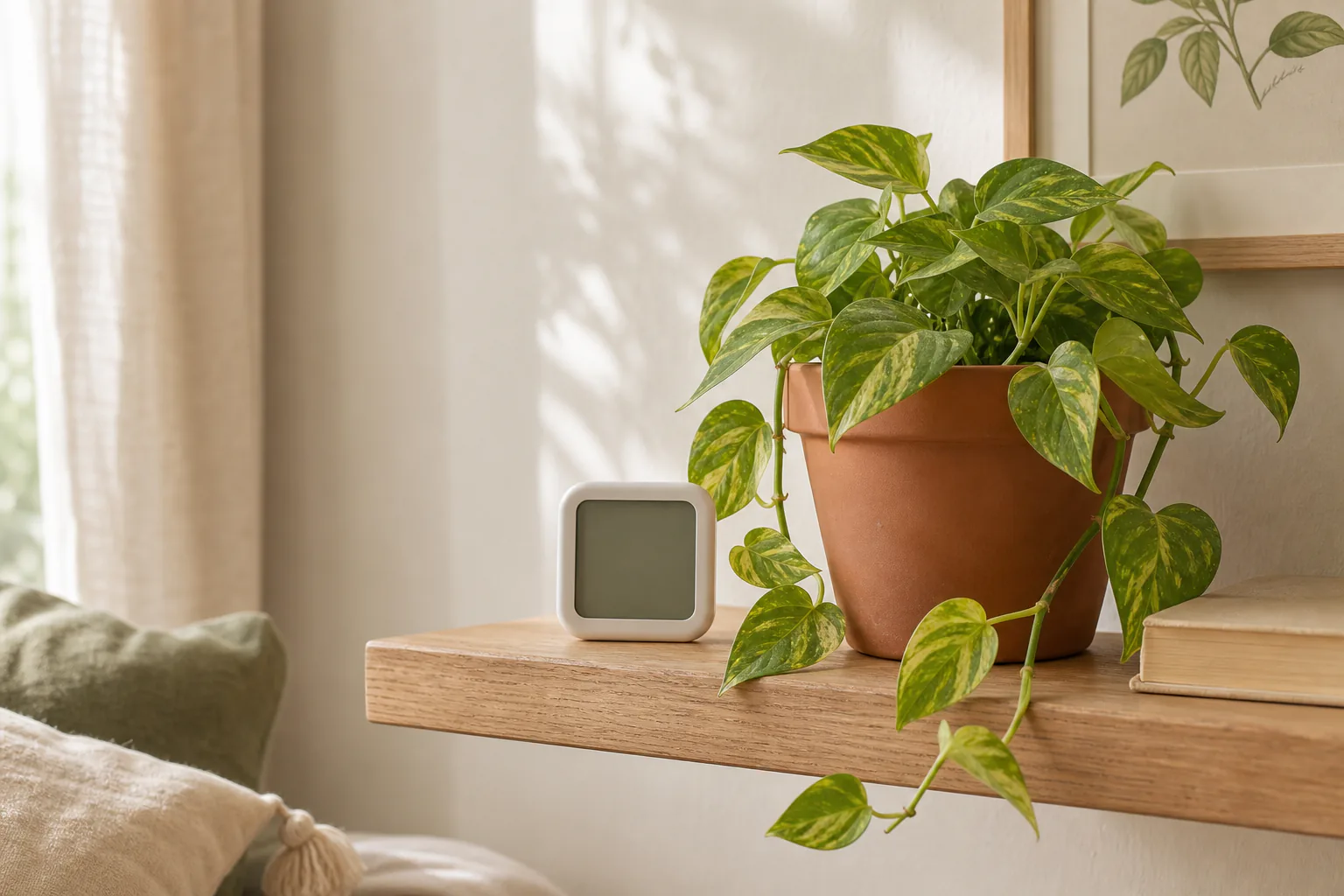
For readers who want a real reading, a small digital hygrometer placed near plant level (not at ceiling height) is the most direct way to see what the air actually looks like in that spot.
How to tell whether humidity is really the problem: an observation order
Plant symptoms that get blamed on humidity, like crispy brown leaf edges, brown tips, and leaf curl, also come from several other common causes. That overlap is exactly why humidity should be approached as a hypothesis, not a default.
A useful order of checks before assuming humidity:
- Watering pattern. Is the potting mix actually drying out at the expected pace, or is it staying wet, or going bone-dry between waterings. Underwatering produces dry, crispy edges that look a lot like low-humidity damage.
- Water quality. Hard water, softened water, or chlorine-heavy tap water can leave mineral deposits at leaf tips. Soluble salt buildup from fertilizer can do the same.
- Light. A plant in a dim corner transpires slowly. A plant in bright, direct light transpires quickly. The same room humidity can feel very different to the same plant in two locations, and reading the natural light in your room is part of this.
- Pot and roots. A root-bound plant or one sitting in soggy soil cannot move water efficiently, which shows up as marginal leaf damage.
- Drafts and heat sources. A plant near a heating vent, radiator, or cold window experiences a local microclimate that does not match the rest of the room.
If those are reasonably in line and a hygrometer near the plant reads at or below the low 30s for extended periods, low humidity becomes a more plausible contributor. If the reading is 40 to 50 percent and the symptoms persist, the answer is more likely elsewhere.
Grouping plants, airflow, and pebble trays: what each can and cannot change
Three low-cost approaches come up constantly in humidity discussions. Each can shift local humidity around a plant, but the size and duration of the effect vary.
Misting briefly raises humidity in the air right at the leaves as droplets evaporate. The effect usually fades within minutes, and very small changes (around one or two percentage points) are unlikely to be biologically meaningful. Misting is fine as a routine if a reader enjoys it, but it is not a sustained humidity source.
Pebble trays raise humidity modestly and steadily in the air immediately around a plant. A shallow tray of pebbles with water sitting below the pot bottom lets evaporation happen continuously. The effect depends on tray size, water temperature, and room airflow, so it is best described as gentle and local rather than transformative. Pebble trays are inexpensive, low-risk, and easy to undo.
Grouping plants can create a slightly more humid microclimate around their leaves as each plant transpires. The effect is real but subtle, and it works best when the grouping is tight enough that the leaves share a small air pocket.
These are reasonable experiments to run before buying anything. None of them is guaranteed to fix a specific symptom, and each becomes more useful when paired with a hygrometer reading rather than a guess.
When a humidifier is worth considering, and what to set it for
A whole-room humidifier is the most reliable way to set and hold a specific RH in a room, but it is also a step up in cost, maintenance, and effect on the room itself. It changes the air for people, pets, and furniture, not just for plants.
A few practical notes readers tend to find useful:
- Sustained indoor RH above about 60 percent is commonly associated with condensation on windows and conditions that favor mold growth. Most general guidance for living spaces suggests staying in the 30 to 50 percent band.
- Humidifiers do not fix brown edges on their own. If the symptom has another cause, adding humidity can mask the real problem or simply add moisture to a room that does not need it.
- Cool-mist, warm-mist, and ultrasonic humidifiers differ in noise, cleaning needs, and energy use. The right type depends on the room and the reader, which is a local decision rather than a general recommendation.
- Humidifiers need regular cleaning to avoid biofilm and mineral dust. That maintenance is part of the real cost, not an afterthought.
A humidifier is most defensible when a hygrometer shows sustained readings well below the typical 30 to 50 percent range, the more common causes of symptoms have been checked, and the reader wants to stabilize conditions for a known humidity-sensitive plant in a dry climate or heated home.
What to do first, before buying anything
A short, observation-first sequence covers most situations:
- Place a small hygrometer at plant level in the room where symptoms appear, and one in a room where the same kind of plant is doing well if possible. A week’s worth of readings tells more than a single guess.
- Walk through the watering, light, water quality, pot, and draft checks above. Adjust what is clearly off before adding humidity.
- Try a pebble tray or a tighter grouping for two to three weeks as a low-cost experiment. Watch for change at the leaf edges, not just for a humidity reading moving a few points.
- Only after that, consider whether a humidifier matches the room, the plant, and the reader’s tolerance for maintenance.
When to stop and look for a different cause
If a hygrometer reads 40 to 50 percent and a plant still shows the same crispy edges after watering, light, and pot conditions have been adjusted, humidity is unlikely to be the driver. The plant may be reacting to water quality, accumulated salts in the soil, a root issue, a draft, or simply a placement that does not match its light needs. Adding a humidifier in that situation adds cost without changing the outcome.
For ongoing issues that do not respond to ordinary adjustments, a local nursery, a master gardener program, or a county extension service can look at the actual plant and the actual room. Indoor plant care has too many interacting variables for any single article, including this one, to diagnose a specific case.
Sources
- Penn State Extension – Humidity and houseplants: https://extension.psu.edu/humidity-and-houseplants
- University of Nebraska–Lincoln Lancaster County Extension – Success with houseplants: humidity: https://lancaster.unl.edu/success-houseplants-humidity/
- Garden Myths – Increasing humidity for indoor plants: https://www.gardenmyths.com/increasing-humidity-indoor-plants/
- Rockledge Gardens – Reading the leaves: https://rockledgegardens.com/reading-the-leaves-signs-of-overwatering-and-underwatering-how-to-know-the-difference/
- Center for Energy and Environment – Managing indoor humidity levels: https://www.mncee.org/managing-humidity-levels