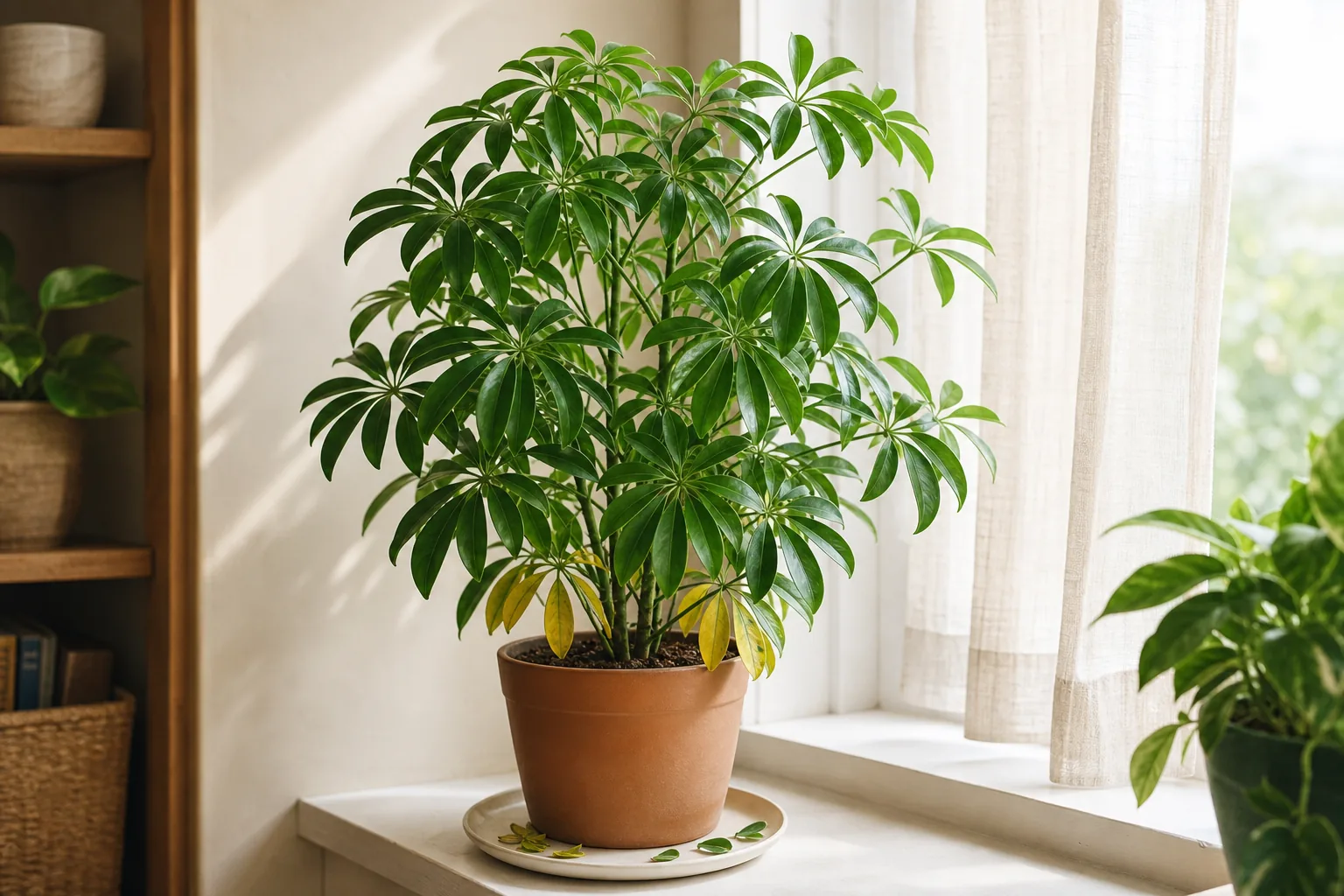
Plant care
Schefflera care indoors: a calm guide to the umbrella plant
· Updated
The umbrella plant is a schefflera, but which schefflera you have matters more than most care articles admit. Two different species are sold under the same common name indoors: Schefflera arboricola, the smaller, often variegated plant usually sold as a tabletop or potted specimen, and Schefflera actinophylla, the larger, broader-leaflet plant more often sold as a floor plant. Both share the same general care rhythm indoors, but they differ in mature size, in how aggressively they stretch toward light, and in how much you will eventually lean on pruning.
For most indoor owners, the practical answer is the same: bright, indirect light, a clear dry-down between waterings, and a stable spot away from drafts and heat vents. Most schefflera problems (yellow leaves, leaf drop, leggy growth, brown edges) come from a mismatch between watering rhythm, light level, and a recent change, and they respond best to observation and a stable spot rather than a new product.
If you just brought a schefflera home, the first two weeks set the tone. A new plant is usually already adjusting to lower light and drier air than the greenhouse it came from, so a short settle-in period matters more than a fast correction. The guide on acclimating a new houseplant after purchase walks through what to do and what to ignore in those first weeks.
What kind of schefflera do you actually have?
If your plant has smaller, often variegated leaves and a denser, more compact habit, it is most likely Schefflera arboricola, sometimes sold as dwarf umbrella tree. It is the species you usually see braided or grown as a small potted plant on a desk or shelf, and it tends to stay a manageable tabletop size for years.
If your plant has larger, broader, glossy leaflets, often on a single tall stem with a crown of leaves at the top, it is more likely Schefflera actinophylla, sometimes sold as umbrella tree, parasol plant, or octopus tree. Indoors, this species behaves more like a small floor tree and can eventually reach roughly ceiling height over many years. It is the one that most often arrives home looking like a single-stem “lollipop” and ends up needing pruning.
The two are similar enough that the rest of this article applies to both. The main difference is what “tall” means and how much you will lean on pruning to keep the plant in proportion to your room.
Realistic light expectations for a schefflera
Schefflera grows best in bright, indirect light. A bright spot where direct sun does not fall on the leaves is the practical target. Some gentle morning or late afternoon sun is generally tolerated; intense midday sun falling directly on the leaves can scorch them.
The plant will tolerate medium light, but the trade-offs show up on the plant itself: slower growth, longer spaces between leaves, and a higher chance of older lower leaflets dropping. Low light is where things go wrong. Extension guidance from Clemson University links low light specifically to leaf yellowing and weak, spindly stems, which is the leggy look owners usually describe when they say their schefflera “isn’t doing well.”
The most useful thing you can do is to check the actual spot rather than trust the plant’s reputation. The guide on reading the natural light in your room before you place a houseplant walks through the observation method so you can decide whether the spot you have in mind is bright indirect, medium, or low.
Where to place a schefflera in an ordinary room
A stable spot matters more than a “perfect” spot. Schefflera prefers daytime temperatures around 65 to 75°F (18 to 24°C) and dislikes sudden cold. Leaves blacken and drop when the plant is exposed to temperatures of about 50°F (10°C) or colder, which is the temperature you can expect from a single-pane window on a winter night, a cold draft, or a blast from an air conditioning vent.
For most homes, this means: a bright window with a curtain, a wall or shelf that is not directly under a heating vent, and some distance from a door that opens to cold outdoor air. A few feet back from a bright window often beats a deep corner where light fades quickly, especially in winter. The article on drafts, vents, and sun-heated glass covers the placement traps in more detail.
Watering schefflera by observation, not the calendar
The cleanest extension guidance on watering comes from Clemson University: water thoroughly until water runs out the drainage hole, then let the top half inch of potting mix dry out before watering again, and never let the pot sit in standing water in the saucer. The dry-down depth is the practical rule, not a number of days.
In practice, the most reliable check is pot weight. Lift the pot right after a thorough watering and remember that weight; when it feels noticeably lighter, the top portion of the mix has dried. A finger in the top inch of mix works too, but for a tall plant in a deep nursery pot, weight is faster and tells you what is happening in the lower root zone as well. The general method of watering by observation rather than a schedule is laid out in more detail elsewhere on this site.
Schefflera forgives an occasional dry-down better than it forgives being kept constantly damp. The single most common cause of yellow leaves on a new schefflera is a deep, moisture-retentive nursery mix that stays wet for weeks while the owner follows a “water weekly” rule. If that sounds familiar, the fix is to lengthen the gap between waterings and to check the pot weight rather than the calendar.
Potting mix, drainage, and pot size
Schefflera does best in an airy, well-drained mix. A peat- or coco-coir-based houseplant mix amended with perlite or orchid bark is a typical, well-supported choice; the goal is a mix that holds some moisture but lets excess water drain through quickly. The houseplant potting mix guide explains how to read a mix label and what the usual amendments actually do.
The pot should have a drainage hole. A schefflera sitting in a pot without drainage, or in a cachepot that holds water at the bottom, will decline quickly because the roots stay wet. The drainage and cachepot guide walks through the three indoor pot setups and the signs that a pot is staying too wet.
On pot size: most new scheffleras are sold in appropriately sized nursery pots. Resist the urge to move a newly bought plant into a much larger pot “to give it room.” A pot that is too large holds moisture the plant cannot use, and the mix will stay wet for too long. Going up one pot size at a time, only when the plant actually needs it, is the safer pattern.
Reading the plant: leaves, stems, and growth habit
Healthy new growth on a schefflera is firm, with evenly spaced leaflets and a sturdy stem. Internodes (the bare section of stem between leaves) are short, and the plant looks full.
A few patterns are normal rather than problems. Older lower leaflets yellow and drop on their own as the canopy moves up the stem, especially in lower light. A schefflera will also drop leaves after a move, a repot, a draft, or a sudden change in light, even if you have done everything else right. The leaf-drop-after-a-move guide walks through the calm observation order that helps you tell adjustment from a real problem.
The patterns worth inspecting are yellowing spread across the canopy rather than on a single lower leaflet, soft or floppy new growth, leaves that drop in large numbers over a few days, brown edges that keep spreading, or sticky residue on the leaves. Each of these is a triage cue, not a diagnosis. Yellow leaves on a houseplant, brown tips and crispy edges, and leaf drop after a change each have their own troubleshooting paths, and the order in those guides is the right one to follow.
Pruning a tall or leggy schefflera
Pruning is how you manage a tall schefflera. It is not a rescue operation; it is a normal part of owning a plant that can keep growing for years.
The standard cut is just above a node (the small bump on the stem where a leaf or branch emerges) or just above a branch fork. The plant will usually send out one or more new shoots from the leaf axils below the cut, which is how a single-stem schefflera becomes a fuller, multi-stemmed one. Most of the year is fine for this indoors, because the plant is in stable conditions rather than following a strict outdoor dormancy.
Staking is a different decision. A stake keeps a top-heavy plant upright, but it does not change the underlying leggy growth pattern. If a schefflera is stretching because it is not getting enough light, the answer is usually more light plus a prune, not a taller stake. The longer piece on why a houseplant gets leggy is worth a read if the plant is already sparse.
When to repot (and when not to)
Repotting is the right call when the pot is genuinely the problem: roots circling the pot or growing out of the drainage hole, water running straight through without being absorbed, the plant tipping over because the canopy is too heavy for the root ball, or the mix breaking down and staying wet for too long.
If none of these are happening, repotting is probably not what the plant needs. A schefflera that is dropping leaves or going leggy usually needs a different spot, a different watering rhythm, or a prune, not a new pot. Going up only one pot size at a time, with fresh airy mix and a clean pot, is the standard move. The full check for when a houseplant actually needs a new pot is laid out in a separate guide.
Fertilizer: less is usually the right answer
Schefflera is not a heavy feeder. A light dose of a balanced houseplant fertilizer, applied only during the active growing season (spring and summer in most homes), is enough. Skip feeding in the lower-light months of late fall and winter, when the plant is using less energy and the risk of fertilizer salts building up in the mix is higher.
Do not chase new growth with more fertilizer. If the plant is not putting out new leaves, the cause is usually light, water, or a recent change, not a missing nutrient.
Common issues: yellow leaves, brown edges, leaf drop, and pests
The big three on schefflera are yellow leaves, brown edges, and leaf drop, and each has a layered list of possible causes that starts with light, watering rhythm, and recent change. The yellow houseplant leaves guide walks through that troubleshooting order; the brown-tips piece covers the dry-down-versus-tap-water-versus-humidity check.
For pests, the inspection cues worth learning on any new houseplant are mealybugs (small white tufts in the leaf axils where the leaflet meets the stem), scale (small brown bumps along the stems and undersides of leaves), and spider mites (fine webbing and a dusty, faded look on the leaves). A routine check of the leaf axils and the undersides of the leaves, especially on a new plant, catches most of these early.
If you do find pests, isolate the plant from your other houseplants and inspect any plants that have been near it. The dedicated articles on mealybugs, scale, and spider mites walk through the inspection and treatment paths.
Seasonal notes: winter, summer, and moving outside
In winter, light drops and indoor air gets drier. Expect the potting mix to dry out more slowly, water less frequently, and skip fertilizer until the days lengthen again. Keep the plant away from cold drafts and from hot, dry air blowing directly on the leaves from a heating vent.
In summer, the plant may dry out faster, especially in a bright window. You may need to water more often, and a brief move to a shadier spot can keep leaves from scorching if the sun gets intense through the window.
Scheffleras can spend warm months outside, but they need to be hardened off gradually and brought back inside well before nights drop into the 50s°F. The move-outside and bring-back-inside guides cover the timing in more detail.
Pets, children, and handling
Schefflera species contain calcium oxalate crystals, which can irritate the mouth and digestive tract of cats, dogs, and humans if any part of the plant is chewed or swallowed. The reaction itself is not something this guide is the right place to assess; for any actual exposure, your veterinarian or local poison control is the right resource.
If you share a home with a curious pet or a small child, how to choose a houseplant when you have pets is the more useful read than any single severity claim made here. It is also worth remembering that the irritation is from chewing, not from being near the plant. A schefflera on a tall stand, in a closed room, or out of reach is a different risk profile from the same plant sitting on the floor.
Sources
- Schefflera | Home & Garden Information Center, Clemson University
- Schefflera actinophylla, University of Florida IFAS Extension
- Growing Houseplant Umbrella Plant – Schefflera actinophylla / Schefflera arboricola, Melinda Myers
- Umbrella plant care: pruning, watering & more, Plantura
- Umbrella Plant Care Guide, The Old Farmer’s Almanac