Plant care
How to revive a neglected houseplant without making it worse
· Updated
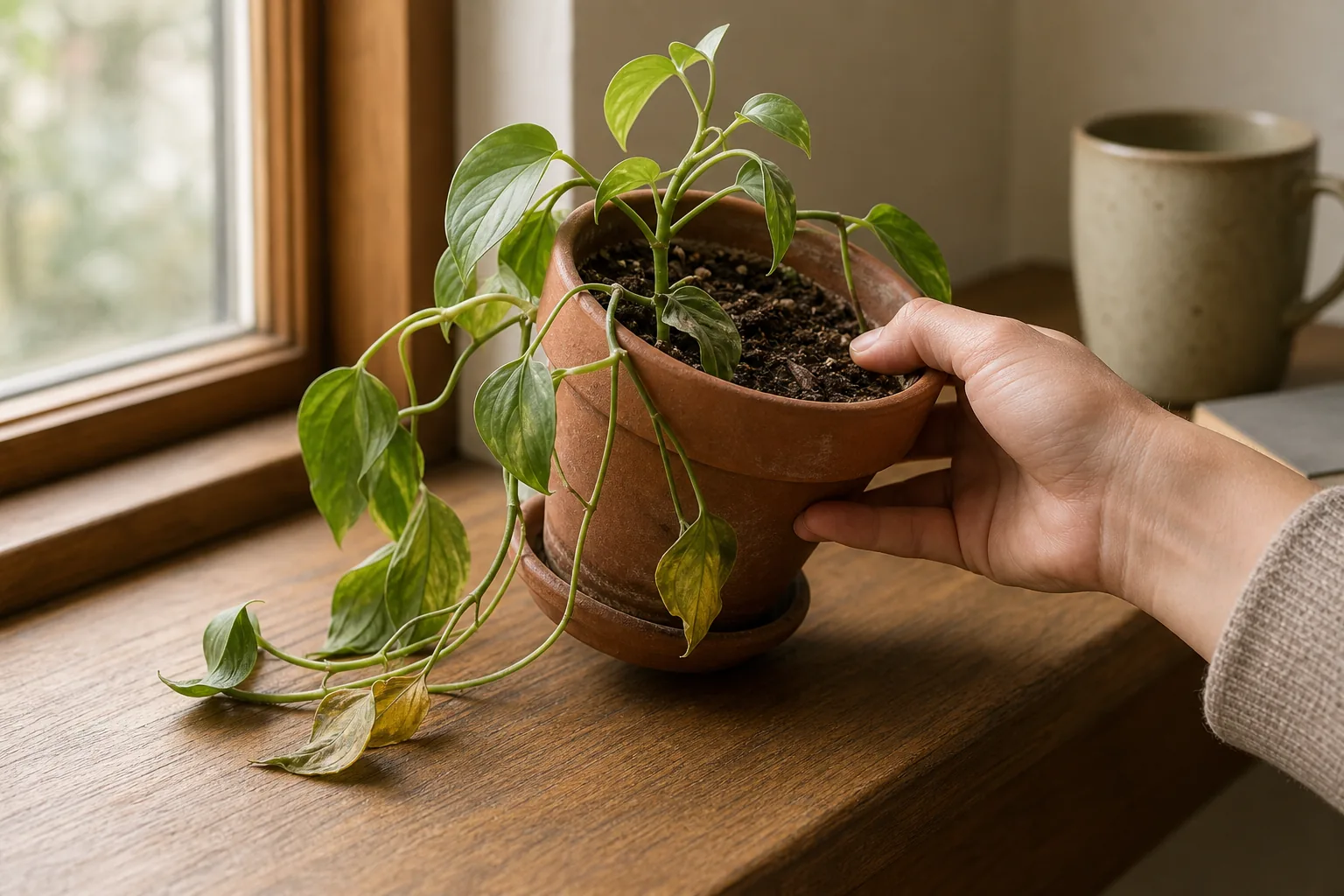
If a houseplant has been neglected, abandoned during a trip, or has simply slid into decline, the single most useful thing to do first is almost nothing. Spend about a minute observing the soil, the light at the current spot, and the recent history of the room. Then make one change, the most urgent one, and wait at least one to two weeks before doing anything else. Recovery from neglect is gradual, and adding more moves on top of an already-stressed plant is the most common reason a savable plant does not come back.
This article is the hub answer for “my plant has been neglected and now looks like it is dying, what do I do first?” It is not a list of miracle cures. It is a ranked, evidence-based sequence that protects the reader from the usual second-kill: doing five things at once.
What “revive” actually means, and what it does not
“Revive” gets used loosely. In this article it means putting a stressed plant back into stable conditions so it can regrow on its own. It does not mean turning damaged leaves green again, forcing a plant out of a natural slow season, or promising a specific recovery date.
Three things are worth saying plainly at the start:
- Brown leaf tips, crispy edges, and yellowed sections are dead tissue. They will not reverse. New growth is the only real signal that a plant is recovering.
- Recovery is gradual and depends on species, degree of damage, light, season, and root health. No honest source commits to a fixed timeline.
- Some neglected plants are too far gone. Recognizing that quickly is part of caring for the plant well, not a failure.
Before any rescue move: the 60-second observation
Most rescue mistakes come from acting on a guess instead of a read. Before doing anything, look at three things.
Soil moisture. Push a finger an inch or two into the medium, not just the surface. The surface can be dry while the deeper root zone stays wet, and vice versa. Lift the pot if you can. A noticeably lighter pot usually means dry medium. A heavy pot with wilted foliage usually means soggy medium and possible root loss. For a refresher on reading moisture by feel and weight, see watering by soil feel and pot weight.
Light at the spot. Look at where the plant actually sits, at the time of day you normally see it. A spot that was bright in October may be shaded by a neighbor’s tree in June. A window that gets a couple of hours of direct sun a few hours before or after you are home is not the same as a bright all-day spot. The natural light assessment guide helps confirm whether the current spot itself is part of the problem.
Recent history. Think about the last few weeks. A new window covering, a heater moved closer, an air vent now blowing directly across the pot, a recent repot, a recent move to another room, a vacation, a work crunch. The answer often lives here.
If the plant is wilted in dry soil, the first move is water. If the plant is wilted in wet soil, the first move is the opposite, and wilting in wet soil is the most dangerous case to misread. The diagnostic order in the overwatered-vs-underwatered guide matters more than any rescue tonic.
The one-change-at-a-time rule
The most reliable pattern in extension guidance on stressed plants is also the simplest: change one condition, wait, observe, and only then decide on the next move.
When readers do several things at once, two things go wrong. The plant is hit with several stressors at the same moment, which compounds shock instead of relieving it. And the reader cannot tell which move actually helped, so the same stack of fixes gets repeated on the next plant that struggles.
A practical version of the rule looks like this:
- Day 1. Make one change, usually correcting watering or, if the current spot is clearly inadequate, beginning a gradual move to better light. Take a dated phone photo and a one-line note of what you did.
- Days 2 to 14. Do not change anything else. Water only when the soil read says to, based on feel and pot weight. Watch for new growth, fresh firmness in stems, or a halt in further leaf loss.
- After two to four weeks. If the plant is stable or improving, decide the next single change. If it is still declining despite correct watering and stable light, re-check the diagnosis before adding anything new.
This is the same patience used when acclimating a new houseplant, and it applies for the same reason: a plant adjusting to consistent conditions is doing quiet work that does not look like recovery until new growth appears.
Move one: water, or light, applied gently
For most neglected plants, the first move is one of two things.
Correct the watering, gradually. If the medium is genuinely dry, water slowly and evenly until a little drains from the bottom. Repeat once the medium has had time to absorb, rather than flooding the pot in a single pass. University and botanical-garden sources emphasize that drought-stressed plants recover more reliably with consistent moisture over weeks than with a single large rescue dose. If a pot has dried out so thoroughly that water runs straight down the sides without wetting the root ball, many growers set the pot in a shallow tray of water briefly so the medium can rehydrate from below, then return to watering by feel and weight; if medium has become severely hydrophobic or compacted, that may be a sign to revisit it later rather than fight it during the first week.
Relocate only if the spot is clearly wrong, and only gradually. If the current spot is too dark, do not jump the plant to a bright south-facing window in one move. Shift it closer to the better spot over a week or two. Sudden changes in light are themselves a stressor, and a neglected plant is in no position to absorb another one.
What about pruning dead leaves and crispy tips? Removing fully dead material is fine and can reduce the surface area a stressed plant is trying to support. Trimming brown tip edges back is generally cosmetic; it will not speed recovery. Do not cut into healthy green tissue to “match” the dead edges. Common symptoms on neglected plants often overlap with what yellow leaves and brown tips and crispy edges describe in detail.
What to deliberately skip during recovery
Several well-meaning moves reliably make a recovery harder. It is worth naming them out loud.
Fertilizer. Fertilizer on a stressed or drought-affected plant is repeatedly cautioned against by extension and nursery sources. The plant cannot use the extra nutrients, and the salts can damage compromised roots. Wait for active new growth to resume, then return to a normal feeding routine guided by the houseplant fertilizer basics and the label on whatever product you use.
Repotting on hope. A bigger pot or fresh soil is not therapy. Repotting disturbs roots at the worst possible moment. It is appropriate only when there is a clear signal: roots circling tightly, water running straight through, mushy or foul-smelling roots, or a medium so compacted that it no longer absorbs water. Otherwise, leave the pot alone and revisit the question in a few weeks. The signs a plant is root bound guide, the when to repot guide, and the potting mix age check exist for exactly this decision, and they consistently recommend repotting during active growth rather than as a crisis move.
Leaf-shine, misting as a cure, and home remedy tonics. Foliar sprays do not substitute for rehydrating the root zone. Misting leaves wet foliage without changing the underlying problem and, in still rooms, can invite spotting. Hydrogen peroxide drenches, sugar water, aspirin, vitamin B cocktails, and Epsom salt solutions circulate widely as “rescue tonics.” No university extension source supports them for indoor plants, and they can interfere with the very roots the reader is trying to protect.
Multiple moves at once. If a reader does only one thing differently after this article, it should be this: stop stacking changes. Dropping several leaves after a recent move or change is more often the result of stacked moves than of any one condition, and the leaf drop after a move piece spells out why adding more changes on top makes things worse, not better.
The two-week quiet watch
Recovery shows up in small, specific signals. New leaves unfurling from the growing point. Stems firming up instead of feeling limp. Existing damaged leaves staying as they are, with no further yellowing or drop. A return of normal color in new growth even where old leaves are still marked.
Decline shows up as well. Continued leaf drop including fairly green leaves. Soft or blackening stems at the base. A sour or swampy smell from the medium. New leaves emerging misshapen or translucent, which can point to ongoing root damage.
If the plant is stable after two to four weeks of correct watering and stable light, the next single change can be considered. If it is still declining, the diagnosis was probably incomplete, and it is time to look at roots, medium condition, and pests more carefully before adding anything new.
When the plant is too far gone
Some plants do not recover. Recognizing that quickly is honest and saves the reader weeks of pouring effort into a dead root system.
A few checks are appropriate before discarding:
- Stems. On thick-stemmed plants, scratch lightly under loose outer bark or peel a small sliver near the base. Green or moist tissue just under the surface means the plant is still alive. Brown, dry, or hollow tissue throughout means the upper growth is gone.
- Crown and rhizome. Some species, depending on type, die back to an underground rhizome during stress or dormancy. A firm rhizome with no mushiness can still be alive, even if every leaf has dropped. A mushy or blackened rhizome is not.
- Roots. Lift the plant only if the medium is already going to be replaced for another reason. Generally, healthy roots feel firm and look light-colored, while rotted roots feel soft, look dark, and may smell sour. Confirm with a local nursery or extension service if the read is uncertain.
A totally brown, leafless plant is not automatically dead, but it is at the edge of what a reader can rescue alone.
When to ask a local nursery or extension service
This article is general guidance, not a diagnosis. If the situation is ambiguous after a week of correct watering and stable light, the next step is a local nursery, a master gardener program, or a regional extension office. They can look at the actual plant, identify pests or disease-like symptoms in person, and recommend a course of action that fits the specific species and home conditions. Houseplant Supplies is an educational journal and shop, not a remote diagnostic service.
A short summary of the rule
Observe first. Change one condition at a time, starting with the single most urgent. Wait at least one to two weeks before the next move. Skip fertilizer, repotting on hope, leaf-shine, and home remedy tonics. Accept that dead tissue will not reverse and that recovery is shown by new growth. Some plants will not come back, and that is part of the honest answer.
Sources
- University of Maryland Extension, Drought Stress to Indoor Plants: https://extension.umd.edu/resource/drought-stress-indoor-plants
- UF/IFAS Gardening Solutions, Plants and Drought: https://gardeningsolutions.ifas.ufl.edu/care/weather/plants-and-drought/
- Morton Arboretum, Drought Care: https://mortonarb.org/plant-and-protect/tree-plant-care/plant-care-resources/drought-care/
- Penn State Extension, Repotting Houseplants: https://extension.psu.edu/repotting-houseplants
- Brooklyn Botanic Garden, When, Why, and How to Repot Your Houseplants: https://bbg.org/article/when_why_and_how_to_repot_your_houseplants
- Monrovia, Should I fertilize a stressed plant?: https://go.monrovia.com/help/should-i-fertilize-a-stressed-plant
- West Central Tribune (Master Gardener Sue Morris), Avoid fertilizing dormant or drought-stressed plants: https://www.wctrib.com/lifestyle/master-gardener-sue-morris-avoid-fertilizing-dormant-or-drought-stressed-plants
- University of Georgia Extension (Lincoln County), Transplanting Landscape Plants: https://site.extension.uga.edu/lincoln/transplanting-landscape-plants/
- California Native Plant Society, Marin Chapter, Gardening During Drought: https://cnpsmarin.org/gardening-during-drought/