Plant care
Why is my houseplant wilting even though the soil is still wet?
· Updated
Wilting leaves on a houseplant with wet soil is one of the most common moments of confusion in indoor plant care. The instinct is to water, because drooping usually means thirst. When the soil is already wet, the right move is to pause and inspect instead. Multiple university extension services describe wilting-in-wet-soil as a symptom pattern with several possible causes, and re-wetting already saturated roots can make recovery harder rather than easier.
The most common causes in an ordinary home are physical, not infectious. They include a pot without drainage or a cachepot holding water, compacted or broken-down potting mix, a root-bound plant, recently disturbed roots from a recent repot, or simply cold, stagnant conditions that have slowed the roots down. True root disease is one possibility among several, and it usually takes more than a glance to confirm. A calm five-minute inspection often narrows the list without any chemicals, tools, or specialist visits.
Stop before you add more water
If you take only one thing from this article, take this: do not add more water until drainage, recent changes, roots, and room conditions have been checked. The leaves are drooping because the plant cannot move water up to them fast enough, and that is as true in a saturated pot as it is in a dry one. Extension sources describe how re-saturating already damaged roots worsens decline rather than relieving it.
The order below is the order most often recommended in extension material: drainage first, then recent changes, then root inspection, then room conditions. Working through them in sequence keeps the most likely, most fixable causes at the top of the list.
How wet is the soil actually? Lift and feel deeper, not just the surface
Surface dryness can be misleading. A pot can feel dry an inch down while the lower half is still saturated, especially in peaty mixes that hold water below the surface or in pots where the top layer dries while the lower layer stays waterlogged.
Two quick checks:
- Lift the pot. A recently watered pot feels noticeably heavier than a dry one, and a saucer full of water adds hidden weight. This is also a quick way to notice whether water has been sitting in the bottom for a while.
- Push a finger or a wooden chopstick two inches into the mix. If the lower layer is cool, dark, and damp, the plant has plenty of moisture even if the top looks dry.
A moisture meter works too if it is already part of your routine. The point is the same: do not rely on the surface to decide whether the plant is thirsty.
Check the pot: drainage, sit-in-water, and the cachepot trap
Drainage is the single highest-leverage variable when soil is already wet. Look at the bottom of the pot and ask three questions:
- Does the pot have drainage holes? Decorative pots without holes are common, and water can sit at the bottom of the mix with no way out.
- Is the saucer full? After watering, water should be emptied from the saucer once the pot has had a few minutes to drain. A saucer that is always wet keeps the lower half of the rootball saturated.
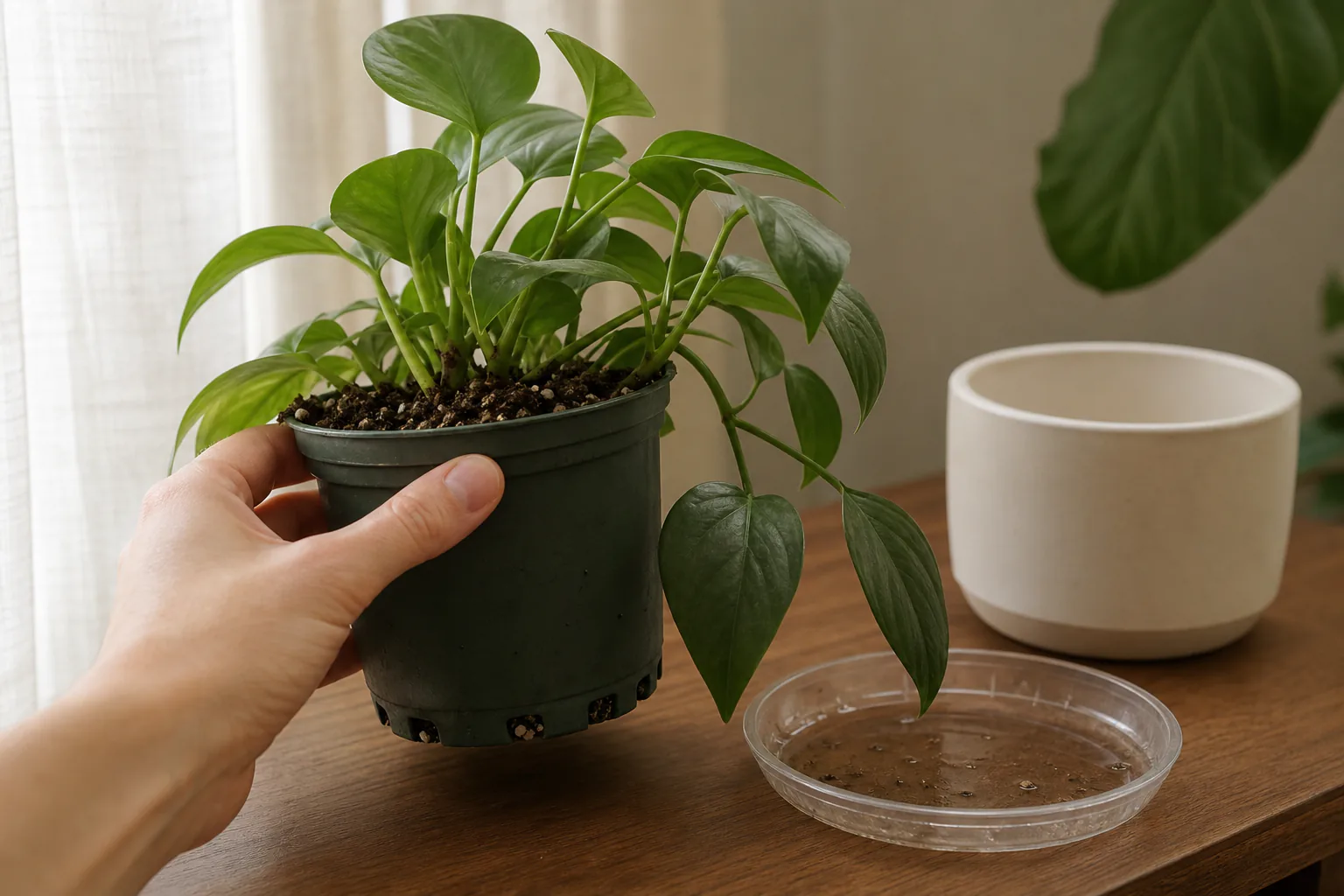
- Is the cachepot holding water? A cachepot is a decorative outer pot that the grow pot sits inside. If water collects in the cachepot below the inner pot, the roots sit in that water for as long as it takes to evaporate, which can be days.
These three traps produce the same end result: a rootball sitting in saturated, oxygen-poor conditions. Extension sources describe this suffocation as the reason a well-watered plant can still wilt. The roots need air as well as water, and when air is displaced, the roots cannot move moisture up to the leaves even when plenty is present below. Some nurseries describe this kind of wilting as transpirational wilt, where the plant cannot move water fast enough to keep leaves turgid even though moisture is available.
If the pot has no drainage and water has been sitting in the bottom, the fix is usually to move the plant into a pot that drains, with a tray underneath that is emptied after watering. For more on this, see why drainage holes matter for overwatered-looking plants.
What changed in the last two weeks? Repotting, move, new light, fertilizer
Recent changes are easy to overlook because they feel like background noise, but they are often the explanation. Wilting that appears within days of a repot is usually transplant shock: the roots were disturbed, the mix settled, and the plant needs time to re-establish. Adding more water at this point usually makes it worse.
A few changes worth noting:
- A recent repot, especially into a much larger pot or into a denser mix
- A move to a new room or a new window, which can change light intensity overnight
- A change in watering schedule, or a new watering routine someone else in the home is following
- A first feed of fertilizer, or a stronger-than-usual dose
- A change in season, with the heating or cooling running more often
When any of these lines up with the timing of the wilting, that is a useful clue. The PNW Plant Disease Management Handbook is direct on this point: on-site inspection of the plant, environment, and management history is more reliable than matching symptoms to a list of diseases from memory.
Look at the roots before you look up a disease
Root inspection sounds more invasive than it is, and it is the single most useful step when the simpler causes have been ruled out. The goal is to look, not to fix anything yet.
Slide the rootball out gently. If it is stuck, work a chopstick or a butter knife around the edge to loosen it rather than pulling on the stem. Once it is out, look at the roots:
- Healthy roots are firm and pale, white to tan, and they hold their shape.
- Damaged roots are brown or black, soft or mushy, and may pull apart easily or smell sour.
Some older plants will have a few discolored roots at the bottom on their own; that alone is not a cause for alarm. A dense mat of circling roots at the edges is a sign the plant is pot-bound and the mix has broken down. A rootball that is uniformly dark, soft, and sour-smelling is a stronger signal of prolonged saturation and possible root damage.
Wash hands or use clean gloves before and after. If any trimming is needed, use clean snips. Beyond basic hygiene, do not apply fungicides, hydrogen peroxide baths, or other chemical treatments as a default response; extension sources recommend inspection and cultural correction first. For a side-by-side look at the signs that point toward overwatering versus underwatering, see how to tell overwatering from underwatering in a houseplant.
Temperature, drafts, and why cold roots drink less
Room conditions are the last part of the inspection, and they are the part most often missed. Two situations come up regularly:
- Cold roots. A plant sitting near a cold window, an exterior door, or an uninsulated floor can have root-zone temperatures well below the rest of the room. Cold roots move water slowly, and a plant that cannot drink fast enough can wilt even when the soil is wet. Extension sources do not quote a specific indoor temperature threshold for slowed root uptake in ordinary houseplants, but the direction is consistent: cold, wet soil slows the roots down.
- Warm, dry air. A plant near a heating vent or in direct afternoon sun can lose water through its leaves faster than the roots can replace it, even when the soil has plenty of moisture. The pattern is usually different from root damage: leaves tend to droop through the day and may recover overnight.
A simple test is to move the plant a few feet away from the suspected draft or heat source for a couple of days and see whether the pattern changes.
What to do in the next 24 to 72 hours
Once the inspection is done, the next steps depend on what was found, but the general sequence is the same:
- Stop watering until the lower half of the pot has begun to dry. With drainage and good airflow, this often takes a few days for a small pot and up to a week or more for a large one.
- Empty any standing water from saucers and cachepots.
- Improve airflow around the pot if the room is still and the mix smells sour. A small fan on a low setting is usually enough.
- Move the plant out of any cold draft or direct heat if applicable.
- Hold off on fertilizer until new growth resumes.
Recovery from root stress is usually measured in weeks rather than days. Stabilization is a reasonable near-term goal, and full recovery, meaning new leaves at the expected rate for the species, often takes longer. The exact timeline varies by species, by severity, and by season, so it is worth treating any quoted number as approximate.
If the inspection showed a rootball that is dark, soft, and sour-smelling throughout, the next step is usually to remove the plant, gently shake or rinse the old mix from the roots, trim away roots that are clearly dead, and repot into fresh, well-draining mix in a clean pot with drainage. This is a reasonable response when the inspection is clear, though a local nursery or extension office can confirm whether repotting is the right next step in your specific case.
When to stop troubleshooting and ask a local expert
Home inspection can narrow the possibilities for most wilting-in-wet-soil cases, but it has limits. Consider reaching out to a local nursery, a master gardener clinic, or a county extension office when any of the following apply:
- Wilting has not improved after drainage, watering, and airflow have been corrected for several days
- Multiple leaves are yellowing or dropping rapidly, or the stem base feels soft
- The root inspection shows extensive dark, mushy roots across most of the rootball
- The same pattern keeps repeating across different plants in the same room, which suggests a wider environmental or water-quality issue
A local expert can look at the plant, the pot, and the room in person, and that is more reliable than remote symptom matching. The PNW Plant Disease Management Handbook makes this point directly: on-site inspection of the plant, environment, and management history is more reliable than matching symptoms to a list of diseases from a distance.
The short version: wet soil and wilting leaves are a signal to slow down, not to water again. Drainage, recent changes, root condition, and room temperature are the four places to look, in that order. Most of the time the cause is one of the first two, and the fix is a matter of minutes rather than chemicals.