Plant care
Signs your houseplant is root bound, and what to do next
· Updated
What “root bound” actually means (and why it isn’t a binary)
A root-bound houseplant is one whose roots have grown beyond the container’s volume, displaced most of the potting mix, and started to circle or overlap at the bottom of the pot. That’s how university extension services describe the condition: less a fixed state and more a sliding scale from “snug” to “constricted.” A plant with a few visible roots at the drainage hole or on the soil surface is usually on the snug end of that scale. A plant whose root ball has become a hard, tightly circling mass that holds the exact shape of the pot is on the constricted end.
The reason the spectrum framing matters is that many indoor plants tolerate a slightly snug pot for extended periods. The trouble starts when the root mass has crowded out the potting mix, which is what actually does the holding of water and air. So the question is not really “is my plant root bound?” but “is the pot actually constraining this plant right now?” Answering that takes two stages: surface clues first, then a careful root inspection.
Surface clues you can check without disturbing the plant
Before sliding anything out of its pot, run through a short list of clues that simply ask the plant to be looked at properly. Each one on its own is a prompt to look closer, not a verdict.
- Roots at or through a drainage hole. A single pale root peeking out of the bottom is normal. Multiple roots, or roots that have grown into a tangle under the pot, are worth investigating.
- Top heaviness. If the plant leans or tips despite a fairly small pot, the visible top growth may have outgrown what the root ball can anchor.
- Water that runs straight through. When you water and it pours out the bottom almost immediately, the root mass has displaced much of the mix that would normally absorb and hold moisture.
- Soil that dries unusually fast. A dense root ball has less medium to retain water, so the plant needs watering far more often than it used to.
- Slowed or stalled growth. If light, water, and fertilizer haven’t changed and the plant has stopped pushing out new leaves, the root system may be the bottleneck.
- Soil pulling away from the pot edges. As the root ball shrinks and swells with watering cycles, the mix can separate from the pot wall, leaving a gap.
These clues together are more meaningful than any one of them alone. A single root at the hole, with normal watering and steady growth, is not an emergency. The same clue in a plant that wilts between waterings and hasn’t grown in months is a reason to inspect.
When and how to do a careful root inspection
The step that actually converts a clue into a finding is sliding the plant out and looking at the root ball. For most small to medium houseplants this is straightforward: water a day or two beforehand so the root ball holds together, lay the pot on its side, support the stems with one hand, and gently squeeze or tap the pot to loosen the root mass. Ease it out without yanking.
A healthy root ball usually holds its shape but stays loose enough to handle. You can see potting mix between the roots, and the roots themselves are firm and pale — white, cream, or tan, sometimes with fleshy white tips. The ball might need a light shake to release loose mix, and that’s fine.
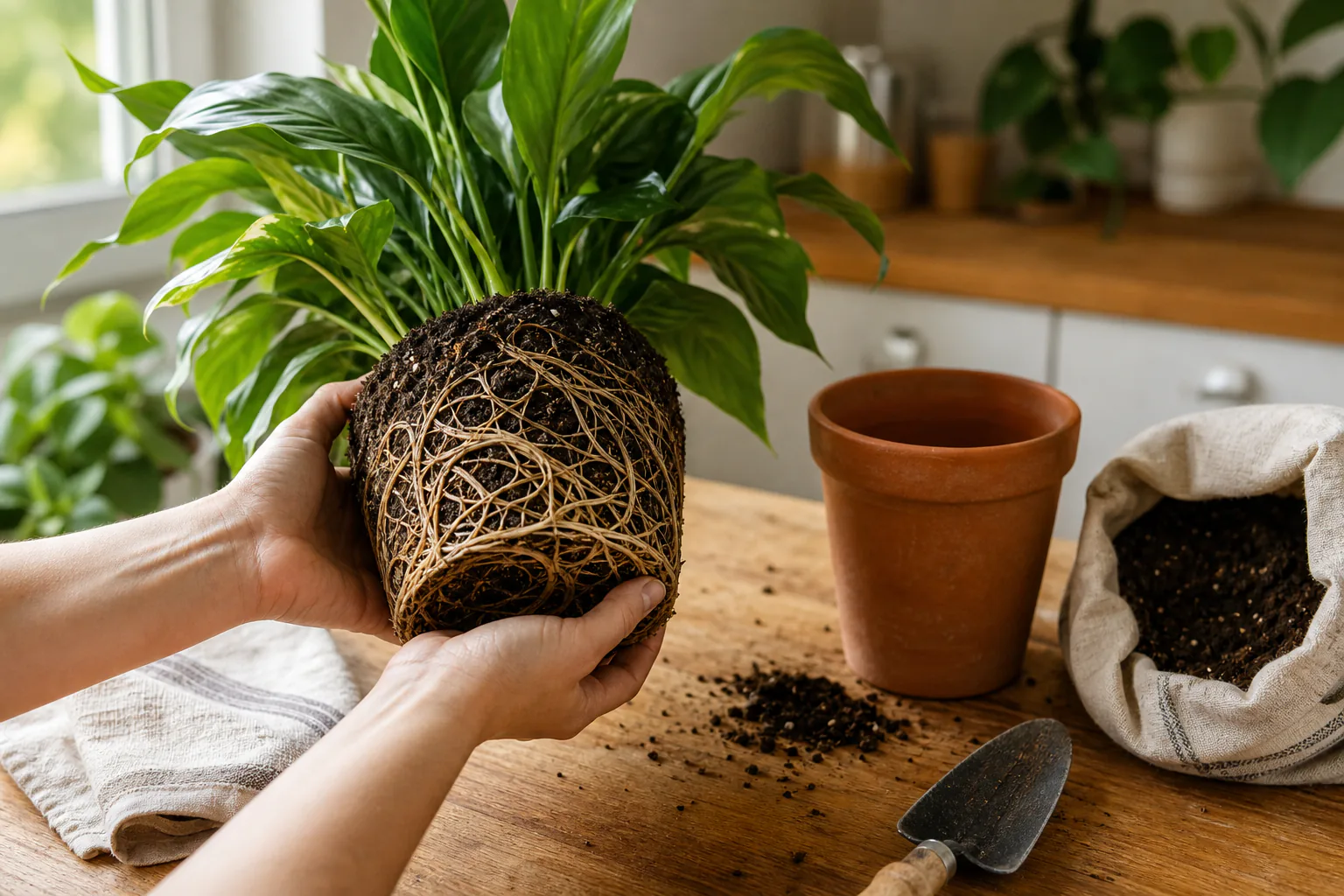
What you’re checking for is whether the roots are still moving through the soil or have started to define the shape of the pot. A few roots visible on the outside of the ball is normal. A hard, densely matted cylinder that comes out wearing the exact impression of the pot, with little or no mix visible, is the pattern that suggests real constriction.
Reading the root ball: what different patterns suggest
Once the plant is out, take a minute to actually read what’s there before deciding anything.
Healthy pattern. Firm pale roots, mix still visible between them, the ball holds together but isn’t rigid. Many roots are visible at the surface and around the sides, but they aren’t circling tightly. This is a snug plant, not a constrained one. Put it back.
Circling or matted pattern. Roots wrap the inside of the pot in a recognizable spiral, especially along the bottom and lower sides. Mix is sparse or absent between roots. The ball is dense and may resist crumbling. This is the classic root-bound pattern and is the case where the pot is genuinely doing the constraining.
Girdling pattern. A smaller subset of plants develop roots that wrap tightly around the main stem base or circle the upper part of the root ball. This pattern can be a sign of more advanced constriction and is worth acting on if you see it.
Unhealthy roots regardless of density. Brown to black, soft, mushy, slimy, or foul-smelling roots point to rot, which is a different problem from being root-bound. A plant can be root-bound and rotting at the same time, but the response to rot is different from the response to crowding, and the two should not be confused. The plant-care guidance for diagnosing root problems at home is observational and educational; persistent rot or rapid decline is a good reason to bring a sample or photo to a local nursery or extension office.
Pot size, plant size, and species context
Two plants in identical pots can be in very different conditions. A slow-growing succulent in a small pot may sit happily for years; a fast-growing tropical can fill the same pot in a season. Pot material also plays a role: porous terracotta dries faster than glazed ceramic or plastic, which can change how a snug root ball is experienced day to day.
There is a widely repeated idea that some houseplants “like to be root bound” — snake plants, peace lilies, spider plants, and pothos are common examples. The lead university extension and botanical garden sources in this area don’t confirm that as a rule. What’s safer to say is that certain species tolerate a snug root ball for longer than others, and that this tolerance depends on light, watering habits, and the size of the plant relative to the pot. If you’ve heard that your plant “prefers to be tight,” treat it as a starting hypothesis, not a directive, and let the inspection be the deciding vote.
Graded next steps: leave it, refresh the mix, or upsize
Once you’ve inspected the root ball, the response usually falls into one of three buckets.
Leave it alone. The roots look healthy, the mix is still doing its job, and the plant is growing. Slide it back into the same pot, top up any depleted mix at the surface, and keep your usual routine. This is a more common outcome than the internet suggests.
Refresh the same pot with new mix. The roots are fine but the medium has compacted, broken down, or pulled away from the pot edges. Knock off the loose old mix, tease out only what’s clearly spent, and repot into the same container with fresh mix. This is often the right move when the problem is the medium rather than the root mass.
Upsize modestly. The root mass is dense and circling, and the pot is genuinely constraining the plant. Move to a slightly larger container with fresh mix so the roots have new medium to grow into. The exact upsize is something the when to repot a houseplant and when to leave it alone guide handles in detail; the general principle is a modest step up rather than a dramatic jump.
Root pruning, scoring, or aggressive teasing of the root ball is sometimes suggested in this situation, but it isn’t a routine step in most extension guidance. If the root ball is mildly circling, gentle loosening at the edges is reasonable. Deep cuts into a healthy root mass aren’t necessary as a default and can be skipped unless you have a specific reason.
What changes the answer
The same plant in the same pot can read very differently depending on context. In a darker or cooler season, slowed growth is expected and is not, by itself, evidence of a constrained root system. A recently purchased plant that has just sent a root to the drainage hole is often simply establishing, not signaling for an emergency repot. Conversely, a plant that has been in the same pot for several years and is now wilting between waterings is more likely to be genuinely constrained.
Watering habits change the picture too. A plant that’s been chronically overwatered may show wilting and yellowing leaves that look like root-bound symptoms but actually reflect root suffocation or rot. Light level matters: a plant in a dim corner grows slowly regardless of pot size, and slow growth there is not a root-bound signal.
Common misconceptions worth letting go of
A few ideas come up again and again and are worth retiring.
- A root at the drainage hole means it’s time to repot. Not on its own. It’s a prompt to inspect, nothing more.
- “Root bound” is binary. It isn’t. Most houseplants sit somewhere on a spectrum from snug to constricted, and only one end of that spectrum needs action.
- A plant in the same pot for years is automatically root-bound. Potting mix can age out while the root system is still fine; in that case, refreshing the mix is the response, not necessarily upsizing.
- Wilting or yellowing leaves always mean root-bound. Those symptoms have many possible causes — light, water quality, drafts, pests, fertilizer — and root-bound is only one of them.
- Repotting is always the right next step. Often the right next step is to do less.
The diagnostic move that ties all of this together is the inspection. Slide the plant out, look at the roots, smell the root ball, and let what you see — not what you assumed — decide what happens next.