Plant care
Choosing a houseplant for a desk in an office with limited natural light
· Updated
A desk plant in low light will most likely survive, not thrive. The honest answer is to start by reading what your specific desk actually receives — distance from any window, hours of indirect daylight, the shadow test, exposure to HVAC drafts — and then pick from species with documented tolerance for low-to-medium indirect light. If the desk is genuinely windowless, a small grow light on a timer is a more honest solution than any plant alone.
What “limited natural light” usually means at an office desk
A perimeter desk a meter or two from a north-facing window, or any window with sheer curtains, usually receives enough indirect daylight for many foliage plants to maintain themselves slowly. A cubicle two meters or more from any window, lit only by overhead LED or fluorescent panels, is a meaningfully darker environment.
UF/IFAS frames this contrast by noting that an office lit only by fluorescent bulbs often sits around 40 foot-candles or fewer, which is at the low end of what foliage plants tolerate. If your desk is in that second category — interior cubicle or windowless office — you should expect survival and slow growth, not vigorous foliage.
The University of Arizona Cooperative Extension adds another useful anchor: most plants need 12 to 16 hours of artificial light per day for good growth. A standard 8-to-5 office schedule falls short of that, which is part of why desk plants tend to plateau rather than fill out.
Read the desk before you pick the plant: a four-pass check
Before browsing species lists, run a quick pass at the actual desk surface:
- Shadow test. Hold a piece of paper or your hand flat on the desk at midday. If you see a defined, soft-edged shadow, the desk receives meaningful indirect daylight. If the shadow is barely visible or absent, you are looking at fluorescent-only or genuinely dim conditions.
- Distance from any window. Less than about 1 to 2 meters from a window usually gives usable indirect light. Past 2 to 3 meters, you are relying mostly on overhead fixtures.
- HVAC exposure. Is there a supply vent directly above the desk, or a return grille on an adjacent wall? Both dry the air and the soil faster than a still corner of a home shelf.
- Footprint and traffic. Does the plant sit where coworkers will brush past it, where a chair can knock it, or where a video call background catches every yellow leaf?
For a deeper walk-through of the shadow test and brightness categories, see how to read natural light in the room.
Realistic expectations: survive vs. thrive on a desk in low light
Most popular “best office plants” lists are written from a window-friendly home, not from a windowless cubicle. The honest framing is:
- In a perimeter desk with some indirect daylight, snake plant, ZZ, pothos, heartleaf philodendron, peace lily, and Chinese evergreen can all survive for months and grow slowly. New leaves will be smaller than the same plant on a bright windowsill.
- In a windowless interior cubicle under overhead fixtures only, the realistic outcome is survival, possibly a single new leaf per season, and gradual leaf-by-leaf turnover. Stems may stretch toward whatever light source exists; that is the leggy signal discussed in why a houseplant grows leggy.
- Variegated forms of pothos, philodendron, and Chinese evergreen will revert partially toward solid green in low light because the plant is not producing enough energy to maintain the lighter sections.
For the deeper framing of what low-light tolerance actually means in practice, the article on realistic expectations for low-light houseplants is the better reference.
Species commonly used on desks with limited natural light
These six species show up repeatedly in university extension and botanical garden guidance as tolerant of low-to-medium indirect light. Each has honest tradeoffs for an office context.
Snake plant (Dracaena trifasciata)
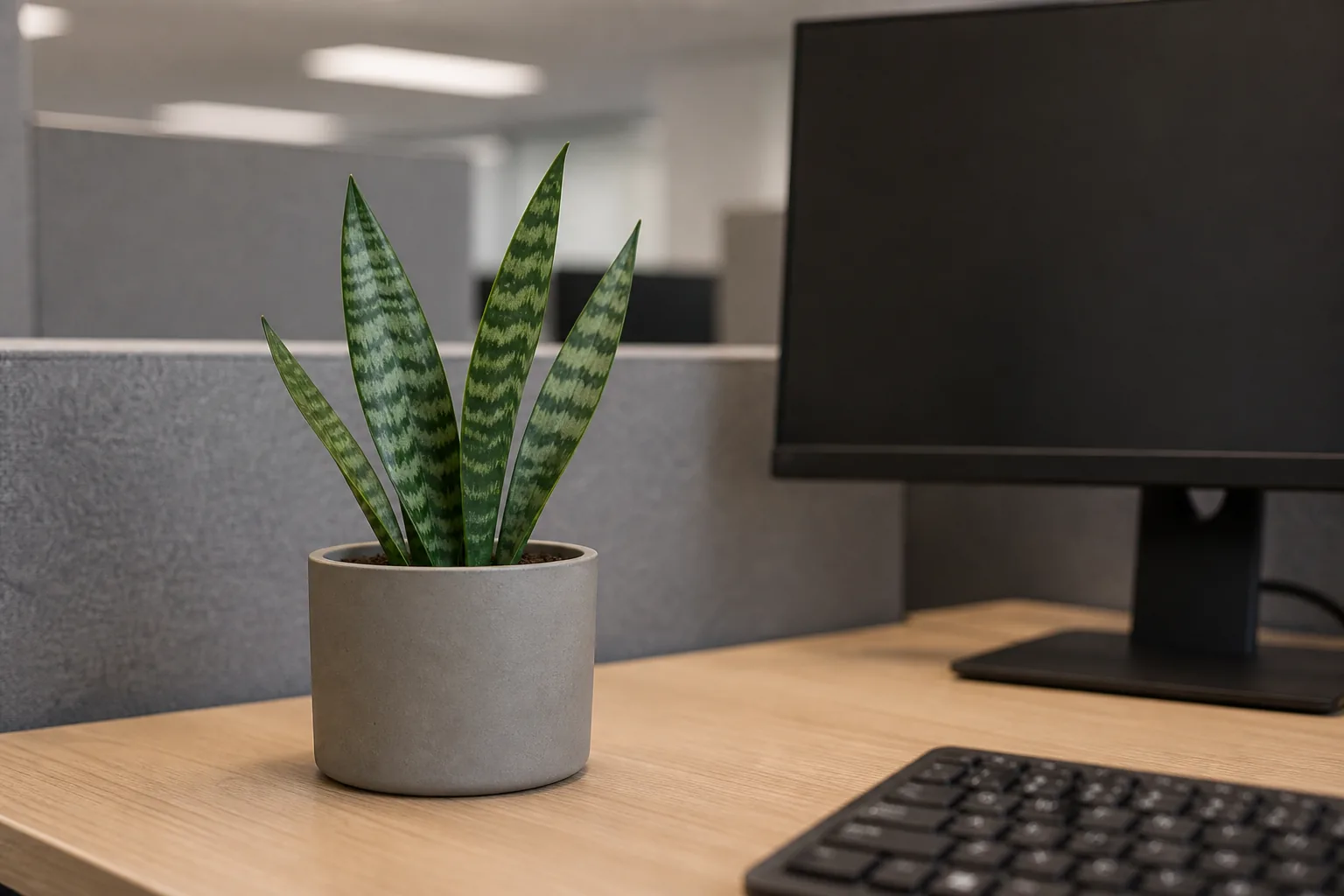
Penn State Extension documents snake plant’s well-known reputation as a low-light tolerant indoor plant, with indoor leaves that can reach up to four feet. NC State Plant Toolbox lists it as a container and interior landscape plant. On a desk in low light it will grow slowly and may not produce new leaves for months, but it tolerates inconsistent watering better than most. In low light the bigger practical risk for snake plant is overwatering — soil dries slowly, so the interval between waterings should be longer than at a bright windowsill.
ZZ plant (Zamioculcas zamiifolia)
ZZ is frequently paired with snake plant in office recommendations for the same reason: both tolerate low light, and both are more forgiving of missed waterings than most foliage plants. ZZ is even slower to show change than snake plant, which can be reassuring or frustrating depending on what you want from a desk plant.
Pothos (Epipremnum aureum)
Pothos is commonly cited as a low-to-medium light trailing plant. On a desk it will trail over the edge of the pot or shelf, but in genuinely low light the leaves will be smaller and variegated cultivars will fade toward solid green. It is a better match for a perimeter desk with some indirect daylight than for a windowless interior.
Heartleaf philodendron (Philodendron hederaceum)
Similar care family to pothos, but heartleaf philodendron tends to fill a small pot more densely rather than sending out long vines. It tolerates medium indirect light better than deep interior dimness, and the leaves will be smaller and less dramatic in low light.
Peace lily (Spathiphyllum)
Peace lily is often labeled a “low-light plant” in popular lists, but extension publications more often describe it as preferring medium indirect light. Its advantage on a desk is the visible droop signal: when it needs water, the leaves droop clearly, which removes some of the guesswork from an office watering rhythm. The tradeoff is that flowering is uncommon in dim office conditions, and it prefers more consistent moisture than snake plant or ZZ.
Chinese evergreen (Aglaonema)
Chinese evergreen is often grouped with the most light-tolerant foliage plants and tolerates uneven watering better than peace lily. It is a compact foliage plant that holds its shape on a small desk footprint. Growth is slow in dim conditions, but the plant is unlikely to collapse.
For species-specific care detail, the snake plant care without the low-light myths, ZZ plant care guide, pothos care in real rooms, heartleaf philodendron care guide, peace lily droop and watering, and Chinese evergreen care for lower-light rooms articles cover the routines and signals for each.
Placement details that change the answer
Species choice matters less than placement once you are in a dim office. Three details move the answer.
- HVAC supply vents. A vent directly above the desk dries foliage and soil faster than the same plant on a still home shelf. Move the plant off the direct airstream if you can; even a half-meter shift makes a noticeable difference. For the wider framing of drafts and vents around a houseplant, see drafts and vents around a houseplant.
- Monitor and equipment heat. The bigger risk here is a plant placed against a warm monitor base or under a printer that runs warm. A few centimeters of clearance is usually enough.
- Window proximity. A desk a meter from a north-facing window is meaningfully brighter than a desk three meters from the same window. If you can shift the plant closer to the window side of the desk, even by a meter, do that before changing species.
Watering rhythm at a desk
In low light the plant uses less water, so the interval between waterings will be longer than at a bright windowsill at home. The University of Missouri Extension puts it plainly: never water a plant unless it needs it, because soil kept either too wet or too dry causes roots to die.
The practical method is observation, not a calendar. For most of the species above, lift the pot: a dry pot feels noticeably lighter than a recently watered one. For snake plant and ZZ, the top inch or two of soil should be dry before you water. For pothos and heartleaf philodendron, the top inch drying is a reasonable cue. For peace lily, the droop is your signal — water when the leaves visibly soften, not before.
Use a pot with drainage. In low light, soil dries slowly, which makes drainage more important, not less. A cachepot setup (a plastic nursery pot inside a decorative outer pot) gives you the office-friendly look without trapping the roots in standing water. Empty the cachepot after watering. For the wider reasoning, the watering without a schedule article walks through the soil-check approach.
Weekends away — two to three days without watering — are usually fine for snake plant, ZZ, and a slightly stressed pothos. Peace lily is the riskier choice if you are away for long weekends, because it prefers consistent moisture.
When a small grow light is the more honest answer
For a genuinely windowless interior desk, no plant will grow vigorously without supplemental light. Sugano et al. (2024) studied ornamental plant survival under office low-light conditions without daylight and found some species survive in those conditions — but none grow the way they would near a window. A small clip-on or under-shelf LED grow light on a 12 to 14 hour timer is the practical fix. It does not change the look of the desk dramatically, and it makes any of the species above a more realistic long-term choice. If your office cannot accommodate a grow light, accept that the plant is a seasonal companion rather than a permanent fixture and plan to replace it when it declines.
First-month signals to watch for
A new desk plant should not change much in the first month, and that is normal. The signals that matter:
- A few yellow leaves at the base. Common in the first month as the plant adjusts to lower light; usually not a problem unless it accelerates.
- Soft, dark stem bases. Almost always overwatering in low light. Stop watering and let the soil dry further.
- Stems stretching toward a light source with widely spaced leaves. The desk is dimmer than the species tolerates, and a grow light or a move closer to a window is the fix.
- Crisp brown leaf edges. Often a supply vent or under-humidity issue, not a light issue.
If the plant collapses within the first month despite correct watering and placement, one common cause is that it may have arrived in poor condition from the supplier rather than failing at your desk. For symptoms you cannot read confidently — sudden leaf drop, spots, sticky residue — your local nursery or cooperative extension office is a better next step than any online list.
A note on pets
If the desk plant will come home on weekends or live in a space shared with pets, the species above are not all equally safe to have around cats or dogs. Rather than restating toxicity severity here, the better resource is the verification method for pet-aware houseplant choices, which walks through how to check each species against current references before bringing it home.
Sources
- Light for Houseplants — UF/IFAS Gardening Solutions
- Low Light Houseplants — Penn State Extension
- Dracaena trifasciata — NC State University Plant Toolbox
- Indoor Plant Selection and Care — University of Arizona Cooperative Extension
- Caring for Houseplants (G6510) — University of Missouri Extension
- Adaptation of indoor ornamental plants to various lighting — Sugano et al., 2024 (PMC NCBI)