Plant care
What low-light-tolerant houseplants can actually do in a dim room
· Updated
A “low-light-tolerant” houseplant is a plant that can survive in lower light. It is not a plant that grows well there. That gap between surviving and thriving is what most readers actually want to understand before buying.
Across university extension and botanical garden literature, “low light” is a narrow, defined band rather than a description of a dark room. It is the light bright enough to read a newspaper by at midday, often somewhere in the range of tens to low hundreds of foot-candles depending on which institution you ask. The University of Maryland Extension, for example, places low light at roughly 25–100 foot-candles, typical of north-facing windows or rooms lit mainly by artificial light. Other extension sources place the band higher. None of these numbers describe an interior hallway with no windows or a closed-off corner that never sees usable daylight.
What this means in practice: a tolerant plant in a true low-light spot will live. It will likely grow more slowly, push out fewer and smaller leaves, and may drop older leaves to balance what little light it has. Many will not flower reliably indoors. If you need lush, dense, fast growth, low light is the wrong place to look.
What “low-light tolerant” actually means (and does not mean)
Marketing language tends to use “low-light plant” the way “low-maintenance” is sometimes used, to suggest easy conditions. Extension and botanical garden sources are more careful. The University of Minnesota Extension describes low-light plants as species grown primarily for their foliage rather than for flowers, and notes that more light is generally required for dense foliage and flowers to develop. The Chicago Botanic Garden calls plants like snake plant, spider plant, and cast-iron plant “workhorses” for low-light settings, a deliberately modest word.
“Tolerant” is the right verb. It signals that the plant can endure a constraint that is well below its ideal. Tolerance is not the same as preference, and it is not the same as performance.
A useful framing: every houseplant has a light range where it grows vigorously and a lower light range where it survives. The species sold as “low-light tolerant” are those whose survival range extends further down. They make it possible to keep a plant in a dimmer spot than most plants would tolerate, but they do not turn a dim spot into a bright one.
Tolerance vs. ideal conditions: the honest gap
The same species placed in different light will visibly look different. Texas A&M AgriLife Extension describes the difference plainly: plants grown in low light tend to be spindly with light green leaves, while the same species in brighter light tend to be shorter, sturdier, and a deeper green.
That visual change is the most honest signal you have. If you take a snake plant or a peace lily from a nursery bench and place it in a dim corner, the leaves that emerge in your home will tend to be longer, narrower, paler, and slower to appear than the leaves it grew under greenhouse light. The plant is not failing. It is adjusting. Over months, this is what surviving in low light actually looks like.
Two practical consequences follow. First, do not judge the species by the dim-corner specimen. Nurseries and growers display these plants under much brighter light, so the visible size and leaf density reflect better conditions than yours. Second, the slower you expect growth to be, the easier it is to notice when watering, root health, or seasonal shifts are actually causing the problem rather than the light itself.
How to read your dim room before you choose a plant
Before picking a species, spend a day reading the room. The published guide on how to read the natural light in your room walks through that process in more depth. A short version:
- Observe the spot at three points during the day: morning, midday, and late afternoon. Note which hours receive any direct sun, which receive only indirect light, and which sit in shade the entire day.
- Use a simple proxy at midday. At the spot where the plant will sit, can you comfortably read a newspaper without artificial light? If yes, the spot is at least inside the low-light band. If no, the spot is at or below the practical floor for most green plants.
- If you want a number, a basic light meter, including many phone-based options, reports foot-candles or lux. Useful as a sanity check, not as a verdict.
- Treat window orientation as a starting hint rather than a final answer. A north-facing window in summer is brighter than the same window in winter, and a south-facing window with two dense trees outside may give less light than a north-facing window with open sky.
What you are really measuring is whether the spot stays inside the narrow “low light” band for most of the day, or whether it dips well below it. Most species sold as low-light tolerant need to stay inside that band at least through the brightest hours.
What realistic growth looks like in lower light
In a true low-light spot, the realistic picture is:
- New leaves appear less often. A pothos that pushes out new leaves frequently in bright indirect light may slow to only a few new leaves across an entire season in a dim corner.
- New leaves may be smaller than the existing ones.
- Stems can lengthen between leaves, producing a stretchy look often called legginess. The plant is reaching for light.
- Lower or older leaves may yellow and drop because the plant is shedding what it cannot support.
- Flowering is unlikely, and should not be the reason to choose the species. Peace lilies and Chinese evergreens may occasionally flower under indoor conditions, but more light is generally needed for that to be reliable.
None of this means the plant is in trouble. It means the spot is providing enough light to maintain the plant, not enough to drive vigorous growth. Knowing the difference removes a lot of unnecessary worry.
Seasonal changes that can push “low” into “very low”
The light in a room is not constant. Across the year two things shift: day length and sun angle. At higher latitudes in winter, both shrink noticeably. A north-facing window that receives clear, indirect daylight in July may receive only a dim, slanted glow in January. The same corner that was inside the low-light band in summer can sit below it in winter.
A few practical adjustments respect this shift without rewriting your whole setup:
- In winter, move plants a step or two closer to the window, still well away from cold glass and drafts, to follow the reduced light.
- Rotate the pot a quarter turn every few weeks so the plant is not leaning in one direction toward whatever light remains.
- Expect a pause in growth over winter. It is normal, not a failure.
- If a plant is visibly stretching, dropping leaves, or pushing out paler new leaves in winter, light is the most likely suspect before anything else.
Plants that survive summer low light without complaint are sometimes pushed past their tolerance in winter, and that is usually the season when readers first notice the gap.
Common pitfalls when a low-light plant struggles
In a dim spot, more plants decline from water and soil issues than from the light itself, because growth is slower and water use drops along with it.
- Water less often than the schedule you may have learned for brighter spots. Soil that stays damp much longer than it would in a brighter spot is a sign to hold off on the next watering.
- Dust on leaves matters more in dim conditions. A periodic wipe with a damp cloth lets more of the limited light reach the leaf surface.
- Fertilize lightly, if at all, during winter. A plant that is barely growing cannot use much nutrition, and salts will accumulate in the pot.
- Avoid aggressive repotting in low light. A plant adjusting to lower light is already doing work, and disturbing its roots at the same time stacks stress.
If a plant is failing across all of these checks and the light truly is dim, the diagnosis is usually that the spot is below the practical floor for the species, not that something else is going wrong.
When the room is genuinely dark: options beyond a plant swap
For a room with no usable natural light, the answer is usually not a hardier species. Most low-light-tolerant plants still need some usable daylight or a substitute. The realistic options in that setting are:
- A modest grow light. A single reasonably priced full-spectrum LED panel on a short daily cycle can keep tolerant species in genuinely better shape than a dark corner offers.
- Moving the plant seasonally. Keep it near a north window in winter and a brighter spot in summer so it can recover.
- Choosing a species whose natural range is genuinely dim. The Chicago Botanic Garden names snake plant, spider plant, and cast-iron plant as durable workhorses in low light, and the Royal Horticultural Society curates a similar set for darker rooms. Even these only survive, not flourish, in a room with no usable daylight at all.
- Accepting that the room may be better suited to something other than a live plant in that exact spot, and placing the plant where it can actually do well.
There is no shame in any of these choices. They are all ways of aligning the plant with the room instead of hoping the plant will override the room.
A short, honest note on commonly cited low-light-tolerant species
A few species show up repeatedly in extension and botanical garden lists. For each, the honest line is “tolerates low light, prefers brighter indirect light.”
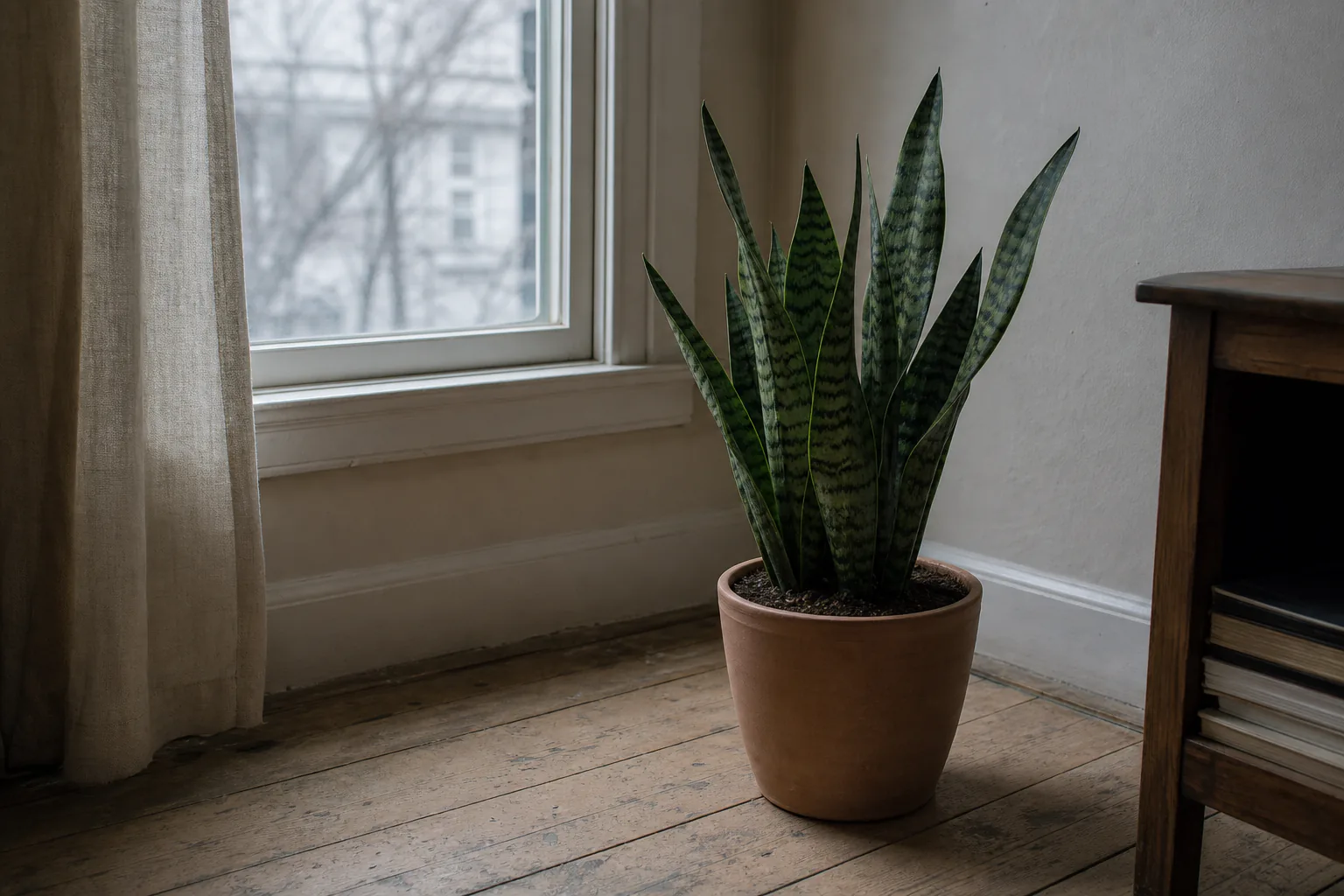
- Snake plant (Dracaena trifasciata). Named by the Chicago Botanic Garden as a low-light workhorse. Tolerates neglect and dim corners. In deep shade, expect slow or no new growth and no flowering.
- Spider plant (Chlorophytum comosum). Also explicitly named by the Chicago Botanic Garden. Tolerates lower light, though it produces plantlets more reliably in brighter conditions.
- Cast-iron plant (Aspidistra elatior). The classic low-light species by name and reputation. Widely described by growers as a slow-growing species even in good light, and slower still in low light.
- Pothos (Epipremnum aureum), heartleaf philodendron (Philodendron hederaceum), ZZ plant (Zamioculcas zamiifolia), peace lily (Spathiphyllum), Chinese evergreen (Aglaonema), and dracaena (Dracaena spp.) are commonly cited by retailers and growers for dimmer spots and are widely treated as tolerant, though specific extension endorsement varies. All grow more visibly in brighter indirect light than they will in a dim corner.
None of these turn a dim room into a bright one. They make it possible to have something green where most plants would not survive, at the cost of slower, sparser growth and little or no flowering.
Sources
- Lighting for indoor plants, University of Maryland Extension
- Lighting for indoor plants and starting seeds, University of Minnesota Extension
- Light, temperature and humidity, Texas A&M AgriLife Extension (Aggie Horticulture)
- Denizens of the dark: indoor plants for low-light spaces, Chicago Botanic Garden
- Light for houseplants, University of Florida / IFAS Gardening Solutions
- Best houseplants for dark and shady rooms, Royal Horticultural Society