Plant care
Tiny bugs in houseplant soil: a calm identification guide
· Updated
If you have just noticed something small moving in the soil of one of your houseplants, the good news is that the list of likely candidates is short. Most readers end up identifying one of these: fungus gnats and their larvae, springtails, soil mites, root aphids or root mealybugs, isopods and earthworms as occasional visitors, or — surprisingly often — objects that are not bugs at all (slow-release fertilizer prills, perlite, mineral salt crust, fungal threads). Identifying them starts with four calm observations: size, color, how they move, and where they sit. Most of these organisms are neutral or only a problem under specific conditions; a few require isolation and prompt action. None of this requires a microscope or a spray bottle, and the answer is rarely urgent enough to act on without looking first.
What “tiny bugs in houseplant soil” usually turns out to be
Across university extension services, the same categories come up again and again as the most common indoor soil identifications. Springtails are documented as harmless to healthy plants and are a moisture issue, not a plant emergency. Soil mites are a different story: extension sources describe them as a mixed group, with some species feeding on decaying organic matter and others feeding on plant tissue, so the category is not uniformly benign. Fungus gnats are the most common match and are tied to excessive moisture, algae growth, and organic buildup in the mix. Root aphids and root mealybugs are less common indoors but worth catching early because they can affect plant health over time. Isopods and earthworms usually enter the picture through contaminated mix and tend to flag that the conditions are wetter than the plant prefers.
A few of these identifications overlap visually. The adult fungus gnat is a small dark fly. The springtail is a tiny pale hexapod that jumps. A perlite granule is a white irregular speck that does not move. From arm’s length, all three can look like an unidentified something in the dirt — which is exactly why an observation routine matters more than a name.
A 90-second soil inspection: size, color, movement, location
Before reaching for any product, take 90 seconds and four observations. These cues will sort most possibilities without a magnifier.
Size. Roughly how big is what you are seeing? About the size of a fruit fly, smaller, or larger? Adult fungus gnats are roughly fruit-fly sized. Springtails are usually smaller, often too small to read fine details on. Soil mites sit in between in size and are easier to confirm with a phone camera zoomed in.
Color. Dark flies versus pale or whitish specks is one of the first forks. Fungus gnat adults are dark. Springtails are often white, gray, or pale and slightly translucent. Slow-release fertilizer prills are often yellow, blue, or brown. Perlite is white and irregular.
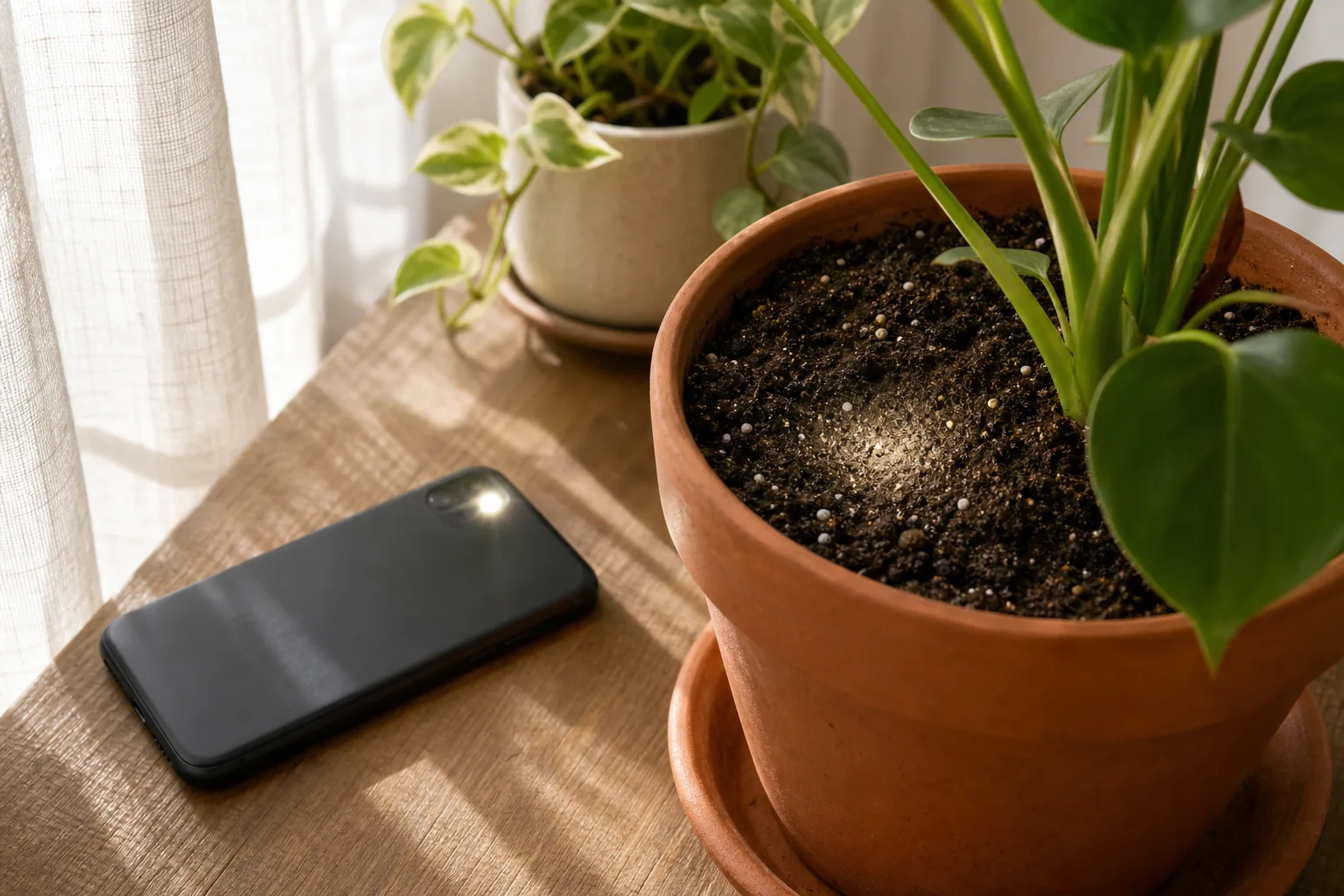
Movement. Use a flashlight or phone light and tap the side of the pot, then watch for 30 to 60 seconds. Jumping or darting in short bursts is consistent with springtails or fungus gnat adults. Slow crawling across the surface is consistent with soil mites, isopods, or earthworms. No movement at all is more consistent with perlite, fertilizer prills, mineral crust, or scale.
Location. Where in the pot? On the surface, near the stem, around drainage holes, or inside a root ball you have unpotted? White cottony tufts at the crown or drainage holes point toward root mealybugs. Pear-shaped pale bodies clinging to roots when the plant is unpotted point toward root aphids. Anything that shows up only on the surface and then disappears back into the mix is usually a moisture-loving organism feeding on organic matter or fungi.
If you have a magnifier, a phone camera zoomed in on a damp spot, or a clear glass placed over a small area for a minute will resolve many identifications that look identical at a glance.
Fungus gnats and their larvae
Adult fungus gnats are small dark flies, roughly fruit-fly sized, that rest on the soil surface or the edge of the pot and dart when disturbed. Larvae live in the top layer of moist mix and are translucent and worm-like, with a visible dark head capsule. Cornell Cooperative Extension of Nassau County describes fungus gnat larvae as primarily feeding on fungi in damp soil but occasionally attacking fine root hairs and tender seedlings under heavy populations. UAF Cooperative Extension Service frames fungus gnats as an indicator of excessive moisture, algae growth, or organic buildup in the soil.
If this is the pattern you are seeing, the fungus gnats prevention guide covers moisture management, sticky-card monitoring, and isolation in more depth than this article does. Letting the surface dry between waterings is the single biggest lever here, and the when-to-water guide explains how to read a pot without a fixed schedule.
Springtails
Springtails are tiny, often pale or whitish hexapods that look like specks moving in short bursts across the soil. The signature behavior is jumping: springtails have a tail-like furcula on the underside that they snap to propel themselves. UC IPM Pest Notes, UMN Extension, and UConn IPM all describe springtails as harmless to people and pets, feeding on decaying plant matter, fungi, and bacteria rather than living plant tissue. UC IPM Pest Notes specifically recommends letting the soil dry between waterings and not allowing drain water to accumulate for managing springtails in indoor potted plants. The same drying-out approach also applies to fungus gnats, since both depend on the same moisture conditions. A short weekly check is usually enough to see whether the population is responding.
Soil mites and other tiny scavengers
Soil mites are arachnids, rounded and slow, often pale to brown. They are a behaviorally mixed group: many feed on decaying organic matter and fungal spores, while some species feed on plant tissue. University of Maryland Extension notes that pest mites feed on a wide variety of outdoor and indoor plant species, which means a soil-mite identification should not be treated as automatically benign. The practical rule of thumb is that any visible plant damage, webbing at the soil line, or a sharp increase in numbers warrants closer inspection, and the local extension service or a regional houseplant society is a reasonable next stop when identification is uncertain.
Root aphids and root mealybugs
This is the bucket where mistakes are most likely. Root aphids are pear-shaped, soft-bodied, and pale yellow to whitish. Root mealybugs are white with a waxy, cottony coating and tend to sit at the crown, inside pot crevices, along drainage holes, and through the root zone. Ask Extension (eXtension) emphasizes that root mealybugs are typically concealed in the root ball and only become obvious when the plant is unpotted, so visual checks of the surface alone often miss them. The Royal Horticultural Society notes that ants can tend root aphids for honeydew and even carry them between plants, which makes ants in a pot worth noticing. Root aphids and root mealybugs are most often introduced on plant material, a shared pot, or reused mix, which is why inspecting a new plant before bringing it home is one of the simplest preventive levers.
Confirmation step: unpot the plant over a sheet of white paper and look for white cottony tufts (mealybugs) or clusters of small pear-shaped bodies (aphids) among the roots. White cottony clusters on the stems or at the crown are covered in more detail in the mealybugs identification guide.
Isopods, earthworms, and other occasional visitors
Isopods (sowbugs and pillbugs) are crustaceans that breathe through gills, so they need damp conditions and are usually a sign the mix is being kept wetter than the plant prefers. Earthworms in a houseplant pot are uncommon in true indoor settings and usually indicate the mix was contaminated outdoors. Extension sources do not list either as primary houseplant pests; their presence is more often a flag for moisture or organic buildup than a direct threat to the plant. Standing water in a saucer or cachepot makes this worse, and the pot drainage and cachepot guide walks through how to set that up.
Look-alikes that are not bugs at all
This is the bucket that surprises most readers. Several non-animal objects in potting mix get mistaken for insects, especially in a dry, low-light room where shapes are hard to read.
- Perlite is white, irregular, and lightweight. It does not move.
- Slow-release fertilizer prills are round beads of consistent size, often yellow, blue, or brown.
- Mineral salt crust is a thin whitish film on the soil surface from hard water or fertilizer.
- Fungal mycelium is fine white threads that can look like cobwebs at the soil surface.
- Peat or coco coir flecks are brown fibrous bits in the mix.
The fastest differentiator is whether anything moves. Mineral crust, fertilizer prills, perlite, fungal threads, and peat flecks do not move on their own. The white crust on houseplant soil article covers the crust and prill cases in more detail.
Triage: do nothing, watch, isolate, or ask a local expert
After the inspection, most readers end up in one of four buckets. Each is observational rather than prescriptive.
- Do nothing when identification points to springtails, perlite, prills, or mineral crust under normal conditions. Continue the existing care routine and avoid creating new moisture or organic buildup.
- Watch closely when identification is uncertain but nothing is visibly damaging the plant. Note the population over one to two weeks; springtails often thin out once the surface dries, and soil mite populations fluctuate with organic matter and moisture.
- Isolate when identification suggests an active pest on a plant sharing space with others. Move the affected plant away from the rest and use the inspect and isolate method to monitor it through at least one full watering cycle, with no treatment until identification is clear.
- Ask a local expert when identification remains uncertain, plant health is declining, or damage is escalating. Your state or county extension service, a local independent nursery, or a regional houseplant society can provide a confirmation that visual matching from a phone photo cannot.
What to do before reaching for any treatment
Two cultural levers show up across university extension guidance regardless of which soil organism is involved.
Let the surface dry between waterings. UC IPM Pest Notes recommends this directly for springtails, and UAF Cooperative Extension ties fungus gnats to the same condition. Both organisms depend on moisture and organic buildup, so a drier surface and better airflow reduces the conditions they thrive in.
Check the pot setup. Standing moisture in a cachepot or saucer is one of the most common underlying conditions. Draining saucers after watering, making sure the pot drains freely, and avoiding setups that keep the lower root zone constantly wet all reduce the pressure from fungus gnats and related fauna.
Mechanical options before chemical ones. Yellow sticky cards are widely used as a monitoring tool for adult fungus gnats: they confirm identification and track population trends over time. They are a way to see what is happening, not a standalone cure. Any product you consider applying — indoors or out — should be used strictly per its label, in a ventilated room, and only after the pest has been identified well enough to choose the right product.
When to escalate to a local source
Reach out to your state or county extension service, a local independent nursery, or a regional houseplant society when identification is unclear after a careful inspection, when plant health is declining despite reasonable cultural corrections, or when you are considering any chemical control indoors and want label guidance specific to the product and the pest. Pictures help but cannot replace examination of an actual specimen in many cases, so be ready to describe or, ideally, send a sample in a sealed container.
A final observation before you escalate: most of what shows up in houseplant soil is either a moisture-related organism that responds to letting the surface dry, or it is not an organism at all. The exceptions — root aphids, root mealybugs, and a handful of soil mite species — are worth isolating early and confirming with a local source rather than treating on a guess. Calm triage almost always beats fast treatment.
Sources
- UC IPM Pest Notes: Springtails
- University of Alaska Fairbanks Cooperative Extension Service: Houseplant Pests and Control
- University of Minnesota Extension: Springtails
- Cornell Cooperative Extension of Nassau County: Springtails and Fungus Gnat Maggots
- University of Maryland Extension: Mites in Home Gardens