Plant care
Scale on houseplants: how to tell it from lookalikes and what to do next
· Updated
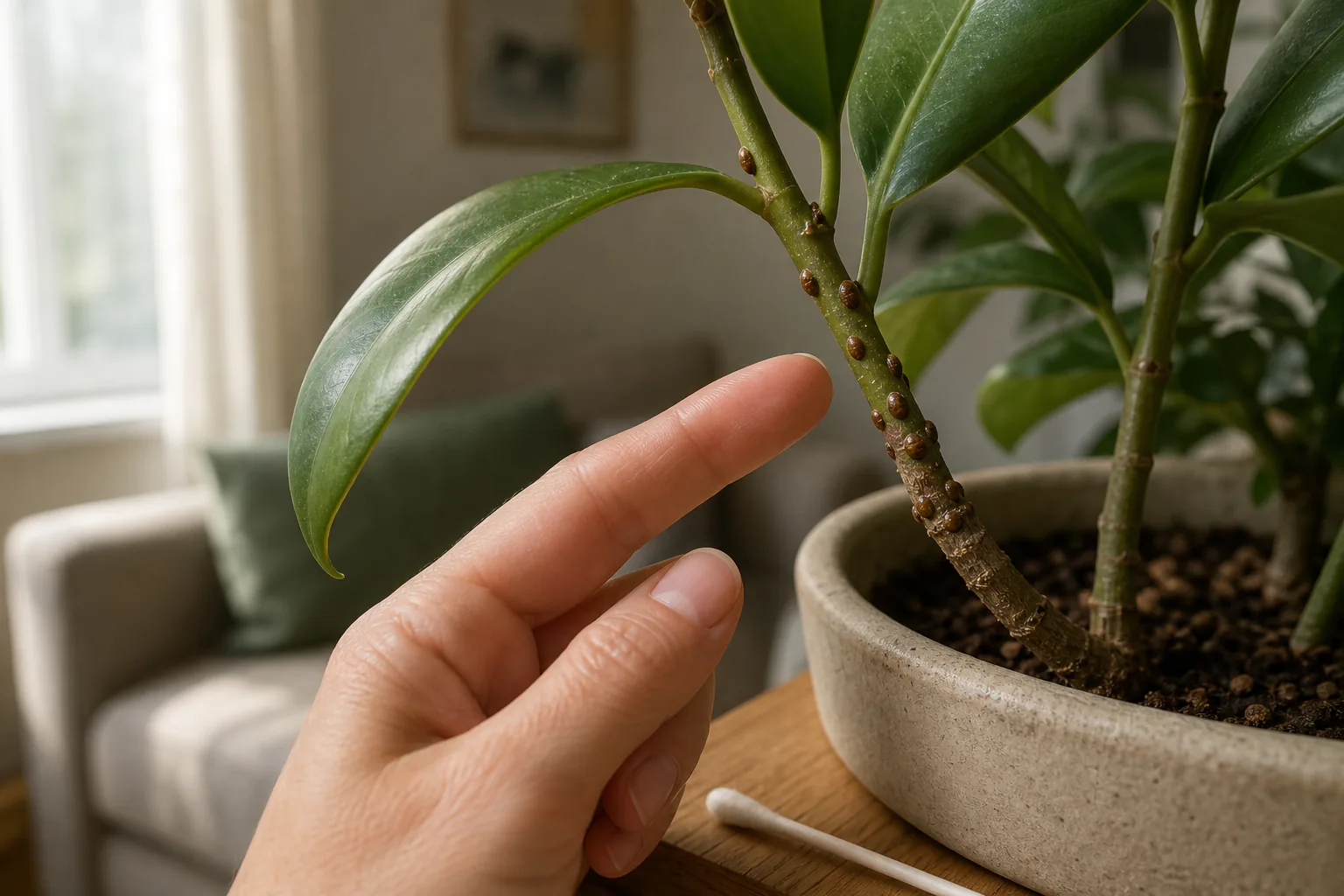
If the bumps on your houseplant are fixed in place, do not easily wipe off, and cluster along stems, leaf midribs, or where a leaf meets its stalk, scale is a reasonable working hypothesis. Several non-pest marks look similar, so a single photo is rarely enough to confirm. Move the plant away from the rest of your collection first, then look closely. What you find there decides everything from how you clean up to whether you reach for a product at all.
What scale insects actually look like on a houseplant
Scale insects are sap-feeders that, once they settle and start feeding, generally stay put. What you usually see is the protective cover, not a moving insect. Indoors you are most likely to encounter two broad groups, both named for the kind of cover they make.
Armored scales build a separate, often waxy cover over their bodies, do not produce honeydew, and are usually small and flat — often small enough to overlook and easy to mistake for part of the plant itself.
Soft scales look more like a small bump fused to the stem or leaf. They tend to be larger, more rounded, and more obviously convex than armored scales. Soft scales feed on sap and excrete a sticky liquid called honeydew, which often shows up on leaves, the pot, the floor, or a windowsill under the plant before the scale itself is obvious.
You will commonly find scale along woody or semi-woody stems, on the underside of midribs, tucked into the joint where a leaf meets the stalk, and along new growth. In many cases, lifting a cover with a fingernail reveals a small soft-bodied insect underneath.
Where scale tends to show up first
Early colonies hide in spots a quick glance misses. Check:
- the underside of leaves, especially along the main vein
- leaf axils, where a leaf joins the stem
- the small ridge a leaf forms where it meets its stalk
- tight clusters of new growth
- nodes along a stem, particularly on plants with woody or semi-woody stems
This matters because a partial look often convinces a reader their plant is clean. A more careful look, including leaf undersides and the corners where stems branch, is how houseplant pests are usually caught early.
Things that look like scale but usually aren’t
Many raised or bump-like marks on houseplants are not insects at all. Common lookalikes that indoor plant owners describe, based on practical observation, include:
- Edema, which appears as small, water-filled bumps, often on leaf undersides, after a plant takes up more water than it can transpire. The bumps are usually translucent or the same color as the leaf.
- Galls, which are irregular plant growths triggered by an irritation. They do not scrape off and are part of the tissue.
- Lenticels, the natural corky pores on woody stems that allow gas exchange. They are part of the stem, not something sitting on top of it.
- Mineral or fertilizer crusts, where water has evaporated and left a whitish or rust-colored deposit on the soil surface or along stem edges. These usually brush off with a damp cloth and feel gritty.
- Leaf or stem scars, where an old leaf or branch was lost. They are flat to slightly sunken and are clearly part of the plant’s surface.
- Young mealybug colonies, which can look like tiny white tufts and are usually cottony rather than smooth and waxy.
The simplest behavior test, drawn from extension guidance, is whether the bump will flake off with pressure from a fingernail, a soft toothbrush, a toothpick, or a cotton swab. Mineral crusts and scars generally do not behave that way. Settled scale covers usually do. This is not a definitive identification, but it is a useful first filter.
For a closer look at mealybugs specifically, see our guide to mealybugs on houseplants, since they are the pest most often confused with scale.
Armored scale vs soft scale: why the difference matters
The armored versus soft distinction changes both the symptom picture and the response.
Armored scales form a separate cover, do not move once they begin to feed, and generally do not produce honeydew. Their covers are easy to miss because they often blend into stem color. Because they are generally less susceptible to contact pesticides than soft scales, thorough coverage of the entire plant, including leaf undersides and stem joints, is more important for this group.
Soft scales feed and excrete honeydew, are usually larger and more rounded, and are often the first to be noticed because of the sticky residue and the blackish sooty mold that can grow on that residue. Soft scales are also the group most often discussed in extension materials when systemic products come up. Some systemic options are described as effective on soft brown scale specifically, which is one reason a generic “spray for scale” tip is misleading.
If you want the full cleanup picture for sticky residue and sooty mold, see our guide to sticky leaves and honeydew on houseplants, which explains what the symptom means and how it differs across sap-feeders.
Start with isolation, not treatment
The first practical move after you have noticed fixed bumps that might be scale is to separate the plant from the rest of your collection. Scale can spread through a mobile juvenile stage called the crawler, which is one reason isolation and basic hygiene habits matter before you treat.
Isolation looks like this in practice:
- Move the plant to a room or shelf that does not share airspace with the rest of your collection.
- Wash your hands and any tools, such as pruners, scissors, and watering cans, before using them on other plants.
- Inspect plants that were sitting near the suspect plant for similar bumps.
- Check new acquisitions and recently moved plants first. Pests of all kinds, including scale, can enter a collection on a new plant, which is also why quarantining a new or suspect plant is a standard houseplant practice.
How long to isolate depends on what you find and on the conditions in your home. There is no single fixed number of days that fits every situation, and the most honest framing is to monitor the plant regularly until you are confident it is clean.
What you can do by hand, and what to avoid
For a small infestation that you can reach, extension services commonly recommend physical removal first.
A cotton swab lightly dampened with isopropyl alcohol is a standard small-spot approach for soft scale. Try it on one leaf or stem section first, wait a day, and check for leaf sensitivity before you use it more broadly. Some plants react to concentrated alcohol with brown spots or burned edges.
A soft-bristled toothbrush, a fingernail, or a toothpick can also dislodge scale covers on tougher stems. Lukewarm water and a soft sponge or paper towel work well as a general rinse for leaves that can take it. A gentle water rinse is one of the lowest-risk ways to start before any product is involved.
What to avoid: scraping with sharp tools that wound bark or leaf tissue, picking at scale on a stem that is clearly soft or actively growing, and assuming one round of wiping is enough. Small, more translucent early stages can be harder to see and can re-establish the infestation if monitoring stops.
Reading a product label before you treat
If hand methods are not enough, the next category on extension lists is usually horticultural oils, insecticidal soaps, or, for some soft scales, certain systemic products. These are categories, not endorsements. The current label for the specific product you are holding has to match the specific plant you are treating, and it has to cover indoor use.
A few practicalities the label controls, that a generic tip cannot:
- Whether the product is allowed on the specific houseplant species. Some plants are sensitive to oils or soaps and the label or its supplemental materials say so.
- Whether the product is allowed indoors. A label that lists scale on outdoor ornamentals is not automatically a label for indoor houseplants.
- How thoroughly the product has to coat the plant. UC IPM specifically notes that thorough coverage is more critical for armored scales, because they are less susceptible to contact pesticides than soft scales.
- Whether a systemic option is described as effective on a specific group, like soft brown scale, or only on a specific life stage.
The National Pesticide Information Center recommends trying integrated pest management first and, if a pesticide is used, reading the label carefully and taking steps to minimize exposure. Treat that as the operating rule.
If pets or small children share the room with a treated plant, the label and a pet-aware reference are the right places to check before you spray. Specific product and active-ingredient questions are best answered by the current label and by a local expert, not by a generic list.
Honeydew, sooty mold, and what they tell you
Sticky residue on leaves or on the surface below the plant, especially when paired with a faint black film that wipes off, is a soft-scale signal rather than a generic mess. Cleaning the residue will not solve the problem as long as the feeding insects are active. The honeydew will return. The right order is to address the infestation and then clean the residue, with our honeydew and sticky leaves guide covering the symptom side in more depth.
When to ask a local expert instead of guessing
Most scale identifications are best made with the plant in front of you, in good light, with a magnifier if needed. Bring a sample or a clear photo to a local nursery, a master gardener clinic, or your state extension service if any of the following apply:
- You cannot tell whether the bumps are scale or a non-pest condition after a careful look.
- The infestation is widespread across the plant or has appeared on multiple plants in the collection.
- The plant has declined significantly, with yellowing, leaf drop, or sticky residue over a large area.
- You are unsure which product label, if any, covers your specific houseplant indoors.
These are practical handoffs, not medical referrals. A local expert can often confirm the identification with a hand lens and recommend a response that fits your specific plant and your specific product shelf.
A short checklist before you do anything else
- Look closely at the bumps in good light, including leaf undersides, leaf axils, and stem nodes.
- Decide whether they cluster like scale or are scattered like mineral crusts or scars.
- Check for honeydew on leaves or surfaces below the plant, which points toward soft scale.
- Isolate the plant and inspect neighbors for similar marks.
- Try hand removal on a small area first, with a fingernail, soft toothbrush, or cotton swab lightly dampened with isopropyl alcohol.
- Wait a day to check for plant sensitivity before broader treatment.
- Read the current label for any product you consider, and match it to the specific plant and indoor use.
- Monitor for several weeks after treatment, because small early stages can be harder to see.
- Ask a local nursery, master gardener clinic, or extension service when the identification is uncertain or the infestation is widespread.