Plant care
Snake plant leaves falling or flopping over: an observation-first checklist
· Updated
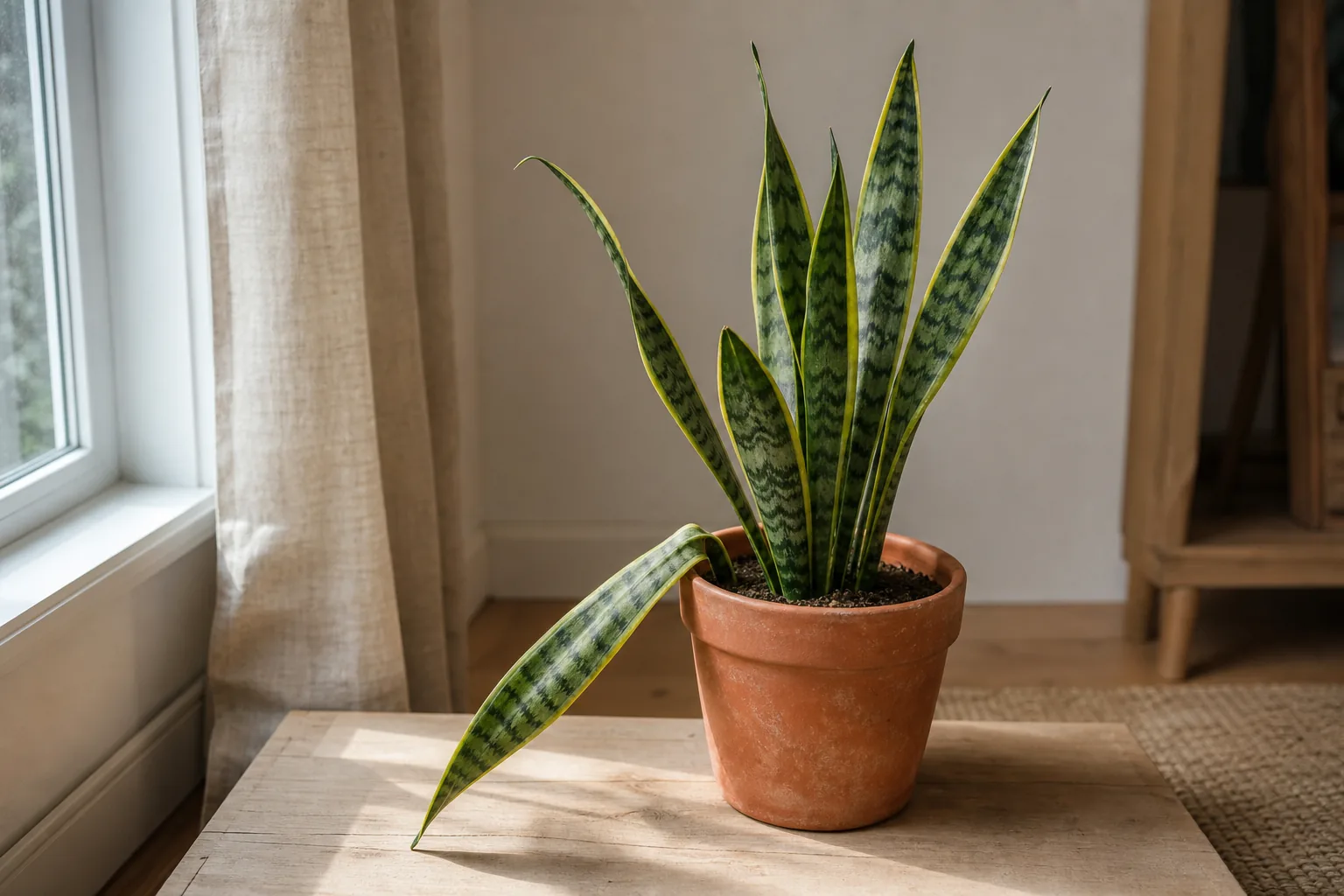
A snake plant leaf that bends, flops, or detaches usually has a small set of explainable causes, and most of them can be checked in order at the plant itself rather than guessed from across the room. Start at the base of the affected leaf, then the root mass if it is safe to peek, then the leaf shape, then the pot, then the room, then the leaf’s age. A single older outer leaf that yellows, leans, and lets go while the inner leaves look fine is normal aging and does not need a fix. A soft, swollen, or darkened leaf base, or floppy leaves with wet soil, points to roots and rhizomes that have been sitting too wet, and that needs a different response.
What ‘falling over’ can look like on a snake plant
The phrase covers several distinct symptoms, and they do not all point to the same cause. Worth telling apart before doing anything:
- A whole leaf that has bent at the base and is leaning out from the rosette.
- A leaf that has gone soft, wrinkled, or translucent at the very bottom but still looks healthy higher up.
- A leaf that is fine along its length but feels weak and floppy, as if it cannot hold its own weight.
- A leaf that has collapsed mid-blade with a wrinkle or sunken scar.
- One outer leaf that has yellowed, leaned, and detached while every other leaf looks normal.
These are not interchangeable. The first two tend to point to roots and rhizome trouble. The third usually points to light. The fourth often points to a one-time cold or sun event. The fifth is usually just an old leaf ending its run.
Step 1: Look at the base of the leaf first
Before lifting the pot, gently pinch the very base of the affected leaf where it meets the soil. This is the single most specific cue the plant will give you in under a minute.
A firm, dry, intact base is healthy tissue. A base that feels soft, squishy, water-soaked, papery, or that has gone darker than the rest of the leaf is the surface sign of tissue breakdown below. When several leaves share that soft base, the most common cause described across extension and botanical-garden sources is that the rhizome and roots have been sitting in soil that stayed wet too long. The New York Botanical Garden’s guide to Dracaena trifasciata names overwatering as the most frequent indoor problem for snake plants, with rot and capsizing foliage as the usual result.
If you can also press lightly on the soil next to the leaf base and get a sour or swampy smell, that is another quiet signal of stagnant conditions below.
Step 2: Check the roots and the soil before adding more water
This is the step where most readers go the wrong way. A floppy snake plant leaf feels like thirst, but the cross-source pattern is the opposite: floppy leaves with wet soil are almost always a roots problem, not a watering problem. Adding more water to a plant with a soft base is the worst next move. The ordered inspection for overwatered versus underwatered houseplants lays out the same logic in species-neutral form.
If the plant is easy to lift out of its pot, slide the rootball out and look at it. Healthy roots are firm and pale tan or whitish. Healthy rhizomes (the pale horizontal stem the leaves grow from) feel firm and look pale tan inside if you nick one. Rotted roots are brown to black, soft, hollow, or slimy, and they may peel or pull apart between your fingers. A rotted rhizome is mushy or crumbles. Purdue Extension’s overview of root rot in landscape plants describes this same look-and-feel pattern: above-ground collapse paired with roots that have turned brown, soft, or hollow instead of firm and pale.
If everything looks firm and the smell is neutral, the soil and roots are probably not the issue and you can put the plant back. If you find soft, dark, or hollow tissue, the cross-source pattern from extension and consumer horticulture references is to stop watering, remove the affected tissue with a clean tool, let any cut surfaces dry, and only then think about a fresh, fast-draining mix in a snug pot. For the inspection logic in more depth, the Houseplant Supplies article on why a houseplant wilts in wet soil walks through the same pause-and-look order.
You do not need to unpot the plant just to read the soil. Lift the pot right after watering and again two or three days later. A snake plant in a working setup should feel noticeably lighter before its next watering. If the pot is still heavy days later, the mix is not drying, and that is itself the answer to most base problems.
Step 3: Read the leaf shape itself: stiff versus long and thin
If the base and roots look fine, the leaf itself can tell you something. Compare newer inner leaves to older outer leaves. New leaves that come in noticeably longer, narrower, or paler than the older ones are a clue that the spot is dimmer than realized. Across extension and consumer horticulture sources, snake plants are described as tolerating low light but slowly deteriorating in it, and the visible effect over weeks is thinner, longer, weaker leaves rather than a sudden collapse on its own.
So if you see long, narrow new growth that has trouble standing up, the cause is more likely a light problem than a watering problem. The fix is not a stake and not more water. It is a brighter spot, or a clearer-eyed assessment of what light the room actually delivers, as laid out in how to read the natural light in a room. The snake plant care hub covers what realistic light and watering rhythm look like in a normal room.
Step 4: Consider the pot size and how long the soil stays wet
A pot that is much larger than the root mass holds water around the roots for longer than a snug pot does. Combined with a dense, peat-heavy mix, that is one of the most consistent indoor setups for a snake plant base-rot symptom, even when the watering schedule looks reasonable on paper. The Houseplant Supplies guide to whether a houseplant is root bound explains the difference between a snug pot and a truly crowded one, since the two are easy to confuse.
The reader-checkable version of this is simple. Is there an inch or more of unused soil all the way around the root mass? Does the pot still feel heavy several days after a thorough watering? Does the bag the mix came from describe itself as a cactus or succulent mix, or as a general-purpose mix with no grit listed? A cachepot or saucer that holds water at the bottom, or a decorative pot with no drainage hole, extends how long the root zone stays wet independent of how often the reader waters, and the Houseplant Supplies pot drainage and cachepot article spells out that risk in plain terms. If the mix itself is the issue, what to look for on a potting-mix bag gives a label-reading framework rather than a brand list.
Repotting is itself a stressor on a snake plant that is already struggling. The decision guide for when a houseplant needs a new pot is the better place to read about that, and the short version here is that it is worth doing only after the inspection above points clearly to the pot or the mix as the problem, not as a hopeful first move.
Step 5: Rule out cold, drafts, and sun-heated glass
If the base and roots look fine and the leaf shape looks normal, the cause is often environmental and recent. Snake plants come from dry tropical climates in West and West Central Africa, and indoor placements below roughly 50 to 55 degrees F are outside their comfort range. The New York Botanical Garden gives 55 degrees F as the practical indoor floor; NC State Extension describes the plant as tolerating cool temperatures around 50 degrees F. Those are ranges, not a single number, and a short, sharp exposure can mark a leaf even if the room later warms up.
The visible signature of cold damage is usually on the leaf surface, not the base: a wrinkled patch, a sunken scar, or a leaf that has gone soft and translucent in a defined area where cold air or chilled glass met it. Common indoor causes are a window opened in winter near the plant, a window air-conditioner, an exterior door that swings open repeatedly, or a pot moved closer to a bright window in late fall without checking the glass temperature.
The reverse problem shows up in summer. A pot moved into direct sun through a window can overheat the leaf surface on the glass side, and the result looks similar: a localized wrinkle or pale scar that is easy to misread as a disease. The Houseplant Supplies drafts, vents, and sun-heated glass article is a practical way to assess the microclimate around a window-side spot.
Step 6: Tell normal outer-leaf aging from a whole-plant problem
A single older leaf yellowing from the outside in, leaning outward, and eventually detaching while the inner leaves look firm and the soil is neither soggy nor bone-dry is consistent with normal aging of an outer leaf. Snake plants replace older leaves one at a time. Acting on that as if it were a whole-plant problem, by cutting, repotting, or moving the spot, usually adds stress without helping.
A whole-plant problem looks different. Multiple leaves going soft at the base at once, a sudden droop after a watering, or yellowing that starts from the base up rather than the tip down is the pattern worth responding to. The difference between one outer leaf ending its life and a rosette losing several leaves at once is the difference between no action and the inspection order above.
What to do once you have a working hypothesis
The smallest change that matches what you actually saw is usually the right next move. A leaf that has already flopped will not stand back up on its own; only new growth from the rhizome can replace it.
- Soft base, wet soil, dark or hollow roots: stop watering, lift and inspect, remove soft tissue with a clean tool, let cuts dry, and move to a fast-draining mix in a snug pot only if inspection confirms the cause.
- Long, thin, weak new leaves with a healthy base: brighter spot, or a clearer read on the room’s light, not more water.
- Single wrinkled or scarred leaf with everything else fine: check the microclimate and adjust placement rather than the plant.
- One outer leaf yellowing on an otherwise healthy plant: leave it alone until it detaches on its own.
- Pot much larger than the root mass with a dense mix: that is a setup problem, not a watering-frequency problem. Reconsider before the next watering rather than repotting immediately.
Recovery is slow either way. A snake plant that has lost several leaves replaces them slowly, over weeks to months, and the realistic sign of progress is the next new leaf coming in stiff and standing on its own, not a fast rebound on the existing leaves.
When to ask a local nursery or extension service
If the base is soft on multiple leaves, the rhizome is mushy across a large part of the plant, the soil smells strongly sour, or the plant has lost several leaves in a short window, an in-person look by a local nursery, a master gardener program, or a regional extension service is the right next step. They can see and smell what a photo cannot, and they can advise on local conditions and any product decisions without an article guessing. Houseplant Supplies is an educational journal, not a diagnostic service, and a stressed plant deserves more than a single written symptom checklist.
Sources
- New York Botanical Garden — Snake plant (Dracaena) LibGuide
- Missouri Botanical Garden — Dracaena trifasciata Plant Finder
- NC State Extension — Dracaena trifasciata plant page
- Royal Botanic Gardens, Kew — Snake plant
- Purdue Extension — Root rot in landscape plants (PDF)