Plant care
Pilea peperomioides care
· Updated
A Pilea peperomioides wants the brightest indirect light your room can give, a fast-draining mix in a pot with drainage, and a dry-down rhythm for watering. It leans toward the window because it is a strong phototrop, so rotating the pot each week helps keep the silhouette even, though it will not stop a mature plant from developing some character in its stem over time. The little plants emerging from the soil are pups, and whether to leave them attached or separate them is a genuine choice rather than a maintenance task. If pets share the home, verifying the plant by its botanical name against an authoritative source is worth doing before you bring one in.
If your Pilea is new to the room, the first one or two weeks are mostly about reading light and water rather than fixing anything. The acclimation framework in how to help a new houseplant settle in after purchase covers that period well.
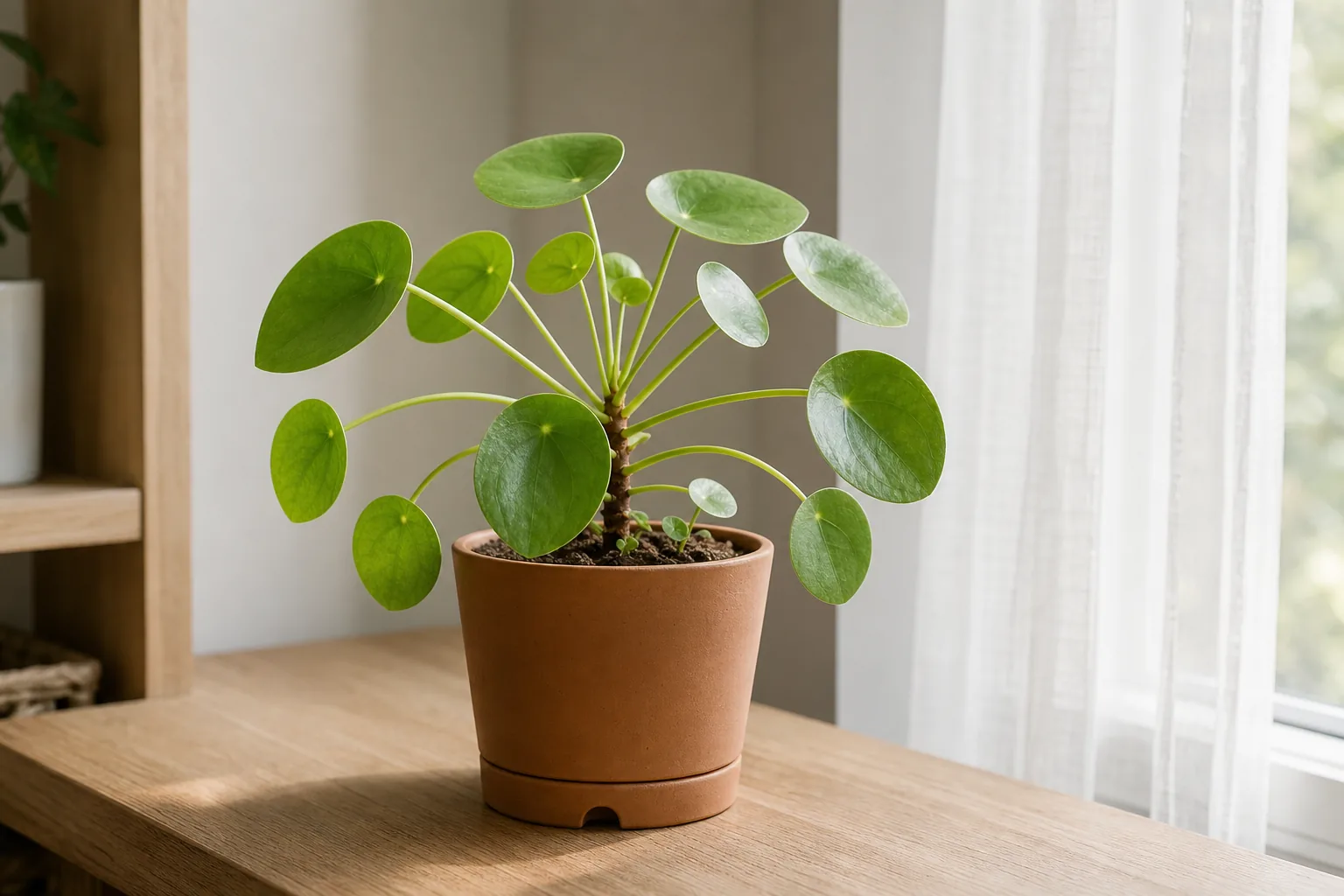
Below is what that looks like in practice, in an ordinary room.
What a healthy Pilea peperomioides looks like in a real room
Pilea peperomioides is a small, soft-stemmed plant in the nettle family (Urticaceae), native to the Yunnan province of southwest China. Most people know it as the Chinese money plant, missionary plant, pancake plant, or UFO plant. Those common names all describe the same species: a tabletop plant with round, flat leaves held out on long petioles from a central stem that slowly thickens with age. It is not a floor plant. A well-grown specimen will sit politely on a desk, shelf, or windowsill for years.
A healthy plant has roughly circular leaves that are bright to medium green, held flat or slightly cupped, with new leaves emerging in pairs from the top of the central stem and unfurling like small parasols. New growth shows up during the active months of spring and summer and slows down in the shorter days of winter.
The other thing to expect in a settled Pilea is pups: small plants that push up through the soil at the base of the main stem. A Pilea that never produces pups is not necessarily unhealthy, but most owners eventually see them once the plant is comfortable in its pot.
Light: bright, indirect, and the single biggest shape lever
Pilea peperomioides wants bright, indirect light. In practical terms, that is the brightest spot in your room that does not put the leaves in direct sunbeams for more than a short stretch each day. A few feet back from a south- or west-facing window, or right next to a window filtered by a thin curtain, is usually the sweet spot.
If you want to confirm what your spot actually delivers, the shadow-and-shape method in how to read the natural light in your room translates well: a soft-edged, hand-shaped shadow with no color but a clear outline means bright indirect. A sharp, hard-edged shadow means direct sun.
Too little light is the most common Pilea problem, and it shows up in the shape of the plant before it shows up in the color. Petioles stretch longer than they used to, new leaves come in smaller than the older ones, and the round leaves begin to cup downward as if trying to catch more light. Too much direct sun shows up as bleached, pale, or yellow patches on the upper leaf surfaces, sometimes with curling.
Watering: a dry-down rhythm, not a calendar
The Pilea’s petioles are thick and slightly succulent, which lets the plant tolerate short dry spells. That single fact is the most useful thing to know about watering it: the pot should almost dry out between drinks rather than stay evenly moist.
The order of observation in how to tell when a houseplant actually needs water maps cleanly onto a Pilea: lift the pot to feel its weight, check the top inch or two of mix, and look at the petioles. A plant that needs water feels light, the mix feels dry below the surface, and the petioles are slightly soft. A plant with plenty of water feels heavy and the petioles are firm.
When you do water, soak the whole rootball and let the excess drain freely from the bottom. Then wait. In an average home during active growth, that usually means watering once a week or so; in winter, it can stretch to two or three weeks. The number is not the point. The feel of the pot is the point.
Overwatering in a Pilea shows up as sudden leaf drop (often green leaves falling from the lower stem), a soft or dark stem base, and a generally droopy, unhappy plant. Underwatering looks more like softly drooping petioles and leaves that feel thin rather than turgid.
Soil and pot setup: airy mix, drainage hole, modest pot size
Pileas rot in pots that hold water. Two things matter more than the specific bag of mix you buy: the pot should have a drainage hole, and the mix should not stay wet for days. The honest comparison in do houseplants need drainage holes? makes clear why an undrained decorative pot is the most common cause of a soggy Pilea.
A general indoor mix built for tropical foliage, or a slightly grittier aroid-leaning mix, both work fine. The label-reading framework in how to choose a houseplant potting mix translates that into a bag decision: the mix should feel light, drain quickly when tipped through, and not stay spongy for days.
The pot itself should be modest in size. A Pilea that is slightly snug in its pot dries out faster and tends to produce offsets more readily than one in a large container. If you are repotting, go up by only about an inch of diameter at a time. Cachepots and decorative outer pots are fine, as long as the inner pot drains and you empty the cachepot after watering so the roots do not sit in standing water.
Temperature, drafts, and the rest of the room
Pileas are happy in the same temperatures most people find comfortable. Cold is the bigger issue than heat. A windowsill that drops below about 10°C (50°F) on a winter night, a steady draft from an old frame, or a vent that blows cold air directly on the plant can all cause leaf drop or dark, sunken patches at the leaf edges. The framework in drafts, vents, and sun-heated glass helps you decide when a Pilea should move a few feet away from a problem spot rather than stay and suffer.
Hot, dry air from a heating register is rarely ideal but is usually tolerable. Pilea is not a humidity-hungry plant in most homes, so a humidifier is not a default need. If leaves are getting crispy edges and the air in the room is genuinely dry, modest humidity can help, but it is a third-tier adjustment after light and water have already been addressed.
Why your Pilea leans, and what rotation can and can’t do
Pileas are strong phototropes. They grow toward the brightest source of light, and they do it fast. A Pilea that sits in the same orientation for a few weeks will lean noticeably, with petioles longer on the side facing the window. The broader leggy-houseplant signal hub covers how this pattern shows up across species.
A quarter turn of the pot each week or so balances the lean and keeps the silhouette roughly even. It does not stop the lean altogether. As a Pilea matures, the central stem will curve, bend, or lean a little even in a well-rotated, well-lit plant, and that is normal character rather than a problem to fix.
If your Pilea is leaning dramatically, the underlying cause is usually that the spot is too dim, not that you forgot to turn the pot. Moving the plant closer to the window or to a brighter room will slow the stretch more reliably than extra turning will.
Pups: what they are, when they appear, and what’s optional
Pilea pups are small plants that emerge from the soil around the base of the mother plant. They come up from the root system rather than from nodes along the main stem, which is one of the things that makes Pilea distinctive.
Whether to separate pups is genuinely optional. Many owners leave two or three on the mother plant for a fuller, clumping pot. Others separate them to share with friends or to fill another pot. The only practical timing note is that the smallest pups, with no real root system of their own, are fragile and slow to establish on their own. Once a pup is a couple of inches tall and has some visible roots when you gently brush the surface soil aside, it is in a reasonable place to consider separating if you want to.
This article does not walk through the full separation process, because those steps deserve a closer look on their own. The short version is that you can do it, and that you do not have to.
Common leaf signals and what they usually mean
Most Pilea leaf signals map to one of a few recurring causes. The list below is an observation-first triage rather than a diagnosis. For the broader framework on yellowing, see the yellow-leaves hub, and for crispy edges and browning, see the brown-tips and crispy-edges hub.
- An occasional oldest, lowest leaf yellowing and dropping is usually normal aging rather than a problem.
- Widespread yellowing, soft stems, and sudden leaf drop together usually point to overwatering or to a pot that is staying wet too long. A pile of dropped leaves shortly after a move or a change in conditions is a common version of this and is covered in why a houseplant drops leaves after a move or change.
- Long petioles, smaller leaves, and downward-cupped leaves usually mean the spot is too dim.
- Leaves that cup upward and feel papery, with crispy or pale edges, usually mean too much direct sun or very dry air.
- Tiny translucent or brown specks on the undersides of leaves, especially on the older ones, are usually edema from inconsistent watering: the plant took up water faster than the leaves could use it.
- Dark, sunken patches at the leaf edges, often after a cold night or a draft, are usually cold damage rather than a disease.
Repotting, fertilizer, and a realistic yearly rhythm
Pileas are light feeders and slow growers in winter. Repot only when the root ball clearly fills the pot or when water runs straight through without soaking in. Once a year or every other year is typical; faster is usually a sign that the pot is too big.
For fertilizer, the houseplant fertilizer basics hub frames it well: a half-strength dose of a general indoor plant food once or twice during spring and summer is plenty for a Pilea. Skip fertilizer in fall and winter, when the plant is not actively growing and a buildup of salts in the mix can burn roots.
A short, realistic yearly rhythm looks like this. In spring, repot if the plant needs it and start light feeding. In summer, focus on steady observation and watering. In fall, taper feeding. In winter, water less and skip fertilizer entirely. A simple weekly houseplant care routine can hold this together without overcomplicating it.