Plant care
Parlor palm care, observed: the light-and-water balance that decides whether yours actually grows
· Updated
Parlor palm care, observed: the light-and-water balance that decides whether yours actually grows
The shortest honest answer: a parlor palm (Chamaedorea elegans) will survive in a dim corner, but it will only grow in the brightest indirect light your room offers. The fastest way to lose one is to water it on a calendar before the top inch or two of mix has dried, especially in a pot without reliable drainage. Treat the plant as a slow-growing, observation-friendly houseplant rather than a self-sufficient “low-light” one, and most of the common problems never appear.
The rest of this guide walks through that tension in detail, so you can read your own plant and your own room instead of following a schedule someone else made for a different setup.
What a parlor palm actually is (and what it isn’t)
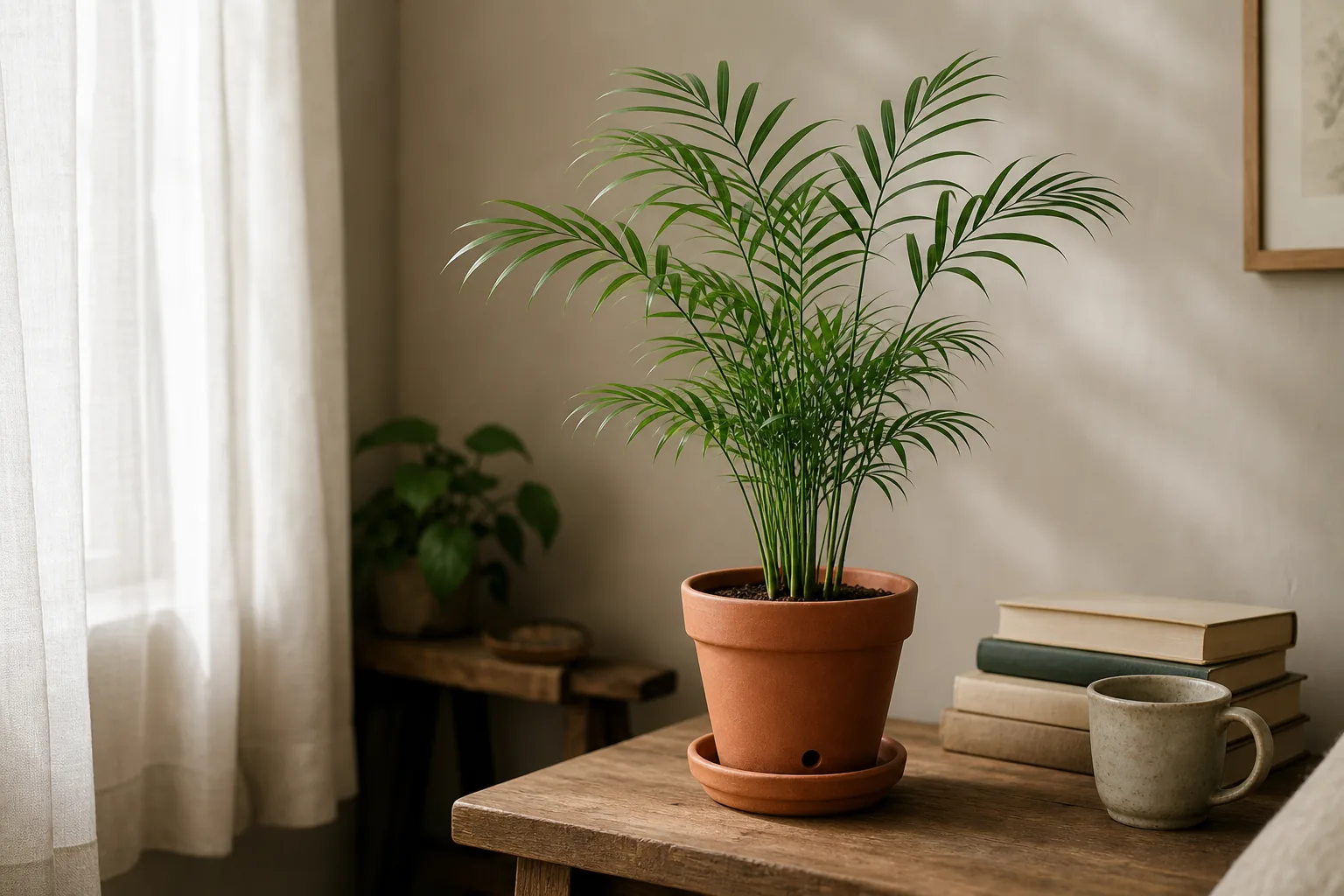
A parlor palm is Chamaedorea elegans, a small, clumping palm native to the rainforests of Mexico and Guatemala. The older trade name “Neanthe bella palm” refers to the same species. It stays compact indoors, usually somewhere between waist and shoulder height at maturity, with thin bamboo-like stems and delicate, slightly arching fronds.
It is not the same plant as:
- Areca palm (Dypsis lutescens), often sold as “butterfly palm” or “golden cane palm,” which gets much larger and needs more light and more water.
- Kentia palm (Howea forsteriana), a slower, taller, more architectural palm with broader leaflets.
- Majesty palm (Ravenea rivularis), a thirsty palm that is generally considered harder to keep happy indoors.
- “Bamboo palm” labels, which can refer to Chamaedorea species other than elegans, or sometimes to other genera entirely.
This matters because the care notes below apply to Chamaedorea elegans specifically. A larger, thirstier palm in the same pot will behave very differently, and a care video tagged “indoor palm” may not match your plant at all.
If you share your home with cats, dogs, or other curious animals, do not rely on a plant’s common name to judge safety. Verify any claim about Chamaedorea elegans against a current reference such as the ASPCA’s toxic and non-toxic plant list using the verification method Houseplant Supplies recommends for pet-aware houseplant choices, since retail labels and secondhand sources often disagree.
Honest light expectations: ‘low-light tolerant’ is a survival label
Parlor palms are often sold or described as “low-light plants.” The label is true, but it describes survival, not growth. University extension and horticultural society guidance is consistent: the plant prefers bright, indirect light and tolerates lower light, but it grows slowly even at the best of times, and slower still in a dim corner.
A useful way to read this in your own room is to start by reading the natural light where the palm will actually sit. For most homes, the brightest usable spot is a few feet back from a south-, east-, or west-facing window behind a sheer curtain, or directly on the sill of a north- or east-facing window. Direct midday sun can bleach the leaflets, but a few hours of gentler morning sun is usually fine.
If your only option is a genuinely dim corner, expect the palm to hold its shape for a long time without doing much else, and expect to be more careful with water than you would be in a brighter spot. Slow growth in low light is one of the reasons people accidentally overwater these plants: they read “no new growth” as “needs less water,” when the slower growth is actually a sign the plant is using less. For a longer read on what low-light-tolerant species can and cannot realistically do indoors, see honest expectations for low-light-tolerant species.
Watering: the central skill, read from soil and pot weight
The most common parlor palm failure indoors is root rot from watering too often or in a mix that stays wet too long. The plant drinks less than most people expect, especially in lower light, and it has a relatively small, shallow root system that dislikes sitting in saturated mix.
Instead of watering on a fixed schedule, water by feel and pot weight. The practical rhythm is:
- Check the top 1 to 2 inches of mix with a finger. If it still feels cool and damp, wait.
- Lift the pot when it is freshly watered and notice the weight. Lift it again a few days later. When it feels noticeably lighter and the top of the mix is dry, it is time to water.
- When you do water, water thoroughly until surplus runs out of the drainage holes, then empty any cachepot or saucer of standing water within a few minutes.
The interval shifts with light, season, pot size, and the mix itself, which is why the schedule is less useful than the feel. If a yellow frond or a heavy, sour-smelling pot suggests something has tipped into overwatering, walk through the overwatering versus underwatering check before changing the watering rhythm.
Pot, mix, and drainage: making a watering rhythm survivable
A good watering rhythm is hard to maintain in a mix that does not drain. Parlor palms do best in an airy, peat-based mix that holds a little moisture but lets excess water leave quickly. Cactus or succulent mixes are usually too dry and lean, even though the plant dislikes sitting in water. For a more complete walk-through of which mix makes sense for this kind of plant, see the guide to choosing a houseplant potting mix.
What matters more than the brand is what happens at the bottom of the pot. A pot with at least one drainage hole, paired with a loose, peat-and-perlite mix, gives the watering rhythm above a real chance to work. If the pot is sitting inside a cachepot, lift it out, water, let it drain, and put it back. Standing water trapped in a decorative sleeve is one of the quietest ways a parlor palm ends up with soggy roots, because the owner is watering correctly and the pot is still sitting in a puddle. The practical look at houseplant drainage and cachepots goes deeper into the difference between a pot with and without a hole.
Repotting is rarely urgent. Parlor palms prefer being slightly snug, and they have a clumping habit rather than a deep taproot. Move up only one pot size when the roots are visibly circling the surface or poking through the drainage holes, or when the pot dries so fast you can barely keep up.
Humidity, temperature, and drafts in a normal room
Average home conditions are usually fine. The Royal Horticultural Society suggests a range of roughly 10 to 27°C (50 to 80°F) for Chamaedorea, ideally with moderate humidity. In practice, a parlor palm in a living room or bedroom at normal humidity is not going to suffer from a lack of humidifier, and the longer read on humidity in real homes is worth doing before deciding to buy one.
What the plant does dislike is a cold draft from a window in winter, hot dry air blowing straight from a heating vent, and a spot that swings in temperature between night and day. If brown tips start appearing on the side of the plant nearest the window, cold glass or a draft is worth suspecting before anything else.
Humidity does become a factor in dry winter rooms, but mostly because dry air is also friendly to spider mites, not because the leaves themselves need tropical levels of moisture. Misting offers only a short-term lift and is not a substitute for routine inspection.
Reading the fronds: brown tips, yellow fronds, and what they actually mean
A parlor palm will not have perfect fronds year-round, and small blemishes are normal. The two complaints that show up most often are brown tips and yellowing lower fronds, and both usually trace back to a small set of causes.
Brown tips on otherwise green fronds can come from any of: a watering rhythm that swings between bone dry and soggy, low humidity around the plant, fertilizer buildup, or minerals and chlorine in tap water. The water-quality angle is real for this species, but it is not a single fix. If your watering rhythm and humidity look right and the tips keep going brown, try a different water source (rainwater, filtered water, or tap water left out overnight) before assuming the plant is the problem. Brown leaf tips in this species often trace back to water source or humidity, not just thirst, and the diagnostic order there is worth following before changing the care plan.
Yellowing of the lowest, oldest fronds is usually a slow adjustment signal. A parlor palm only carries so many fronds at a time, and it sheds the oldest to put energy into new growth. Yellow that is widespread, soft, and accompanied by a soggy pot is a different signal. That is the overwatering pattern, and the step-by-step overwatering-versus-underwatering check is the right place to start before reaching for a treatment.
Trim brown tips back to the green tissue with clean scissors rather than removing whole fronds. A parlor palm does not have a lot of fronds to spare, and a partly brown tip is still photosynthesizing.
Pests: spider mites especially, and how to catch them early
The pest worth watching for on a parlor palm is the two-spotted spider mite, especially in dry winter rooms. They show up as fine webbing in the crown or between leaflets, a faint stippling or dusty look on the upper surface of the fronds, and tiny moving specks on the undersides. Because the leaflets are small and the plant has a lot of surface area, an early catch is mostly a matter of looking at the right place. For a close-up look at what to look for and the order in which to respond, the spider mite identification guide covers both inspection and the early response options.
Scale insects can also appear on palms, generally as small brown bumps on stems or along the midrib of the leaflets. Routine inspection catches both. Wiping the undersides of a few fronds gently with a damp cloth during a normal watering check is usually enough to catch an early outbreak, and it gives the plant a bit of dust relief at the same time.
A realistic weekly rhythm for a parlor palm
Most of this is rhythm rather than rules. In a normal room with bright indirect light and a free-draining pot:
- Every watering day (the interval will shift with light, season, and mix): water thoroughly, let the pot drain, empty any cachepot, and at the same time wipe the undersides of a few fronds and scan for webbing or bumps.
- Every few weeks: lift the pot, feel the top of the mix, and notice whether the rhythm feels right. If the pot is staying heavy for much longer than expected, the light may be lower than you think, or the mix may be holding too much water.
- Every few months: check whether roots are crowding the surface or the drainage hole, and consider stepping up only one pot size if so.
- Any time you see brown tips or yellow fronds: do not change everything at once. Walk the plant through light, water rhythm, drainage, humidity, and water source in that order before reaching for a treatment.
If a parlor palm in an ordinary room puts out one or two new fronds over a season, looks mostly green, and does not sit in soggy mix, it is doing fine. That is the bar.