Plant care
Large indoor plants for bright rooms: a shortlist built from the room
· Updated
A large indoor plant that fits a bright room with floor space is chosen by reading the room before you read the species list. University of Arizona Cooperative Extension divides indoor light into three bands — high (roughly 150 to 1,000 foot-candles), medium (75 to 150 foot-candles), and low (25 to 75 foot-candles) — and what most readers call “bright” usually spans the upper end of medium and the lower end of high, depending on window orientation, distance from the glass, and any sheer curtain or obstruction. A shortlist that holds up across that range typically starts with Monstera deliciosa, fiddle leaf fig (Ficus lyrata), rubber plant (Ficus elastica), Dracaena marginata, Dracaena fragrans, Schefflera spp., Pachira aquatica, ponytail palm (Beaucarnea recurvata), and Strelitzia nicolai. The species you actually keep will depend less on the room being bright and more on the specific room being bright.
What “large” realistically means indoors, and what changes it
Indoor “large” is not the same as outdoor large. The species on this list are commonly sold at three to six feet in a nursery pot, and most will keep growing for years without reaching the heights they would outdoors. What changes the indoor number is pot size, light hours, water quality, feeding, and the cultivar chosen (a cultivar is a named selection within a species, often bred for leaf color, compact growth, or variegation). A Ficus elastica ‘Robusta’, the deep-green form most often sold, is reported by NC State’s Plant Toolbox as reaching up to about 8 feet indoors; the rarer variegated ‘Tineke’ is reported at up to about 13 feet. Both numbers are best read as ranges shaped by the conditions you actually give the plant, not as promises.
Two related variables often get conflated with height:
- Floor footprint, or how wide the canopy or base spreads. A Beaucarnea recurvata stays relatively low with a wide base, which makes it a common-sense pick where ceiling height is the constraint rather than floor space. A mature Strelitzia nicolai spreads wider than most readers expect.
- Vertical reach versus ceiling clearance. A “tall” plant in a room with eight-foot ceilings behaves differently from the same plant under a skylight, and a tall species under a low ceiling is a relocation problem waiting to happen.
Treat height, footprint, and ceiling clearance as separate measurements, and the species list reshuffles itself.
Read the bright room before you read the species list
“Light” in a plant care context usually means three things at once: the brightest direct rays the spot receives, the total bright hours across the day, and how steady the light is across seasons. A south- or west-facing window a few feet back, or one filtered by a sheer curtain, will deliver bright indirect light for most of the day. A spot directly in front of a south- or west-facing window for several hours sits in the upper end of the high band and behaves like a different condition that several shortlisted species react to differently.
A bright windowsill is not automatically a safe spot. Oregon State University Extension notes that houseplants placed with leaves against cold glass can be damaged in winter, and that placement near heating vents and fireplaces exposes them to drafts and heat stress. The same window that works beautifully in April can scorch a leaf in July, and the same window that is ideal in July can chill a Monstera in January.
If you have not already measured the spot, our guide on how to read the natural light in your room before you place a houseplant walks through a simple observation method. If you have not yet decided which room the plant belongs in, the room-first framework for picking a houseplant sets up the upstream thinking this shortlist then applies.
The floor-space variables that narrow the shortlist
Once the light is read, four floor-space variables usually settle the question faster than any species characteristic:
- Pot weight and mobility. A heavy ceramic or terracotta planter with a saturated mix can weigh enough to scuff floors, damage tile, or be unsafe on an upper-level room. University of Georgia Cooperative Extension notes that clay containers are heavy, especially at large sizes, and can chip or break. A plant caddy with casters is a small accessory that solves a real problem at this scale.
- Reservoir space, the gap between the potting mix and the rim. NC State Extension’s container chapter notes that larger containers need proportionally more headroom — on the order of about a quarter-inch to roughly three inches depending on diameter. Get the reservoir wrong and either watering is impossible or the pot holds a long, quiet puddle after every drink.
- Traffic path and door swing. A leaf canopy that intrudes into a hallway is the most common reason large floor plants get repeatedly relocated, and large Ficus species in particular react visibly to moves.
- Pet and child presence. Some commonly kept large species contain compounds that are toxic to cats or dogs if ingested. Reactions vary by pet species and individual animal, so treat any blanket claim as a starting point, not a verdict. Our post on how to check toxicity honestly before choosing lays out a verification method rather than offering a single safe-or-unsafe list.
A short, condition-led list of large indoor plants for bright rooms
Rather than a ranked list, here is the species most often considered for bright rooms, paired with the one or two conditions that most often decide success or failure. For full care detail on the three most commonly kept, see the full Monstera care guide, the fiddle leaf fig care guide, and the rubber plant care guide.
- Monstera deliciosa. Tolerates bright indirect light well and rewards a moss pole or coir pole with the large, fenestrated leaves most readers expect. Without support, it grows as a spreading vine rather than the upright form in common photos.
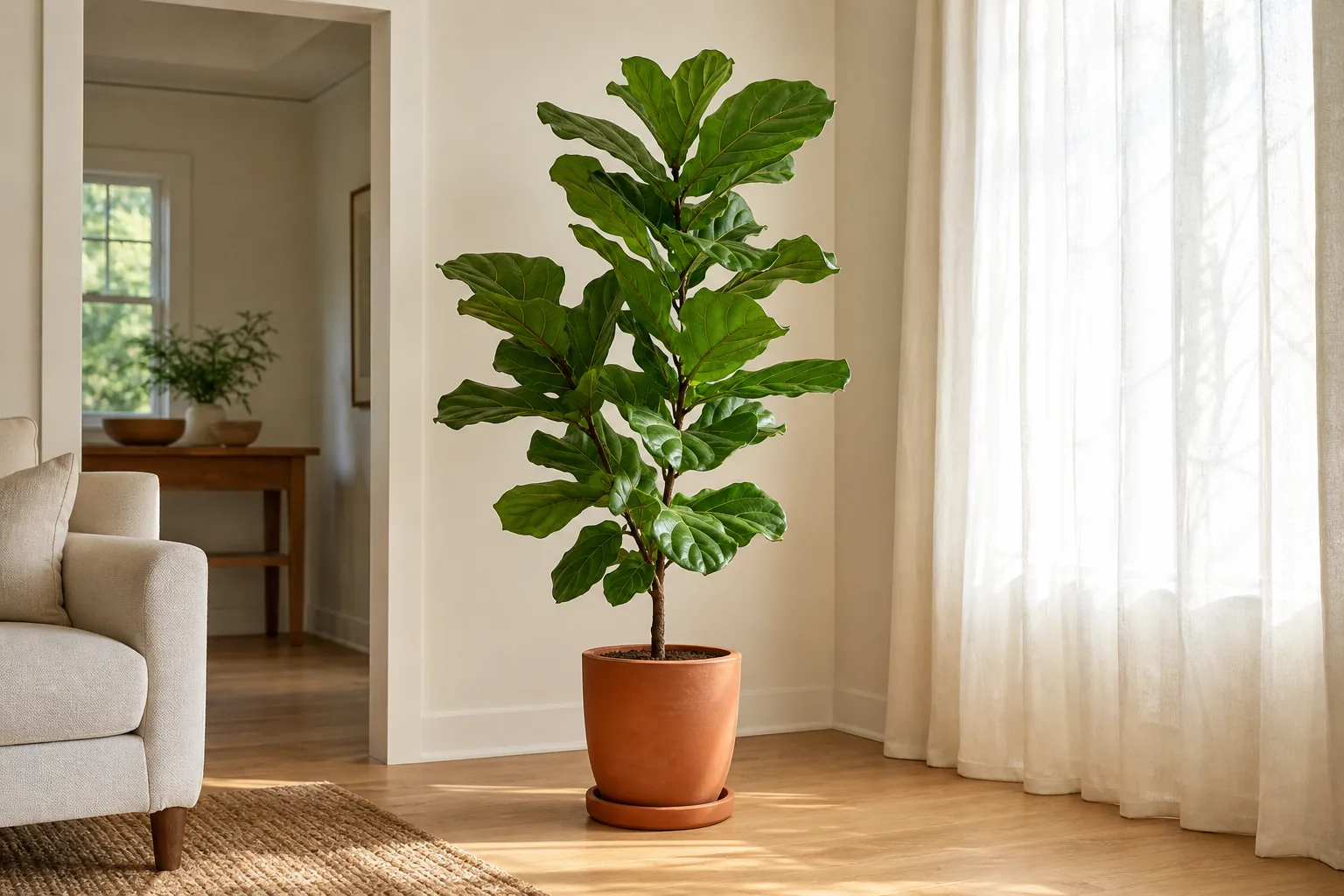
- Ficus lyrata (fiddle leaf fig). Wants a steady, bright spot and resents being moved. Dropped leaves in the first weeks at home are common and not necessarily a sign of failure.
- Ficus elastica (rubber plant). Tree-form, self-supporting, and tolerant of bright indirect light. Cultivar matters for mature size; common ‘Robusta’ tops out shorter than the variegated forms.
- Dracaena marginata and Dracaena fragrans. Narrow footprint with vertical reach, well-suited to corners where floor space is limited. Leaf-tip browning is often a tap-water or humidity response rather than underwatering.
- Schefflera actinophylla and Schefflera arboricola. Both handle bright indirect light; the umbrella tree form spreads wider than the dwarf form and may surprise readers expecting a narrow silhouette.
- Pachira aquatica (money tree). Often sold braided and tolerates bright indirect light. Direct sun is a real risk, especially in a west-facing window in summer, where leaves can scorch.
- Beaucarnea recurvata (ponytail palm). Stays relatively low with a wide base and a swollen caudex (the bulbous trunk that stores water), making it a common-sense pick where ceiling height is the constraint rather than floor space.
- Strelitzia nicolai. The largest candidate by footprint; split leaves can crowd a doorway and the plant is best treated as an architectural feature rather than a corner accent.
This is a shortlist, not a ranking. The species that fits your room is whichever one matches your ceiling height, footprint, light intensity, and willingness to give it a steady spot.
What a large floor plant asks for in pot, mix, water, and support
Container. A common rule of thumb when repotting is to step up by about two inches of diameter rather than four or six. Skip-up creates an oversized reservoir and a mix that stays wet for too long. A pot with a drainage hole is worth insisting on; caching a naked-root plant in a pot without drainage is a common cause of root rot at this scale. See why drainage matters in large floor pots for the practical setup.
Potting mix. Larger pots hold more mix and dry unevenly, so the airy structure of the mix matters more at this size. An indoor mix with good drainage is a safer starting point than a dense garden soil. See how to choose a potting mix for a large floor pot for the detail.
Watering rhythm. A larger pot does not mean less frequent watering; it means a longer dry-down with a higher total volume per drink. Watering by observation (top inch or two of mix, pot weight) is more reliable than a fixed schedule — see how to water by observation instead of a calendar.
Support. Climbing or vining species need a pole, plank, or trellis to produce the form most readers expect. Without it, the plant will not fail, but the look will be different from common photos. How to support a climbing houseplant covers the practical options.
Mobility. A caddy under a heavy pot makes watering, rotating, and cleaning much easier and protects the floor.
Common failure modes to watch in the first two months
- Leaf drop after delivery or moving. Even tolerant species drop leaves while they readjust to new light and humidity. This usually settles on its own over four to six weeks if the rest of the conditions are stable. See why a new large plant may drop leaves while it settles.
- Brown leaf tips on Dracaena. Often a tap-water sensitivity or low humidity rather than underwatering.
- Yellowing lower leaves on a fiddle leaf fig after relocation. A signal to stop moving the plant and let it settle.
- A constantly wet lower mix. Usually a reservoir or drainage issue, not a watering schedule issue.
- Scorched patches in a west window in summer. A location problem, not a species problem — and drafts, vents, and sun-heated glass can quietly change the same window across seasons.
For a routine that catches these signals early, our realistic weekly houseplant care check is a useful counterweight to the size of a large floor plant, which is easy to overlook in a quick room walk-through.
When to ask a local nursery or extension service instead
If your room conditions are unusual — a skylight with significant summer heat, a north-facing room that is bright only because of reflective surfaces, a rental with strict floor-load rules, or a pet with a known plant allergy — a local nursery or your state’s extension service is a better source than any online guide. They can look at the actual room, the actual water, and the specific plant in question, and they can flag local issues a generic guide cannot. This article stays educational and is not a substitute for that in-person read.
Sources
- Indoor Plant Selection and Care — University of Arizona Cooperative Extension
- Set houseplants up for success: right plant, right place — Oregon State University Extension
- Plants Grown in Containers — NC State Extension Gardener Handbook, Chapter 18
- Growing Indoor Plants with Success — University of Georgia CAES (B 1318)
- Ficus elastica — NC State Plant Toolbox