Plant care
Monstera deliciosa care: a calm, observation-first guide
· Updated
A quick safety note before anything else: Monstera deliciosa contains calcium oxalate crystals in every part of the plant. It is toxic to cats and dogs and mildly toxic to humans if any part is chewed or swallowed. If you share your home with curious pets or small children, place the plant out of reach and contact a veterinarian or poison control if any ingestion is suspected.
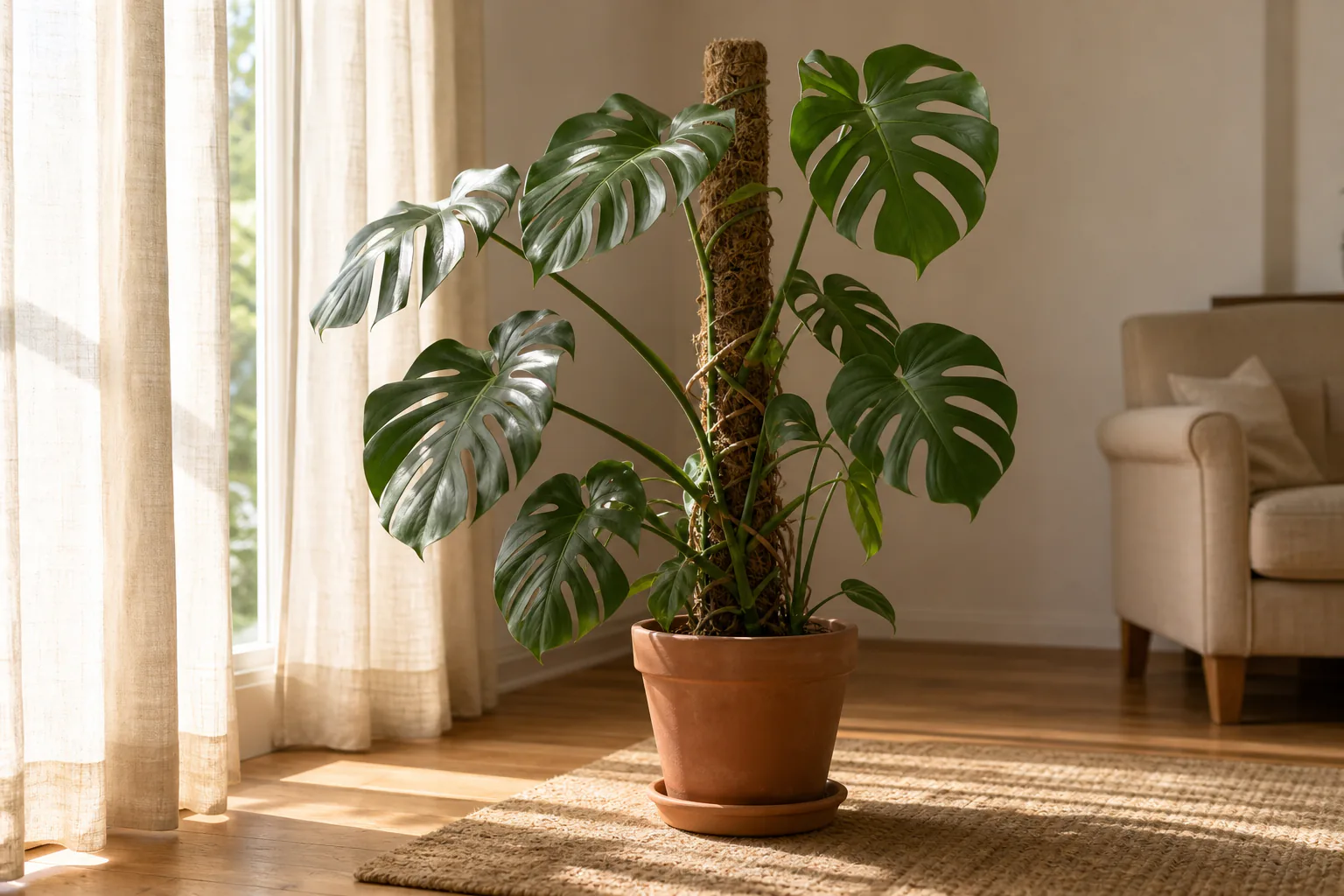
A Monstera deliciosa does best in the brightest indirect light your room can offer, watered when the top two to three inches of potting mix dry out, supported with a sturdy moss or coir pole if you want larger, split leaves, and allowed to grow at its own pace. Its mature indoor size and its leaf fenestration depend on light, support, and time, not on a faster routine.
If you only do four things after reading this, do these: observe the light at the spot where you want to place it, check the top of the mix with a finger before you water, give it something textured to climb once it has more than a few leaves, and accept that a young plant will not split its leaves on a schedule.
What a Monstera actually does indoors
Monstera deliciosa is a climbing hemiepiphyte. In the wild, the seed often germinates on the ground, the seedling sends a vine up a tree trunk using aerial roots, and the leafy end climbs toward brighter light while the rooted end tolerates shadier conditions. Indoors, that habit shows up in two ways: the plant is more tolerant of medium light than many tropicals, and it grows noticeably larger and produces more split leaves when it has something textured to climb.
This is also why a Monstera in a living room grows differently than the same plant in a botanical greenhouse. The living room has a ceiling, less consistent light, and a finite pot. The greenhouse has taller supports, brighter filtered light, and a long runway of stable conditions. Both are honest versions of the plant; neither is the wrong one. The plant simply does what its conditions let it do.
Read the light in your room before you place (or move) your Monstera
A Monstera’s label usually says bright indirect light, which is a starting point rather than an answer. The actual brightness of any given spot depends on your window direction, the season, obstructions outside, and where the pot sits in the room. Our guide on reading the natural light in your room before placing a Monstera walks through a simple observation method. The short version:
- Watch the spot for a full day. Where does the sun actually fall, and for how long?
- A spot a couple of feet from an unobstructed south-, east-, or west-facing window in active growth is a reasonable bright indirect spot.
- A spot further back from the window, or near but not in a sunny beam, is medium light. The plant will live there, but growth slows and fenestration is less common.
- Direct midday sun through glass can scorch leaves, especially during the spring and summer months of active growth. A sheer curtain or a step back from the window turns harsh direct light into the bright filtered light a Monstera prefers. Gentler direct sun in winter is usually less of a problem.
A Monstera in medium light is not failing. It is operating on a smaller budget. If you can move it closer to a window or add a sheer curtain, expect growth to pick up over the next growing season.
Where a Monstera fits in a real room: floor space, traffic, and windows
Two practical placements usually work best: a bright spot a few feet back from a sunny window, or right at a bright east-facing window with a sheer curtain during the strongest midday hours. Both keep the leaves out of a harsh direct beam while still giving them several hours of usable light.
Three things to think through before settling on a spot:
- Floor space. The plant grows outward as well as upward once the pole is in. Leave room to walk around it without brushing the leaves.
- Traffic. A doorway or a hallway corner is not ideal. Each bumped leaf tears at the split seams, which is cosmetic but irreversible.
- Heat and cold. Keep the pot away from a radiator, a heating vent, and a cold draft from an exterior door. Monstera is prone to root problems in cold, wet conditions, and a chilly windowsill in winter can swing temperature faster than the mix can buffer.
If you rent, think about ceiling height too. A well-supported Monstera in a bright room can reach toward a ceiling over a few years. That is a feature, not a problem, but it changes whether the spot in front of the window is the right one or the wrong one.
Watering by observation, not by calendar
The reliable rule for Monstera, from both university extension guidance and botanical garden care notes, is to water thoroughly when the top two to three inches of the mix dry out, then let the excess drain away. Skip any fixed schedule. Watering on a calendar is a frequent cause of problems with this plant because the dry-down time varies so much with light, pot size, mix, and season.
A short, repeatable check:
- Stick a finger or a wooden chopstick two to three inches into the mix. If it comes out cool or with damp mix clinging, wait. If it comes out dry, water.
- Lift the pot right after a thorough watering and notice the weight. Lift it again before watering. The difference is unmistakable once you have done it a few times.
- Water slowly until it runs from the drainage holes, and remove any run-off from the saucer after about fifteen minutes. Sitting in standing water keeps the lower mix saturated and is the usual path to root rot.
In lower light and in winter, the mix takes longer to dry. The pot tells you. Lift, check, water, repeat. Drainage matters more than any other pot feature for this plant, and a pot with drainage holes is the simpler default.
Support: why a Monstera climbs and when to add a pole
A pole is not decoration. It is the surface a Monstera expects to find. Aerial roots along the stem can grip a textured surface, anchor the plant, and, when the pole is kept lightly moist, send feeder roots into it. That attachment is associated with larger leaves and more consistent fenestration than unsupported trailing growth.
Three common options, with honest trade-offs:
- Sphagnum moss poles hold moisture, feel most like a mossy tree trunk to aerial roots, and invite attachment. They do need occasional misting or watering to stay inviting, and lower-quality moss can shed or stay soggy.
- Coco coir poles are more durable, hold less moisture than sphagnum, and still give aerial roots plenty of texture to grip.
- A plain wooden or metal stake supports the weight of the plant but offers nothing for aerial roots to attach to. The plant stays upright, but the larger-leaf effect does not really kick in.
When to add a pole: once the plant has several leaves and a clear stem to attach, or once you can see aerial roots reaching out into the air. Press the pole into the back third of the pot and gently pin the stem against it with soft plant tape. Aerial roots that wander off the pole can be redirected with the same tape or trimmed near the stem if they are unsightly.
A pole in a dim corner will not unlock split leaves on its own. Fenestration still needs adequate light and a mature plant. Think of the pole as giving the plant the surface it evolved to use, then let the light do its work.
Fenestration and realistic mature size indoors
The splits and holes in mature Monstera leaves, called fenestration, are partly a maturity signal and partly a response to light and stable support. A young plant with all solid leaves is not doing something wrong. It is just young. The first fenestrated leaves typically appear on the largest, most mature leaves once the plant feels secure on a pole and the spot is consistently bright.
Mature indoor size is a range, not a number. Extension services and established care publications commonly report roughly three to ten feet tall with support, with exceptional plants in very bright, well-supported spots reaching further over many years. Outdoors, in suitable climates, the vine can exceed seventy feet when left unpruned, which sets a generous ceiling on what the species is actually capable of.
Two practical takeaways: plan a spot that can accommodate a few years of growth rather than a few months, and treat social-media ceiling-height-in-a-year photos as the upper end of a long distribution rather than a default.
Common problems to watch for: yellow leaves, brown edges, drooping
Most Monstera problems in homes come from a small set of causes. Read the whole plant before reacting to one leaf.
- Yellowing lower leaves with a mix that stays wet more than a week usually point to overwatering or a pot that holds too much moisture. Lift the pot, ease back on watering, and consider a chunkier mix or a smaller pot.
- Yellowing leaves with a mix that dries out fast and crispy brown edges usually point to underwatering or very low humidity. Soak the rootball thoroughly and check more often.
- Pale leaves, long spaces between leaves, and no splits usually point to not enough light rather than a routine problem. Move the plant closer to the window or add a sheer curtain.
- Drooping that recovers after watering points to a thirsty plant. Drooping that does not recover after watering, with a wet mix and a soft stem near the soil line, points to root rot and warrants unpotting and a closer look at the roots.
- Brown leaf edges with otherwise healthy leaves can come from dry indoor air, a buildup of minerals in the mix, or fertilizer residue on dry roots. Flushing the pot with plain water every few months is reasonable; fertilizer is best kept to a light, general feeding during active growth only.
When in doubt, slow down. One change at a time, observed over a few weeks, tells you more than a flurry of adjustments in an afternoon.
A short placement and care checklist
If you want a single section to pin above the potting bench, this is the version worth keeping:
- Place the plant in the brightest indirect light the room offers, a couple of feet from a sunny window or right at a bright east window with a sheer curtain.
- Keep the pot out of cold drafts and away from heating vents.
- Water thoroughly when the top two to three inches of mix are dry, and remove run-off after about fifteen minutes.
- Use a pot with drainage and a chunky, well-draining mix, especially in a lower-light room.
- Add a moss or coir pole once the plant has a clear stem and several leaves. Pin the stem in place and let the aerial roots attach.
- Expect slower growth and fewer split leaves in medium light. Move the plant if you can, or accept the slower pace.
- Plan a spot that can hold a plant in the three to ten foot range over several years, not a fixed height on a fixed timeline.
- Keep the plant out of reach of cats, dogs, and small children, and contact a veterinarian or poison control if any part of the plant is ingested.
The reading we have of the plant will always be partial. Light changes with the season, watering needs shift, and a Monstera that looks settled today may ask for something different in six months. The care that tends to work is the care that responds to what the plant and the room are actually doing.
This article is educational and is not a substitute for local advice. Plant behavior varies with species, cultivar, mix, light, temperature, season, water quality, and pests. If a plant shows serious or spreading symptoms, contact a qualified local nursery, your regional extension service, or a veterinarian for pet-related concerns. See our plant care disclaimer.
Sources
- Monstera deliciosa — UConn Home & Garden Education Center
- Monstera growing in the Florida home landscape — University of Florida IFAS Extension (HS311)
- Monstera (Monstera deliciosa) — New York Botanical Garden LuEsther T. Mertz Library
- Lighting for indoor plants and starting seeds — University of Minnesota Extension
- How to grow and care for Monstera deliciosa — The Spruce