Plant care
How to support a climbing houseplant without breaking the stems
· Updated
Should you support this plant at all (and when trailing is the better answer)
Support is a choice, not a requirement. If your pothos, philodendron, or monstera is healthy and you like how it looks trailing from a shelf or hanging basket, that is a perfectly valid answer. Pothos and philodendrons will trail along the ground in the wild as well as climb; monsteras more typically germinate on the forest floor and work their way up a host trunk. In any of those habits, a long, flowing pothos or a heartleaf philodendron cascading off a bookshelf is a mature, healthy specimen, not a neglected one.
Support becomes worth considering when:
- Vines are piling on the floor and getting trampled or stepped on
- A monstera trunk is leaning hard and the crown is pulling away from the pot
- Aerial roots are growing into open air with nothing to grip
- You have a tall, narrow space where an upright habit fits better than a trailing one
- You simply want the look of a climbing plant
If none of those apply, do not feel pressure to add a pole. The plant will keep growing either way.
What “climbing” actually means for the common houseplant aroids
Pothos (Epipremnum aureum), philodendrons, and monsteras are root climbers. In their native tropical habitats they climb tree trunks and other textured surfaces using aerial roots, the small brown or whitish nubs that grow out from the stem opposite each leaf. These roots anchor the plant and absorb some moisture from humid air and the damp surfaces they touch.
This matters because it tells you what kind of support actually helps. A smooth bamboo stake gives aerial roots almost nothing to grip. They need a textured surface: the rough fiber of a moss pole, the slightly bristly surface of a coir pole, the flat face of a wood plank, or a wall with a hook system that holds the stem in place.
If you want to understand how light interacts with growth habit and where the pole should live in your room, the guide on how to read the natural light in your room covers the placement side of this question.
Choosing a support type: moss pole, coir pole, flat trellis, stake, wall hook
There are five common categories. Each has tradeoffs in a typical home.
Sphagnum moss poles are a plastic or wire core wrapped in sphagnum moss. The surface is soft, fibrous, and grippy. If you keep the moss damp, aerial roots will readily grow into it. The downsides are that moss dries out fast in heated indoor air and can shed bits onto the floor.
Coco coir poles are the same shape but wrapped in coconut fiber. Coir stays slightly moist longer than loose sphagnum and tends to be tidier. Both work as vertical climbing surfaces.
Flat wood planks or trellises give the plant a wide, dry, rigid face to attach to. They look decorative and work well for monsteras where you want a clean display, but they rely more on ties than on root attachment because the wood is too dry for roots to grip on its own.
Bamboo and cedar stakes are simple, sturdy, and inexpensive. They are best for straight staking (holding a leaning stem upright) rather than as a climbing surface, because there is not much texture for aerial roots to grab.
Wall hooks and rails let long vines trail along a wall rather than climb. They are particularly useful for pothos and philodendrons where the goal is to guide the path of growth rather than force attachment.
For upright growers like monstera, a vertical pole or plank keeps the footprint small. For spreading vines, a flat trellis or wall system spreads the plant sideways but needs more wall space. There is no single right answer; pick what fits your room and how you want the plant to look.
When to add support, and how to do it without breaking stems
The safest moment to add a pole is at potting time, when the root ball is loose and easy to work around. You can also retrofit one into an established plant without repotting: insert the support into the potting medium at a slight angle away from the densest root mass, push it deep enough to be stable, and firm the medium around the base.
Try not to drive the pole straight through the center of the root mass. A small angle and gentle pressure is enough.
For species-specific guidance on monstera growth and where a pole fits into its care, the monstera care guide is worth reading alongside this post.
Attaching the plant to the support: soft ties, where to anchor, how tight is too tight
Ties are the part most readers get wrong. Two rules matter more than any specific material.
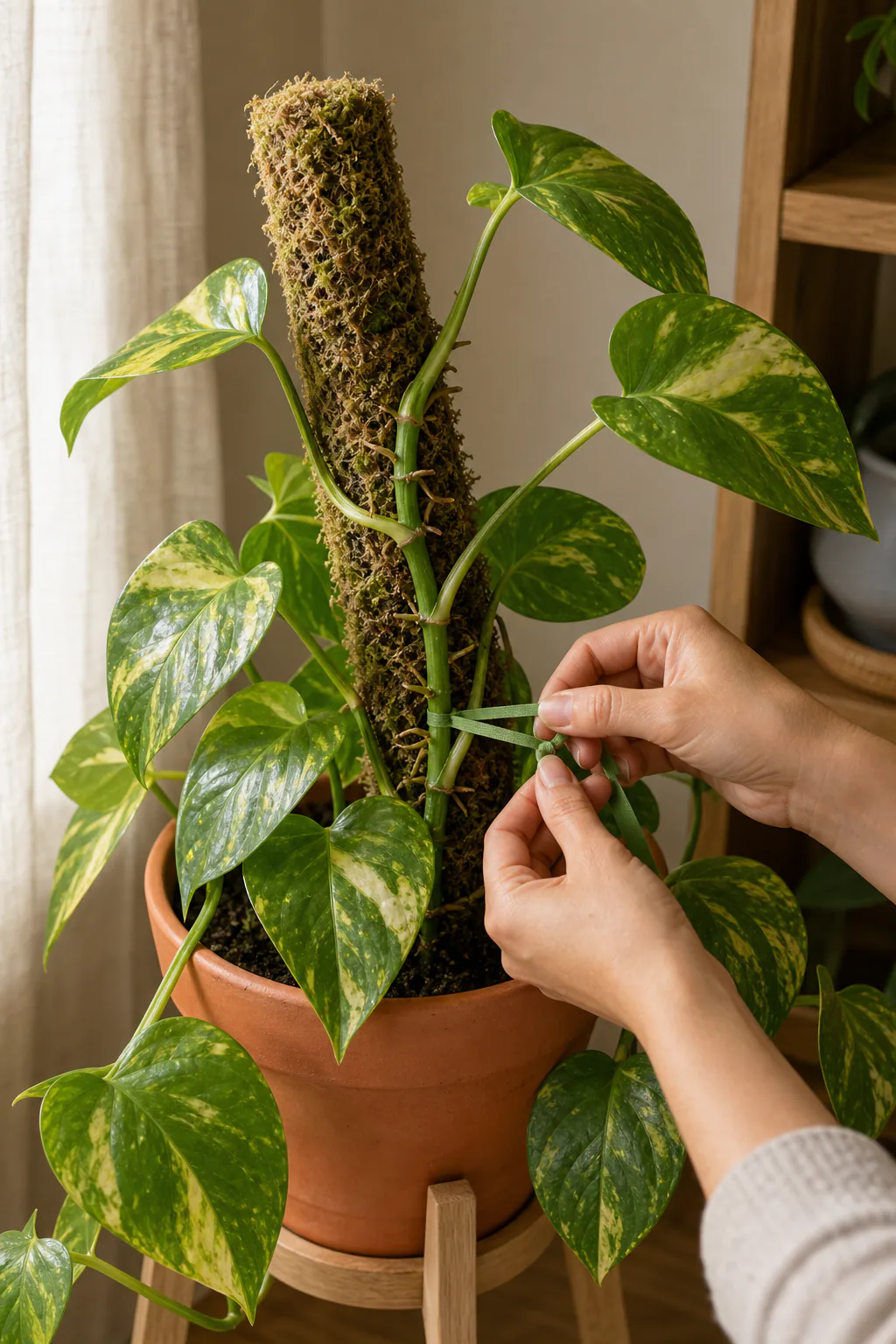
Tie the main stem, not the petiole. The petiole is the thin stalk that connects a leaf to the stem. Petioles bend, kink, and snap under pressure, and a tight tie on a petiole will quickly cause the leaf to droop. Anchor your ties on the thicker vine or stem instead.
Leave slack. A tie that is snug at installation becomes tight as the stem thickens over weeks and months. A tight tie can girdle the stem, cutting into the vascular tissue and damaging it permanently. Aim for a loop loose enough to fit a finger, or for the stem to thicken noticeably before the tie starts to bite.
Common tie materials that work: soft garden twine in a figure-eight loop, reusable plant Velcro (the soft green tape sold for tomatoes and vines), strips of old tights or soft fabric, and stretchy plant tape. Avoid wire, fishing line, and thin plastic ties, which cut in quickly.
A figure-eight loop is a simple pattern: wrap the tie around the stem, cross it over itself, then wrap around the support, leaving a small gap between stem and support at the crossing. It keeps the stem from rubbing against the support while still holding it close enough for aerial roots to find the surface.
Aerial roots on a pole: what they do and what to do about them
Aerial roots are not a sign of distress and they do not need to be cut off. They serve two real functions: anchoring the plant to a host surface, and absorbing moisture and a small amount of nutrients from humid air and the surfaces they contact. A 2023 peer-reviewed study found that on several common indoor aroids, aerial roots took up nitrogen more efficiently than soil roots under the tested conditions.
Whether that absorption matters in a typical dry home depends on contact with a moist surface and ambient humidity. In practical terms, an aerial root that grows into a damp moss pole is doing real work. An aerial root waving in dry room air is mostly an anchoring attempt that did not find a surface.
Roots that fail to attach are not a failure state. They will not harm the plant, and cutting them off removes a small amount of absorptive surface without any clear benefit.
For more on how these plants behave on shelves and in hanging setups, the post on heartleaf philodendron care covers the trailing side in more depth.
Training vs. forcing: adjusting the plant a little at a time
This is the part that does the most damage in real life. A mature trailing pothos or philodendron has long, partly woody stems that do not want to bend upward. If you pull the entire vine up against a new pole in one session, you risk cracking the stem at a node, splitting the internode, or breaking a petiole.
New growth is what actually climbs. Young, flexible vine tips with two or three nodes can be pinned gently against the pole and trained upward over a few days. Older stems are best left where they are, or repositioned in small increments over a week or two.
A practical approach:
- Insert the pole and tie the lower portion of the plant where the stem is already closest to the support.
- Move one or two nodes up the stem every few days, adding ties as you go.
- Let new growth find the pole on its own by pointing the growing tip toward it.
- Accept that the lower, older section may keep some of its trailing shape. That is fine.
If a stem kinks, cracks, or splits at a node when you bend it, stop, ease the tension, and let that stem recover where it is. A cracked stem may recover on its own in time, but a fully snapped vine is generally best pruned back to healthy tissue so the plant can redirect its energy.
Common support mistakes that crack stems or rot the crown
A few patterns show up repeatedly:
Forcing long trailing stems into a vertical position in one session. Older woodier stems resist and crack.
Tying on the petiole rather than the stem. The petiole bends, the leaf droops, and the tie ends up cutting into the thinnest part of the plant.
Letting a sphagnum moss pole stay bone dry. The point of the moss surface is moisture; a dry pole is just an expensive stake. In heated indoor air, plan to check a moss pole every day or two and rewet it when the surface feels dry to the touch, especially during winter.
Pushing the pole straight through the root mass. A slight angle away from the densest roots is far less disruptive.
Leaving ties in place indefinitely. A tie that was loose at installation will tighten as the stem thickens. Check ties every few weeks and loosen or replace any that are starting to bite.
Pressing the crown of the plant (where stem meets soil) under the base of the pole. Trapped moisture at the base of the pole can sit against the crown and create conditions where rot is more likely, particularly for monsteras and philodendrons, which dislike wet crowns.
Expecting a pole to produce larger leaves on its own. Larger, more fenestrated leaves on monstera are most strongly linked to adequate light and plant maturity. Climbing is one contributing factor among several, not a switch you flip.
When the pole and the room work together
The best support setup is the one that matches both the plant and the spot you have for it. A monstera in a bright corner with a damp moss pole, a pothos on a wall hook system near a window, a heartleaf philodendron climbing a coir pole on a plant stand in medium light: each of these is a working answer.
The plant will tell you how it is doing. New growth pointing toward the pole, aerial roots visibly entering the moss, and a stable upright crown are the signs the support is working. New growth ignoring the pole, stems still flopping, and leaves yellowing or drooping more than usual are the signs to slow down, check light and water, and adjust gradually.
There is no urgency. A climbing houseplant will not decline because you took a few weeks to decide whether to add a pole. Take it at a pace that lets you watch what the plant is doing.