Plant care
Hanging houseplants for bright and medium-light rooms
· Updated
The short answer
Pick the plant to match the light at the spot, not the other way around. For bright, indirect spots near a sunny window, pothos, heartleaf philodendron, hoya, string of pearls, and tradescantia are reliable hanging choices. Spider plants fit comfortably a step farther back, into the medium-light tier. Before anything goes on the hook, make sure the total wet weight (pot + saturated soil + plant) stays below the hardware’s printed rating, and plan how water will drain while the pot is suspended.
Start with the light at the hanging spot, not the plant
Every other decision in this post depends on this first one. UF/IFAS defines direct indoor light as four or more hours of sun, usually in unshaded south- or southwest-facing windows, while a few steps back from that same window the light drops into a bright-indirect range that suits most trailing foliage plants. Further away still, in an east-facing room or a north-facing window, you are in medium light. N.C. Cooperative Extension sorts indoor plants the same way and lists spider plants among those with moderate (medium) light needs.
The point is to read the actual spot before you commit. A spot three feet back from a south-facing window that “feels bright” by midday is not the same as the windowsill itself. If you have not measured or observed light before, the guide to reading natural light in a room walks through the simple steps. Matching the plant to your actual room, rather than to a generic recommendation list, is the broader habit this hangs under — see the houseplant-by-room guide for the framing. Once you have a sense of which tier your hanging spot sits in, the plant list gets much shorter and much more honest.
What a “hanging houseplant” actually covers
“Hanging” covers more than one format, and the format changes the watering mechanics.
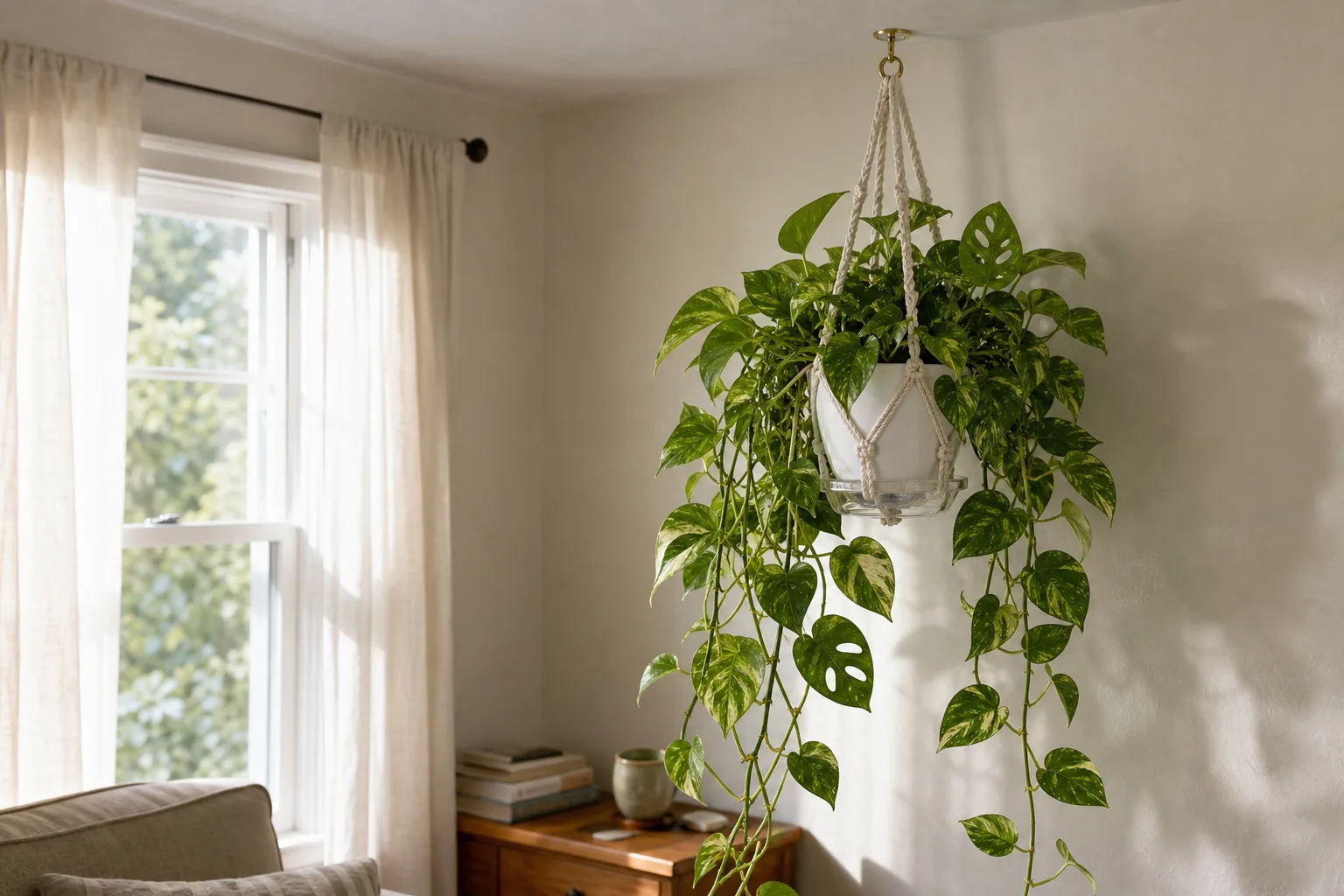
- Macramé and rope hangers cradle an existing pot, usually a plastic nursery pot set inside a decorative cachepot or directly in the rope cradle. The hook above the hanger still bears the full loaded weight, and knot construction contributes to how the load transfers through the assembly.
- Wire baskets, often lined with coir or moss, are the historic hanging container, and Purdue Extension notes that any container with drainage holes can serve as a hanging basket. University of Illinois Extension adds that lined wire baskets lose moisture faster than solid-wall pots and need more attentive watering.
- Solid ceramic or terracotta hanging pots are the heaviest format empty and the hardest to water in place because they are usually one piece.
- Wall hooks and ceiling hooks differ mainly in where they sit relative to the window. A wall hook near a window stays in the brighter light; a ceiling hook in the middle of the room often sits in the dimmer end of the same room.
The format does not change the plant’s tolerance. It changes how fast the pot dries and how easy it is to water.
Bright, indirect hanging options
These species handle hanging well in a window-side spot that gets strong ambient light but no direct, hot midday sun on the leaves. Each has a fuller care guide on the site, so the notes below are intentionally brief.
- Pothos: trailing aroid, tolerant of a wide light range indoors but grows fastest in bright, indirect light. See the pothos care guide for watering and repot cadence.
- Heartleaf philodendron: similar habit and similar range to pothos, with slightly thinner leaves that show underwatering quickly.
- Hoya: a slow, semi-succulent trailing plant that wants the brighter end of bright, indirect and prefers to dry between waterings.
- String of pearls: wants the brightest end of the bright, indirect range and grows leggy, dropping pearls in dimmer spots.
- Tradescantia: thin-leaved trailing plant that colors up well in bright, indirect light and tolerates the occasional trim back to a fuller shape.
Each of these will grow out of a six- to eight-inch pot into a curtain of foliage over time, with mature trailing length depending more on season, pot size, and watering than on anything indoors you can lock down ahead of time.
Medium-light hanging options and what to expect
Medium light is the tier where most of the bright-indirect plants above will still live, but they slow down. You will see longer gaps between new leaves, narrower leaf spacing on the vines, and less side branching. That is the trade for keeping the trailing habit in a room without a sunny window.
In practical terms, the medium-light tier is where the spider plant earns its spot. N.C. Cooperative Extension lists spider plants among indoor plants with moderate light requirements, and the offset plantlets read well spilling out of a hanging pot. Tradescantia is the second medium-light candidate to consider, but it loses the bright coloring and grows spindly without good light, so it sits closer to the bright end of medium than the dim end.
If the spot is dimmer than medium (a hallway with a single overhead fixture, a corner several meters from any window), most of the species above will slow down markedly. A foliage plant on a stand is often a better fit for a dim corner than a hanging basket.
Pot weight, mount rating, and the math you actually need
Two extension publications and one trade publication give the principle, and the principle is all you really need. The number that matters is the anchor’s printed rating, not the plant’s weight.
- Total wet weight is pot + saturated soil + plant. Saturated soil weighs significantly more than dry soil — the exact difference depends on the mix — so use the freshly watered weight when you check against the rating.
- Stud-mounted hooks into joists are the most secure option for heavier pots. The Family Handyman piece on hanging plants from the ceiling frames the requirement as a “rock-solid anchor point” rather than a specific number. Read the package, and stay below the rating it lists.
- Hollow-wall anchors (toggle bolts, molly bolts, screw-in drywall anchors) have lower ratings that vary by product. Treat the printed rating on the package as the load ceiling for that assembly in that wall.
- Tension rods avoid drilling entirely and are reasonable for light loads, but the supplied guidance did not include controlled load figures, so treat them as the lightest-tier option and verify with the manufacturer’s instructions.
When in doubt, hang the empty pot on the hook first, water it, and see how the assembly sits before you trust it day after day. Knots in macramé hangers, the loop on a rope hanger, and the ring on a cachepot all shift load around, so the hardware above the hanger is doing most of the work.
Watering and drainage when the pot is above your head
Two facts shape this section.
Purdue Extension’s framework is that the container must have drainage. That is the baseline for any hanging basket, indoors or out. Without drainage, salts accumulate and roots sit wet, especially in a small suspended pot that gets regular watering.
University of Illinois Extension’s point is that suspended containers, particularly lined wire baskets, dry faster than solid pots on the floor. That faster dry-down is manageable with a routine, but it does mean two things in practice. First, you will likely water more often than the same plant in a floor pot. Second, you need a way to catch or redirect the drainage without taking the plant down every time.
A few workable options:
- A hanging pot with a built-in saucer that clips into the bottom. Useful for small plastic hanging pots.
- A removable inner liner pot set inside a decorative hanging pot. You can lift just the liner out, water and drain it at a sink, and slide it back into the decorative pot. The drainage and cachepots guide covers the trade-offs in more detail.
- A long-spout watering can and a floor mat under the hanging spot, if the pot has open drainage and no built-in saucer.
How this fits into a regular rhythm is covered in the weekly care routine guide. The one option that does not work well is watering a heavy ceramic hanging pot in place without any drainage catch. Even careful waterers end up with drips on the floor.
Pet and child safety: hanging is a placement, not a barrier
A few hanging staples in the list above (pothos and heartleaf philodendron, in particular) are commonly reported as toxic to cats and dogs. The plant-specific status varies by genus and cultivar, and the reported severity varies. Elevation makes a plant harder for a toddler or a curious cat to reach, but it does not stop a long vine. Vines get pulled down. Plantlets dangle into reach. So treating “hanging” as a safety feature is not a sound frame.
Before you bring any plant home, verify its status on the ASPCA Toxic and Non-Toxic Plants list for cats and dogs (and the equivalent resource for any other species in your household). For a calmer framework around the choice itself, the pet-aware houseplant guide walks through how to sort the species list before you commit. A pet-aware household should treat the species list, not the mount height, as the safety question.
When the hanging spot is not working, and what to try first
If a hanging plant is struggling, the spot is almost always the issue. Leaves yellowing across the whole plant usually means the spot is too dim and the soil is staying wet too long. Leaves crisping at the edges usually mean the opposite: the air is dry or the watering is light, and the suspended pot is drying too fast. Scorched patches in the middle of leaves usually mean direct sun that you underestimated when you chose the spot.
The first move is to confirm the light, not to start a new watering schedule. Once the light is right, the same plant often settles in within a season.
A short, honest recap
Match the plant to the light at the spot, give the anchor the rating it needs for the wettest version of the pot, and keep the drainage honest. The species list is small and largely the same across reputable sources because it reflects what actually survives hanging indoors: pothos, heartleaf philodendron, hoya, string of pearls, tradescantia, and spider plant. The choosing is in the spot and the setup, not in finding a “best” plant.