Plant care
Indoor Tradescantia care: keeping the pot full and colorful
· Updated
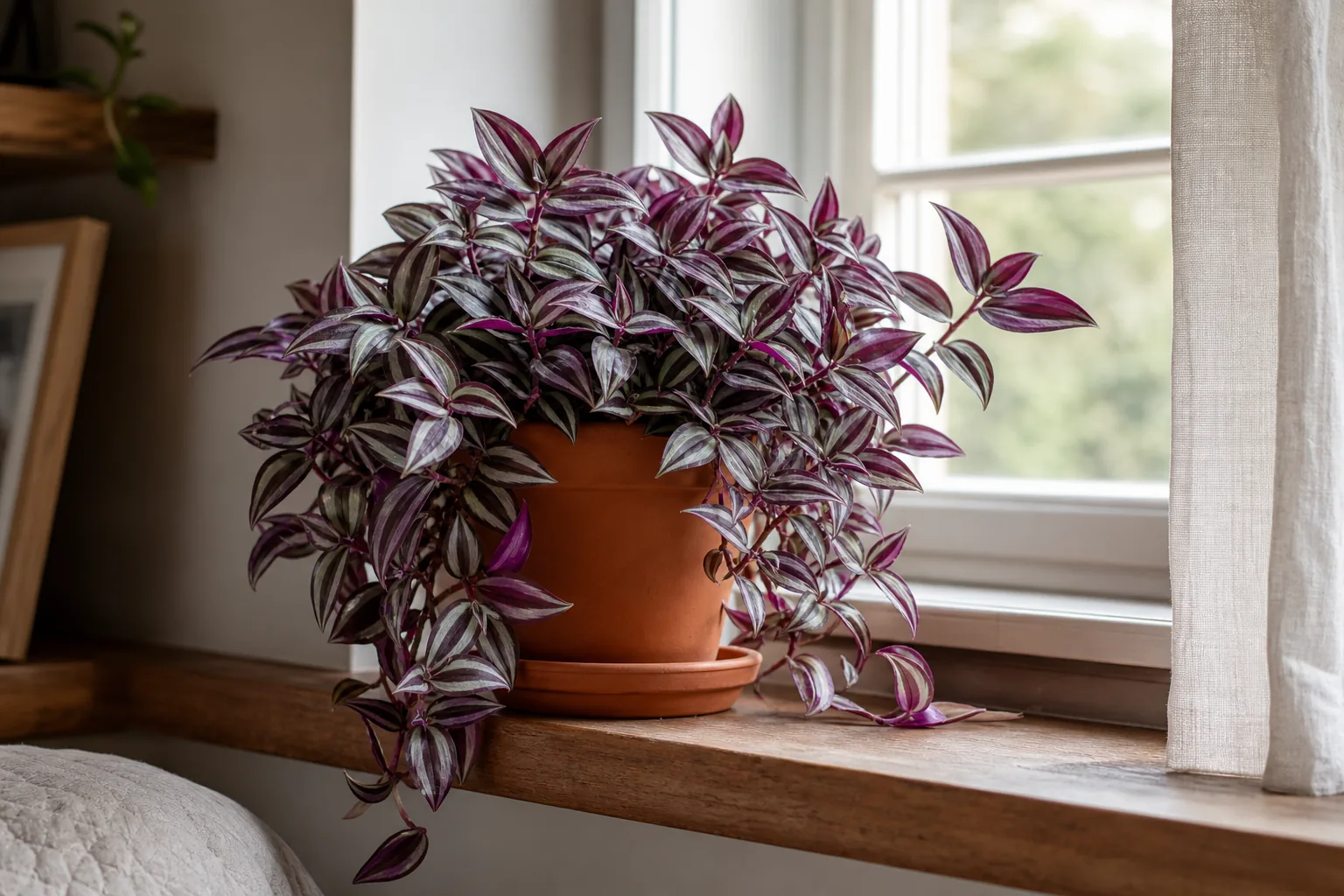
An indoor Tradescantia stays colorful and full when it gets the brightest indirect light your room can offer, a dry-down watering rhythm read by feel and pot weight, an airy well-drained mix in a pot that is not oversized, and regular tip-pruning above a node so the stems branch instead of stretching. Color, leaf size, internode spacing, and stem firmness are the on-plant signals that tell you whether each part of that routine is working.
Most of the struggles readers describe with indoor Tradescantia, including fading stripes, leggy stems, thinning centers, and brown leaf edges, trace back to one input the plant is short on, and that input is almost always light. Watering rhythm, mix, and pot size matter, but they sit underneath the light decision the reader makes when they set the pot down.
What ‘indoor Tradescantia’ usually means at the store
The plant sold as Tradescantia at a grocery store or garden center is usually one of three species, sometimes with a cultivar name attached. Tradescantia zebrina has pointed, slightly fuzzy leaves with silver and purple striping. Tradescantia fluminensis tends to have smaller, smoother green leaves, sometimes variegated white. Tradescantia pallida has solid purple, almost succulent-looking foliage. You may also see cultivars marketed as ‘Nanouk’, ‘Bubblegum’, or similar names, which tend to have thicker leaves and bolder variegation.
Store labels are inconsistent, and the same plant can show up under two or three names. The care principles below apply across all of them, though color stability and growth shape will differ between cultivars. If a specific cultivar’s leaves are losing their color or pattern, treat it as a light observation rather than a label problem.
Light: the single biggest driver of color and fullness
University of Wisconsin Extension states that Tradescantia does best in bright light indoors, even though it prefers light shade outdoors. That framing is the working baseline: in an ordinary room, the brightest spot you can give it short of harsh afternoon sun through glass is the right starting place.
A useful way to find that spot is to read the room before you trust a window-direction rule. A north-facing window a few feet away may be brighter than a south-facing window behind a sheer curtain, and a skylight can beat both. Our guide on how to read the natural light in the room before placing the plant walks through that process step by step. The on-plant confirmation matters more than the compass direction.
What “enough light” looks like on the plant:
- Leaves are full size for the cultivar, with tight internode spacing, which is the gap between leaves on a stem.
- Stripes and purples hold their color rather than fading toward plain green.
- New growth comes in steadily during the warmer months.
- Lower leaves stay on the stems instead of dropping as the stem lengthens.
What “not enough light” looks like:
- Long bare gaps between leaves on otherwise thin stems.
- Smaller new leaves compared to older ones.
- Color fading or greening out of variegated or purple cultivars.
- Stems reaching toward the window with the back of the pot bare.
If you see those signals, the answer is usually to move the pot closer to the brightest usable light in the room, or to accept that the spot will keep the plant alive but not full. Tradescantia tolerates medium light, but tolerance is a survivability statement rather than a thriving statement.
A little direct sun is usually fine. Morning sun tends to be gentle enough that Tradescantia takes it without scorching. Harsh afternoon sun through south- or west-facing glass can bleach or crisp leaves. If leaf edges suddenly look papery and pale in a spot that recently got more sun, the light has crossed into too much rather than just enough. The fuller diagnostic for stretched indoor plants lives in our guide on why leggy houseplant growth usually means more light is needed.
Watering rhythm: dry-down on feel, not a schedule
NC State Extension describes Tradescantia stems and leaves as somewhat succulent, with fleshy, mucilage-filled tissue. That matters because the plant stores water in its stems and leaves rather than depending on constant moisture in the mix. Thin, soft leaves wilt visibly when they are dry, which can fool a reader into watering again before the mix has actually dried through, and that pattern is the most common route to mushy stems.
A dry-down rhythm read by feel is more reliable than a calendar:
- Check the top inch or two of mix with a finger. If it feels dry at that depth and the pot feels light when you lift it, water.
- Water thoroughly until water exits the drainage holes, so the entire rootball gets rewet. NC State Extension’s container chapter notes that water can channel through a very dry mix without wetting it evenly, which is why a second pass after a minute or two helps.
- Lift the pot again after watering to learn its wet weight. That wet-versus-dry difference becomes your fastest repeatable signal.
What changes the rhythm:
- A smaller pot dries faster than a larger pot of the same material. Mississippi State Extension observes that larger containers generally need less frequent watering than smaller ones of the same material.
- Porous pots such as unglazed terracotta tend to dry faster than smooth plastic pots of the same size, as a general observation rather than a hard rule.
- A warm, bright room speeds drying. A cool room with lower light slows it.
- Pots without drainage convert a moisture-tolerant plant into a rot-prone one, because there is nowhere for excess water to go.
Softened tap water and very hard tap water both tend to show up on leaf edges and on the rim of terracotta pots over time, as a faint white crust or as crisper-than-expected leaf margins. Rainwater or filtered water is one workaround if you see that pattern, but it is a soft observation rather than a hard rule. The full read-by-feel routine, including pot weight and top-of-mix checks, is laid out in our guide on how to tell when a houseplant actually needs water. The diagnostic order for crispy edges is covered in brown tips and crispy edges on houseplants.
Potting mix and pot choice
Tradescantia wants an airy, well-drained mix. A standard indoor potting mix amended with perlite, orchid bark, or coarse sand usually drains fast enough to support the dry-down rhythm above. The label-reading framework on the bag is more useful than any single recipe, since the goal is air in the root zone and water moving through quickly. Our guide on how to choose a potting mix for a fast-draining indoor plant covers what to look for on the label.
Two practical cautions:
- Resist over-potting. A pot that is much larger than the root system holds moisture the plant cannot use, and the mix stays wet longer than the stems can comfortably sit in.
- Drainage matters. A pot without a drainage hole needs careful watering because there is no escape route for excess. Cachepots are fine as long as the plant sits in a drained nursery pot inside them and is not left sitting in standing water.
Pruning for a fuller pot, not just for length
Tradescantia responds well to regular pinching. The technique is simple: find a node, which is the small bump on the stem where a leaf joins it, and snip or pinch the stem just above that node and leaf. The node and the leaf stay on the plant, and the growing tip is removed.
Why this works: removing the tip releases the dormant buds at the node below, which branch out and fill in the pot. Unpruned stems tend to grow longer, drop their lower leaves, and leave a bare center.
A few honest caveats:
- Pinching does not by itself make a plant bushy. The response depends on adequate light and active growth, so a pinched plant in dim light will branch slowly if at all.
- Pinching during the warm growing months tends to give the fastest fill-in. During the lower-light winter stretch, growth slows and pinching has less to work with.
- Newly purchased plants are usually already acclimating to a new room. Give them a short settling-in period to adjust before doing any meaningful pruning.
Trimmed pieces can be set aside for a separate propagation routine, but the propagation workflow, including node selection, water versus medium, and the transition to soil, is detailed enough to warrant its own article, so this piece stays focused on keeping the original pot full.
Temperature, drafts, and seasonal shifts
Tradescantia is comfortable across the typical indoor temperature range that most homes maintain. The real risks at the edges of that range are not the average temperature but the localized extremes:
- Cold window glass in winter. Foliage in direct contact with a frosted window can chill the leaves.
- Hot window glass in summer. A west-facing window in late afternoon can heat the pot and the leaves against it.
- Heating and cooling vents blowing directly across the plant.
Growth also slows naturally during the lower-light months even when the room temperature is steady. That is normal, not a problem to fix.
Reading the most common signs
Tradescantia tells you a lot if you slow down and look. The signs below are observation cues, not diagnoses from a photo, and they usually appear in combination rather than alone.
- Color fading or greening out of variegated and purple cultivars is usually a light signal, and the first thing worth checking. It can mean too little light or, if the leaves have gone papery or pale after a move, too much direct sun. Either way, the spot is the place to start.
- Brown, crispy leaf edges are often a watering rhythm issue, a humidity issue, or a water-source issue. Check the dry-down pattern and the pot rim for mineral crust before assuming humidity.
- Yellowing lower leaves combined with wet mix are a likely overwatering signal. Let the mix dry further and reassess pot size.
- Mushy stems at the base are a stop-watering signal. Inspect the crown and roots, since soft dark stems with wet mix are a rot warning rather than a thirst warning.
- Stretched stems with small new leaves are a light signal, even if the plant looks otherwise healthy.
Each of these is a starting point for the reader’s own observation, not a verdict. The diagnostic hubs for leggy growth and brown tips give a fuller order of operations.
A simple routine for an indoor Tradescantia
A workable weekly rhythm looks like this, and most of it is observation rather than action:
- Look at the spot. Is the plant still in the brightest reasonable light in the room? Is one side leaning toward the window?
- Feel the top of the mix and lift the pot. Wet weight and dry weight become intuitive fast.
- Scan the stems and the undersides of leaves for pests, webbing, or sticky residue.
- Pinch any stem tips that have grown long or sparse, cutting just above a node and leaf.
- Rotate the pot a quarter turn so growth stays even on the side facing the window.
- Water thoroughly only when the top of the mix and the pot weight both say it is time.
- Hold off on feeding until growth is clearly active in the warmer months. Dosing and label-reading details live in our guide on houseplant fertilizer basics.
That routine adapts to the room rather than the other way around. Bright light speeds growth and dry-down, while lower light slows both. The plant’s color, internode spacing, and leaf turgor are the feedback that tells you whether the routine is matching the room, and the only adjustments that matter are the ones you can read on the plant itself.
Sources
- Tradescantia zebrina – Wisconsin Horticulture, University of Wisconsin Extension
- Tradescantia – NC State Extension Plants
- Plants grown in containers – NC State Extension Gardener Handbook
- Care and selection of indoor plants – Mississippi State University Extension
- A comparative study of Tradescantia cultivars – Chicago Botanic Garden