Plant care
String of pearls care indoors
· Updated
String of pearls care indoors: bright light and dry roots, not one or the other
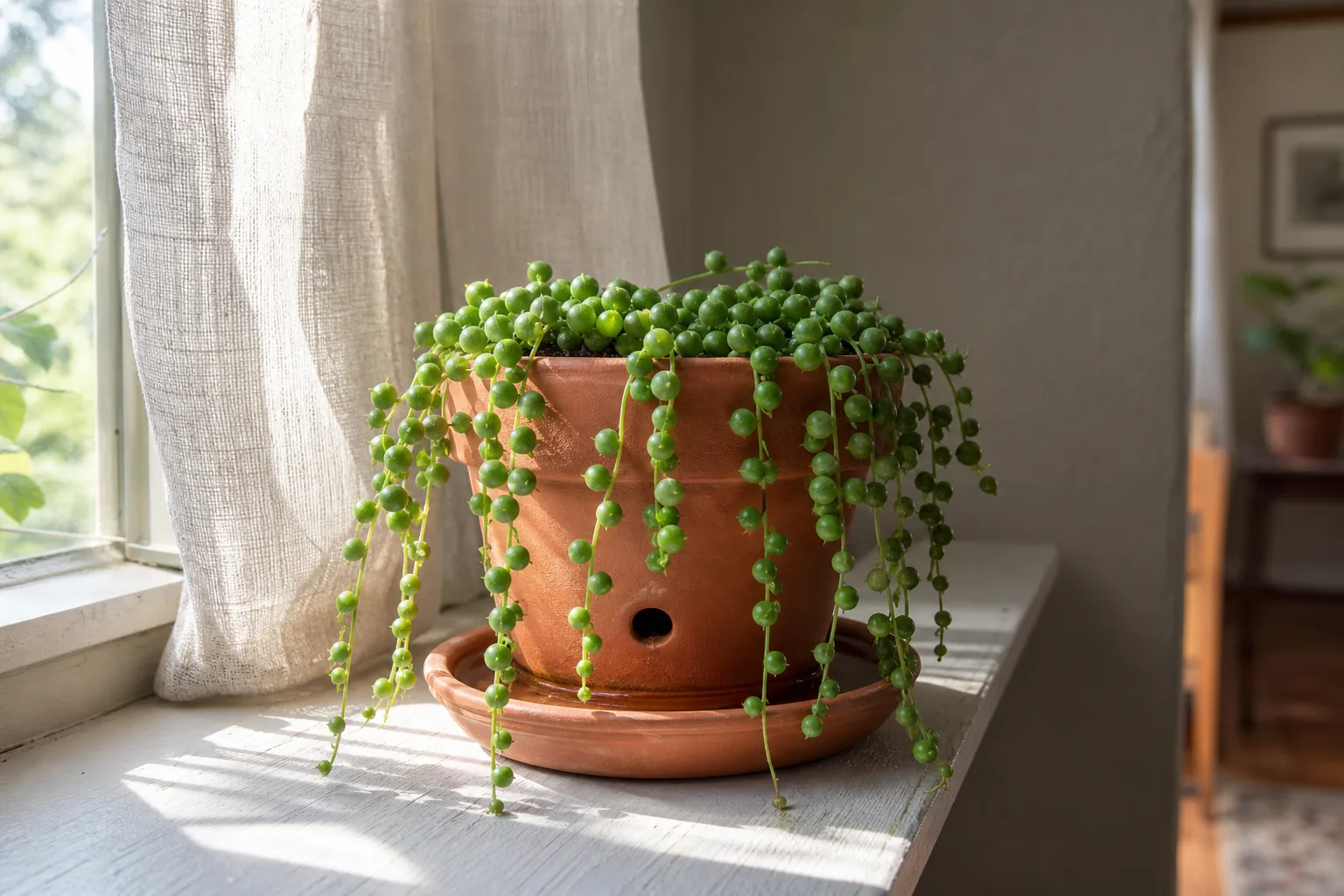
String of pearls (Curio rowleyanus, still sold as Senecio rowleyanus in many shops) is one of the easiest houseplants to misunderstand at a glance. It looks like a soft, trailing plant for a hanging basket in a dim corner, but it is a succulent from the dry Cape Provinces of South Africa, with thin vining stems and shallow surface roots that punish any pot or mix that stays wet. Most of the failure modes readers run into trace back to answering only one half of the question: bright light, or dry feet, rather than both at the same time.
The practical version is short. Place it in a genuinely bright window or a few feet back from a very sunny one. Keep it in a small-to-medium pot with a drainage hole and a fast-draining cactus-leaning mix. Water only when the pearls and the mix tell you it is time, not on a calendar. Do those three things consistently and the plant stays plump, dense, and trailing. Skip any one of them and the pearls shrivel, the stems go mushy, or the whole plant thins out and never recovers. For the broader succulent framework this guide leans on, see the indoor succulent care guide.
What string of pearls actually is
Curio rowleyanus is a creeping, perennial succulent vine. In the wild it trails along the ground and scrambles over rocks and bushes, often emerging from cracks in rock in search of a workable microclimate. The pearls are spherical, bead-like leaves that store water, and the stems root where they touch soil, slowly forming dense mats. The University of Wisconsin Horticulture Extension describes the plant as growing from weak surface roots, which is the structural reason it tolerates a fast-draining mix and a smaller pot much better than a deep, moisture-retentive one.
That single trait, weak shallow roots holding up a long thin trailing plant, is the source of every other care rule for the species. A deep, rich, damp pot is not the plant’s natural situation. Bright, dry, with roots in a thin layer of fast-drying mix, is.
Light: bright but not sun-baked through glass
The species wants bright light to stay compact. In a north-facing apartment, or on a shelf a few metres from any window, the stems stretch, the gaps between pearls grow longer, and the pearls themselves get smaller. That sparse, leggy look is almost always a light problem, not a watering or feeding problem, and old stems do not fatten back up after the fact. New growth at a brighter exposure is the realistic recovery signal.
In practical indoor placement, the working options are an east window, a west window with a watch on hot afternoon sun, or a spot within roughly five feet of an unobstructed south-facing window. A south window with the plant set back a foot or two from the glass usually works. Some direct morning sun through a window is generally tolerated and helps the stems stay tight. Hot, direct afternoon sun through glass can scorch the thin stems and pearls, so the brightest summer windowsills often need a step back or a sheer curtain rather than full exposure. The NYBG houseplant basics reference gives a useful rule of thumb: south-facing windows provide direct sun within about two to three feet of the glass and bright indirect light up to roughly five feet in.
Placement is not a one-time decision either, because the same window changes character with the season. If you are not sure whether your chosen spot is bright enough, the guide to reading natural light indoors walks through a simple observation method that takes the guesswork out.
Why wet roots are the bigger failure mode
The bigger indoor killer of string of pearls is not too little water, it is a mix that stays wet. The thin stems rot quickly, and the shallow root system sits in the upper layer of the pot where it dries unevenly. A dense, moisture-retentive potting mix, an oversized pot, a pot without a drainage hole, or watering before the upper half of the mix has dried out are the four ways this goes wrong.
The confusing part is that an overwatered plant often looks thirsty at first. Pearls shrivel because the rotted roots can no longer move water up to the leaves. The reader sees shriveling, assumes underwatering, waters again, and the rot accelerates. Reading the plant means reading the pearls and the mix and the stem together, not just the pearls.
Reading the pearls instead of a schedule
A weekly or biweekly schedule does not work for this species, because the same plant on the same shelf can dry out in a few days in summer and take three weeks in winter. Instead, treat the pearls as the readout.
A pearl that is firm, slightly glossy, and full-looking means the plant is fine. A pearl that looks slightly dimpled or feels softer than its neighbours usually means water soon, especially if the mix below also feels dry. A pearl that is visibly shriveled like a tiny raisin but still green, with the mix dry and the stem firm, means the plant missed its window and a thorough drink is in order. A pearl that is mushy, translucent, yellowing, or coming away from the stem with the slightest touch, especially when the stem base is soft or black, means too much water has already happened. In that case, adding more water makes it worse, and the next move is to unpot and inspect the roots. The when-to-water guide for houseplants covers the feel-and-weight method in more detail, and it applies directly here.
Pot, mix, and drainage for fast dry-down
A small-to-medium pot sized to the root ball, with a drainage hole, dries predictably. A generously oversized pot holds water the shallow roots cannot reach, and the surface can dry while the deeper mix stays damp for a week or more. Hanging pots and shallow bowls work well for the trailing display, but only if they actually drain. If the chosen hanging pot does not have a hole, the inner nursery pot inside it is the safer setup, as long as water is not left pooling at the bottom. The drainage-hole and cachepot guide walks through that setup.
For the mix, a bagged cactus and succulent blend is the right starting point. If that bagged mix still feels rich or peaty in the hand, lighten it further with extra perlite or pumice. The recurring fast-draining components across grower sources are pumice, perlite, lava rock, coarse sand, and coco chips, with a smaller share of organic material. The realistic target is a mix that dries roughly within a week in a warm bright room, faster in summer and slower in winter. The potting mix guide walks through how to read what is in the bag and what to add when the mix feels too rich.
A useful habit is to lift the pot right after a thorough watering and remember that weight. When the pot feels noticeably lighter a few days later, the upper portion of the mix has dried and a drink is reasonable. Lift again after watering to reset the reference.
Placement: hanging baskets, high shelves, and the bright-spot trade-off
Most readers want to hang or shelve the plant for the trailing effect, which is the whole appeal. The honest trade-off is that high shelves and ceiling hooks are usually the dimmest spots in a room, and the most dramatic display is often the worst place to put a bright-light plant. Two ways to thread this: choose a bright spot closer to the window and accept a shorter trailing length, or commit to a bright shelf and use a small grow light on a timer to extend daylight if the spot is dim. Either works. Mixing the two, a dim spot with a dense mix, is the combination that loses plants.
Also worth watching in either placement: cold drafts at windows in winter, hot air from heating vents directly onto the pot, and sun-heated glass in summer. Thin succulent stems react more to temperature swings than tougher tropicals do, and a window that is comfortable in February is often sun-baked in July. The drafts, vents, and sun-heated glass guide covers how to read those placement traps before they damage the plant.
Seasonal changes to expect
String of pearls grows slowly indoors, full stop. New stems appear in spring and summer, slow down in autumn, and mostly stop in winter. Pearls plump and prune themselves back as part of a normal rhythm, so a plant that looks slightly less full in late winter is not necessarily in trouble. Watering should follow the same rhythm: more often in active growth, less often when the plant is resting. A modest feeding with a dilute, balanced fertilizer during active growth is fine and optional; skip it in winter.
A mature, well-grown plant can also produce small, fragrant, brush-like white flowers in summer, which is a useful marker that the light, pot, and watering have been roughly right for a while.
Quick troubleshooting: shriveled, mushy, or sparse pearls
When something is off, run through three checks in order.
Shriveled pearls with a dry mix and a firm stem base usually mean underwatering or a root-bound pot. Water thoroughly, and if water runs straight through the pot without being absorbed, the mix has dried out and pulled away from the sides. A soak from below, set the pot in a few centimetres of water until the surface of the mix feels damp, often rehydrates it faster than top-watering.
Mushy or translucent pearls, soft or black stems at the base, or pearls that come away with a light touch usually mean rot. The next move is to unpot, brush the mix away, and look at the surface roots. Healthy roots are pale and firm; rotted roots are dark, soft, and sometimes smell sour. Cut back to firm, pale tissue with a clean blade and repot into a fresh, dry, fast-draining mix. Hold off watering for a few days so the cuts callus.
Sparse, leggy stems with widely spaced pearls almost always mean not enough usable light over time. Stems that have already stretched will not tighten back up, but new growth at a brighter exposure will be visibly tighter and fuller, which is the realistic signal of recovery. For a heavily rotted or bare plant, taking healthy stem cuttings and laying them on a fresh fast-draining mix to root is often a faster path back than nursing the original pot.
Limits and when to ask for local help
The recommendations above are observation-led starting points rather than guarantees. Pot size, mix brand, light quality, indoor humidity, and water hardness all shift the answer, and a plant that arrived stressed from a garden centre behaves differently from one that has been settled in for months. If a string of pearls is collapsing quickly with no obvious cause, an independent local nursery or a regional extension service can look at the actual plant, which is more useful than another round of guessing online.
One last household note. String of pearls is widely listed as toxic if ingested by humans and pets. This guide does not make a severity claim, and any household decision with curious pets or children is worth verifying against a primary toxicology source such as ASPCA rather than relying on a general care article. The pet-aware houseplant guide walks through how to verify pet-safety claims against real sources, which is the responsible next step for a household with animals.
Sources
- String of Pearls, Senecio rowleyanus — University of Wisconsin Horticulture Extension
- Curio rowleyanus — NC State University Plant Toolbox
- String of Pearls Plant: 10 Reasons Why Yours Isn’t Growing — Joy Us Garden
- 30 Indoor Plants That Like Direct Sunlight — The Spruce
- Houseplant Basics — New York Botanical Garden Libguides