Plant care
Hoya care: a calm guide for a slow, semi-succulent houseplant
· Updated
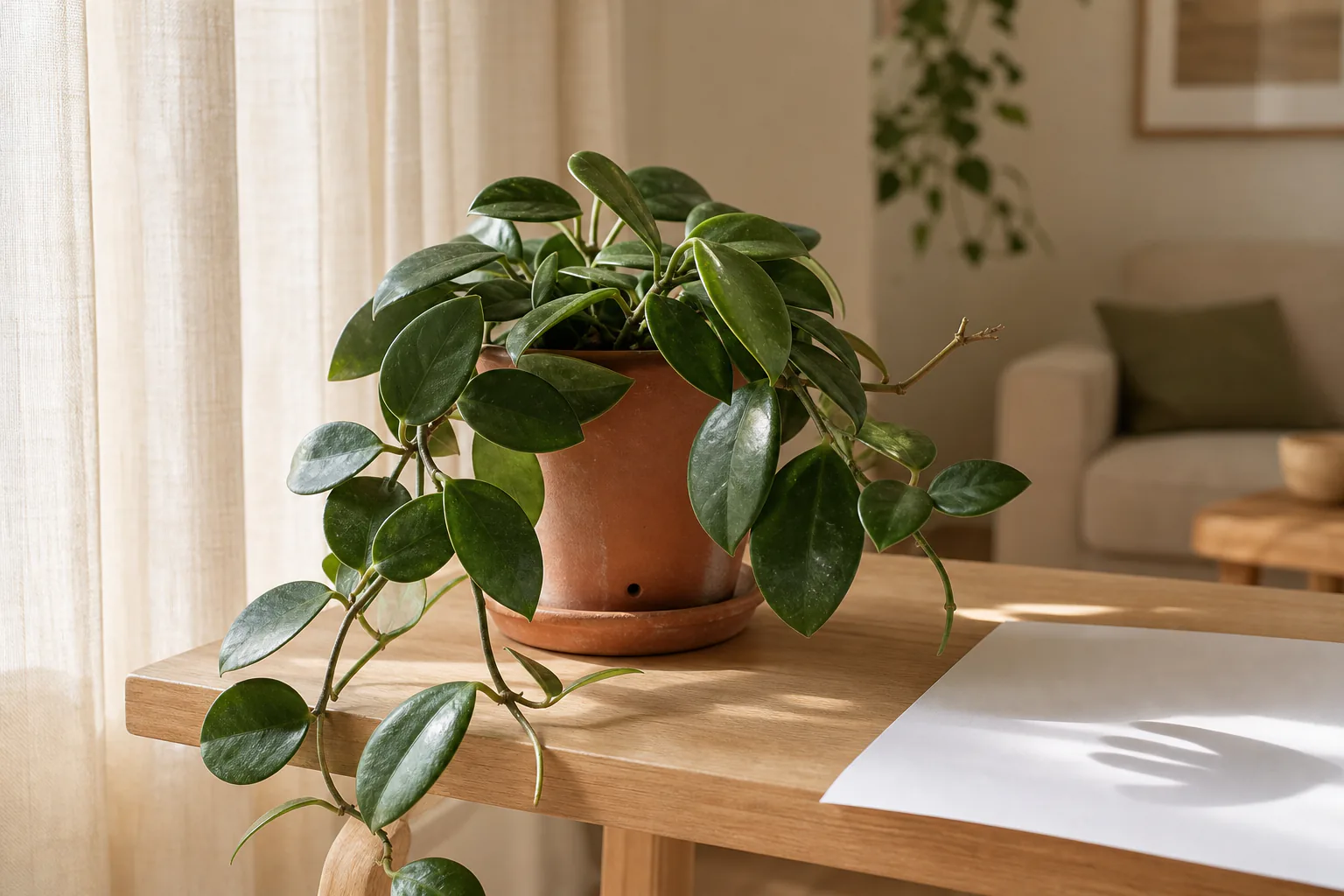
A Hoya wants bright, indirect light, a small pot with an airy, bark-based mix, and a soak-and-dry watering rhythm you read from the pot and the leaves rather than from a calendar. Growth is patient, the leaves are the main signal, and flowers are a bonus that depends on maturity and consistent conditions, not on a special routine.
If you only learn one habit, learn to read your pot. Pick it up right after a thorough watering and again a few days later. The day it feels clearly lighter than the just-watered baseline, it is ready to think about water again, especially if the top inch of the mix is also dry and the lowest leaves still feel firm and slightly plump.
What a Hoya is, and why its care story is different
Hoya is a genus of roughly five hundred species in the dogbane family, mostly native to tropical and subtropical Asia, Australia, and Oceania. In nature they are epiphytes or hemiepiphytes. The plants climb and root into tree bark rather than live in deep soil, and they store water in thick, waxy, semi-succulent leaves.
That single sentence does most of the work in this article. The leaves tell you the plant is built to outlast short dry spells in the canopy. The climbing, bark-rooting habit tells you the roots want air as well as moisture, and that a dense potting mix will hold too much water around them. The tropical range tells you the plant prefers steady warmth and dislikes cold drafts.
Most houseplant Hoyas sold as “wax plants” are Hoya carnosa or close relatives, often trained on a small hoop or grown as a hanging plant. Hoya kerrii is the single heart-shaped leaf sold as a novelty. Hoya compacta, sometimes called the Hindu rope plant, is the tightly bunched, curled-leaf form of carnosa. All of them share the same basic care frame, and this guide sticks to that shared frame rather than chasing a list of species-level exceptions.
Light: bright, indirect, and what “bright enough” looks like
Hoyas do best in bright, indirect light. Iowa State University Extension is straightforward about this: Hoyas want bright light and airy soil. Several horticultural sources place them near an east or west window, or a few feet back from a south-facing window.
You do not need a light meter to find this spot. Hold your hand about a foot above an empty sheet of paper at the place where the plant would sit. If you see a soft-edged shadow with the rough outline of your hand, that is bright indirect. A sharp, hard-edged shadow means direct sun is reaching the spot. No readable shadow means the spot is too dim for a Hoya to keep steady growth. The full method is described in our guide to how to read the natural light in your room before you place a houseplant.
University of Maryland Extension places medium-bright indoor light at roughly one hundred to five hundred foot-candles and direct indoor sun above one thousand foot-candles. UF/IFAS uses a similar range, with low light at roughly twenty-five to one hundred foot-candles. Hoyas sit firmly in that medium-to-bright window, not in the low-light band where some social-media guides place them.
Watch the plant over weeks, not hours. Pale new growth that stays small, long stretches of bare stem between leaves, and a general lack of progress from spring through fall all mean the spot is too dim. Moving the plant closer to an east window or a few feet closer to a south window usually fixes this within a few weeks.
A Hoya can also tolerate some early morning or late afternoon direct sun, especially in winter when the sun is lower. Watch the leaves for crisping or yellowing patches if you put it right at a sunny window, and ease it back a step if you see that kind of damage.
Watering: a soak-and-dry rhythm you read from the pot
Iowa State University Extension gives the clearest one-line rule: water thoroughly so the entire root zone is moistened, then allow the mix to dry almost completely before watering again. That sentence is the whole watering section in compressed form.
In practice, three observations together tell you when to water:
- Pot weight. A clearly lighter pot than the just-watered baseline is the strongest single cue.
- The top inch or two of mix. Dry mix feels dry to a finger pushed in past the first knuckle.
- Leaf feel. Firm, plump leaves mean the rhythm is matching the plant. Thin or slightly wrinkled leaves mean the gap is too long. Soft, yellowing leaves mean the mix has stayed wet too long.
Fall and winter change the rhythm. As light drops and days shorten, growth slows and the plant uses less water. The gap between waterings naturally lengthens through the colder months as the plant drinks more slowly. The simplest way to track this shift is the pot’s weight in your hand, not a fixed day on a calendar.
Thick-leaved Hoyas tolerate a longer dry-back than thin-leaved Hoyas. If your plant has waxy, succulent-looking leaves, lean toward letting the mix go a bit drier before rewatering. If the leaves are thinner and more papery, shorten the gap. Both groups still need the same bright, indirect light.
Pot and potting mix: airy roots in a small container
Hoyas do best in a small pot with drainage, in a mix that lets air into the root zone. The plant’s natural rooting environment is a thin layer of bark and moss on a tree branch, and the potting mix tries to mimic that.
Across horticultural sources, a workable mix has three roles to fill:
- Drainage and aeration. Orchid bark and perlite keep the mix from compacting and let air back to the roots.
- Light moisture holding. A peat-based or coco-coir potting mix holds enough water to bridge the gap between soakings.
- Something stable. A small amount of coarse sand, pumice, or charcoal is often added to keep the structure open over time.
A standard moisture-holding potting mix on its own is usually too dense for a Hoya. It holds too much water in the center of the pot and goes too long between useful dry-downs, which over time is the most common cause of root trouble.
Repot only when the plant is clearly crowded. A Hoya that has filled its pot, with roots circling the inside, can usually handle a move up one pot size, and only in spring or early summer when it is actively growing. Many growers keep Hoyas slightly tight in their pots rather than sizing up early, and the plant tolerates this for extended periods.
Temperature, drafts, and air movement in a normal room
Hoyas are generally comfortable at typical indoor room temperatures, which sit in a range that most homes already provide. The two stress sources to watch in a normal home are cold winter windowsills and direct hot air from a heating vent. Either of those can cause sudden leaf drop after a particularly cold night or a particularly dry, hot afternoon.
Hoyas tolerate ordinary household humidity. Misting is not needed; Hoyas do well in the humidity most living rooms already provide. Good air movement from a normal room or an open window on mild days is more useful than added moisture.
Growth, leaves, and what “patient” actually means
A healthy Hoya can easily go weeks without putting out a new leaf, especially in winter. Slow growth is normal growth. Resist the urge to fertilize harder, repot, or move the plant every time you have not seen movement for a month.
The leaves are the main visual reward over the year. In good light with a working watering rhythm, leaves thicken, deepen in color, and hold their shape. New leaves often emerge with a softer color and firm up as they mature.
Pruning is optional. If you do prune, watch for the small woody nubs along the stem called peduncles or spurs. Hoyas flower from these spurs and can rebloom from the same spur in later seasons. Cut the leafy vine if you want, but leave the spurs alone unless you have a specific reason to remove them.
Reading the signs when something is off
A few general patterns are worth knowing, framed as commonly reported signals rather than as a diagnosis:
- Yellow, soft lower leaves and a mix that still feels damp a week after watering usually point to overwatering or a mix that stays wet too long. Lifting the plant out and checking the roots is a reasonable next step; healthy roots are pale and firm, not black and mushy.
- Thin, slightly wrinkled leaves with bone-dry mix point to underwatering or a root system that has stopped taking up water. A thorough soak from the top, or setting the pot in a tray of water for twenty to thirty minutes, usually rehydrates the plant if the roots are still functional.
- A sudden leaf drop after a cold night or a move usually points to a temperature or location shock rather than a disease. Move the plant back to steady conditions and leave it alone for a few weeks.
If symptoms persist or spread, a local independent nursery, a county extension office, or a qualified indoor-plant professional can look at the actual plant. This article is an educational starting point, not a diagnostic service.
About flowers: why we do not promise them
Honesty helps here. Hoyas do flower indoors, and Iowa State Extension notes that with proper care they bloom reliably. But “proper care” is doing a lot of quiet work in that sentence. Flowering is a function of three things the reader can influence:
- Maturity. A young, small plant often will not flower even in good conditions. A single-leaf Hoya kerrii sold as a heart-shaped novelty is the clearest example: most sold this way do not have a stem node and will not develop into a flowering vine on their own.
- Consistent bright, indirect light across a full season, not just this month.
- Stable conditions across months. Long dry spells, then sudden soaks, then a winter move all work against flower initiation.
There is no fertilizer hack or “bloom in six weeks” trick that overrides those three. Treat flowers as a bonus that arrives when the conditions line up, and enjoy the leaves in the meantime.
Sources
- Iowa State University Extension and Outreach. All About Hoyas. https://yardandgarden.extension.iastate.edu/how-to/all-about-hoyas
- University of Maryland Extension. Lighting for Indoor Plants. https://extension.umd.edu/resource/lighting-indoor-plants
- University of Florida IFAS Gardening Solutions. Light for Houseplants. https://gardeningsolutions.ifas.ufl.edu/plants/houseplants/light-for-houseplants/
- Royal Horticultural Society. How to grow hoya. https://www.rhs.org.uk/plants/hoya/how-to-grow
- Espoma. Hoya Plants: Caring for Hoya. https://www.espoma.com/indoor-gardening-2/hoya-plants-caring-for-hoya/
- Stamen & Stem. The Top 5 Hoya Care Mistakes. https://www.stamenandstemblog.com/blog/2018/9/15/hoya-plant-faqs