Plant care
Fittonia (nerve plant) care in an ordinary home
· Updated
The short answer
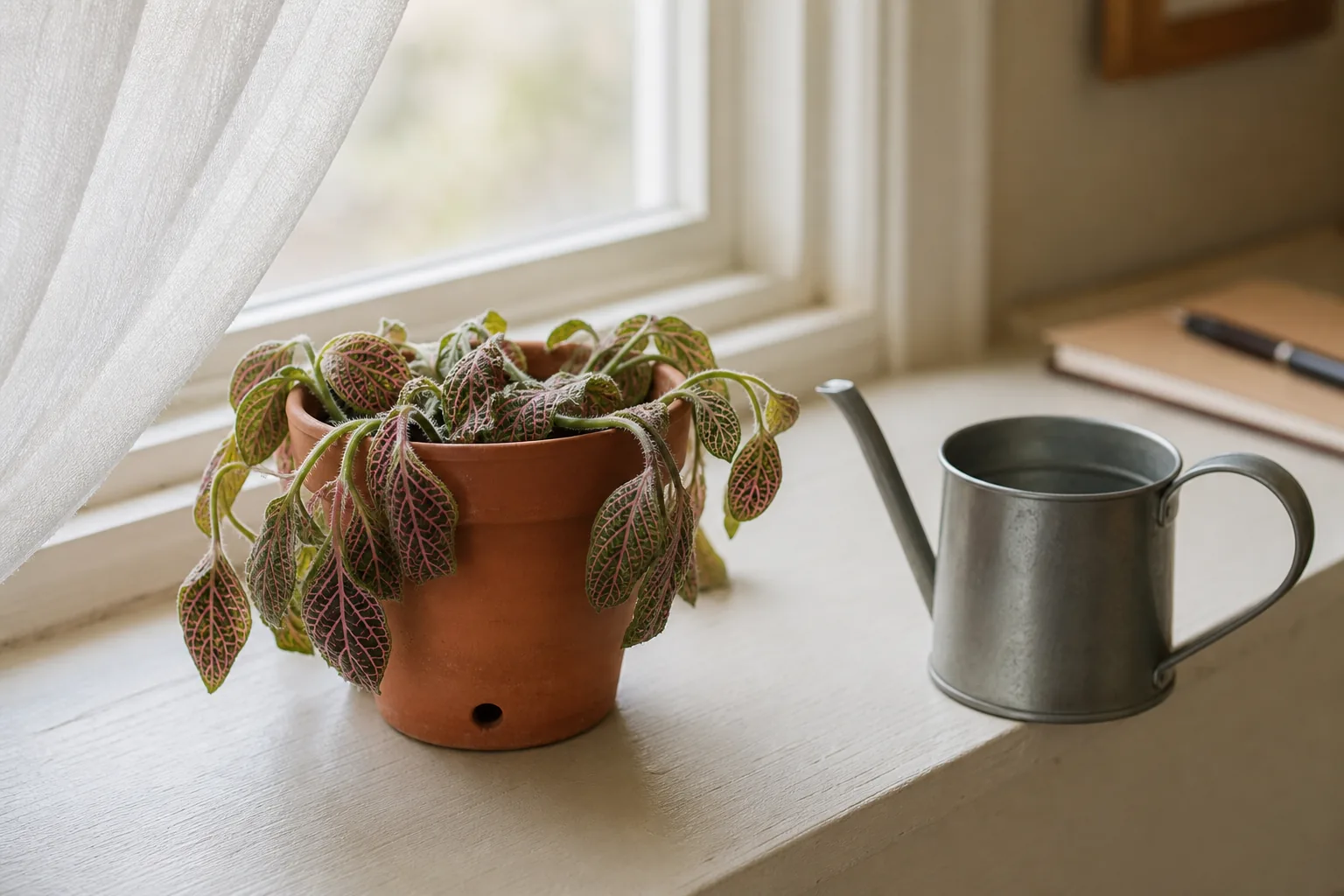
Fittonia, also called nerve plant or mosaic plant, wilts visibly within hours of drying out and usually perks back up within hours of being watered. That fast collapse is normal plant behaviour, not evidence the plant is dying. The real care goal is keeping the soil evenly moist but airy, in bright indirect light, at ordinary home temperatures, with humidity supplemented only when the leaves themselves tell you the air is too dry. Treat the wilting as a signal to inspect the soil, the pot, and the room, not as an automatic command to flood the plant.
Why Fittonia wilts so dramatically
Fittonia albivenis is a small tropical understory plant in the family Acanthaceae, native to rainforests in South America. The leaves are thin, the root system is shallow and fine, and the plant has very little capacity to store water between rain events. When the potting mix dries even a little, those thin leaves lose turgor pressure within hours and the stems flop. When the mix is rewetted, the leaves stand back up almost as fast.
This is the same pattern you see in some ferns and selaginellas, and it is the opposite of how a prayer plant or calathea fails. If you have read the calathea and prayer plant guide, the useful contrast is this: calathea wilts slowly, takes days to recover, and tends to show stress first as browning leaf edges. Fittonia wilts fast, recovers fast, and shows stress as whole-plant collapse. Both want consistent moisture and bright indirect light, but Fittonia signals inconsistency loud and immediately instead of slow and quietly.
Fast wilt and fast recovery is normal in a plant that is otherwise healthy. It is not normal when the soil is wet and the plant stays collapsed, or when the same plant collapses again within a day of being watered.
Read the wilting before you water
Before adding water, do a quick inspection in this order. The same overwatered versus underwatered checklist is the framework to use for almost any drooping houseplant, and it is especially useful here because the dramatic wilt can look identical whether the plant is thirsty or drowning.
- Check the top centimetre of the mix. If it is dry past the first knuckle, water. If it is still damp, do not water yet; the wilt is probably not thirst.
- Lift the pot. A dry Fittonia pot feels noticeably lighter than a freshly watered one. A heavy pot with a collapsed plant usually means soggy soil or root rot.
- Look at the pot. Does it have a drainage hole, or is water trapped in a cachepot or saucer? Standing water at the bottom is the most common reason a Fittonia wilts in wet soil, and the wilting in wet soil post walks through what that looks like across species.
- Look at the room. Has the plant been near a cold window, a heating vent, or a hot afternoon sunbeam in the last day? A chill or a heat blast can collapse a Fittonia for hours even when the soil is fine.
If the soil is dry and the rest of the picture checks out, water thoroughly until it drains, and the leaves should recover within a few hours. If the soil is wet and the plant is still drooping, the problem is more likely at the roots or in the room than at the watering can.
Light: bright, indirect, and stable
NC State University describes Fittonia as thriving in bright to medium light as a houseplant. That matches its life on the rainforest floor: filtered, not dim, and never direct.
A north-facing window, an east-facing window that gets gentler morning sun, or a few feet back from a brighter south- or west-facing window usually works well. The signs of the right spot are compact growth, evenly coloured veining, and leaves that stay steady through the day. The signs of too little light are leggy stems, gaps between leaves, and faded vein contrast. The signs of too much light are pale patches that turn brown and crisp at the centre of the leaf, especially on the side nearest the window.
Rotate the pot a quarter turn each week so the plant grows evenly. Fittonia leans toward light quickly and will become lopsided without a turn. If you are not sure whether a given spot is bright enough, the post on reading natural light in your room gives a way to judge without a meter.
Watering rhythm: even moisture, not a schedule
The mix should stay lightly moist, never bone-dry and never soggy. How you reach that depends on the pot, the mix, and the room, which is why a strict schedule usually fails with this plant. The detailed watering by observation approach is worth a read, because Fittonia’s fast wilting is exactly the kind of plant that tempts people onto a calendar and onto a guilt cycle.
A working approach is to lift the pot, check the top centimetre, and water when both signals suggest it is due. Water thoroughly until it runs out of the drainage hole, then let the excess drain away. Do not let the pot sit in a saucer of water. If your tap water leaves a white crust on the soil or pot rim, that points to soluble salts rather than to a Fittonia-specific problem; occasional flushing with plain water and switching to rainwater, filtered, or rested water are general options worth considering across your collection, not a special requirement for this species.
Either top watering or bottom watering can work. Top watering makes it easier to inspect the soil and to flush salts occasionally. Bottom watering helps rewet a peat- or coir-based mix that has dried slightly and keeps water off the leaves. Neither method rescues a pot without drainage.
If you have a habit of forgetting to water, Fittonia will punish that fast: it will collapse, you will water it, and it will recover. Do that a few times and the plant will start to lose lower leaves and look sparse. If you have a habit of watering daily out of guilt, the same plant will start to yellow and rot at the base. The honest read is that this is a consistent-moisture plant, not an easy one.
Humidity in an ordinary home
Missouri Botanical Garden notes that Fittonia prefers high humidity and that withering leaves can indicate a need for more. NC State calls for medium humidity. In practice, this means watch the leaves rather than the hygrometer.
- If leaf edges stay smooth and flat, the air in your room is fine as it is.
- If edges curl under, turn papery brown, or feel crispy, the air is too dry for this plant.
A small humidifier near the plant, grouping it with other houseplants, or moving it into a bathroom with usable light are the more reliable options. Misting the leaves provides only a brief, localised humidity bump that disappears within minutes and is not a solution. For a fuller framework, the realistic look at indoor humidity covers what room humidity actually does in apartments and regular houses.
Potting mix and pot choice
Fittonia has fine roots that like air around them, so a peat- or coir-based mix amended with perlite works well. Plain garden soil and dense mixes stay wet too long and suffocate the roots. A label that lists peat or coco coir plus perlite is a reasonable starting point; for more on reading bag labels and ingredient lists, the post on choosing a potting mix walks through what to look for.
A snug pot suits Fittonia better than an oversized one. A plant in a pot with too much extra mix takes longer to dry out, and that excess moisture around fine roots is how rot starts. Drainage is not optional. If you bought the plant in a greenhouse pot with no hole, repot into a draining pot on the same day, or set the greenhouse pot inside a cachepot that you empty after every watering.
After purchase and through the seasons
Fittonia is usually sold in small greenhouse pots at grocery and big-box stores, in conditions very different from your living room. Expect the plant to drop a few leaves, look tired, or collapse more than usual during the first one to two weeks. That is acclimation, not a verdict. For more on what to do and what to skip during that window, the acclimating a new houseplant post sets realistic expectations.
A few seasonal shifts are worth noting.
- In winter, keep the plant away from cold window glass overnight, and keep it away from radiators or heating vents. Both drafts and dry heat can collapse a Fittonia. The drafts, vents, and sun-heated glass post is a useful checklist whenever a new plant starts to droop near a window.
- In summer, watch for sunbeams that reach further into the room as the angle changes; a spot that was fine in April can scorch in July.
- Feeding is light. A dilute general houseplant fertiliser applied occasionally during the growing season is plenty, and many Fittonia owners skip feeding entirely, especially in lower light or for the first month in a new pot. The fertilizer basics post is a useful sanity check before you reach for a bottle.
Propagation and keeping the pot full
Fittonia roots readily from short stem cuttings, which is also how you refresh a leggy or sparse plant.
Snip a healthy stem section about five to ten centimetres long, remove the leaves from the bottom half, and set the cutting in a small glass of water or directly into a moist, airy mix. Roots typically appear within a couple of weeks in water, though timing varies with light and temperature, and new leaves follow once the cutting is established. Several cuttings placed back into the same pot will fill it in faster than waiting for the original plant to branch.
This is also how most people keep a Fittonia for years rather than months. The plant does not need to be replaced when it gets sparse; it needs fresh cuttings.
Common problems to read calmly
A brief triage, with each problem pointing back to the inspection order above rather than to a single fix.
- Yellowing lower leaves with damp soil. Most often overwatering or poor drainage. Check the pot hole and the saucer.
- Brown, papery leaf edges with otherwise healthy leaves. Usually dry air or inconsistent watering. Look at humidity and at how often the mix goes fully dry.
- Sudden full collapse with dry soil. Usually thirst. Water and watch for recovery within hours.
- Sudden full collapse with wet soil. Usually drainage, root rot, or a chill. Lift the pot, check the bottom, and think about what the plant has been through in the last 24 hours.
- Leggy, stretched growth with pale veins. Usually not enough light. Move closer to a bright window or add a steady light source.
If a pet shares your home, the ASPCA lists Fittonia verschaffeltii as non-toxic to dogs, cats, and horses. Ingestion of any plant material can still cause mild stomach upset in pets, and this is not a substitute for veterinary advice. The pet-aware houseplant choices post walks through how to verify a plant’s status for yourself rather than rely on any single list.
A realistic one-line summary
Fittonia is a consistent-moisture, bright-indirect-light plant that wilts fast when dry and recovers fast when watered. Read the wilting as information, water on observation rather than on a calendar, supplement humidity only when the leaves say so, and refresh a leggy plant with stem cuttings rather than a replacement.
Sources
- Fittonia albivenis, NC State University Plant Toolbox
- Fittonia albivenis (Verschaffeltii Group), Missouri Botanical Garden Plant Finder
- Nerve Plant, ASPCA Toxic and Non-Toxic Plants
- Guide to Growing Houseplants, University of Nebraska–Lincoln Extension
- How to Grow and Care for Nerve Plant, The Spruce