Plant care
Calathea and prayer plant care in an ordinary home
· Updated
Calathea and prayer plants can grow in ordinary homes. They will, however, react visibly and quickly to dry air, fluctuating moisture, harsh light, and certain water sources. That reactivity is information you can read, not a judgment of your care, and it usually points to which of those four factors needs adjusting.
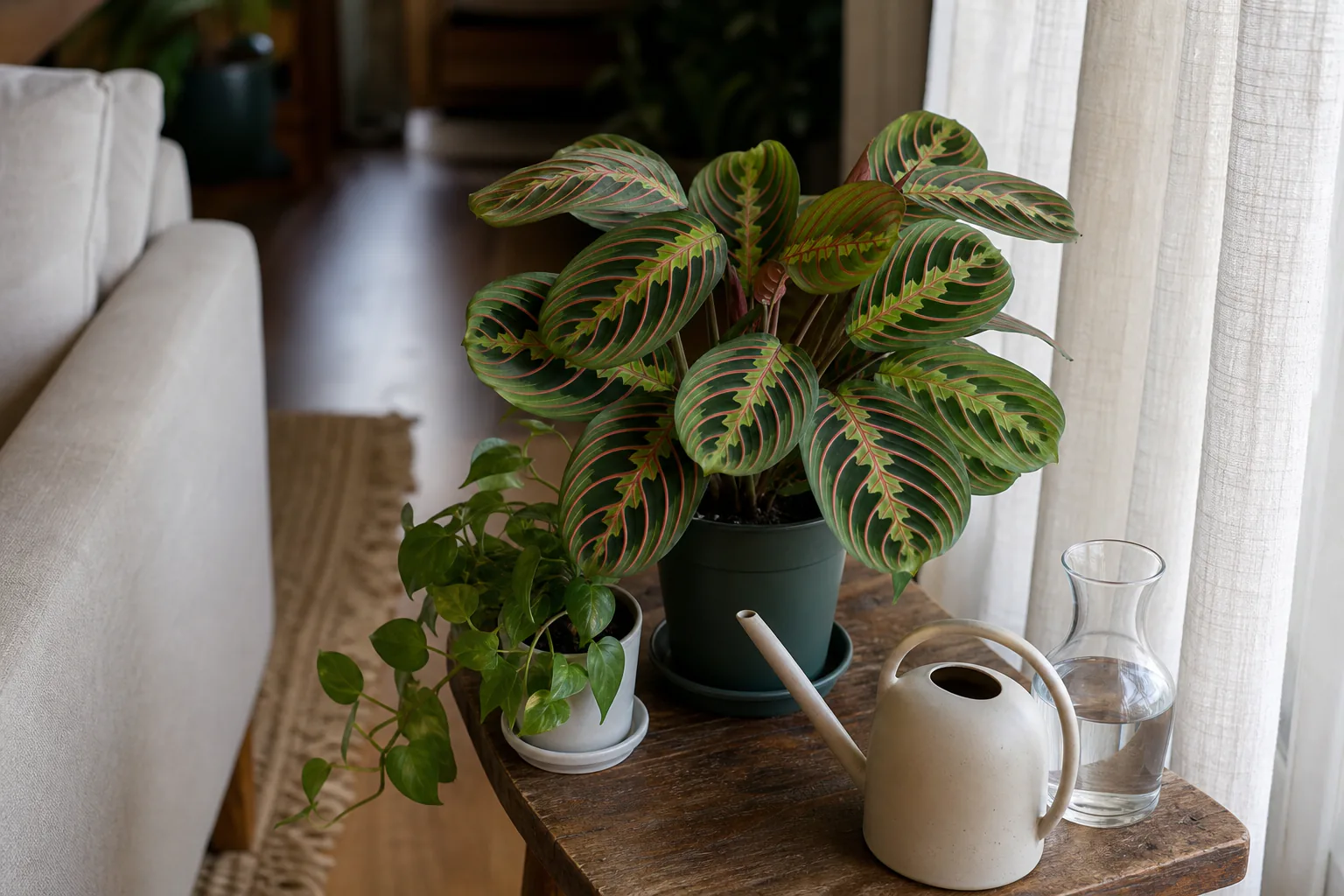
The “prayer plant” label is used loosely in everyday plant care. In the strictest sense, it refers to Maranta, a genus whose leaves fold up at night like hands held in prayer. In common houseplant use, the same label is often applied to Calathea and to a few related genera. All of them sit in the Marantaceae family, and their care notes overlap heavily, so grouping them together here is reasonable even though species-level differences exist.
If you have ever bought one of these plants and watched it decline, the rest of this article is for you.
Why calathea and prayer plants react so visibly to small changes
These are rainforest understory plants. In their native habitat they sit beneath a leafy canopy and receive dappled, filtered light, steady warmth, and humidity that holds through the day. Our living rooms are a different kind of place: air is drier, light comes from one direction, central heating pulls moisture out in winter, and water quality depends on where you live.
Calathea and Maranta have thin, expressive leaves. When something in the environment shifts, they show it. Lower humidity speeds transpiration, the process by which leaves lose water, so dry air often shows up as leaf curl or crisping within a day or two. Dry soil, direct sun, and salty water all produce their own visible signatures. Other houseplants such as pothos or philodendron are more forgiving and can absorb a wider range of conditions before showing any reaction, but the same shift that leaves those plants largely unchanged can move a calathea’s leaves noticeably within days.
Reading the plant well, then, is mostly about noticing which symptom pairs with which cause.
Light these plants actually need, and what ‘bright indirect’ really looks like
Across reference sources, the consistent description is medium to bright indirect light, with direct sun repeatedly flagged as a problem. The Royal Horticultural Society notes that calathea grows best in a bright spot out of direct sunlight, and the New York Botanical Garden describes prayer plant as preferring partial shade because direct sun fades the leaf color.
In practice, “bright indirect” usually means a few feet back from a sunny window, a window with a sheer curtain, or an east-facing exposure where the sun is gentle. North-facing windows can work, though growth will be slower. The most common light mistake with these plants is putting them directly on a bright south- or west-facing sill, where afternoon sun will bleach or scorch the leaves. If you are unsure about the light in your specific room, the article on how to read the natural light in your room is a useful place to start.
Steady moisture: how to water without swinging from dry to soaked
Calathea and Maranta prefer soil that stays evenly moist without becoming waterlogged. The Royal Horticultural Society puts it simply: keep the compost evenly moist, and take care not to overwater in winter. The single most common pattern in failing calathea plants is soil that swings hard from bone-dry to soaking, often because the reader waits too long and then floods the pot to make up for it.
A better approach is to check the soil with a finger or a wooden chopstick before each watering. If the top inch feels dry, water thoroughly until it drains from the bottom. If it still feels damp, wait a day or two. The goal is a rhythm, not a schedule, and the article on how to tell when an indoor plant needs water without using a calendar walks through the same observation-based approach in more detail.
In winter, when the plant is growing less and the air is drier, watering needs usually drop. The plant will tell you when it is thirsty.
Humidity in a real home: what helps, what does not move the needle
Reference sources consistently describe these plants as preferring “high” or “above-average” humidity, though they do not agree on a single required number. Most homes sit somewhere in a middle humidity range, with winter lows in heated apartments often dropping well below that. Calathea and Maranta are described as happier toward the higher end, especially during the heating season.
What tends to make a meaningful difference around a plant:
- Grouping plants together, which raises the humidity in the small space between their leaves
- Placing a tray of water with pebbles beneath the pot, with the pot sitting above the waterline (some growers find this helpful)
- Running a room humidifier in the room where the plants live
- Moving the plant to a kitchen or bathroom, where cooking and bathing add moisture to the air
A quick misting feels like it should help, and many growers include it in their routine, but its effect on ambient humidity is short-lived. Misting is fine as a habit; it should not be relied on as the only humidity strategy. The article on humidity and houseplants in an ordinary home goes into this in more detail and is worth reading if you are weighing whether a humidifier makes sense in your specific room.
The honest version: these plants often grow fine in average home humidity, but their leaves will look better in higher humidity. If your plant is alive and producing new growth, your home is probably working for it, even if the edges are not picture-perfect.
Water quality: minerals, salts, and why some growers switch sources
University extension publications on ornamental water quality document that high soluble-salt levels and certain minerals can build up in potting soil over time and impair root function. That is a general finding for ornamentals rather than a calathea-specific rule, and the effect depends on what is actually in your local water.
Some growers report that calathea leaves develop brown edges when watered with hard tap water, and that switching to filtered, distilled, or rainwater reduces the problem. Others see no change at all. The likely reason for the difference is that tap water composition varies considerably from one municipality to the next. The sensible approach is to treat water quality as a variable worth observing rather than a known requirement. If your plant is browning at the edges despite even watering and decent light, switching water source for a few weeks and watching the new growth is a reasonable test. If new growth comes in clean, your tap water was probably part of the problem.
Whichever water you use, occasional flushing of the pot with plenty of water until it drains through helps wash accumulated salts out of the soil.
Soil, pot, and drainage for moisture-sensitive roots
These plants do best in a mix that holds some moisture but does not stay soggy. A standard indoor potting mix amended with perlite and a small amount of peat or coco coir is a common recommendation, and it gives the roots both moisture retention and the air they need. A pot with drainage holes is essentially required, since sitting in standing water is a fast path to root rot for these species. Terracotta dries out faster than glazed ceramic or plastic, which can be a help or a hindrance depending on your watering habits.
Repotting every year or two refreshes the soil and gives the roots more room, but it is best done in the active growing season rather than in the depths of winter, when the plant is slower to recover from disturbance.
Reading the signs: curling, browning, crisping, fading, and what each points to
This is where these plants earn their reputation, and where the rest of the article pays off. The visible symptoms below are common starting points, and they are clues rather than verdicts.
- Leaves curling inward along the long axis: usually dry air or underwatering, sometimes both. Check soil moisture and humidity first.
- Brown, crispy edges or tips: low humidity, mineral buildup in soil, or inconsistent watering. Often a combination of all three.
- Faded, washed-out, or bleached color: too much direct sun. Move the plant back from the window or add a sheer.
- Yellowing lower leaves: often overwatering, or simply older leaves dying back. New growth at the top is the more useful signal.
- Limp, droopy leaves despite moist soil: usually overwatering and possible root issues. Check the roots and the drainage.
- Leaves that fold up at night and open by day: this is normal for Maranta, a feature called nyctinasty, not a sign of stress. Calathea shows subtler movement.
Damaged leaf edges do not heal. Once a section is brown or crispy, it stays that way. The signal that conditions have actually improved is new growth coming in clean and healthy, not the existing leaves recovering.
When a calathea or prayer plant may not fit your home (and what to grow instead)
Some homes are simply not good fits. If you travel frequently and cannot keep moisture steady, if the only window you have is a hot south-facing exposure, if you heat with wood and the air is consistently very dry, or if you would rather not adjust your routine for one plant, the honest answer is to grow something else. There is no virtue in struggling with a plant that does not match your conditions.
For similar foliage in less demanding plants, consider:
- Pothos and philodendron, which tolerate a much wider range of light and watering habits
- Peperomia, which has similarly patterned leaves with more forgiving watering needs
- Stromanthe and Ctenanthe, which are close relatives of calathea with broadly similar care notes, so the same caveats apply
- Spider plant or Chinese evergreen, if you want something that is hard to fuss up
If you do want a calathea or prayer plant, pick the species that matches your home. Maranta leuconeura and its varieties are widely described in houseplant literature as more forgiving than some of the showier calatheas, though individual plants and homes vary a lot. Buying from a source that lets you inspect the plant before purchase, so you can see the leaves and the soil condition, is worth the effort.
The right plant for your room is the one that grows, not the one that fits an image of what your shelf should look like.
Sources
- Royal Horticultural Society — How to grow calathea: https://www.rhs.org.uk/plants/calathea/growing-guide
- New York Botanical Garden — Prayer plant (Maranta leuconeura): https://libguides.nybg.org/prayerplant
- Rutgers NJAES — Evaluating water quality for ornamental plant production: https://njaes.rutgers.edu/fs893/
- UMass Extension — Water quality for crop production (greenhouse BMP manual): https://www.umass.edu/agriculture-food-environment/greenhouse-floriculture/greenhouse-best-management-practices-bmp-manual/water-quality-for-crop-production
- ASHRAE — Humidifiers chapter (typical indoor relative humidity ranges): https://www.ashrae.org/file%20library/technical%20resources/covid-19/i-p_s16_ch22humidifiers.pdf