Plant care
Dracaena care indoors: light, watering, and brown tips
· Updated
A dracaena kept indoors grows more in bright, indirect light but tolerates medium and lower spots, prefers a real dry-down between waterings in a well-drained mix, and tends to signal stress at the leaf tips. Those signature brown tips are usually the combined result of irregular watering, dry indoor air, and fluoride or chloride in some tap water, not one single missing input. Tips that have already browned will not green back up; the realistic goal is to read the signal and reduce future damage.
What “dracaena” usually means in a living room
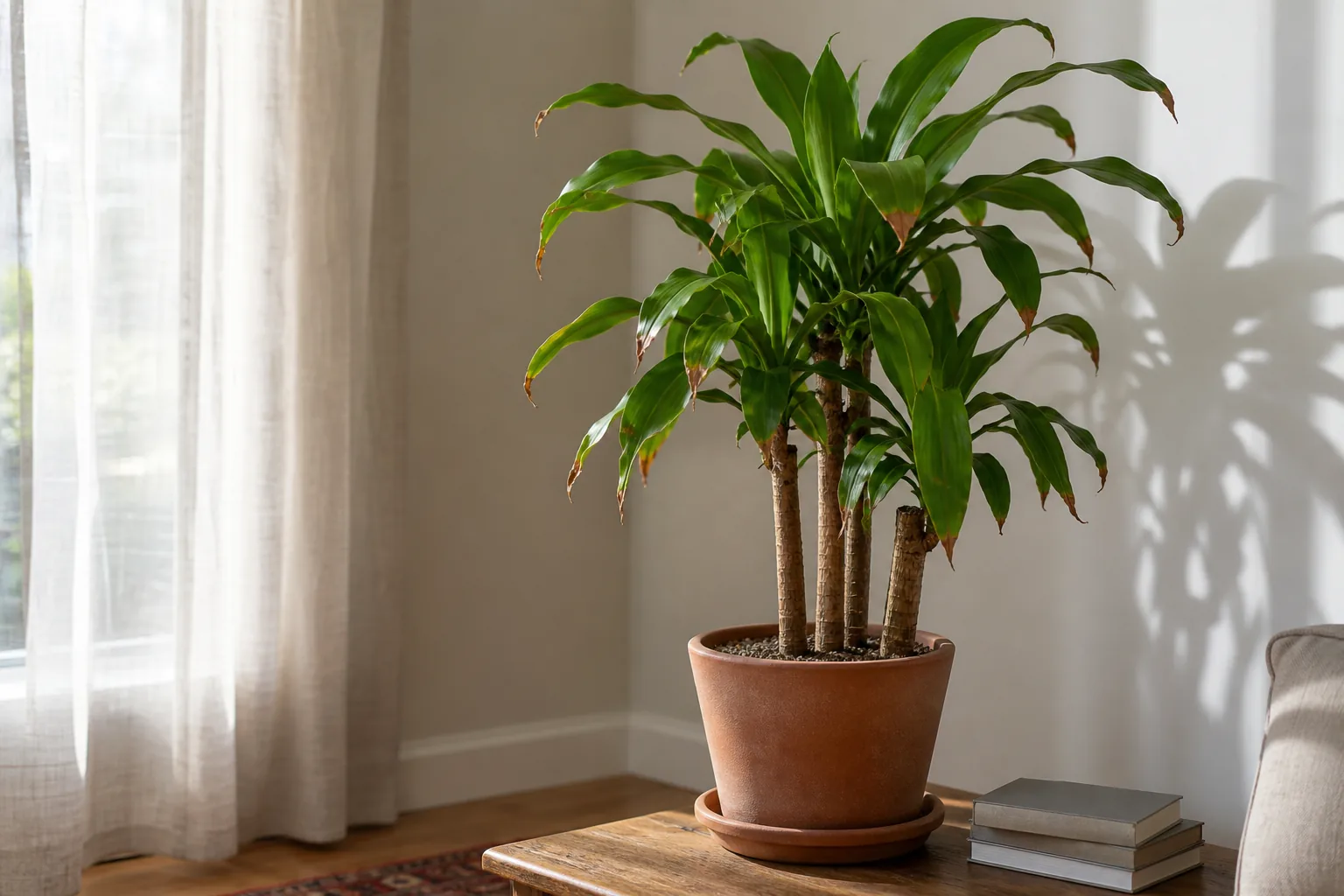
Most plants sold as “dracaena” in big-box stores and nurseries are one of a handful of indoor types. The two you’ll see most often are Dracaena fragrans, commonly sold as a mass cane (a pot with several thick, woody canes and broad, soft green leaves, often labelled “Janet Craig,” “Lisa,” or just “corn plant”), and Dracaena marginata, a slender single-stem plant with narrow, spiky leaves sometimes called a dragon tree. Dracaena deremensis cultivars such as “Warneckii” share the same general pattern with striped or variegated foliage.
A mass cane is usually three or more rooted canes sharing one pot, with a sizeable root mass that’s partly soilless from the grower. That root mass dries unevenly, which is why pot weight and a deeper soil check matter more for a mass cane than for a small marginata.
Light: tolerates medium and lower light, grows more in bright indirect
University extension and botanical garden sources consistently describe dracaena as a plant that prefers bright, indirect light but tolerates medium and lower light, with growth noticeably slower in dimmer spots. The Clemson Home & Garden Information Center and NC State Extension both frame it as best in bright, indirect light and tolerant of lower light. Some species within the genus, particularly D. fragrans (mass cane), tolerate slightly less light than others, which is one reason mass canes often do reasonably well a few steps back from a window.
In a real room that usually means a spot a few feet from an east- or west-facing window, or back from a south-facing window behind a sheer curtain. Direct sun for more than a couple of hours can scorch leaves. A deep interior corner will keep the plant alive, but growth will be slow and lower-leaf drop more common. If you want a steadier pace, it’s worth reading the actual light in your room before assuming a corner is “bright enough,” and keeping realistic expectations about what lower-light-tolerant plants can actually do in a dim spot.
Watering rhythm: dry-down between waterings, not a weekly schedule
Dracaena wants the upper half of the potting mix to dry out before the next watering, and it wants water to flow through and out the drainage hole rather than sit at the bottom. Weekly-on-the-clock watering is one of the most common setups for a stressed dracaena, because a mass-cane root mass in a large pot dries more slowly than the surface suggests.
A few practical checks work better than a calendar:
- Pot weight. Lift the pot right after a thorough watering and remember that feeling. When it gets noticeably lighter, the root mass has used more of that moisture.
- Finger or chopstick test. Push a finger or wooden chopstick a few inches into the mix. If it comes out cool and damp, wait. If it feels dry and the chopstick slides out clean, water.
- Cane feel. In practice, a slightly soft or wrinkled cane segment near the top of a mass cane can be a late-stage thirst signal you don’t want to reach often.
The goal is to water by observation instead of a calendar. Indoor light, humidity, and season all change how fast the mix dries, so a fixed weekly rhythm usually drifts into either chronic underwatering or chronic overwatering within a season or two.
The leaf-tip browning pattern and what it usually means
Brown leaf tips are the most common dracaena complaint, and they’re almost always a multi-cause signal rather than a single failure. Three inputs usually overlap:
- Inconsistent watering, where the plant swings between bone-dry and soaked.
- Dry indoor air, especially in winter when heating is running.
- Fluoride or chloride in some tap water, which dracaena accumulates at the leaf margins.
The Royal Horticultural Society lists overwatering, underwatering, fluoride in tap water, sun scorch, and very dry air as overlapping causes of dying leaves and brown tips in dracaena, which matches what extension material tends to find. The University of Florida IFAS Extension is explicit that high fluoride, boron, or soluble salts produce chlorotic or necrotic tips and margins, and that damaged leaves will not recover.
A useful pattern to notice: tip browning that begins on the newest growth is more often water-source related, because fluoride and soluble salts travel with the water the plant is taking up now. Tip browning on older leaves with otherwise healthy new growth is more often inconsistent watering or low humidity.
If you want the full diagnostic flow across all houseplants, our brown-tips diagnostic order walks through the inspection sequence. The honest expectation is that already-browned tips will not green back up; trimming them with clean scissors is cosmetic. The goal is to reduce future damage.
Water source, fluoride, and the white crust at the soil surface
Dracaena deremensis and D. fragrans are repeatedly flagged by extension sources as very sensitive to fluoride, with tip and margin necrosis as the typical symptom. The Pacific Northwest Plant Disease Handbook describes this as the classic “dracaena tip burn” pattern, and NC State Extension adds that soluble salts, chlorine, and fluoride in tap water can all produce tip browning.
Two practical signals at home:
- A white or pale crust at the soil surface or on the inside of the pot rim is a sign of soluble-salt buildup from fertilizer and minerals in tap water. Our guide to white crust on soil and pot surfaces walks through what that pattern usually means and what to do about it.
- Tip browning that persists even after watering rhythm and humidity seem fine is the classic water-source signal.
The standard extension response is to switch to filtered, distilled, or rainwater and see whether new growth comes in with cleaner margins. This doesn’t reverse existing damage, and it doesn’t help every home, because fluoride levels vary by municipality. But it is a low-cost next step that’s well-supported by extension guidance. Letting tap water sit out overnight mainly off-gasses chlorine; fluoride is generally not removed this way.
Potting mix, pot size, and drainage
Dracaena grows in a well-drained indoor potting mix, ideally one that holds some moisture without staying soggy. A peat-based indoor blend with perlite or bark, a pot with a drainage hole, and going no more than one size up when you repot are the safest defaults. Mass canes are often sold in pots that are larger than the root mass needs, which is one of the most common overwatering setups in indoor plants. If you’re working out the mix and the timing, our potting-mix selection guide and when-to-repot decision guide are the right places to slow down, rather than repotting on instinct.
Temperature, drafts, and humidity in real rooms
The Royal Horticultural Society recommends keeping dracaena in a consistently warm spot between about 18 and 30°C (65 to 86°F), avoiding cold draughts and hot radiators. Damage becomes more common when indoor temperatures stay below roughly 10°C (50°F) for extended periods, which is more likely next to a single-pane window in winter than anywhere else in the room. Our drafts, vents, and window-placement guide walks through the room-level checks that matter here.
Dry indoor air during heating season is one of the contributors to crispy dracaena tips. A modest humidity boost from grouping plants together, a pebble tray, or a small humidifier in the same room is usually enough to make a difference; you don’t need a greenhouse environment. Our piece on what humidity actually changes in an ordinary home goes deeper on which of these moves tend to matter.
Acclimation, growth pace, and what realistic indoor growth looks like
A new dracaena often drops one or two lower leaves in the first weeks as it adjusts to lower light and indoor humidity than its greenhouse origin. That’s normal acclimation, not a sign you’ve done something wrong. Indoors, growth is reliably slower than the pace the plant had under grower conditions. Some lower-leaf loss on an older mass cane is normal as the plant ages; rapid loss across the whole plant is not.
Common problems that aren’t leaf tips
A few patterns are worth distinguishing from the leaf-tip signal:
- Soft, pale yellowing leaves, especially on lower growth, often point to overwatering or root stress rather than tip burn.
- Dry brown patches in the middle of a leaf are more often a direct-sun or physical-damage signal than a watering one.
- Brown or black soft spots on canes, paired with a sour smell from the soil, suggest stem or root rot and are not the same as the slow tip-browning pattern.
If you live with cats or dogs, dracaena is documented as toxic to pets. We don’t restate severity claims here because the framing matters; instead, see our pet-aware verification method for the broader approach, and contact your vet or a pet poison resource if you suspect ingestion.
When to ask a local nursery or extension office
If lower-leaf loss is rapid, canes are soft or hollow, the root crown smells sour, or you see webbing, sticky residue, or visible insects, the plant needs a closer look than a species guide can offer. A local independent nursery or your regional extension office can examine the actual plant, which a website can’t. Houseplant Supplies is an educational journal, not a diagnostic service, and the right next step in those cases is a hands-on local resource.
Sources
- Dracaena — Clemson University Home & Garden Information Center
- Dracaena — NC State Extension Gardener Plant Toolbox
- Cultural guidelines for commercial production of dracaena — University of Florida IFAS Extension
- How to grow dracaena — Royal Horticultural Society
- Dracaena tip burn — Pacific Northwest Plant Disease Handbook