Plant care
A practical guide to keeping a dieffenbachia (dumb cane) healthy indoors
· Updated
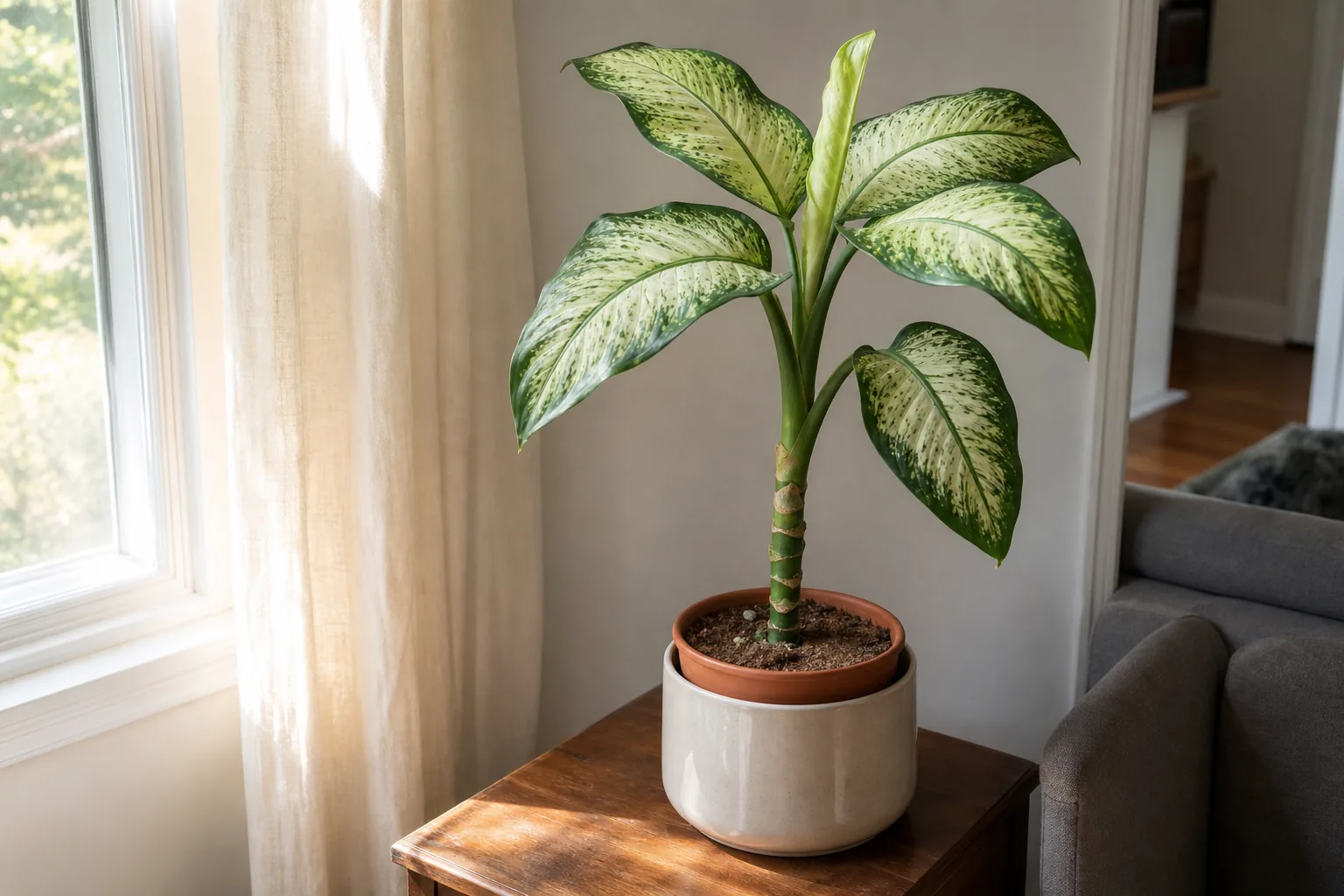
A dieffenbachia grows steadily in bright, indirect light with a well-drained mix and watering guided by feel rather than a calendar. It is a tropical plant that dislikes cold drafts and sitting in wet soil, and its tissues contain calcium oxalate raphides, which are needle-shaped crystals that act as a plant defense. Honest placement, washing your hands after pruning, and keeping the plant where pets or small children cannot chew it are part of ordinary care, not a separate warning to fear.
What a dieffenbachia actually is, and why it behaves the way it does indoors
Dieffenbachia is a genus in the arum family, Araceae, the same family as pothos, philodendron, monstera, peace lily, and Chinese evergreen. If you already grow any of those, the rhythm of care will feel familiar. What makes a dieffenbachia its own plant is the thick, cane-like stem and the large, often cream-and-green variegated leaves that unfurl from the top.
Indoors, dieffenbachias tend to grow upright and to drop their oldest lower leaves as they put on new growth at the cane tip. That natural progression is part of why older plants look leggy, and it is also why a bit of patience, not panic, is useful when one yellow leaf appears at a time.
Placement and light: bright, indirect is the realistic target
University extension sources consistently describe bright, indirect light as the realistic target for a dieffenbachia, with tolerance for lower light and for a few hours of mild direct sun. In a real room, that means an east-facing window where the plant gets morning light without a hot beam, or set back from a south- or west-facing window where the sun does not land directly on the leaves.
If the room reads as a comfortably lit reading spot during the day, the plant will likely be happy there. If the only available spot is darker, the plant will usually tolerate it while growing more slowly and accepting some loss of variegation contrast. The deeper skill here is reading the natural light in your room before you place the plant, since the answer depends on what is outside the window as much as what is beside it.
Rotate the pot a quarter turn each week so the plant does not lean toward the light.
Watering by feel: a dry-down rhythm that avoids both wilt and rot
The most consistent extension advice for dieffenbachia is to let the top inch or two of mix dry before watering again, and to make sure excess water drains freely. The frequency is not a fixed number of days; it shifts with pot size, light, season, and the mix itself, so the practical habit is to water by feel rather than by schedule.
A simple way to check is to push a wooden chopstick or your finger an inch or two into the mix. If it comes out cool and damp, wait. If it comes out dry and the pot feels lighter than you expect, water thoroughly until it drains from the bottom, then empty any cachepot of standing water within a few minutes.
Overwatering and underwatering can look similar at first, since both can cause drooping. The difference shows up in the mix and the stem base. A mix that stays wet for days and a soft, mushy lower cane point to saturation. A bone-dry mix that has pulled away from the pot edge and crisp, curling lower leaves point to thirst.
Pot, soil, and drainage for a thick-stemmed tropical
Dieffenbachia’s thick cane is the reason drainage matters so much. A saturated root zone quickly turns into stem rot at the soil line, and recovery from there is much harder than preventing it. The reasoning and cachepot habits that make this work in practice are covered in the drainage and cachepot hub.
The mix that suits this plant best is a chunky, well-drained aroid-style blend, the kind explored in the potting-mix hub. The most forgiving setup is a pot with a drainage hole, that chunky mix, and a cachepot if you want the look of a decorative pot. The drainage hole is the non-negotiable feature. The cachepot is optional but useful, because you can lift the inner pot to confirm nothing is sitting in water after a watering.
When water rushes straight through the pot without the mix absorbing any, the mix has either become hydrophobic from drying out completely, or the plant has outgrown its pot and the roots have replaced the mix. Both are signals to refresh the soil or move up one pot size, not to compensate with more frequent watering.
Temperature, drafts, humidity, and what changes at the window
Dieffenbachia thrives in room temperatures between roughly 60 and 75°F. The risk zone is prolonged chill: tropical foliage plants including dieffenbachia show chilling injury in the range from just above freezing to about 59°F, with severity depending on how long the plant sits there. In practice, that means keeping the plant away from a cold window in winter, off a cold window sill at night, and out of the direct path of an air-conditioning vent in summer. The reasoning behind those placement choices is unpacked in the drafts, vents, and windows hub.
Average household humidity is usually fine. Brown leaf tips will appear in very dry winter air, but misting alone rarely fixes that; see the troubleshooting section below.
If the leaves droop suddenly in winter, check for a cold draft before you check for thirst. The two problems look similar and have opposite fixes.
Honest safety boundaries: handling, pruning, and shared spaces
Dieffenbachia is widely described by extension, hospital, and food-safety sources as containing calcium oxalate raphides, which are needle-shaped crystals the plant uses as a defense. Chewing or biting the leaf or stem, or getting the sap into eyes or onto broken skin, is documented to cause tissue irritation and pain.
If you share the home with curious pets, toddlers, or anyone who tends to taste houseplants, the practical response is straightforward placement and handling rather than alarm. The pet-aware houseplant choices hub walks through how to verify severity from authoritative sources instead of relying on social-media lists; the principles below are the species-specific version of that approach.
- Set the plant on a sturdy surface where it cannot be knocked down and where leaves are not at chewing height.
- Wear gloves or wash your hands with soap and water after pruning, propagating, or wiping leaves. The same habit applies to other raphide-containing aroids you may already grow.
- Sweep up dropped leaves promptly, especially during a move or a repot, so nothing is left where a pet or child might pick it up.
- Do not assume any placement makes the plant entirely safe. The realistic framing is reducing incidental contact and avoiding chewing or biting, not eliminating the plant’s natural defense compounds.
If a person or pet chews or tastes the plant, contact a poison control center or your local medical professional rather than self-treating at home. The Children’s Hospital of Philadelphia Poison Control Center and similar resources frame this kind of plant exposure in terms of getting professional guidance quickly. Note the species name (Dieffenbachia) and the part of the plant that was chewed, and follow the professional’s instructions.
Common problems: brown edges, yellowing lower leaves, drooping, leggy stems
Brown leaf tips and edges on a dieffenbachia are common. The usual suspects, in a useful diagnostic order, are fluoride or chloride in tap water, soluble salts left behind by fertilizer, dry air, and inconsistent watering; the brown-tips troubleshooting hub walks through how to tell them apart. Switching to filtered, distilled, or rested water and flushing the pot with plain water every few months are practical first steps.
Yellowing lower leaves, one at a time as new leaves emerge from the cane tip, are usually normal aging rather than a crisis. Many yellowing leaves at once, especially with a soft stem base, point to overwatering, and the yellow-leaves checklist can help you tell the difference.
Drooping can come from thirst, chill, or root rot. Check the mix and the temperature before you water.
Leggy stems with bare cane below a tuft of leaves are a normal growth pattern in a maturing plant, not a sign that something is wrong. The honest response is pruning, which the next section covers.
When to repot, refresh the mix, or leave the plant alone
Dieffenbachias tolerate being slightly snug in their pots and do not need frequent repotting; the when-to-repot hub covers the broader room-level reasoning. Routine signs that a new pot is due include roots circling the drain hole or pushing the plant up out of the mix, water that runs straight through without being absorbed, and a mix that has compacted into a tight mass.
When you do repot, a useful rule of thumb is to step up by roughly one pot size (about an inch wider in diameter), refresh with new aroid-style mix, and water lightly to settle the roots. Stepping up by much more leaves the roots in a large volume of mix that stays wet for too long.
If the plant has become leggy, pruning above a node to re-root the top is a standard option for cane-type aroids. UF/IFAS describes cane-section cuttings as the typical propagation method for the genus, and the lower cane often pushes out a new shoot from a node below the cut. Treat pruning as routine maintenance, not a rescue.
A short weekly check for a dieffenbachia in a real room
A ten-minute walk-through each week covers most of what a dieffenbachia needs, and the simple weekly care routine frames it as a habit rather than a chore:
- Look at the newest leaf. New, healthy growth is the most honest sign that light, water, and temperature are working.
- Press a finger or chopstick into the top inch or two of mix, and water only if it feels dry.
- Rotate the pot a quarter turn.
- Wipe a dusty leaf with a damp cloth, and wash your hands afterward.
- Scan the undersides of leaves and the stem joints for cottony tufts, sticky residue, or fine webbing.
- Glance at the thermometer and the nearest window; if a cold snap is coming, move the plant back from the glass.
When to ask a local nursery or extension service
A dieffenbachia that wilts repeatedly without a clear watering or chill cause, that develops a spreading soft rot at the base, or that arrives home with a pest problem you cannot identify is a good reason to bring a photo or a sample to a local independent nursery or your regional extension service. They can look at the actual plant and the actual room, which is something a care article cannot do.
For any suspected exposure to the plant’s sap, by a person or a pet, contact a poison control center or your local medical professional rather than self-treating.
Sources
- Dieffenbachia – UF/IFAS Gardening Solutions
- Cultural Guidelines for Commercial Production of Dieffenbachia – UF/IFAS
- Chilling Injury in Tropical Foliage Plants: III. Dieffenbachia – UF/IFAS
- Plants That Irritate – Children’s Hospital of Philadelphia Poison Control Center
- Calcium Oxalate, the Stinging Crystals in Plants – Hong Kong Centre for Food Safety