Plant care
Bird-of-paradise care indoors: an honest guide for Strelitzia
· Updated
Bird-of-paradise indoors is a bright-light, slow-growing foliage plant, not a flowering houseplant. Give it the brightest indirect light the room can actually offer (a south or west window honestly assessed), water deeply and let roughly the upper third of the mix dry before rewatering, keep it in a pot only slightly larger than the root ball with an airy, well-drained mix, and read the leaves for the real story. Indoor bloom is the rare exception and only happens after several years in sustained very bright light.
The rest of this article is about how to do that without overpromising. If you are still deciding whether a bird-of-paradise suits your space, our guide to matching a plant to the room you actually have is a good place to start.
What an indoor bird-of-paradise actually is
Two species get sold as “bird of paradise” for indoor use, and the difference shapes every expectation you should have.
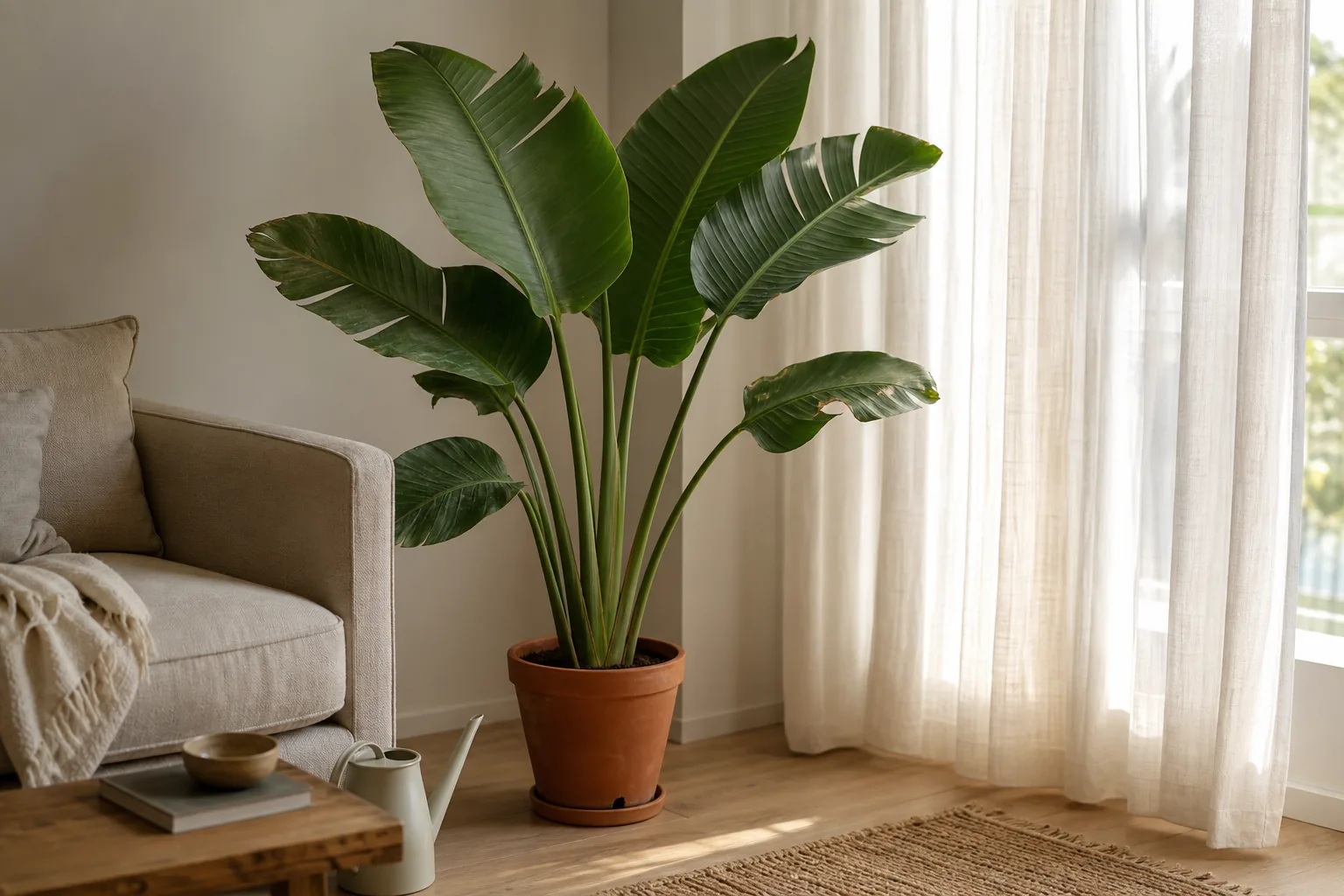
Strelitzia nicolai is the large, banana-leaf plant most often chosen for a statement corner indoors. Its leaves are broad, paddle-shaped, and held on long stalks. With enough light the blades develop natural splits along the veins as they mature. This is the species most people picture when they picture an indoor bird-of-paradise.
Strelitzia reginae is the smaller plant that carries the orange-and-blue crane flower the group is named for. Its leaves grow in tighter clumps from a low rhizome, and it is the species botanical-garden and extension sources usually describe when they talk about flowering indoors.
If you are not sure which you have, look at the leaf shape and the overall form. A tall, paddle-leafed plant on a long stalk is almost certainly nicolai. A shorter clump with narrower, more spear-shaped leaves from a low crown is more likely reginae.
Realistic indoor size and growth speed
Bird-of-paradise indoors grows slowly. The Royal Horticultural Society notes that Strelitzia can reach at least 1.5 m tall and 1 m wide over time, but that ceiling assumes years of decent light and an unrestricted root run. In an ordinary apartment, expect growth measured in leaves per active growing season rather than leaves per month. A healthy plant pushing out a few new leaves from spring through early fall, then resting through shorter winter days, is normal. A plant that does not push any new leaf across a full year is more often a light problem than a feeding or water problem.
Read the light before you place it
This is the single most important step, and it comes before any watering or potting decision. Strelitzia sits at the high end of the indoor foliage light scale, well above snake plant, ZZ, and pothos, and roughly in the same tier as Monstera.
What “bright indirect” really means here:
- A south- or west-facing window that gets several hours of direct sun, especially in the cooler months, is the standard recommendation across botanical-garden and extension sources.
- The New York Botanical Garden notes that three to four hours of direct sunlight support a strong leaf framework and any chance of indoor bloom.
- If all you have is a north-facing window or a hallway away from any window, the plant will live but will not push new leaves quickly and is unlikely to flower. University of Minnesota Extension places typical indoor light at roughly 50 to 250 foot-candles for medium-light plants in general; Strelitzia wants conditions well into the bright end of the typical indoor range, with the exact value depending on your window, hemisphere, and season.
A quick way to test your spot is the shadow test. Hold your hand a foot above a sheet of paper where the plant will sit. A sharp, clearly defined shadow means strong direct light. A soft-edged but visible shadow means bright indirect. No visible shadow means the spot is too dim for Strelitzia long-term.
For a fuller method of scoring your window, see how to read the natural light in the room.
Watering rhythm by feel, not calendar
A bird-of-paradise in a deep pot dries slowly when the mix is heavy and the plant is not in active growth, and quickly when the mix is airy, the light is strong, and the room is warm. A weekly schedule cannot account for any of that.
The reliable signal is pot weight. Lift the pot right after a deep soak and remember the feeling. Lift it again a few days later. When it is noticeably lighter and the upper third of the mix feels dry to a finger or chopstick, water again: thoroughly, until water runs from the drainage hole, then let the pot drain fully. Empty the saucer or cachepot afterward so the roots are not sitting in standing water.
Two common mistakes:
- Watering lightly on top every few days. This wets only the upper roots and leaves the lower mix dry. The plant wilts, you water again, and the cycle repeats.
- Leaving the saucer full. Long-saturated mix suffocates the rhizome and is the most common way indoor Strelitzia declines.
For a fuller breakdown of this rhythm and how to read the plant between waterings, see our water-by-feel method for houseplants.
Pot, soil, and root room
Bird-of-paradise wants an airy, well-drained mix with chunky components. UF/IFAS Extension guidance for general houseplant mixes pairs an organic base (peat or coco coir) with a coarse drainage component (perlite, pine bark, or coarse sand). That pattern fits Strelitzia well: it keeps air around the rhizome while holding enough moisture for the plant to draw on between waterings. For how to read a bag and what to look for, see our guide to choosing an airy, well-drained mix.
Choose a pot with a drainage hole. If you want the look of a cachepot, the nursery pot goes inside and you remove the plant to water. A pot only slightly larger than the root ball is enough when stepping up — over-potting in a container the roots cannot fill keeps the mix wet and is a frequent cause of decline. For the practicalities of drainage and cachepots, see our drainage and pot setup guide.
Temperature, drafts, and humidity in ordinary rooms
Ordinary room temperatures are tolerated. The practical risks are local: cold window glass on a winter night, and direct heat from a forced-air vent. Either can scorch leaf edges or chill the plant faster than the room thermometer suggests. Move the plant a foot back from single-pane glass in deep winter, and away from a vent pointed straight at the foliage.
Humidity is helpful but not required. If your home is very dry through winter, you will see crisper leaf edges and more spider-mite pressure than in spring and fall. A humidifier is one option; grouping plants together and avoiding hot, dry air directly on the leaves is a quieter one. For a more careful look at the humidity question, see our guide to humidity in an ordinary home.
Leaf shape: splits and edges versus browning
This is where most readers misread the plant.
Splits running perpendicular to the central rib of the leaf, and small edge nicks on otherwise turgid, green leaves, are a normal developmental feature of mature Strelitzia foliage under adequate light. They are not damage from pets, kids, or low humidity. Trying to “fix” them usually means changing something that does not need changing.
Brown, crispy, papery margins along the leaf edge are different. They tend to track back to one of three things: an inconsistent watering rhythm, fluoride or chloride in tap water, or low humidity over a long stretch. When only the oldest leaves are affected and the rest of the plant looks healthy, water rhythm or water quality is the more likely cause. When the browning is broad and the air is dry, humidity is in the picture. For a full diagnostic order, see our guide to brown and crispy leaf edges.
Repotting and root cues
Step up only when the roots have clearly filled the pot. Signs include roots circling densely when you slide the plant out, water running straight through without being held, or the plant physically lifting itself out of the pot as the rhizome pushes. Otherwise, top-dress the upper few centimetres of mix with fresh material each spring and leave the container alone. Many indoor Strelitzia do best when the roots are a little snug for a while — over-potting is a common cause of decline. For the full step-up method, see our guide to when a bigger pot is actually needed.
Fertilizer and the dormant season
Light feeding during the active growing months is enough. Skip fertilizer through the darker, cooler months when growth slows; pushing feed into a plant that is not actively growing does not make it grow faster and can leave mineral salts in the mix that show up as leaf-edge burn.
Common problems and what they point to
- Brown, crispy leaf margins: water rhythm, water quality, or low humidity. Look at the oldest leaves first.
- Yellowing oldest leaf only: normal turnover. Yellowing several leaves at once, especially with soft stems, points to overwatering or a cold, soggy root zone. For the full order, see our yellowing-leaves checklist.
- Plant alive but no new growth across a full year: light is the first suspect, not fertilizer or pot size.
- Tiny webbing and a dusty, faded look on the underside of leaves in dry winter air: spider mites. A plain water rinse on the leaf undersides and a humidity bump are the usual first moves; isolate the plant from nearby houseplants while you work it out.
- One leaf partially yellowing or splitting soon after purchase: acclimation to lower indoor light, not a failure. Our first-two-weeks acclimation guide covers what to expect.
Indoor bloom: when it can happen and when to let it go
Bird-of-paradise sold as a flowering houseplant is mostly a marketing promise, especially for Strelitzia nicolai. The New York Botanical Garden notes that it can take about five years for a young Strelitzia to begin flowering and that indoor bloom happens only under the most auspicious conditions. University of Wisconsin Horticulture is more direct: nearly full sun in summer and as much light as possible in winter are needed for any bloom at all.
If you want to give a Strelitzia reginae a real chance to flower indoors, treat the plant as a high-light project from the start: the sunniest window you have, a summer move outside once nights are reliably warm and frost is no longer a risk in your area, and consistent watering through the growing season. Even then, bloom is a long outcome rather than a guaranteed one. For Strelitzia nicolai, indoor bloom is rare enough that it is reasonable to treat the plant as a foliage specimen and enjoy the leaves.
Pets, children, and a brief honesty note
Bird-of-paradise is widely listed as toxic to cats and dogs, and is generally considered toxic to humans if ingested. We do not characterize severity here. For the verification method, current entries on the ASPCA list, and what to do if a pet or child has chewed on any part of the plant, see our pet-aware houseplant choices guide and contact your local poison control or veterinarian for current detail.