Plant care
African violet care indoors: how to keep one alive and blooming
· Updated
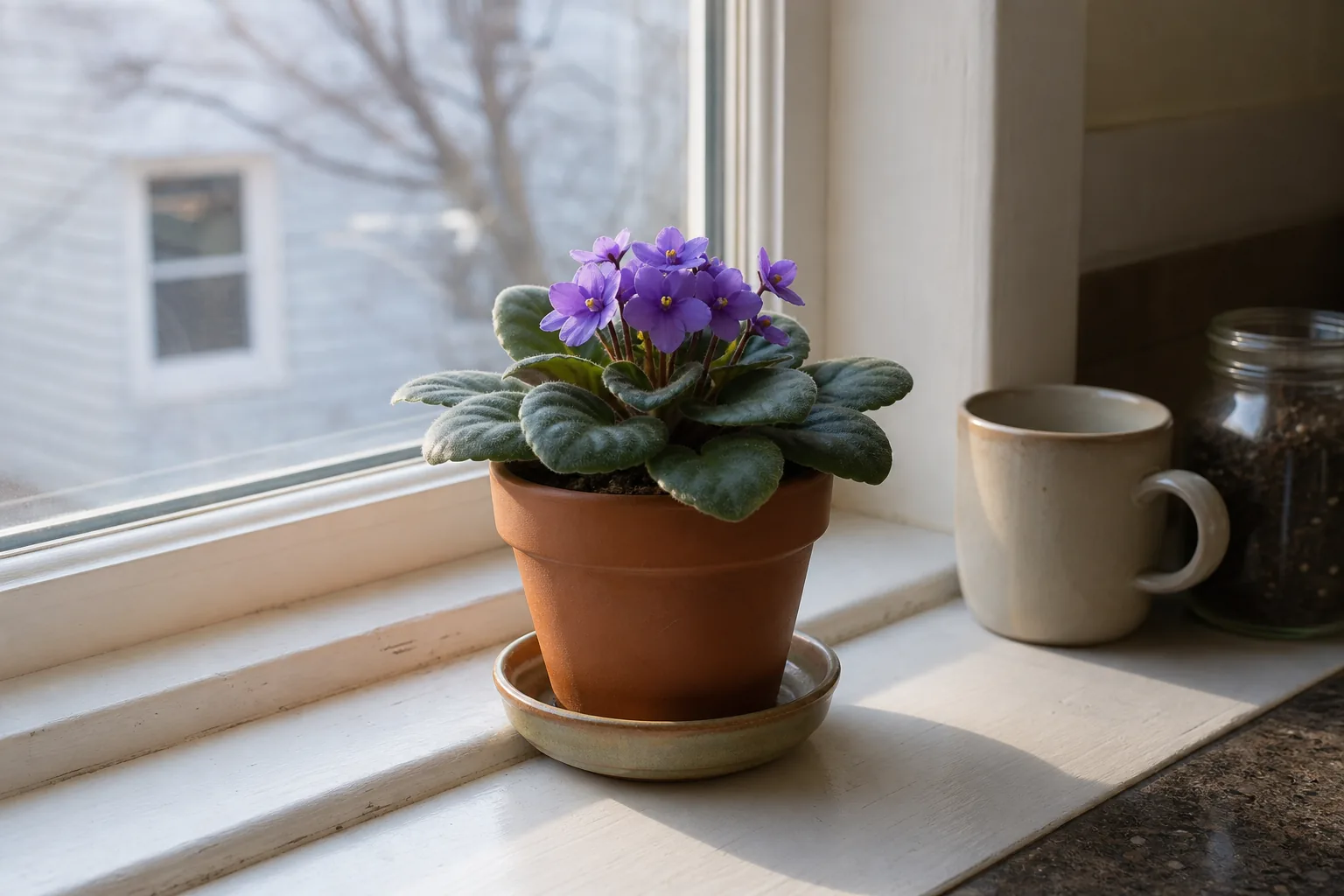
A healthy African violet in a real home is the result of a small number of conditions held steady at the same time: bright indirect light, room-temperature water delivered from below, a small pot with a coarse mix, an indoor temperature between roughly 65 and 80°F, and a weak balanced feed during active growth. Repeat blooming is not a trick to perform. It is the side effect of those conditions staying steady while the plant keeps growing.
The most common reason a violet that looked fine when you brought it home quietly stops blooming is crown rot, which usually comes from overwatering the top of the plant rather than from a missing fertilizer. If you can keep the crown from staying wet, solve the light at the spot you actually have, and not let the leaves press against a cold winter windowpane, you have already done most of the work.
What an African violet actually needs in an ordinary room
African violet care tends to be talked about as a checklist of separate tricks, but it works better as a steady-conditions problem. Five things have to be roughly right at the same time, and if one of them is off, the plant usually tells you by going leafy and quiet rather than by dying outright.
- Bright indirect light for most of the day
- Room-temperature water, applied from below, with the crown kept dry
- A small pot in a coarse, peat-based mix with a drainage hole
- Indoor temperatures in the comfortable band, without cold drafts or hot dry air on the leaves
- A weak, balanced feed during active growth, with the mix flushed with plain water every few waterings
Treat the goal as keeping a small handful of conditions steady, not as forcing a milestone. That framing also makes it easier to read the plant when something drifts.
Reading the light: bright, indirect, and what that means in your room
University extension sources consistently describe African violet light as bright but indirect, with a target intensity around 1,000 foot-candles and no direct sun on the foliage. The University of Florida IFAS Extension and the University of Georgia both cite that range, and UGA notes it is comparable to a sunny east or west window. Smithsonian Gardens adds that the plant wants strong light for 10 to 12 hours a day. The Royal Horticultural Society warns that direct sun, especially in summer, can scorch the soft leaves.
Translated into a room you can actually read, that means an east or west window where the sun does not hit the leaves directly, or a bright north-facing shelf with reflected room light. A quick hand-shadow test works as a practical reading aid: hold your hand a foot above the leaves at midday. A soft-edged shadow suggests bright indirect light. A sharp dark shadow on the leaves means direct sun is landing on them, and you should either filter it with a thin curtain or move the plant back a step from the glass.
In winter the same window can lose a lot of light as the sun drops lower in the sky. A small LED grow light on a timer is a general option for the darker months; specific distance and duration targets vary by fixture, so treat any number you see from a manufacturer as a starting point rather than a rule. The Houseplant Supplies guide on how to read the natural light in your room walks through the shadow and timing cues in more detail.
Rotate the pot a quarter turn every week or so. African violets lean toward the light, and a steady rotation keeps the crown from pulling to one side.
Watering from below at room temperature, and what to watch
Bottom watering is the single most useful habit for African violets in real homes. It keeps water off the fuzzy, pubescent leaves, where it can leave permanent ring-shaped marks, and it keeps water from pooling in the crown, which is where rot starts. The University of Minnesota Extension, the African Violet Society of America, Purdue Extension, and the Pacific Northwest Plant Disease Handbook all describe bottom watering or wick watering as the safer default.
A workable rhythm looks like this. Let the top of the mix dry to the touch. Set the pot in a saucer of room-temperature water for roughly 20 to 30 minutes, which is a common grower default rather than a hard rule. Lift the pot, let the excess drain, and pour off anything still sitting in the saucer. The trigger is the moisture in the mix, not the calendar, and the same observation cues in the Houseplant Supplies guide on how to read when a houseplant actually needs water carry over cleanly. For a deeper look at bottom watering as a method, the bottom-watering guide walks through the same setup in more detail.
Two cautions are worth naming. Cold or splashed water can leave ring-shaped marks on pubescent foliage, and cultivar sensitivity varies, so some plants show it more than others. And while top watering is not strictly forbidden, it carries a higher risk of wetting the crown and leaving water marks, so it is worth treating bottom watering as the safer default unless you have a reason to do otherwise.
Pot size, potting mix, and the self-watering option without trapping the crown
African violet society references commonly cite a pot diameter roughly one-third of the leaf-span diameter as a starting guideline. The reason is not that the plant likes being root-bound. It is that a too-large pot holds more water than the small root system can drink, and a wetter mix is what tips a healthy plant toward crown and root rot. Use a coarse, peat-based mix with perlite, and a pot with a drainage hole. The underlying mechanics of pot setup and how long water actually sits in a pot are covered in the Houseplant Supplies guide on drainage and how long a pot stays wet, and the broader question of how to choose a houseplant potting mix explains why a coarse African violet mix behaves differently from a general indoor mix.
Self-watering and wick pots are a workable option when the design is right. Smithsonian Gardens describes the classic arrangement as a glazed outer pot that holds water and a non-glazed inner pot that wicks moisture upward. AVSA describes a wick dangling out of the bottom of the pot into a reservoir below, with the pot itself not sitting in the fertilizer water. The mix has to be coarse enough to wick, the reservoir has to not touch the pot base, and the reservoir has to be refilled on a rhythm you control rather than topped up indefinitely. If any of those details are off, a self-watering pot just keeps the mix soggy, which is the opposite of what you want. The Houseplant Supplies guide on self-watering pots for houseplants covers the design trade-offs in more detail.
Refresh the mix periodically, roughly every year or two, even if the pot size stays the same. The mix breaks down and holds more water over time, which is one of the quiet ways a healthy-looking violet stops blooming.
Temperature, humidity, and the leaf surface
Smithsonian Gardens and AVSA both describe 65 to 80°F (18 to 27°C) as the comfortable band. Iowa State Extension gives a slightly wider 60 to 80°F range, which lines up with most ordinary homes. Two failure modes are worth watching for in real rooms. In winter, leaves pressed against a cold windowpane can chill and develop marks similar to cold-water spotting. In summer, or in winter with the heat running, hot dry air from a vent or radiator can stress the plant and dry the leaf edges. The Houseplant Supplies guide on cold drafts and sun-heated glass covers the underlying mechanics.
Smithsonian cites about 80% humidity as the ideal. Most homes run lower than that, and extension sources do not require a specific humidity target. If the air is very dry, grouping the violet with other plants or setting it on a shallow tray of pebbles and water can stabilize the local microclimate without turning the room into a greenhouse. The Houseplant Supplies guide on humidity in real homes covers what those numbers actually mean in a heated apartment.
Encouraging repeat blooms without forcing the plant
If the conditions above are steady, a mature African violet tends to bloom in flushes with rest periods in between, rather than as a plant in constant flower year-round. The signal that another flush is on the way is a tight, pale green center with small new leaves coming up. The signal that something is off is a loose, leggy plant with long petioles reaching toward the window, leaves that look pale or dull, or a crown that has gone soft and dark.
Feeding is part of keeping the plant growing, not a way to force flowers. UMN Extension recommends a balanced fertilizer at about one-quarter of the label strength applied at every watering. AVSA describes a low but constant feed. The practical version is to use a general houseplant fertilizer diluted well below label strength while the plant is actively growing, and to ease back during any rest period. A periodic plain-water flush, every few waterings, helps prevent the white salt crust that shows up on the rim of the pot or the surface of the mix. For a fuller look at when fertilizer helps and when less is the better answer, the Houseplant Supplies guide on fertilizer basics is a useful complement.
UMN also mentions distilled water, rainwater, or reverse-osmosis water as workable options. That is a useful choice if your tap water leaves visible mineral spots on the leaves or rim, but it is not a universal requirement.
Common problems on leaves and crowns and how to read them
A few patterns are worth knowing, because each one points to a different adjustment.
- Ring-shaped or water-mark spots on the leaves, especially where water may have splashed, are usually water-related ring spot, which Purdue and the PNW Handbook describe as non-pathogenic. The plant is fine. The fix is to keep water off the leaves and use room-temperature water.
- A soft, dark, collapsing crown is crown rot. It comes from a wet crown and a dense mix, not from a missing fertilizer. Stop watering from the top, check that the pot drains, and consider repotting into a coarse mix in a smaller pot if the current one has been staying wet.
- A white crust on the soil surface or pot rim is salt buildup. Flush with plain water and ease back on fertilizer strength. For broader context on leaf-edge symptoms, the Houseplant Supplies guide on brown tips and crispy edges on houseplants walks through the usual culprits.
- Long, pale petioles reaching outward and no blooms usually mean the light is too low, even at a window that reads as bright to your eye.
- Tight, brittle, downward-curling new center growth can point to cyclamen mite damage, but the same look can come from cold injury or cultural stress. Slow watering, raise the humidity a touch, and ask a local nursery or an African violet society affiliate to look at the plant before assuming the worst.
For any pest or disease you can clearly see, such as white fluffy specks hiding in the crown, follow the product label on whatever treatment you apply, keep children and pets away from the treatment itself, and contact a local nursery or your regional extension office if you are not sure what you are looking at.
What realistic African violet bloom cycles look like indoors
Extension and society sources describe healthy African violets as plants that bloom in flushes, often with rest periods of varying length between them, rather than as plants in constant flower year-round. Smithsonian and AVSA both describe them as well-adapted to indoor environments under steady conditions, which is the more honest framing. Cultivar, season, light, and feeding all shift the rhythm. If the plant is actively growing, the center is tight and pale, the leaves are firm, and you have not just repotted or moved it, another flush usually follows.
A common reader scenario is a violet that bloomed in the store, settled into a quiet leafy phase at home, and then refused to bloom again. In most cases that is not a fertilization problem. It is a light problem at the new spot, a watering rhythm that has been wetting the crown, or a pot that has gone one size too large. Adjust those one at a time, and the next flush tends to appear on its own schedule.
When to ask a local nursery or African violet society for help
A reader with a steady spot, a coarse mix, and bottom watering has done most of what an African violet needs. When something still looks wrong after a few weeks of that baseline, a local independent nursery, an African Violet Society of America affiliate club, or your regional university extension office can look at the actual plant and confirm whether you are seeing crown rot, cyclamen mite, a fungal issue, or simply a plant that is resting between flushes. For anything involving pesticides, follow the product label, and for anything involving pets, children, or persistent symptoms, contact a qualified local or emergency resource rather than diagnosing from a photo. The Houseplant Supplies guide on a simple weekly houseplant care routine is a useful way to keep those baseline checks on a calm schedule.