Plant care
Self-watering pots for indoor houseplants: how they actually work
· Updated
Self-watering pots are a useful tool for indoor houseplants, but only when the plant, the room, and the setup actually fit the way the pot works. A reservoir-and-wick system keeps the potting mix steadily moist by capillary action, which makes it a reasonable choice for moisture-tolerant tropical foliage in a well-lit room, and a poor choice for succulents, snake plant, ZZ, and other species that genuinely need a dry-down. The wick, the mix, and the reservoir level matter more than the brand of pot, and a reservoir pot does not replace reading the soil or the plant.
What a self-watering pot actually is
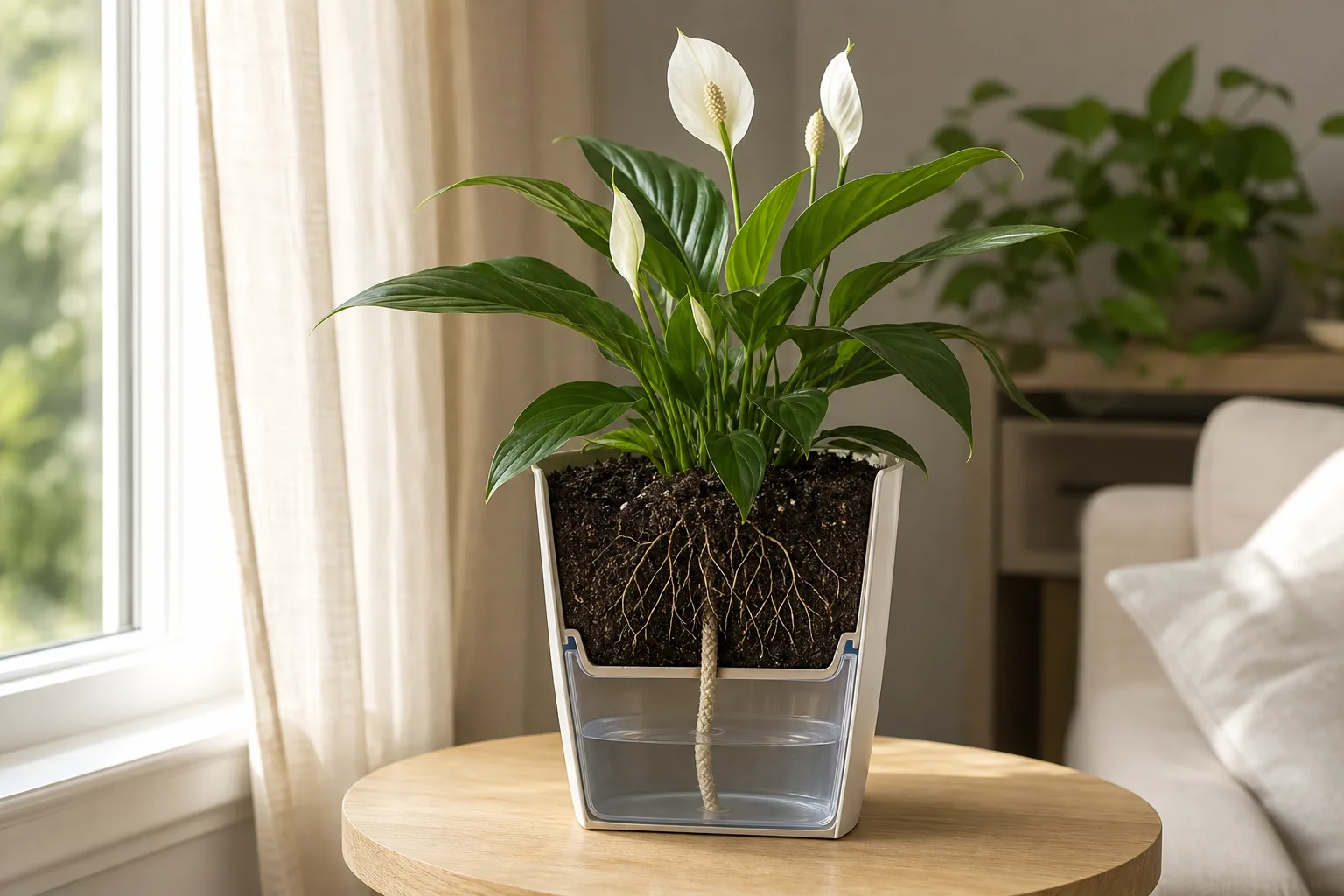
A self-watering pot is two chambers stacked inside the same container. The upper chamber holds the plant and potting mix. The lower chamber is a refillable water reservoir, separated from the root zone by a platform or floor. Between them, a wick, a soil column, or a contact mat provides the pathway water climbs on.
This is not the same thing as a regular pot sitting in a deep saucer. A saucer holds runoff briefly after you water and is meant to be emptied. A reservoir is designed to be refilled and to feed the soil over days or weeks. If a “self-watering” pot you are considering does not have a clear separation between the planting chamber and the water below, it is really just a pot with a deep saucer, and it will behave like one. Our guide on how drainage and cachepots affect how long a pot stays wet covers the same pot-versus-saucer idea in more depth.
How the reservoir and wick are supposed to work
Water moves into the root zone by capillary action, the same physics that pulls water up a paper towel or a sponge. The wick fibers, or the fine particles in the potting mix, create many small continuous channels along which water rises against gravity. As the soil dries slightly, internal tension pulls more water up from the reservoir. Plant transpiration through the leaves adds to that pull, which is why a plant in bright light draws the reservoir down faster than one in a dim corner.
In a properly built pot the water level sits below the base of the root ball. The roots are not sitting in standing water; they are wicking from a chamber beneath them. That is why the planting chamber still needs an overflow path. Without one, a heavy top-watering or a sudden rain of water from above can flood the root zone and undo the design.
The mix matters as much as the wick. Standard peat-based soilless potting mixes, the kind made from peat moss, perlite, and vermiculite, wick adequately for most reservoir setups, according to extension-service guidance. Very chunky mixes with large bark pieces, large perlite, or coarse inorganic chunks can break the capillary column, especially in taller pots, because the air gaps interrupt the continuous water path. A mix that is perfect for a normal aroid pot can be the wrong mix for a reservoir pot. Our guide on how to read a potting mix label for your plant and pot walks through how to think about airy versus moisture-retentive blends.
The honest case for self-watering pots
A self-watering pot is a reasonable choice when three things line up.
- The plant genuinely prefers steady, even moisture. Peace lily, pothos, many ferns, and several tropical foliage plants sit in this group.
- The room is bright enough that the plant is actively transpiring. In a well-lit window, the reservoir actually empties over a few days to a couple of weeks. Our piece on how to read the natural light in your room goes into the bright-versus-dim distinction in more detail.
- Your watering rhythm is inconsistent, or you want a buffer for short absences.
In those conditions a reservoir reduces the number of top-watering sessions, smooths out the wet-dry swings that stress roots, and gives the plant a steadier moisture profile than a forgotten midweek watering would.
The honest case against self-watering pots
The same steady moisture becomes a problem when the plant or the room does not match it.
Plants adapted to dry-down, including succulents, cacti, snake plant, ZZ, and many caudex or semi-succulent species, store water in thick leaves, rhizomes, or stems and tolerate a saturated root zone poorly. A reservoir pot is generally the wrong tool for them.
Dim rooms are a quieter problem. A plant in low light transpires slowly, which means the reservoir barely empties. The mix stays wet for weeks, and the root system has little reason to grow. A reservoir that stays full for a long time is a sign that the setup and the plant are mismatched, not a sign that everything is working.
Reservoir pots also still fail. A wick can slip out of the water, dry out, or be the wrong material for the pot size. Roots can clog the wick path. Mineral salts can build up at the surface. None of these failures are unique to reservoir pots, but a reservoir can hide them longer because the top of the soil looks fine.
Setup mistakes that keep the soil too wet
- A potting mix that is too dense or too moisture-retentive for the pot and plant. What wicks well in one pot can flood another.
- A wick that is too thick or that delivers water faster than the plant uses it.
- Filling the reservoir above the indicator line on day one, before the root system has settled in.
- No overflow path in the planting chamber, so any top-watering has nowhere to go.
- A plant in a dim room where the reservoir barely draws down.
If the soil smells sour, stays cold to the touch, or the lower leaves are yellowing while the upper leaves look fine, the most useful next step is to read the plant as carefully as you would without a reservoir. Our guide on how to tell overwatering from underwatering in a houseplant walks through that read step by step.
Setup mistakes that keep the soil too dry
- The wick is not actually touching the water. It can slip, kink, or sit just above the water line and pull air instead of water.
- The wick is too thin, too short, or the wrong material for the size of the pot. Different fibers wick at different rates and to different heights.
- The potting mix is very airy and chunky, breaking the capillary column. This is the same mix that would be ideal for drainage in a normal pot, which is why transplanting a plant straight from a normal pot to a reservoir pot with its existing mix can fail.
- The reservoir has been allowed to run dry for long stretches. Peat-based mixes are known to become hydrophobic when they dry out fully, which can interrupt the wick’s ability to pull water back up.
- The room is bright, warm, and dry, and the plant is large enough to transpire more than the wick can supply. The reservoir empties faster than you expected.
In any of these cases the symptom looks the same from above: dry top inch, drooping leaves, and a full or recently refilled reservoir. The diagnosis is not “more water.” It is that the wick is not delivering water to the part of the root ball you can see.
The first one to two weeks after switching
Treat the move into a self-watering pot as a form of repotting. The plant is changing how it gets water, and the root system needs time to grow into the new pattern. Our guide on what to expect in the days and weeks after repotting covers the same read-the-plant-first approach for a normal repot.
A common setup mistake is to fill the reservoir on day one and walk away. Many reservoir guides suggest the opposite: leave the reservoir empty or nearly empty for the first week or two, water from the top as you normally would, and let the existing root structure start growing downward toward the water. Once the plant is established and you can see the reservoir drawing down on its own, refill the reservoir to the recommended level.
Continue reading the top of the soil and the plant’s leaves through this transition. The reservoir window tells you how much water is left, not whether the plant needs water. Those are not always the same thing.
Reading the plant, not just the reservoir
A reservoir can make watering feel mechanical: fill, watch the indicator drop, refill. That is the most common failure mode of reservoir pots, in the sense that the reader stops paying attention to the plant.
The plant’s signals have not changed. Lift the pot to feel its weight, press a finger into the top inch of soil, watch for soft new growth and pale leaves, and note the difference between a slight droop from thirst and a persistent droop with yellowing lower leaves. Our guide to watering by observation rather than a schedule covers the same habit without any reservoir.
Maintenance: algae, salt buildup, and fungus gnats
Three things tend to show up over the life of a reservoir pot.
White crust at the soil surface and on the inside rim is usually mineral salt buildup, drawn upward as water evaporates from the surface. Periodic top-watering until water runs out the bottom helps flush salts through the mix rather than letting them accumulate on top. Our guide on what white crust on soil and pot surfaces can mean goes into how to read that crust.
Algae on the inside of the reservoir walls or on the water surface is common in transparent reservoirs where light reaches the water. An opaque reservoir reduces this. If algae appear, empty the reservoir, wipe it out, and refill.
Fungus gnats are a familiar complaint with constantly moist soil. The interface between the soil and the reservoir can sustain the larval stage of fungus gnats. Letting the reservoir run dry periodically, top-watering occasionally, and avoiding permanently soggy topsoil all help interrupt the cycle. A calm, indoor-safe plan for fungus gnats is laid out in our separate guide.
If a self-watering pot is not right for you
A reservoir pot is one option, not the only one. For plants that genuinely need a dry-down, a normal pot with drainage and a saucer that gets emptied after each watering is a better fit. For short absences, grouping plants together to raise local humidity, asking a neighbor, or using a simple DIY wick from a water container can cover the gap. Bottom watering in a tray wets the soil from below briefly and still depends on you remembering to refill the tray, but it does not leave a reservoir sitting wet for weeks.
The honest answer is that self-watering pots are a real tool with a specific behavior. They shine when the plant, the mix, the room, and the reader’s attention all line up, and they cause problems when any one of those four is mismatched.
Sources
- Ask Extension, Soil for wicking. https://ask.extension.org/kb/faq.php?id=895119
- Science World, Self-watering planter. https://www.scienceworld.ca/resource/self-watering-planter/
- Albopepper, Basic techniques: gravity vs capillary watering. https://albopepper.com/watering-techniques-gravity-vs-capillary.php
- Joe Gardener, Houseplant myths: facts behind caring for indoor plants. https://joegardener.com/podcast/houseplant-myths-facts-behind-caring-for-indoor-plants/
- Flora Grubb Gardens, Houseplant care: light, water, and soil. https://www.floragrubb.com/indoor-house-plants-at-flora-grubb-gardens/houseplant-care-light-water-and-soil