Plant care
When to throw away an infested houseplant, and how to do it without spreading the problem
· Updated
When an infestation has lingered for weeks without a clear turning point, deciding whether to keep trying or to discard a pest-damaged houseplant can feel like the hardest call in the hobby. There is no universal rule, but university extension services consistently describe the decision as situational. When an infestation is heavy or unresponsive, or when a single plant has become the source that keeps re-infesting its neighbors, removing that plant from the collection is a defensible integrated pest management (IPM) step, not a failure. Whether to keep fighting is then a separate question of plant value, available time, and whether the rescue is actually gaining ground.
Before you decide, actually look at the plant
Start with a calm, ordered inspection rather than with an emotion. The decision is built on what you can observe, not on how long you have been treating the problem.
Walk through these in order:
- Foliage. Note the proportion of damaged, yellowing, or dropped leaves versus healthy ones. Plants that are still pushing out new growth at the growing tips are still fighting. Plants that have been stalled for weeks with no new leaves usually are not.
- Stems and crowns. Look for live green tissue under the bark and at the crown. Scrape lightly with a fingernail. Green and moist underneath means living; brown and dry underneath means that section is dead.
- The root system. Slide the root ball partway out of the pot, or remove it entirely. Healthy roots are firm and pale; damaged roots are dark, soft, hollow, and often sour-smelling. The condition of the root system and the main stems is one of the strongest practical indicators of whether a plant can recover once pests are controlled, even though it is not an absolute rule. The signs your houseplant is root bound, and what to do next post walks through healthy versus damaged roots in more detail.
- The pot and the surface below. Sticky residue, often called honeydew, plus a soot-like film on leaves or on the surface below the plant is a reliable signal that a sap-sucking pest has been feeding for some time, even when the pest itself is hard to see. The site’s guide to sticky houseplant leaves and honeydew explains what to look for.
Look at all four before deciding. A plant can look hopeless above the pot and still have functional roots below, or look fine above with a dead root ball underneath.
Name the pest, because the species changes the answer
Different indoor pests spread in different ways, and that changes how risky keeping a heavily infested plant is for the rest of the collection.
Spider mites and aphids can move between plants relatively easily; spider mites ride air currents, hands, and clothing. Whiteflies and thrips fly between leaves. Soft scale, armored scale, and mealybugs are largely sessile as adults, but their crawler stage can be carried on hands, tools, water splash, and any shared surface a plant sits on. Fungus gnats are mostly a soil and moisture issue, with mobile adults that fly short distances.
This is the practical reason the species matters. A heavy spider mite, mealybug, or scale infestation on an already damaged plant is one situation where university extension publications commonly recommend removing the plant from the collection, though the recommendation is situational, not automatic. A few fungus gnats flying around a pothos is a nuisance, not a plant-health crisis, and is rarely a reason to discard. Identification should come before any discard or treatment choice, and the identifying and managing mealybugs on houseplants, how to identify spider mites on a houseplant, scale on houseplants, and fungus gnats and houseplants posts walk through what each one looks like and how it behaves.
The three signals that usually tip the decision
When you have looked at the plant and named the pest, three observable signals tend to decide the call.
Signal one: how much of the root system and main stems still work. If most of the root ball is dark and soft, or if the main stems are brown and dry under the bark for more than a short section, the plant is unlikely to push new growth even after the pest is controlled. If there is still a meaningful amount of firm, pale root, recovery is realistic.
Signal two: how the pest is gaining ground over a defined window. Pick a specific period, such as two weeks, and recheck at the end. If the same plant is still hosting most of the same pests in the same places, and they are showing up on the neighbors too, the plant is acting as a continuing source. UC IPM’s broader guidance on establishing a treatment threshold is the closest formal version of this idea: there is a level at which continued treatment is no longer the rational choice for your situation, and that level depends on the plant, the pest, and what is at stake around it.
Signal three: what the plant risks costing the rest of the collection. A small collection of healthy plants on a single shelf is a bigger loss than a single struggling plant. A plant that is physically touching neighbors, sitting in the same water tray, or sharing a humidifier or mister is moving the pest closer to them by the hour. Colorado State University’s houseplant pest guide points out that grouping plants together makes pest movement between them easy, which is why physical separation matters.
Two of three pointing toward discard is usually enough to act. All three pointing the same way is an easy call.
Weigh the plant itself: rarity, age, and what it would take to replace
The observable signals are the same for every reader. The weighting is not.
A common, easily replaced plant, such as a basic pothos, philodendron, or spider plant from a nearby nursery, sets a low bar for discard: the cost of replacing it is small, and the cost of keeping it is paid partly by every other plant in the room. A rare, slow-grown, or sentimental plant sets a higher bar: the same level of infestation might justify a longer, more careful fight, with the same sanitation and isolation steps either way.
This is the part no article can decide for you. A bonsai you have trained for years, a cutting from a parent, or an unusual cultivar you would have to mail-order are reasonable reasons to extend the rescue window. A houseplant you picked up six months ago at a grocery store is a reasonable reason to keep the bar low. Either answer is fine.
If you are keeping it: a focused two-week rescue window
Giving a plant a real chance looks like this:
- Move it away from the others. Close grouping makes pest transfer easy; physical separation is one of the most effective non-chemical steps.
- Pick a response appropriate to the named pest. The pest-specific posts on the site cover what each one is and the layered approach that generally works.
- Do short, daily two-minute checks. Look at the undersides of leaves, the crown, and the soil surface. Note what you see in roughly the same way each day so your comparison at the end of the window is fair.
- Set a defined re-evaluation point, about two weeks out. At that point, look at the same three signals again: roots and stems, pest density on this plant, and presence on neighbors.
This window is a decision frame, not a guarantee of recovery. If the plant is clearly gaining ground and the neighbors are clean, keep going. If nothing has changed or things have worsened, the same signals now point more clearly toward discard.
If you use any pesticide product indoors, read and follow the label exactly. For questions about pets, children, pregnancy, or application around food, the label and a qualified local professional are the right answers; an article cannot give you that guidance.
If you are discarding it: doing it without spreading the problem
Discarding is not a verdict. It is one valid choice, and the point is to do it without dragging the problem out of the room with you.
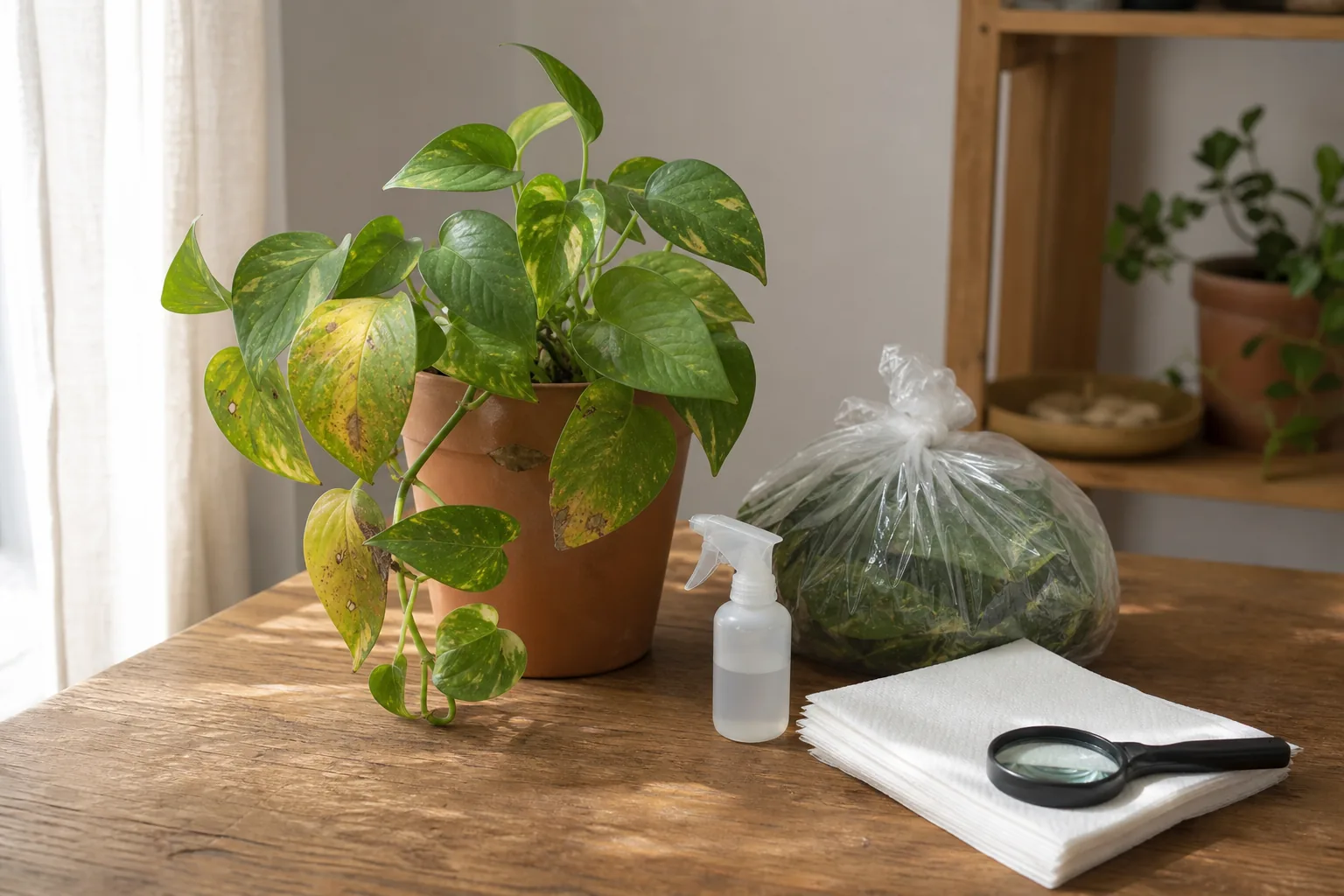
Bag the plant and the top layer of soil at the spot where it sits, in a sealed plastic bag, before you carry it through other plants. Tie the bag and place it in the household trash. Do not put pest-infested material in a backyard compost pile or in a municipal green-waste bin; both are common ways pests and diseases move between gardens.
Set the pot aside for cleaning before it goes back into rotation. Do not reuse the soil from a heavily infested plant; a fresh, pasteurized potting mix is the safer starting point.
The pot, the spot, and the tools: cleaning between plants
Three things in the plant’s environment need attention after either a discard or a successful rescue.
Reusable pots. Wash in hot soapy water first to remove debris, then rinse. UC Marin Master Gardeners and Ohio State Extension both describe soaking reusable pots in a 1:9 bleach-to-water solution (about 10%) and letting them dry thoroughly before reuse. Porous materials like unglazed terracotta and wood are harder to clean to that standard; plastic and glazed ceramic are easier.
Tools. Pruners, scissors, and snips used on a heavily infested plant can carry pests and pathogens to the next one. Wipe or dip them between plants. The University of Minnesota Extension lists 70% or higher isopropyl alcohol as one option, alongside a diluted bleach solution.
The spot. Wipe the surface the pot was sitting on, including any tray, saucer, or decorative outer pot. Let it dry before placing another plant there.
A replacement plant should not go straight into that spot, even after cleaning. A short, realistic isolation period, kept physically separate from the rest of the collection, is the simplest way to make sure you have not just traded one infested plant for another. The site’s guide to inspecting and isolating a new houseplant walks through what that window looks like in practice. When you do replace the plant, the post on how to inspect a houseplant before you bring it home is worth a look.
When to ask a local nursery or extension service
Bring a sample, or a clear photo showing the pest in context, to an independent local nursery, a master gardener clinic, or your state’s land-grant extension office when the pest itself is unfamiliar, when the plant is rare enough that you do not want to guess, or when the discard call is genuinely hard. Identifying pests from a clear photo is a normal part of what these services do, and it is a better use of their time than treating a plant that should not have been kept.
Short answers to common questions
Should I throw the soil away too? Yes, for a heavily infested plant. Replace it with a fresh, pasteurized mix rather than reusing it.
Can I compost an infested plant? No. Backyard compost and municipal green-waste bins are both common ways indoor pests are introduced into outdoor gardens.
How long should I keep the spot empty? A short, realistic window, such as a couple of weeks, is a reasonable convention. There is no mandated rule; the point is to use the time to inspect and clean, not to wait for a magic number of days.
Is it ever right to bring in a replacement right away? Bring it in, but isolate it. A new plant goes into a separate spot for inspection, not next to the cleaned area.
Sources
- UC IPM Home and Landscape: Houseplant Problems
- UC IPM Agriculture: Establishing Treatment Thresholds
- Colorado State University Agricultural Biology: Houseplant Pests
- Ohio State University Extension (Fairfield County Master Gardeners): How to properly clean your tools and pots
- University of Minnesota Extension: Clean and disinfect gardening tools and containers