Plant care
How often to water an indoor cactus
· Updated
There is no single safe watering interval for an indoor cactus. The reliable answer starts with the soil in the pot, not with a calendar. Water only when the mix has had a chance to dry through between drinks in the growing season, soak the pot thoroughly when you do water, and cut back sharply in winter for desert cacti. The New York Botanical Garden’s working cue for cacti and succulents is dryness about half an inch below the surface, which is what we are really checking each time. Forest and holiday cacti such as the Christmas cactus follow a softer, more even rhythm and do not enter a true dry dormancy at all.
If you keep just one habit from this guide, keep this one: read the pot before you read the calendar.
Why indoor cacti do not have one watering frequency
A cactus in a small unglazed clay pot on a south-facing windowsill in July uses water very differently from the same species in a glazed ceramic pot on a dim shelf in February. The pot material, the mix, the light, the room temperature, and the time of year all change how fast the soil dries. A fixed schedule such as “once a month” or “every two weeks” only describes one specific setup, and that setup is not yours.
The New York Botanical Garden recommends skipping the calendar and instead checking soil moisture about half an inch below the surface, then watering slowly and thoroughly when that cue is met. That single check is more useful than any interval you have read online, because it adapts to your pot, your mix, and your room.
Two families of indoor cacti, two different rhythms
Before deciding how often to water, identify which cactus you actually have. Indoor cacti split into two practical groups with different watering rhythms.
Desert cacti include the small globular types you usually see at a garden center: Mammillaria, Echinopsis, Gymnocalycium, Parodia, and the paddle-type Opuntia. They store water in thick stems, grow in mineral-rich, fast-draining soils, and rest in a cooler, drier winter. Their watering rhythm is a real soak-and-dry cycle followed by a near-dormant rest.
Forest or holiday cacti include Schlumbergera (the Christmas and Thanksgiving cactus), Rhipsalis, and Hatiora (the Easter cactus). Montana State University Extension points out that holiday cacti are recognized by their flattened stem segments and their short-day flowering response, and that they need different care than desert cacti. UC Agriculture and Natural Resources notes that the Christmas cactus is native to the coastal mountains of southeastern Brazil, a humid forest habitat, not a desert. Forest cacti never go fully dry-dormant and are watered more like a leafy succulent than like a barrel cactus. If you are new to indoor succulents broadly, our guide to caring for indoor succulents without a watering schedule walks through the same soil-led approach for the wider family.
If you treat a Christmas cactus like a desert cactus, you will under-water it through the year and over-stress it in winter. If you treat a Mammillaria like a Christmas cactus, you will very likely lose it to rot.
The three things to actually check before watering
Before you reach for the watering can, look at three things in this order.
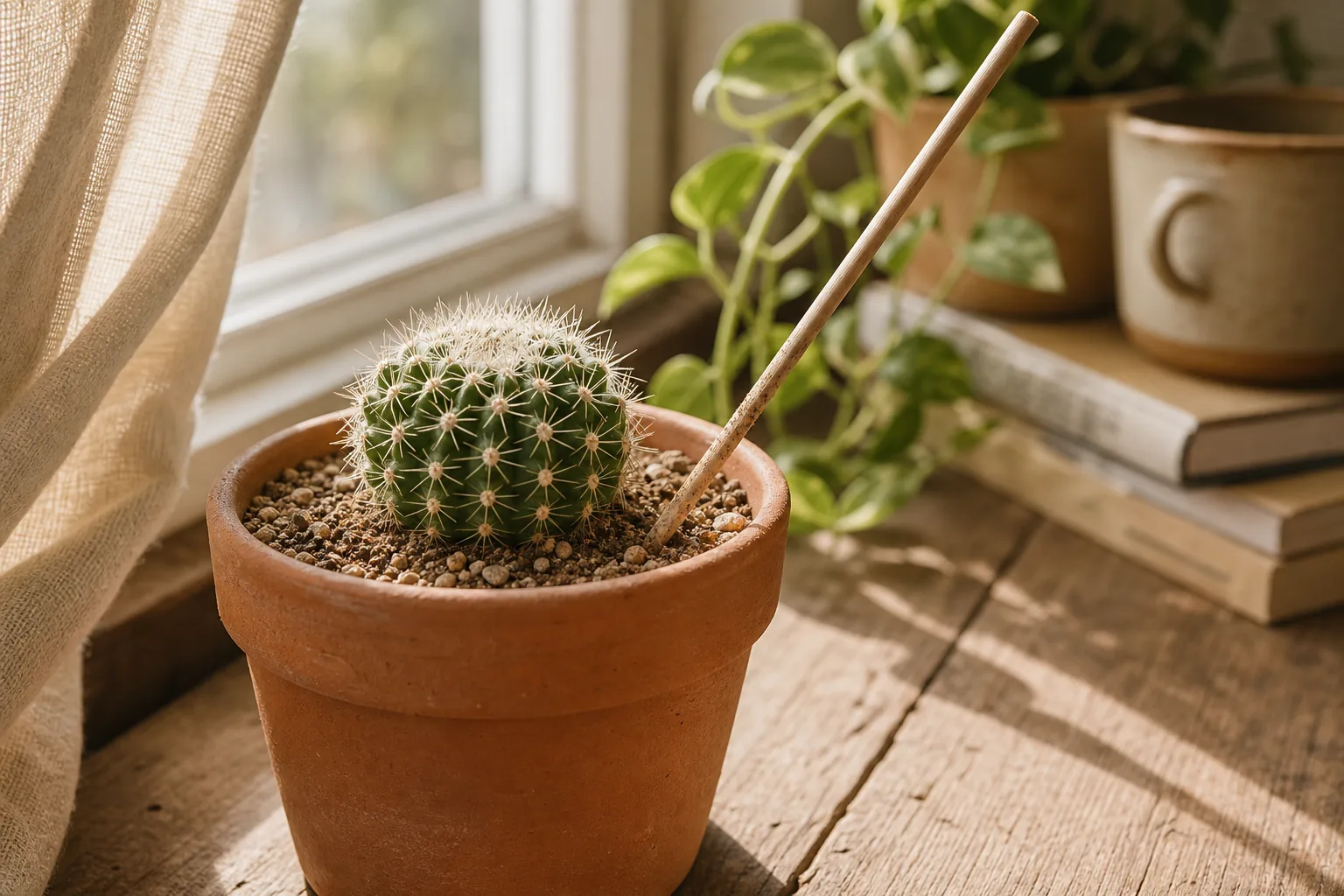
First, the surface. Press a dry finger or a thin wooden chopstick about half an inch into the mix. The New York Botanical Garden cue is dryness at this depth, not bone-dry throughout. If it feels cool or damp, wait.
Second, the weight. Lift the pot right after a thorough watering and remember how heavy it feels. A dry cactus pot is noticeably lighter a week or two later. Comparing the two is the most reliable indoor check without a moisture meter, and the same method we describe in our guide to watering without a calendar.
Third, the body of the plant. Wrinkling between ribs, a slightly soft or pucker-marked stem, and a paler color can all mean the cactus actually used its stored water and wants a drink. Yellowing at the base, soft or mushy spots, and a sudden lean are early signs of overwatering and are far more common on indoor cacti than underwatering.
Reading the soil and pot without a moisture meter
A dry chopstick is a simple, honest tool. Push it all the way to the bottom of the pot and pull it up. If dark, damp mix clings to the wood, the lower half is still wet and you should wait several days. If it comes up mostly dry with only a faint trace of dust, the mix is dry enough to water.
Pot weight tells the same story at a glance once you have learned the wet and dry feel of your specific pot. The chopstick catches the middle of the dry-down; pot weight catches the start and end.
If you use a moisture meter, treat the reading as a second opinion rather than the answer. Inexpensive meters can be unreliable in gritty cactus mixes.
How pot, mix, and light change the interval
The mix is the main control on how fast a cactus pot dries. A fast-draining mineral mix heavy in pumice, lava, or coarse sand dries predictably in almost any pot. A peat-based standard houseplant mix stays wet long enough to rot cactus roots in any pot. Our guide to choosing a cactus potting mix walks through what a good mix looks like in practice.
The pot modulates how fast that mix dries. Unglazed terracotta and unglazed ceramic breathe through their walls and so dry the mix faster than glazed ceramic or plastic, which act as a moisture barrier. A cactus in a small unglazed clay pot in a bright window may need water every ten to fourteen days in midsummer. The same cactus in a glazed decorative pot on the same sill may go two to three weeks or more between waterings, depending on the pot and the room.
Light is the main driver of water use. A cactus in a south-facing window pulls water from the mix faster than the same cactus in a medium indirect corner, which in turn pulls faster than one on a low-light shelf. Our guide to reading natural light in your room helps you place the plant where its rhythm is easiest to predict. The same thinking carries into the warmer months of the year, and our summer houseplant care guide describes what to observe and adjust when the sun gets stronger.
The right starting question is not “how often do I water a cactus” but “what is my pot, what is my mix, and how much light does this spot actually get?”
Watering in spring and summer: the growing rhythm
During the long-day, warm part of the year, most desert cacti are actively growing. Wait until the mix has dried through between waterings, then water slowly until a little runs from the drainage hole. Let the pot drain completely so the plant is not sitting in a saucer of water. That soak-and-dry cycle, anchored by the half-inch surface cue from the New York Botanical Garden, is the safest default.
In bright, warm indoor conditions, cactus retailers often describe this rhythm as roughly every ten to fourteen days for a small desert cactus. Treat that number as a starting reference for a typical setup, not a rule, and shorten or lengthen it based on your own pot weight and chopstick checks.
Watering in fall and winter: the cool, drier rest for desert cacti
As daylight shortens and indoor temperatures drop a few degrees, a desert cactus slows down. Its water use falls sharply. Most hobby sources describe this rest period as roughly every four to six weeks, with some growers choosing to pause watering almost entirely once the mix stays dry on its own.
The rest does not need a precise temperature threshold. A noticeably cooler, brighter-dry spot in the home, paired with much less water, is enough for most common desert cacti. A cactus near a cold window or a drafty sill will stay cool enough to slow its water use further, so lengthen the interval again rather than watering on a fixed date. Our guide to drafts, vents, and cold windows explains how placement shapes that calculation.
Watch for two failure modes. Continued summer-level watering in winter is a leading cause of rot. Complete neglect for long stretches, especially in a warm dry room, can shrivel a small cactus past recovery. The middle path is sparse but not zero, and only when the soil has actually dried.
Forest and holiday cacti: a different cold-season rhythm
A Christmas or Thanksgiving cactus does not want a true dry dormancy. It wants a brief, slightly cooler and drier rest in fall to trigger bud set, then a return to normal watering once buds are visible. Through the rest of the year, treat it like a soft succulent: water when the top half-inch is dry, soak thoroughly, and let the mix dry a little between drinks rather than drying all the way through.
A swing in either direction, including a long dry stretch at the wrong moment, is a common reason a Christmas cactus drops its buds. Our guide to winter houseplant care describes how that seasonal shift looks in an ordinary room.
How to water without losing the plant to rot
Top-water slowly until water runs from the drainage hole, then let the pot finish draining before returning it to its saucer or cachepot. This flushes accumulated salts from the mix and wets the entire root zone, which encourages roots to grow downward rather than crowding the surface. In hard-water areas, a pale crust on the surface of the mix is a clue that minerals are building up, and our guide to white crust on houseplant soil explains what that residue means and when to act on it.
Bottom-watering can leave mineral salts concentrated near the top of the mix and may not flush the root zone as thoroughly as a slow top-watering. It is workable in a pinch but is generally not the first choice for cacti in hard-water areas, and it does not fix a pot without a drainage hole.
A pot without drainage, or one that holds water at the bottom, is one of the most common reasons indoor cacti develop rot. If you want to keep a cactus in a decorative pot without a hole, our guide to drainage and cachepot setup explains how to use it as an outer shell with a properly drained inner pot.
When to ask a local cactus or succulent source for help
If your cactus stays wrinkled weeks after a thorough watering, sits in mix that never seems to dry, or develops soft dark spots at the base, unpot it and look at the roots. Firm, pale roots are healthy. Soft, dark, or hollow roots suggest rot. A local cactus or succulent society, an independent garden center, or your regional extension office can look at a photo or a small root sample and help you tell the difference. This article is educational, not a diagnostic service, and species such as Opuntia have spines and sap that can irritate skin, so handle the plant with care and ask a qualified source if you are unsure.
If you want a routine that ties watering into the rest of weekly houseplant care, our simple weekly houseplant care routine walks through how observation fits into a normal schedule.
The short version is still the same one. Read the pot, read the season, read the cactus family, and let the soil tell you when to water.
Sources
- New York Botanical Garden — How do I water my cacti and succulents?
- Montana State University Extension — Holiday Cactus Confusion: Thanksgiving, Christmas or Easter?
- UC Agriculture and Natural Resources — Cactus from the Rainforest: Christmas Cactus
- Cactus En Ligne — How Often and When to Water Your Indoor Cactus
- Planet Desert — Cactus Watering: Everything You Need to Know