Plant care
Yellow leaves on a pothos: how to read the symptom before changing anything
· Updated
A yellow leaf on a pothos is a symptom, not a diagnosis. The same yellow color can come from a half-dozen different conditions, and the goal is not to identify the leaf’s cause from a glance. The useful first move is to read the pattern on the vine, then the soil in the pot, then the light at the spot the plant actually sits, then the recent history. That order matters more than any single guess, because the yellow color alone does not pick the cause.
Because pothos is sold as a tolerant, easy plant, it’s tempting to shrug at a yellow leaf and assume the plant will sort itself out. That reflex is worth slowing down. Pothos forgives a lot, but it still communicates through its foliage, and a wave of yellow leaves usually means one or more conditions drifted outside the plant’s comfort zone. The job is to figure out which condition has drifted, make one small change, and wait. This article sits between the broader general yellow-leaf troubleshooting checklist and the full pothos care guide, and it focuses only on reading yellowing on a pothos.
Start with the leaf, not the cause
Before changing anything, look at where the yellow leaf is on the vine, how many leaves are affected, and how fast they are changing. A handful of patterns cover most pothos yellowing, and each one points in a different direction.
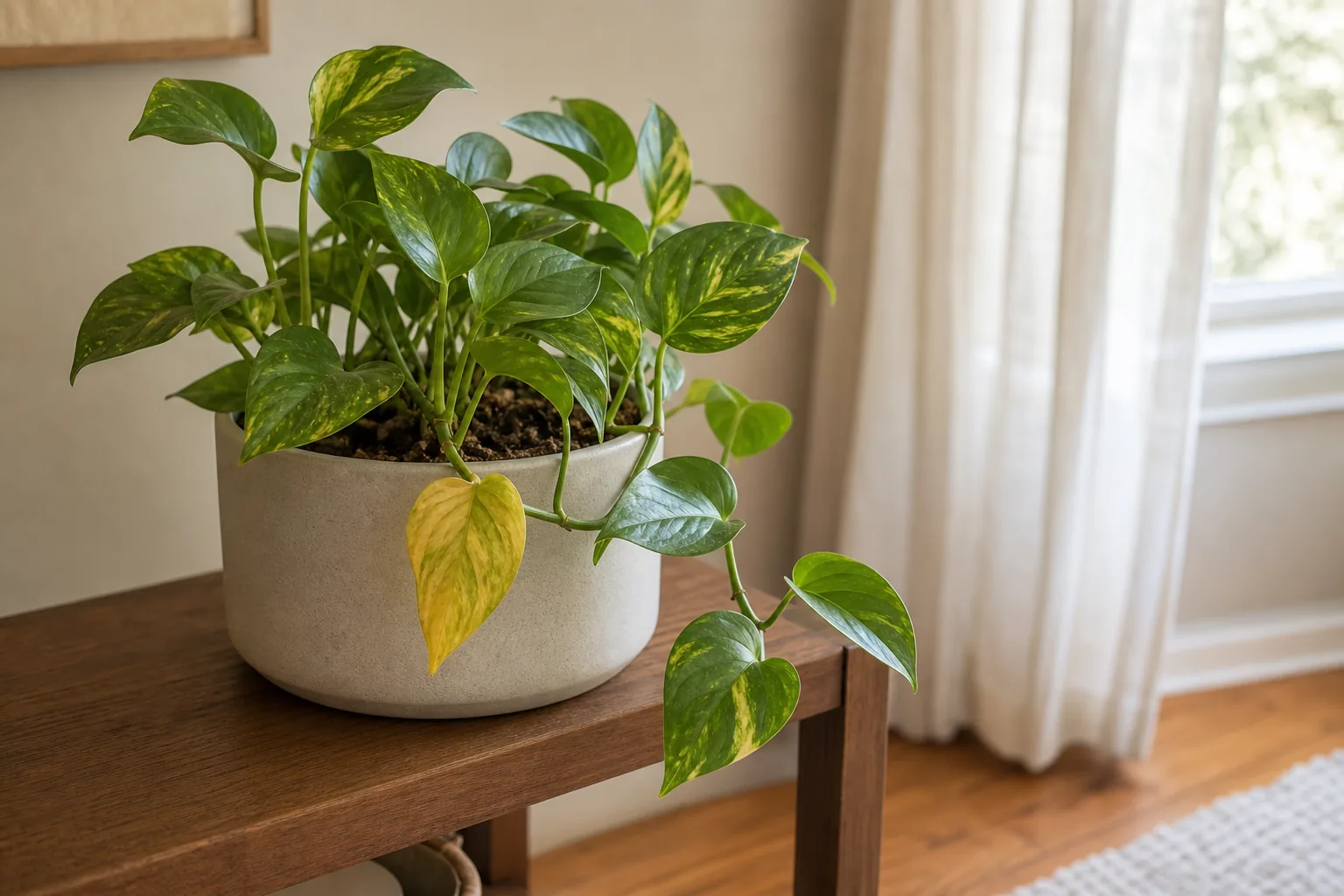
Pattern 1: a single older leaf at the base of the vine
The oldest leaf on a pothos vine, usually the one closest to the soil, will eventually yellow, soften, and drop while the rest of the plant keeps growing. This is normal aging. Pothos is a vining aroid, and as the vine extends, the plant lets go of its oldest leaves rather than carrying them indefinitely.
If the rest of the plant is firm, the new growth is coming in green and at a normal size, and only one leaf has changed color, the right response is usually no response. Yellow tissue will not turn green again, but the plant is not in trouble.
Pattern 2: several leaves yellowing at once across the plant
Several leaves yellowing together is the pattern that usually signals a real shift. The plant has not just lost an old leaf; it is losing leaves from across the vine, and the cause is more likely to be a recent change in conditions than simple aging.
The drivers worth checking, in roughly this order:
- Soil staying wet longer than the plant’s normal dry-down, especially after a repot or a move into a denser potting mix.
- A compacted, aged-out, or hydrophobic mix that no longer drains the way it did when fresh.
- A drop in usable light, including a seasonal shift, a moved piece of furniture, a new curtain, or growth of a tree outside the window.
- A cold draft off a window, hot air from a heating vent, or a cold night near glass.
- A recent move to a new room or a new shelf.
- A new watering schedule, a new fertilizer, or a new water source.
- Pests, particularly scale, which sits on stems and leaves as small, bark-colored bumps and is associated with yellowing on pothos.
Each of these is a hypothesis to test by reading the conditions around the plant, not a label to apply from a photo.
Pattern 3: new growth emerging yellow, pale, or small
When new leaves come in yellow, smaller than the leaves before them, or stretched out on long internodes, the cause is usually a steady light problem rather than a single event. Pothos tolerates lower light but prefers bright, indirect light, and a slow downward drift in usable light is a common, easy-to-overlook cause of yellowing on otherwise healthy plants. The same drift shows up on established pothos as the leggy, pale growth covered in why a pothos gets leggy, so it helps to read the leaf pattern and the stem pattern together.
For variegated cultivars, including golden, marble queen, snow queen, manjula, and neon, low light often shows up first as a fade in the variegation rather than as full yellowing. A golden pothos whose yellow patches are quietly going green is sending a light signal, not a moisture signal.
Pattern 4: yellow with soft or limp leaves, dark stems at the soil line
This is the cluster that warrants stopping before doing anything else. Yellowing paired with soft or limp older leaves, darkening or blackened stem tissue near the soil line, a sour or swampy smell from the pot, or stems that come away from the soil with a gentle tug is the pattern most consistent with overwatering and possible root issues. University extension sources document root rot pathogens including Pythium and Phytophthora on pothos, both associated with soil that stays wet for too long.
The move here is to pause watering, gently inspect the root ball and lower stems, and read the moisture state of the mix. The pot itself matters too. A pothos in a nursery pot with drainage holes is in a different situation from a pothos set inside a decorative cachepot with no drainage, where standing water can keep the lower stem wet for days. For the moisture read, the overwatered vs. underwatered checklist is the closer look.
Check the soil and the pot before you check anything else
Before changing watering rhythm, lift the pot in your hand. Pothos prefers a real dry-down between waterings, and feeling that dry-down is the foundation of the broader method in watering a houseplant without a schedule. With practice on your own pot, a pothos in a healthy mix in a normal indoor pot is noticeably lighter when the top inch and the root zone have dried down. A heavy, slow-drying pot is a different problem from a bone-dry, light pot, and both can produce yellow leaves.
Three things are worth noticing in the soil itself:
- The surface. A tight crust, algae, or visible compaction suggests the mix has aged out and is holding water differently than when it was fresh.
- The behavior when watered. Water that pools on top and runs straight down the inside of the pot suggests the mix has become hydrophobic, meaning it repels water rather than rewetting the root ball.
- The drainage hole. Water that sits in the saucer for hours after watering is a standing-water risk, especially in a cooler or less bright room.
Reading these together is more useful than any single rule about watering frequency.
Re-read the light at the spot your pothos actually sits
The next move is to check the light where the plant is, not where you think it is. Stand at the spot at the brightest time of day and notice what is between the window and the plant: a tree outside that has leafed out, a new curtain, a moved bookcase, or a piece of furniture that has quietly cut the usable light. The room-light reading framework is a useful place to slow this down.
Pothos tolerates lower light, but tolerance is not the same as preference. A plant that has been slowly getting less light over weeks or months may not show the change in any single week, and a yellow leaf can be the first visible sign of a long drift. The signal is often clearest on new growth, which comes in smaller, paler, or with longer spaces between leaves.
Look at recent changes before you change anything new
A short list of likely triggers, in the prior two to six weeks, covers most pothos yellowing:
- A repot, especially into a larger container or a denser mix.
- A move to a new room or a new shelf, including a seasonal relocation away from a cold window.
- A new watering schedule or a new pot without drainage.
- A new fertilizer or a first feeding after a long gap.
- A new water source, which can change what the roots are actually sitting in.
- A draft from a window, vent, or door that was not there before.
- A change in the room, like new flooring, a new pet, or new paint fumes.
Yellowing soon after a repot or a move is common. The rest of the plant usually stays firm, and the new growth typically recovers once the plant settles, with the timing varying by conditions rather than following a fixed schedule. The right move during that window is to hold the conditions steady rather than to add water, fertilizer, or another repot.
What yellow leaves on a pothos are not telling you
A few shortcuts are worth setting aside.
Yellow does not automatically mean overwatered. Several different conditions, including low light, compacted or hydrophobic mix, ethylene exposure near ripening fruit or some indoor sources, recent stress, pests, and root pathogens, can produce the same yellow color.
Yellow does not mean the plant needs fertilizer. Most indoor pothos in ordinary potting mix are not nutrient-limited on a short timeline, and a yellow leaf is more often a moisture, light, or root signal than a feeding signal.
Removing a yellow leaf will not fix the underlying issue. Yellow tissue will not turn green again, and the leaf will continue to age out even after the cause is corrected. Cutting yellow leaves is a cosmetic choice, not a correction.
And a plant that has lost several leaves is not necessarily dying. In many cases, a wave of yellow leaves after a move, a repot, or a seasonal light shift is a stress response that resolves once the conditions are right.
A calm response order for most pothos yellowing
A useful default sequence:
- Confirm it is not just an old basal leaf on an otherwise healthy plant.
- Check the soil and the pot: weight the pot, feel below the top inch, look at drainage, look at the mix surface.
- Re-read the light at the actual spot, including any seasonal or furniture change.
- Look at recent changes over the prior two to six weeks.
- Make one small adjustment and wait. Yellow leaves will not regreen, but new growth should come in normal.
If the pattern is unusual, the spread is fast, the leaves show mottling or deformation, or yellowing continues after obvious conditions have been corrected, that is the point to bring the plant to a local nursery, a master gardener, or an extension service for an in-person look. Houseplant Supplies is not a remote diagnosis service, and a photo description is rarely enough to pick a single cause from.
Sources
- University of Florida IFAS Extension, Pothos (Epipremnum aureum) diseases (PP340)
- Clemson University HGIC, How to grow pothos indoors (Epipremnum spp.): care, cultivars, and common problems
- North Carolina State Extension, Epipremnum aureum
- University of Wisconsin Horticulture Extension, Pothos (Epipremnum aureum)
- Ask Extension, Pothos soil drying out (FAQ 678142)