Plant care
Houseplants for a north-facing window: what actually tolerates the light
· Updated
The short answer
In the Northern Hemisphere, a typical north-facing window delivers the lowest natural light of the four cardinal directions, with no direct sun at any time of year. A small number of foliage species tolerate that light and grow slowly there, but most common houseplants will stretch, drop leaves, or quietly decline. Whether your specific window supports a plant depends less on its compass direction than on the actual light at the spot where the plant sits, observed over two to four weeks of new growth.
In the Southern Hemisphere, the labels flip. A north-facing window there is one of the brightest windows in the home, and a south-facing one is the dimmest. Everything below assumes the Northern Hemisphere framing; if you are south of the equator, mentally swap the two.
What a north-facing window actually delivers as light
The sun tracks across the southern sky in the Northern Hemisphere, so a window facing north never receives direct sunbeams. What it does receive is diffuse skylight, soft and even, with no hot afternoon beam and no gentle morning beam. Naples Garden describes north-facing windows plainly as the windows that “receive the least light and are the weakest and coolest.”
Three things follow from that:
- The intensity is low all day, every day. There is no part of the year when a north window suddenly becomes a south window.
- The light is also cool in temperature, not just in color. North windows in winter are often the coldest interior surfaces in a room, which is a separate problem from light.
- “Bright” outside and “bright” at the plant are not the same thing. A north window can look cheerful on an overcast day and still deliver only a fraction of the usable light of an east or south window on the same day.
The honest baseline is that a north window supports survival, not growth in the way a south or bright east window does.
Read the window itself, not just its compass direction
Two north-facing windows in the same apartment can deliver very different light. Before choosing a plant, look at the window itself.
- Size and orientation. A tall north-facing picture window admits more total daylight than a small north-facing bathroom window, even though the brightness per square foot at the glass is similar.
- Obstructions outside. A tree, a neighboring building, an overhang, or a fire escape can cut usable light substantially. An obstructed north window is one step dimmer still.
- Interior obstructions. Sheer curtains, internal blinds, even a nearby bookshelf can shadow the spot where a plant would sit.
- Season. Light at a north window drops noticeably from summer into winter. A plant that looks fine in June may be at the edge of its tolerance by January.
If you want a framework for thinking about all of these together, our guide on how to actually read your room’s light walks through the same categories in more detail.
Tolerance versus thriving at a north window
“Low-light tolerant” is one of the most overused phrases in houseplant marketing. It usually means the plant survives in low light, not that it grows vigorously there. The houseplant guides on this site frame it the same way: low-light tolerance is a floor, not a recommendation.
Our guide on what low-light tolerance really means is explicit that a dim room keeps the plant alive, often at a fraction of its growth rate, and that “doing well” in low light usually means “not getting worse quickly.” Apply that framing to a north-facing window and the honest picture is:
- A few species tolerate a north window and grow slowly there.
- Many species tolerate a north window for a few months and then start to decline.
- A large number of species sold as “low-light plants” actually need medium indirect light and will only stretch at a typical north window.
Watching the plant over a few weeks tells you which category you are in far better than any list.
Houseplants that tend to tolerate a north-facing window
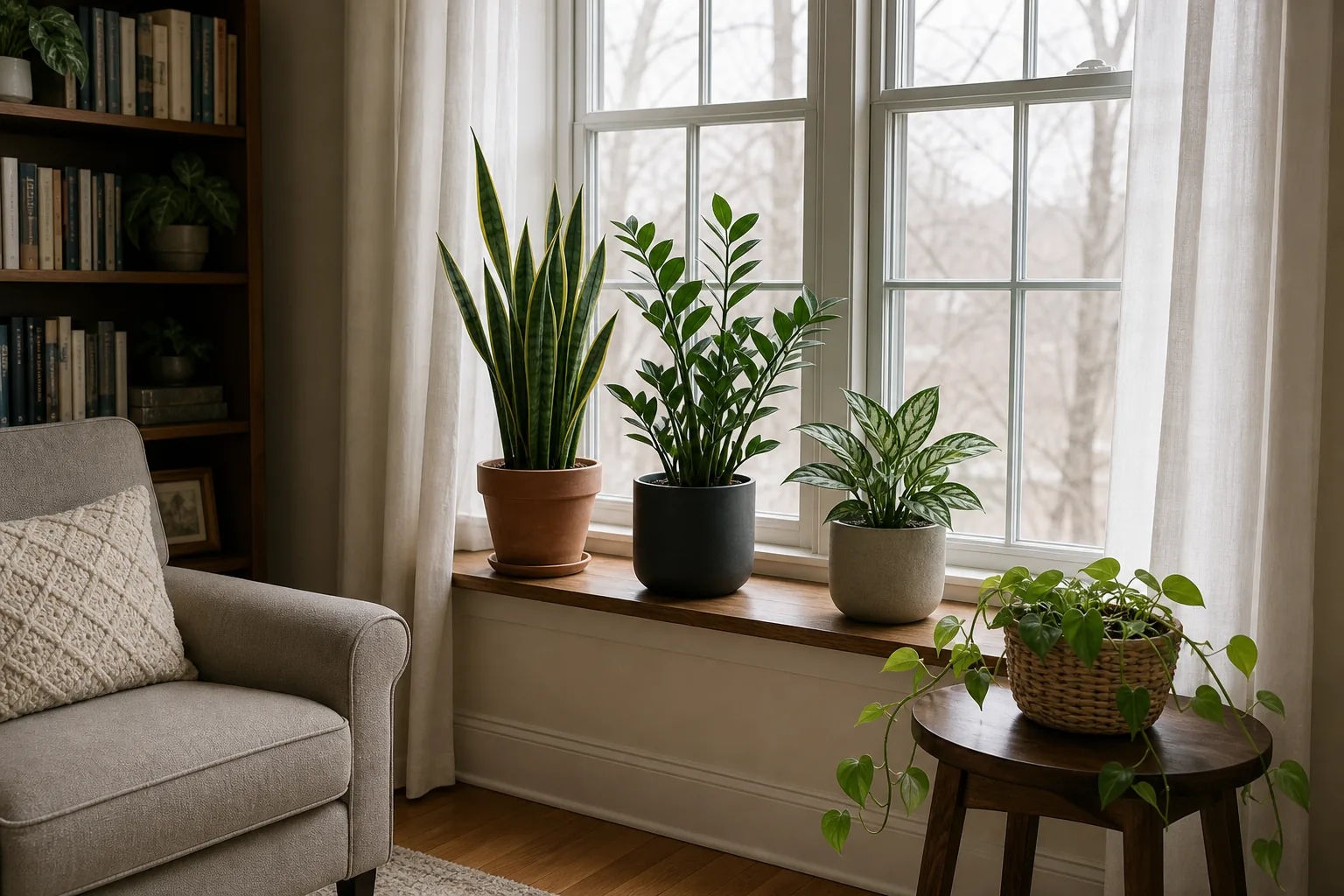
A short, honest shortlist appears across multiple extension and horticultural sources for north-facing, no-direct-sun conditions: snake plant, ZZ plant, Chinese evergreen, cast iron plant, pothos, and heartleaf philodendron. Parlor palm and peace lily are also commonly listed; peace lily is the species most often credited with flowering in those conditions. Proven Winners’ low-light houseplant list, savvygardening.com’s north-window plant guide, and extension horticulturist Melinda Myers’ matching-plants-to-light principle converge on roughly the same group.
A few practical notes on each:
- Snake plant care. Tolerates diffuse light well, prefers to dry between waterings, and is one of the safer picks for a north sill.
- ZZ plant care. Slow even in good light, slower in low light, but holds its leaves and tolerates forgetful watering.
- Chinese evergreen care. Among the few foliage plants that genuinely handles medium to lower light, with cultivars that vary in how much variegation they keep in dim conditions.
- Cast iron plant. Named for a reason; tolerates dim spots and cool drafts, though it grows very slowly.
- Pothos in a real room. Tolerates a north window but often shows it through longer gaps between leaves and reduced variegation. The all-green form holds up better than highly variegated cultivars.
- Heartleaf philodendron care. Similar pattern to pothos: tolerates low light, but the variegated forms usually need more.
- Parlor palm. Tolerates a north window with patience; do not expect fast growth.
- Peace lily. The closest thing to a flowering option at a north window, especially in the brightest part of the sill.
The watering rhythm at a north window is usually longer than the rhythm in brighter light, so read the species guide before placing the plant rather than relying on the tag’s instructions.
For flowering options in brighter north spots, Phalaenopsis and Paphiopedilum orchids, African violets, and bromeliads are commonly listed as possibilities, with the caveat that they need the brightest part of an unobstructed north window.
Distance from the glass: the easiest variable to miss
Light intensity at a window falls off roughly with the inverse-square law, so doubling the distance from the glass reduces the light reaching the plant dramatically. The practical consequence is that most of the usable light at a north window is concentrated near the glass.
- On the sill or within about a foot of the glass is where a north window does its real work.
- Two to three feet back, on a side table or low shelf, is meaningfully dimmer.
- Across the room, even a few feet farther, is closer to deep-room light and beyond what most foliage plants can use.
The exact percentage of light lost at any given distance is hard to pin down without a meter, and the specific figures given by grow-light retailers are not always sourced from independent research. The qualitative point holds across the sources: keep the plant as close to the glass as room conditions allow.
Failure modes to watch for at a north window
The most common early sign that a north-window spot is at a plant’s usable-light floor is not yellowing or wilting. It is leggy growth: new stems with longer gaps between the leaves, smaller new leaves, weaker color. That is the plant reaching. Our guide on when stretching means the light is too low goes deeper into what that signal looks like across species.
Other signs to watch for over a few weeks:
- Variegated pothos, philodendron, or Chinese evergreen losing variegation and pushing out smaller, greener leaves.
- Slow or absent new growth during the active season, especially compared with the same species at a brighter window.
- Lower leaves yellowing and dropping while the plant continues to push out thin tips at the ends of the stems.
- Soil staying wet much longer than expected because the plant is not transpiring quickly.
Two of those, cold damage and chronic damp, are microclimate issues rather than light issues, and they are worth flagging separately. North windows in winter are often the coldest interior surface in the room, and cold glass is where window condensation is most likely to form in cold weather. If leaves are touching cold glass or sitting in a chronically damp sill, the plant can be damaged by temperature and moisture even when the light is acceptable. Our guide on cold glass and drafts at a window covers how to spot and fix that part of the problem.
When a grow light is the honest next step
A grow light is not a default requirement at a north window. For the shortlist of low-diffuse-tolerant species placed close to unobstructed glass, the window alone is often enough, with patience and reduced watering.
A grow light becomes the better answer when one or more of the following is true:
- The plant keeps showing leggy growth, variegation loss, or leaf drop after a month or two at the window, even when placed close to the glass.
- You want to keep a brighter-light species at that window, such as a succulent, a croton, a fiddle leaf fig, or most flowering plants.
- The only available spot is more than a couple of feet back from the glass, where diffuse light has already dropped off.
- You want more than survival. A modest full-spectrum LED on a timer for the darker months is the most common honest upgrade.
If you do add a light, treat it as a supplement to the window, not a replacement for choosing an appropriate species. The wrong plant plus a grow light is still a more expensive and more effortful path than the right plant plus the window.
A two- to four-week observation routine for a plant at a north window
When in doubt, watch the plant. A short, consistent routine tells you more than any species list.
- Pick the spot closest to the glass where the plant can actually live, accounting for drafts, cold glass, and foot traffic.
- Note the date and take a photo of the whole plant, plus a close-up of the newest leaf or stem.
- Water only when the soil or the pot weight tells you it needs it, which at a north window is usually less often than the tag suggests.
- After two weeks, photograph the same views again. Look for new leaves and the spacing between them.
- After four weeks, decide. New growth with normal internode spacing and stable leaf color means the spot works. Long gaps between leaves, smaller new leaves, variegation loss, or no new growth at all means the spot is at the plant’s floor.
If the spot is at the floor, the next step is one of three moves, in roughly this order: slide the plant closer to the glass, swap to a more tolerant species from the shortlist above, or add a modest grow light. The wrong move is to keep replacing struggling plants with brighter-light species and hoping the next one adapts.
A north-facing window is a workable spot for a handful of plants. It is not a stand-in for a south or east window, and it is not a lost cause either. Read the actual light at the spot, choose a species that tolerates that light, and let two to four weeks of new growth tell you whether the match is right.
Sources
- Naples Garden, “It’s All About the Lighting”
- Auckland Drape, “Managing Light in North-Facing vs. South-Facing Rooms”
- Proven Winners, “14 Low-Light Houseplants That Thrive in Dim Spaces”
- Savvy Gardening, “North facing window plants: 15 houseplants for northern windows”
- Melinda Myers, “Increase your indoor gardening success by matching plants to your indoor light conditions”
- NDSU Extension, “Window Condensation Common Problem”
- Plant Daddy Podcast, “Which plants thrive best in an obstructed, north-facing window?”